
Decentralized finance has introduced a paradigm where individuals can transact without intermediaries. This shift places the responsibility of security and risk assessment directly onto the user. Unlike traditional financial systems where banks or brokers manage custody and execution, decentralized protocols rely entirely on code and user interaction. Before engaging with any protocol, understanding the underlying mechanics of how assets are stored, traded, and incentivized is fundamental to maintaining security.
The primary venue for this activity is the decentralized exchange, or DEX. These platforms allow for the permissionless exchange of cryptoassets. However, the absence of a central authority means that the security of your funds depends on the robustness of the smart contracts and the economic health of the protocol. Assessing these risks requires a deep understanding of liquidity, smart contract interactions, and the economic models that drive yield.
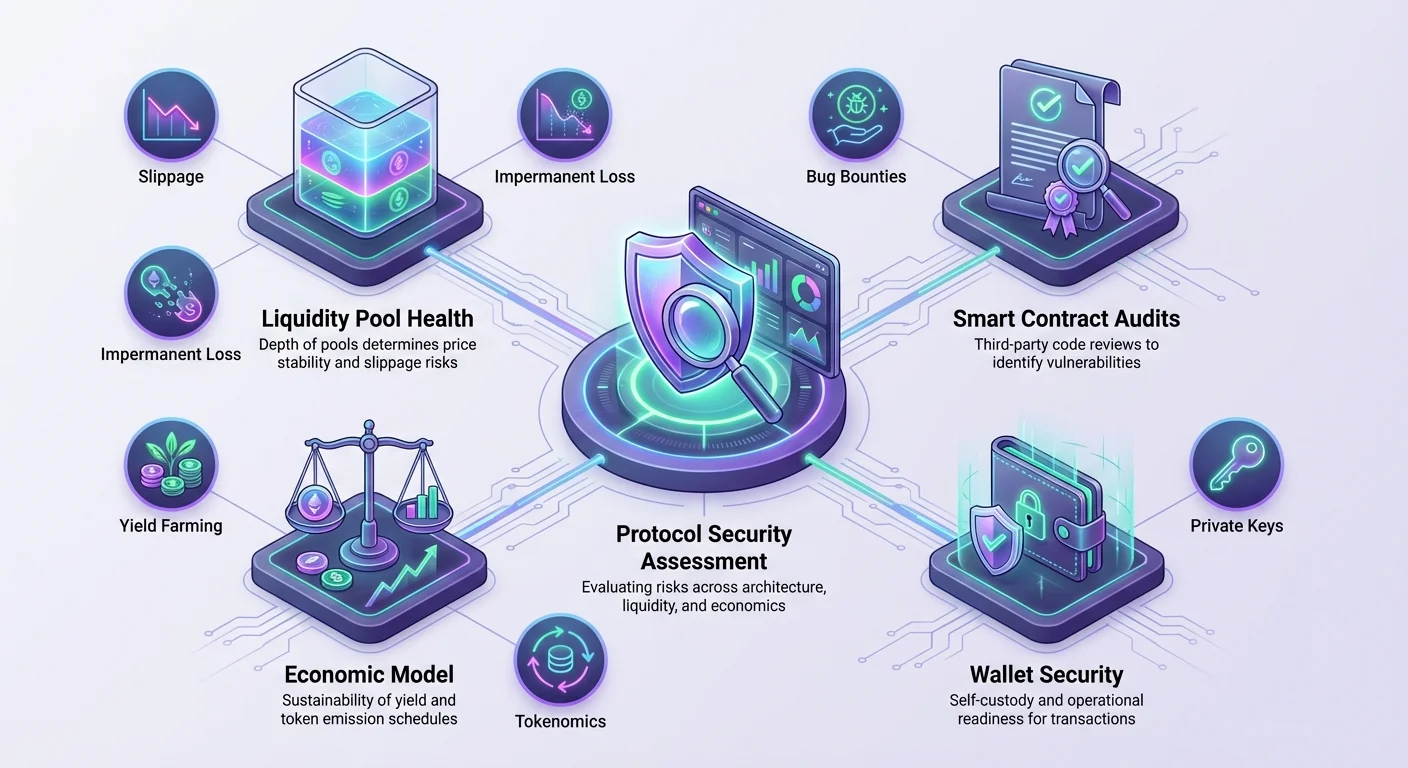
To navigate this environment safely, one must look beyond the surface interface of a trading application. A proper assessment involves analyzing the depth of liquidity pools, the sustainability of yield farming rewards, and the custody model of the wallet used to interact with the blockchain. By deconstructing these elements, users can identify potential pitfalls such as high slippage, impermanent loss, or unsustainable tokenomics that could lead to asset devaluation.
This guide explores the critical components of protocol security assessment. We will examine how liquidity pools function, the specific risks associated with smart contract deposits, and the economic indicators that separate sustainable protocols from high-risk ventures. Through this analysis, users can develop a robust framework for identifying and mitigating the risks inherent in smart contract interactions.
The Architecture of Decentralized Exchanges
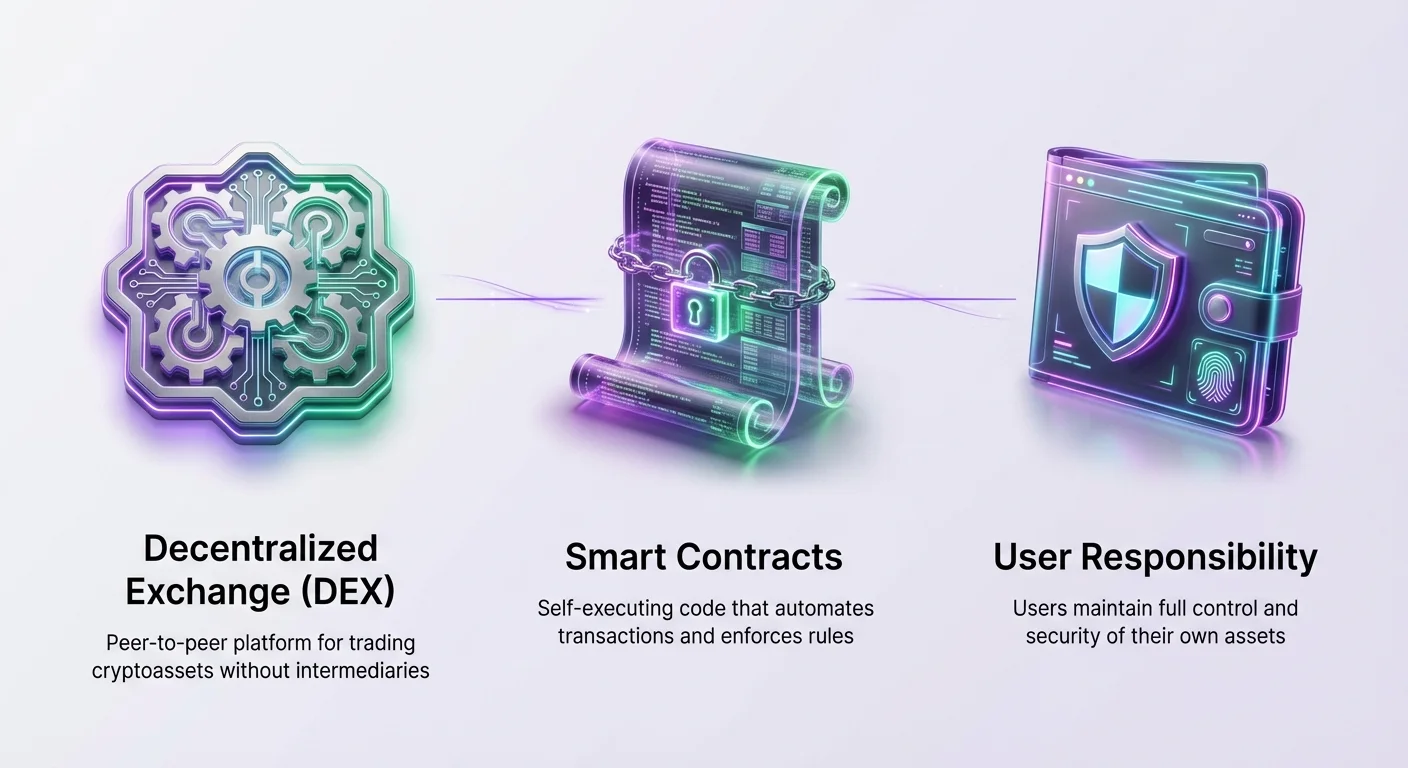
To assess the security of a protocol, one must first understand its architectural foundation. A decentralized exchange operates differently from its centralized counterparts. In a centralized exchange (CEX), a trusted third party facilitates trades, holds user funds in custody, and manages an order book. This introduces counterparty risk, where the failure of the institution puts user funds in jeopardy.
In contrast, a DEX operates as a peer-to-peer network. It does not require a trusted intermediary to facilitate the exchange of cryptoassets. Instead, it relies on a collection of smart contracts deployed on a blockchain. These contracts automate the process of trading, ensuring that swaps occur exactly as programmed. Security in this context shifts from trusting a company to trusting the code and the economic incentives that secure the network.
Smart Contract Dependencies
The core of any DEX is the smart contract. This is a self-executing contract with the terms of the agreement directly written into lines of code. When a user interacts with a DEX, they are sending digital assets to a smart contract address. The contract then executes the logic defined by the protocol, such as swapping one token for another or adding funds to a liquidity pool.
From a security perspective, the immutability of smart contracts is a double-edged sword. Once deployed, the code generally cannot be changed. This protects users from arbitrary interference by developers, but it also means that bugs or vulnerabilities cannot always be easily fixed. Therefore, assessing a protocol requires verifying that the platform is reputable. Users should look for protocols that have undergone rigorous audits by third-party security firms to ensure the code functions as intended.
Permissionless Access and Openness
A defining feature of DEXs is their permissionless nature. Unlike centralized platforms that may gatekeep which assets are listed, DEXs often allow anyone to create a market. Anyone can add a cryptoasset trading pair to a DEX or strengthen an existing one by providing liquidity. This openness fosters innovation and access but introduces a specific layer of risk.
Because anyone can create a market, scam tokens or illiquid pairs can exist alongside legitimate assets. A security assessment must involve verifying the contract addresses of the tokens being traded. Just because a pair exists on a reputable DEX does not guarantee the legitimacy of the tokens within that pair. Users must exercise due diligence to ensure they are interacting with the correct asset pools.
Evaluating Liquidity Pool Mechanics
The functional health of a DEX relies entirely on liquidity. Liquidity refers to the ease with which assets can be exchanged without causing dramatic shifts in price. On a DEX, this is achieved through liquidity pools. A pool is a collection of funds locked in a smart contract for a specific trading pair. For example, a VERSE-WETH pool contains both VERSE tokens and Wrapped Ethereum.
Security assessment involves analyzing the depth of these pools. A deep pool with substantial assets offers a stable trading environment. A shallow pool is vulnerable to volatility and manipulation. When users provide liquidity, they deposit assets into these pools. The smart contract accepts these deposits, usually requiring an equal value of both assets in the pair based on the current market price.
The Role of Liquidity Providers
Trading on DEXs is made possible only by people adding liquidity. These participants, known as liquidity providers (LPs), are the backbone of the ecosystem. Without sufficient liquidity, a smoothly functioning exchange is impossible. DEXs incentivize this participation by distributing a portion of the trading fees to the providers.
For instance, a protocol might allocate 0.25% of trading volume to LPs. If a pool processes $100,000 in volume, the providers share $250 in fees proportional to their stake. When assessing a protocol, potential providers must calculate if the fee revenue compensates for the risks involved in locking assets. The potential for yield is the primary driver, but it must be weighed against market risks.
Ratio Requirements and Asset Exposure
Smart contracts governing liquidity pools enforce strict rules on deposits. Most pools represent trading pairs and require deposits of equal value. If 1 ETH is valued at 1600 USDC, a provider wishing to deposit 0.25 ETH must also deposit 400 USDC. This requirement forces the user to hold exposure to both assets.
This dual-asset exposure is a critical risk factor. If one asset in the pair significantly loses value compared to the other, the ratio in the pool changes. The liquidity provider ends up holding more of the depreciating asset and less of the appreciating one. This mechanism is fundamental to how Automated Market Makers work, but it represents a financial risk that must be included in any security assessment.
Market Liquidity and Price Stability Risks
Low liquidity in a trading pair can have an outsized effect on the price of one or both cryptoassets. When analyzing a protocol, the volume and depth of the available pools are key indicators of safety. The lower the liquidity, the less likely the reported value of the asset is accurate. In thin markets, a single large trade can skew prices significantly, creating a discrepancy between the market price and the actual realizable price.
This phenomenon leads to slippage. Slippage happens when the expected price of a trade differs from the price at the time of execution. High slippage is a direct symptom of poor liquidity. It effectively acts as a hidden fee, reducing the efficiency of trades. In extreme cases, low liquidity can make a market practically unusable, trapping users in positions they cannot exit without incurring massive losses.
Assessing Slippage Tolerance
Protocols often allow users to set slippage tolerance settings. However, relying on high slippage tolerance to push a trade through is a security risk. It opens the user to front-running attacks, where bots detect the pending transaction and manipulate the price before it executes. A secure interaction involves trading primarily in pools with sufficient depth to minimize slippage naturally.
To gauge the health of a market, one can observe price movements following standard trades. Imagine a scenario where a user swaps 1 ETH for 1500 USDC, and the next user swaps 1 ETH for 2000 USDC. If a single relatively small transaction causes such a dramatic shift, the exchange’s pair has poor liquidity. This volatility indicates a high-risk environment for both traders and liquidity providers.
The Role of Digital Wallets in Security
Accessing a DEX requires a digital wallet. These tools, often called web3 wallets, are the gateway to decentralized applications. The security of the protocol is irrelevant if the user’s access point is compromised. Therefore, the choice of wallet is the first line of defense in protocol security assessment.
The most secure option for interacting with DEXs is a self-custodial wallet. Self-custody means the user has full control over the contents of the wallet. This is distinct from custodial wallets, where a third party maintains ultimate control over the private keys. In a custodial arrangement, the user is dependent on the security practices of the service provider.
Transaction Fees and Native Currencies
Security also involves operational readiness. A wallet must contain sufficient cryptocurrency to pay for transaction fees. These fees pay for actions that make changes to a blockchain. They are always paid in the blockchain’s native currency. For example, interacting with a smart contract on Ethereum requires ETH.
Running out of the native currency can leave funds stuck in a smart contract or prevent a user from exiting a position during a market downturn. Part of a proper risk assessment is ensuring that the wallet maintains a buffer of native assets to cover approval, deposit, and withdrawal fees. This operational liquidity is a safety mechanism that ensures users always have the ability to execute transactions when needed.
Assessing Yield Farming Protocols
Beyond simple liquidity provision, many protocols offer yield farming. This practice involves depositing assets into specific decentralized applications to earn rewards. In the context of a DEX, this typically involves a two-step process that layers additional smart contract risk onto the user.
First, a user provides liquidity to a pool and receives a Liquidity Pool (LP) token. Second, they deposit this LP token into a "farm" contract. By doing so, they earn additional yield on top of the standard trading fees. While this increases potential returns, it also increases the complexity of the interaction. The user’s assets are now dependent on the security of both the liquidity pool contract and the farming contract.
Understanding LP Tokens
Liquidity pool tokens act as a receipt. When funds are deposited into a pool, the smart contract mints these tokens and sends them to the user. This token is required to realize any outstanding rewards and to withdraw the original deposited assets. Security assessment requires treating these tokens with the same care as the underlying assets.
If a user loses access to their LP tokens, they lose access to the liquidity they provided. Furthermore, depositing these tokens into a farm involves transferring their custody to another smart contract. Users must verify that the farming contract allows for withdrawals at any time. Some farming strategies impose lockup periods, but reputable user-friendly platforms often allow funds to be withdrawn instantly.
Tracking Rewards and Positions
The complexity of farming requires diligent monitoring. DEXs create interfaces to track rewards, but the underlying reality is recorded on the blockchain. Users should be aware that their "yield" is often accumulating in a smart contract until claimed.
On platforms like Verse DEX, users can track their LP position in specific tabs or use third-party DeFi tools to view positions. The ability to independently verify balances through block explorers or third-party tools adds a layer of verification to the security assessment process. Relying solely on the protocol's UI can sometimes obscure delays or issues with the underlying chain.
Analyzing Economic Sustainability and Tokenomics
A critical, often overlooked aspect of protocol security is the economic model. Yield farming rewards typically come from a specific allocation of the protocol’s native token supply. The operators of the DEX set the Annual Percentage Yield (APY) and the duration of rewards. Assessing the sustainability of these numbers is vital to avoiding financial loss.
Some DEXs offer astronomical APYs, sometimes exceeding 1000%. While tempting, these rates are usually unsustainable security risks. If rewards are distributed too aggressively, the market becomes flooded with tokens. If recipients immediately sell these tokens, the value collapses, rendering the "high yield" worthless.
Mercenary Liquidity Risks
High APYs tend to attract "mercenary liquidity providers." These are participants who provide liquidity solely to harvest rewards and sell them immediately. Once the rewards dry up or the token price drops, they withdraw their liquidity en masse. This capital flight can leave a DEX with no liquidity and a token with no value.
A secure protocol focuses on sustainable growth. For example, the Verse Ecosystem Incentives program allocates 35% of the supply to rewards but distributes them linearly over seven years. This slow release is designed to bootstrap liquidity without causing hyperinflation. Assessing a protocol involves checking if the emission schedule is aggressive or conservative.
Reward Calculation and Distribution
Farming rewards are generally allocated based on the user's proportion of the pool and the time the tokens are held. The APY is a projection. It assumes that the current state of the pool remains constant. If more people enter the farm, the yield is diluted.
Security assessment requires understanding that APY is dynamic. It is not a guaranteed interest rate. If a protocol advertises a fixed, high return forever, it is likely a Ponzi scheme or economically flawed. Legitimate protocols show dynamic rates that adjust based on participation. Understanding this variability is key to accurate financial planning and risk management.
Mitigating Risks through Due Diligence
The final step in security assessment is verifying the operational integrity of the platform. A reputable DEX platform will have its protocol audited by third-party security firms. These audits review the smart contract code to identify vulnerabilities before they can be exploited. While an audit is not a guarantee of invincibility, it is a minimum requirement for any protocol handling user funds.
Users should also look for transparency in fee structures and reward mechanisms. Reputable exchanges clearly display exchange fees and provide analytics pages for their pools. Hidden fees or opaque reward calculations are red flags.
Analyzing Protocol Longevity
The age and volume of a DEX are also indicators of security. A protocol that has secured substantial volume over a long period has withstood the test of time and market stress. Newer, low-volume exchanges carry higher risks as they have not yet been battle-tested.
By sticking to established platforms that prioritize sustainable tokenomics over short-term hype, users significantly reduce their risk profile. Security in DeFi is not just about code; it is about the economic viability of the system users are participating in.
Comparison of Security Indicators
The following table outlines key differences between sustainable protocol designs and high-risk environments that users should avoid.
| Indicator | Sustainable Protocol Signal | High-Risk/Warning Signal |
|---|---|---|
| APY Rates | Moderate, dynamic, based on volume | Fixed, extremely high (>1000%) |
| Liquidity | Deep pools, low slippage | Shallow pools, high price impact |
| Audits | Verified third-party security audits | No audits or undisclosed authors |
Conclusion
Protocol security assessment is a multifaceted process that extends far beyond simply checking if a website uses encryption. It requires a holistic view of the decentralized ecosystem, combining technical understanding of smart contracts with economic analysis of market dynamics. By recognizing the mechanical risks of liquidity pools, such as slippage and ratio imbalances, users can make informed decisions about where to deploy their capital.
Furthermore, the economic health of a protocol is just as critical as its code. Distinguishing between sustainable incentive programs and predatory high-yield schemes is essential for long-term preservation of capital. Utilizing self-custodial wallets and interacting only with audited, reputable platforms provides the necessary foundation for safe participation. In the permissionless world of DeFi, knowledge and due diligence are the primary safeguards against risk.
True security in crypto comes from verifying the mechanics of the protocol rather than trusting the promises of the interface.