
Decentralized finance has fundamentally altered the way digital asset holders view their portfolios. In the traditional financial world, assets often sit idle until they are sold. In the crypto ecosystem, specifically within decentralized exchanges, assets can be put to work to generate continuous returns. This shift from passive holding to active yield generation requires a robust understanding of how markets function. It involves moving beyond simple speculation and into the realm of liquidity provision and yield farming.
Constructing a portfolio that balances risk with potential returns is not about chasing the highest percentage number on a screen. It requires a strategic approach to allocation and a deep understanding of the underlying mechanics of decentralized trading protocols. Investors must evaluate where yield comes from, how sustainable it is, and what risks are involved in obtaining it. A risk-weighted approach ensures that capital is preserved while still capturing the upside of market activity.
The foundation of any DeFi yield portfolio lies in the concept of liquidity. Markets cannot function without it. When liquidity is low, price discovery becomes inefficient, and trading becomes difficult. By solving this problem for the market, investors earn fees. However, this is only the first layer of the yield stack. The second layer involves protocol incentives, often referred to as farming, which introduces a different set of variables and reward structures. Combining these layers effectively allows for the creation of a diversified strategy that can weather various market conditions.
The Mechanics of Decentralized Liquidity
To build a portfolio, one must first understand the engine that drives decentralized exchanges. Unlike centralized counterparts that rely on order books, decentralized platforms often use automated market makers. These systems allow users to trade against a pool of tokens rather than matching with another specific person. This pool is funded by liquidity providers who deposit assets into smart contracts.
The Role of Liquidity Pools
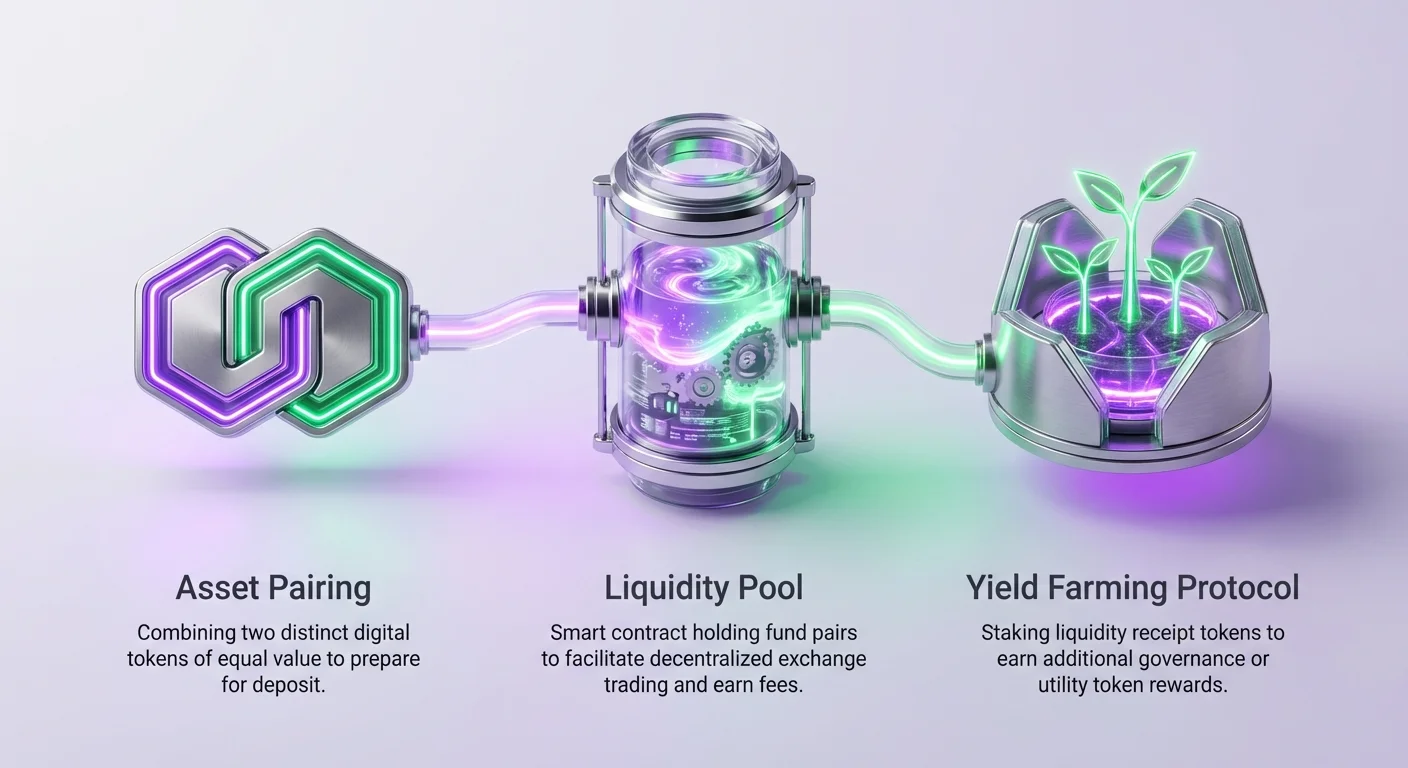
A liquidity pool is essentially a smart contract that holds funds. These pools are specific to trading pairs. For example, a pool might hold a mix of a volatile asset and a stable asset, or two volatile assets like ETH and a protocol token. The depth of this pool determines the health of the market. Deep pools allow for large trades to occur with minimal impact on the price. Shallow pools result in high slippage, where the execution price differs significantly from the expected price.
When a user provides liquidity, they are facilitating trades for others. In exchange for this service, the protocol rewards them. This reward usually comes in the form of trading fees. A portion of every swap that moves through the pool is collected and distributed to the liquidity providers. This creates a direct correlation between trading volume and yield. High-volume pairs generate more fees, providing a consistent baseline of income for the portfolio.
Understanding the Deposit Ratio
Participating in a liquidity pool typically requires depositing two assets of equal value. The protocol uses a mathematical formula to maintain the balance of these assets. If an investor wants to provide liquidity for a pair, they cannot simply deposit one side. They must calculate the current market value and provide an equivalent amount of both tokens.
For instance, if an investor holds a specific token and wants to earn yield on it, they must also hold the pairing asset, such as a stablecoin or Ethereum. This requirement dictates portfolio composition. It means that to capture yield, one cannot be 100% allocated to a single asset. The portfolio must be split to satisfy the 50/50 value requirement of the automated market maker. This structural necessity acts as a natural diversification mechanism, forcing exposure to multiple assets within the ecosystem.
Liquidity Provider Tokens and Ownership
When assets are deposited into a pool, they are technically transferred to the smart contract. To prove ownership of these deposited funds, the protocol mints a receipt token. These are known as Liquidity Provider tokens, or LP tokens. They represent a proportional share of the pool. If a user provides 1% of the total liquidity in a specific pair, their LP tokens entitle them to 1% of the assets in the pool plus 1% of the accrued fees.
These tokens are dynamic. As trading occurs and fees accumulate, the value of the pool grows. When the LP tokens are redeemed, the user receives their original deposit ratio back, plus the fees earned during the period. However, the actual number of specific tokens returned will likely differ from the deposit due to price shifts. This receipt mechanism is crucial because LP tokens are composable. They can be utilized in other parts of the DeFi ecosystem to generate additional yield, a process known as farming.
The Layer of Yield Farming Incentives
While trading fees provide a base level of return, they are often supplemented by yield farming rewards. Decentralized exchanges need to attract significant liquidity to ensure smooth trading experiences. To compete for capital, they offer additional incentives to liquidity providers. This is where the portfolio strategy shifts from passive fee collection to active yield seeking.
Farming Mechanics and Rewards
Yield farming involves taking the LP tokens received from providing liquidity and depositing them into a separate smart contract known as a farm. By staking these receipt tokens, the protocol acknowledges the user's contribution to the network's health and pays out rewards. These rewards are typically denominated in the exchange's native governance or utility token.
The rate of return for farming is often expressed as an Annual Percentage Yield (APY). This rate is distinct from the trading fee APY. It is derived from a specific allocation of tokens set aside by the project team to bootstrap growth. For example, a protocol might allocate a percentage of its total token supply to be distributed over several years to users who stake in specific farms. This creates a dual-income stream: the fees from the trading activity and the token rewards from the farming contract.
Assessing Reward Sustainability
The sustainability of farming rewards is a critical factor in portfolio risk management. Rewards come from the protocol's token supply. If a project issues tokens too aggressively to attract users, it risks diluting the value of the token. High APYs can be attractive, but they often signal high inflation of the reward token.
Investors must analyze where the yield comes from. Is it a fixed distribution schedule that spans years, or is it a short-term burst designed to pump metrics? Sustainable ecosystems often employ a linear distribution model, releasing tokens block-by-block over a long timeline. This approach aligns the incentives of the liquidity providers with the long-term health of the exchange. It discourages "mercenary capital" that enters for a quick profit and leaves immediately, which can destabilize the platform.
Risk Weighting and Impermanent Loss
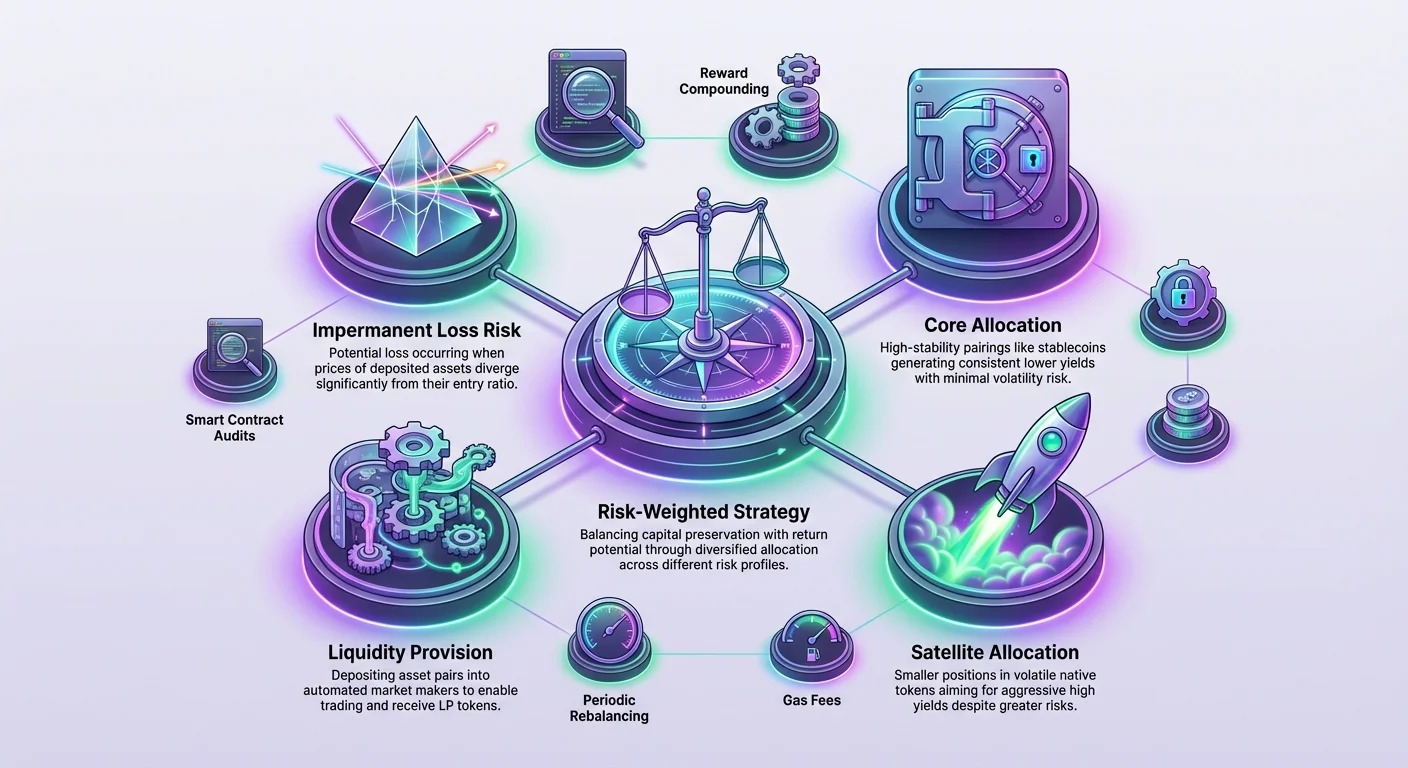
No yield is without risk. In DeFi, the primary risk specific to liquidity provision is impermanent loss. This phenomenon occurs when the price of the deposited assets changes relative to one another after they have been deposited. Because the pool acts as an automated market maker, it always sells the appreciating asset and buys the depreciating asset to maintain balance.
The Dynamics of Price Divergence
If one asset in the pair doubles in price while the other stays flat, the liquidity provider will end up holding less of the expensive asset and more of the stagnant one. When they withdraw, the total value of their holding may be less than if they had simply held the two assets in a wallet without providing liquidity. This loss is termed "impermanent" because it is only realized if the funds are withdrawn while the prices are divergent. If prices return to the original ratio, the loss disappears.
However, if the price shift is permanent, the loss becomes permanent. A risk-weighted portfolio must account for this. High-volatility pairs offer higher trading fees and often higher farming rewards to compensate for this risk. Stablecoin pairs, where both assets are pegged to a currency like the US Dollar, have minimal impermanent loss risk but typically offer lower returns. Balancing these two types of pools is central to portfolio construction.
Smart Contract and Platform Risk
Beyond market dynamics, there is technical risk. When funds are deposited into a pool or a farm, they are held by a smart contract. The security of the portfolio depends entirely on the quality of that code. Reputable exchanges undergo rigorous audits by third-party security firms to ensure their contracts are safe.
Using established platforms with a track record of security reduces this risk. A risk-weighted approach involves avoiding obscure, unaudited platforms promising astronomical returns. It prioritizes exchanges with transparent code and substantial existing liquidity. Diversifying across different pools within a trusted ecosystem is safer than chasing yield on unproven infrastructure.
Strategic Allocation Frameworks
Building the portfolio involves categorizing opportunities based on their risk-return profile. A balanced framework allocates capital across different types of pools to smooth out volatility while maintaining a steady income stream. This prevents a single adverse market event from wiping out gains.
| Pool Category | Risk Profile | Primary Yield Source | Allocation Role |
|---|---|---|---|
| Stable/Stable | Low | Trading Fees | Capital Preservation |
| Bluechip/ETH | Medium | Fees + Low Farm Rewards | Core Growth |
| Volatile/Native | High | High Farm Rewards | Aggressive Yield |
Core versus Satellite Allocation
A common strategy is the Core-Satellite approach. The "Core" consists of lower-risk positions. This might include liquidity pools made up of major assets like ETH paired with stablecoins, or even stablecoin-to-stablecoin pairs. These positions generate consistent, albeit lower, yield with reduced volatility. They form the bedrock of the portfolio.
The "Satellite" positions are smaller allocations to higher-risk pools. These often involve the native token of the DEX or newer, more volatile assets. These pools generally offer much higher APYs to compensate for the increased risk of impermanent loss and price volatility. By limiting the size of these positions, an investor can capture the upside of high yields without exposing the entire portfolio to excessive risk.
Execution: Entering the Market
The process of deploying capital into these strategies requires specific tools and steps. It begins with self-custody. A user must possess a digital wallet that allows them to retain full control over their private keys. Centralized exchange accounts do not typically allow for direct interaction with decentralized yield protocols.
Wallet Funding and Asset Preparation
The wallet must be funded with the necessary cryptocurrency. This includes the assets intended for the liquidity pool and the native coin of the blockchain to pay for transaction fees. For example, interacting with an Ethereum-based DEX requires ETH for gas fees.
Once funded, the user navigates to the DEX interface. The first step is often swapping assets to achieve the required 50/50 ratio for the desired pool. If a user starts with only USDC but wants to enter a VERSE-ETH pool, they must swap an appropriate amount of USDC for VERSE and ETH. Slippage management during these swaps is important; executing large swaps in low-liquidity environments can result in poor pricing.
Depositing and Staking
After acquiring the assets, the user deposits them into the liquidity pool section of the DEX. The interface will request approval to access the tokens, followed by a confirmation of the deposit. Upon success, the interface updates to show the user's liquidity position and the accrued fees.
The final step for maximum yield is navigating to the "Farms" section. Here, the user locates the farm that matches their LP tokens. They select the option to deposit or stake the LP tokens. This action moves the receipt tokens from the wallet into the farming contract. From this moment forward, the position begins earning farming rewards in addition to the standard trading fees.
Rebalancing and Maintenance
A DeFi yield portfolio is not a "set and forget" instrument. Market movements constantly alter the value of the assets inside the pools. As prices shift, the ratio of assets changes, and the exposure to specific tokens fluctuates. Periodic rebalancing is necessary to maintain the desired risk profile.
If a volatile asset in a satellite position appreciates significantly, it may grow to represent a larger percentage of the portfolio than intended. Periodic rebalancing involves withdrawing a portion of that liquidity, selling the profits, and redistributing the capital back into the Core positions. This locks in gains and returns the portfolio to its target allocation. Conversely, if a position shrinks due to price drops, an investor might assess whether to add capital or exit the position to prevent further loss.
Managing Farming Rewards
The rewards generated from farming are dynamic. They accumulate in real-time, often block by block. Investors must decide on a strategy for these rewards. They can be claimed and sold immediately for stablecoins, claimed and compounded back into the position, or held for potential long-term appreciation.
Compounding Strategies
Compounding involves taking the earned reward tokens, swapping half of them for the pairing asset, and depositing them back into the liquidity pool. This increases the base capital generating yield, creating a snowball effect. This strategy is aggressive and bets on the long-term viability of the pool and the reward token.
Alternatively, a more conservative approach involves "harvesting" rewards regularly and converting them into a stable asset or a blue-chip cryptocurrency like Bitcoin or Ethereum. This realizes the yield and separates it from the risk of the farming position. The frequency of this action should depend on the cost of transaction fees versus the value of the rewards.
Navigating Lockup Periods
Some yield farming protocols impose lockup periods where funds cannot be withdrawn for a set time. Others allow for instant access. In a risk-weighted portfolio, liquidity access is a key variable. Strategies that lock funds carry higher opportunity cost risks.
Preferring farms with no lockup periods allows for agility. If market conditions change rapidly, or if a better opportunity arises, the capital can be moved. Flexibility is a form of risk management. Being able to withdraw LP tokens and dismantle a position instantly ensures that the investor retains control over their assets at all times.
Analyzing DEX Metrics for Selection
Choosing where to deploy capital is as important as the allocation strategy itself. Volume is a primary indicator. A DEX with high trading volume generates more fees for liquidity providers. Volume to Liquidity ratios can help identify efficient pools. A pool with high volume but relatively low liquidity will pay out higher fees per dollar deposited.
Reputation and transparency are non-negotiable. Users should look for platforms that provide clear analytics pages. These pages should display the total liquidity in each pool, the 24-hour trading volume, and the historical fee generation. Avoid platforms that obscure this data.
Furthermore, the user interface plays a role in safety. A confusing interface can lead to errors, such as depositing into the wrong pool or failing to stake LP tokens correctly. Platforms that offer clear, step-by-step guides and intuitive dashboards reduce operational risk.
The Impact of Transaction Fees
Every action in a DeFi portfolio incurs a network fee. Approving tokens, swapping, adding liquidity, staking in farms, and claiming rewards all require gas payments. On high-cost networks, these fees can eat into potential profits, especially for smaller portfolios.
A risk-weighted analysis must include the cost of execution. If the projected yield is $50 per month but the cost to claim and rebalance is $40, the strategy is inefficient. Investors with smaller capital bases may prefer networks with lower transaction costs to maximize their net yield. Or, they may choose to claim rewards less frequently to minimize gas interaction.
Monitoring Performance
Effective portfolio management requires constant monitoring. Users should track the APY of their positions, as these rates are variable. A farm that offers 80% APY one week might drop to 20% the next as more capital floods in. The reward pie is shared among all participants; as the number of participants grows, the slice for each individual shrinks.
Tools that track wallet history and current positions are valuable. They help visualize the impermanent loss and the net value of the portfolio. If the combined value of the LP tokens plus the earned rewards is less than the value of simply holding the assets, the strategy needs review. However, in many cases, the dual stream of trading fees and farming rewards compensates for moderate price divergence, resulting in a net positive outcome.
Conclusion
Building a risk-weighted DeFi yield portfolio is a dynamic process that combines technical knowledge with financial discipline. It moves beyond simple asset ownership into the active management of liquidity. By utilizing the mechanics of liquidity pools and yield farming, investors can generate revenue streams from their digital assets. The key lies in balancing the high-yield opportunities of volatile pairs with the stability of core positions.
Success in this arena requires a vigilant approach to risk. Understanding impermanent loss, smart contract security, and the sustainability of reward emissions allows investors to navigate the landscape safely. Regular rebalancing and a clear strategy for managing rewards ensure that the portfolio remains aligned with the investor's goals. Ultimately, the objective is to harness the power of decentralized finance to create a productive, efficient, and resilient asset base.
Yield generation requires active management and a clear understanding of protocol risks.