
Introduction to Cryptocurrency Derivatives
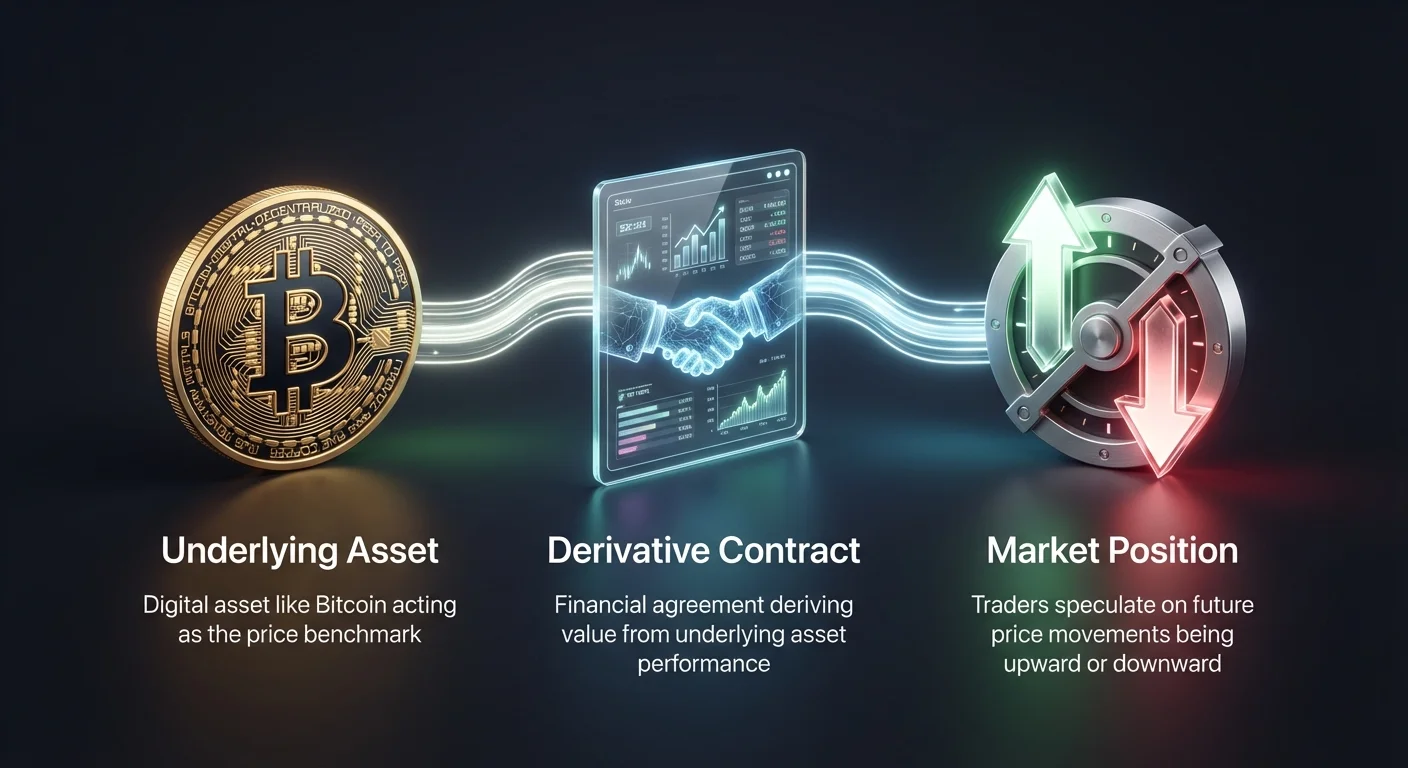
Financial markets have evolved significantly over the last few decades, and the cryptocurrency sector has adopted many sophisticated instruments from traditional finance. Among the most prominent of these instruments are derivatives. A crypto derivative is a financial contract between two or more parties. The value of this contract is not intrinsic but rather derived from the performance of an underlying digital asset.
In the context of cryptocurrency, the underlying asset is typically a specific token or coin, such as Bitcoin or Ethereum. When traders engage in derivatives trading, they are not necessarily buying or selling the actual cryptocurrency to hold in a wallet. Instead, they are entering into an agreement to transfer value based on the future price movements of that asset. This distinction is fundamental to understanding how these markets operate.
The primary utility of these financial instruments lies in their flexibility. They allow market participants to speculate on price movements without the need for physical custody of the asset. This removes the complexities of setting up digital wallets or managing private keys for the sole purpose of trading. Furthermore, derivatives open the door to advanced strategies that are not possible with simple spot trading.
Traders use these instruments for various purposes, ranging from aggressive speculation to protective hedging. For instance, a trader might use a derivative contract to bet on the price of Bitcoin rising. Conversely, they might use a different type of contract to profit if the price falls. This ability to profit from both market directions is a key driver of volume in the derivatives sector.
The market for crypto derivatives has grown to become substantially larger than the spot market. This mirrors the structure of traditional financial markets, where the notional value of derivatives far exceeds the value of underlying stocks or commodities. In the digital asset space, the 24/7 nature of trading adds a layer of intensity and continuous opportunity that attracts both retail and institutional participants.
The Core Concept of the Underlying Asset
To fully grasp derivatives, one must understand the relationship between the contract and the underlying asset. The "underlying" is the benchmark that dictates the financial outcome of the contract. In crypto, this is usually the spot price of a major cryptocurrency.
When a trader opens a position, they are essentially making a prediction about where this underlying price will go. The derivative contract tracks this price, often using an index that aggregates price data from multiple exchanges to ensure accuracy. This prevents manipulation that might occur if the contract relied on a single price source.
The performance of the derivative is tethered to this index. If the underlying asset appreciates in value, a "long" derivative position gains value. If the asset depreciates, a "short" position becomes profitable. The contract itself is merely the vessel for this value transfer.
Centralized Versus Decentralized Venues
Derivatives trading occurs on two primary types of platforms: centralized exchanges and decentralized exchanges. Centralized exchanges (CEXs) act as intermediaries. They facilitate trades, manage order books, and hold user funds in custody. These platforms typically offer high liquidity and rapid trade execution.
Centralized platforms are known for their responsive environments, which are crucial for high-frequency trading. They provide deep liquidity, ensuring that large orders can be executed with minimal price slippage. However, they also introduce counterparty risk and require users to trust the platform with their assets.
Decentralized exchanges (DEXs) operate using smart contracts on a blockchain. They aim to remove the middleman, allowing users to trade directly from their self-custodial wallets. As the sector known as Decentralized Finance (DeFi) matures, these platforms have become viable alternatives.
While DEXs offer enhanced privacy and security regarding fund custody, they historically faced challenges with liquidity and speed compared to their centralized counterparts. However, innovation in this sector is narrowing the gap, providing traders with more options for engaging in derivatives markets without relinquishing control of their private keys.
Mechanics of Futures Contracts
Futures contracts are among the most traditional forms of derivatives found in financial markets. A futures contract represents a legal agreement to buy or sell a particular cryptocurrency at a predetermined price at a specified time in the future. These contracts are standardized to facilitate trading on exchanges.
In a traditional futures contract, there is a fixed expiration date. This date is critical because it serves as the deadline for the contract's settlement. For example, a trader might purchase a Bitcoin futures contract that expires on the last Friday of a specific month. Until that date arrives, the value of the contract fluctuates based on the market's expectation of the future price.
If a trader buys a futures contract, they are agreeing to purchase the asset when the contract expires. This is known as a long position. Conversely, selling a futures contract commits the trader to selling the asset at the expiration date, known as a short position.
The price of a futures contract does not always match the current spot price of the cryptocurrency. Instead, it reflects the market sentiment regarding what the price will be when the contract expires. In bullish markets, futures often trade at a premium to the spot price. In bearish markets, they may trade at a discount.
Settlement Procedures
When the expiration date of a futures contract arrives, the contract must be settled. There are generally two ways this settlement occurs: physical settlement and cash settlement.
Physical settlement implies that the underlying cryptocurrency is actually delivered. The buyer receives the Bitcoin, and the seller receives the fiat currency. This is common in commodities but less common in retail crypto trading.
Cash settlement is the predominant method in the crypto derivatives space. Upon expiry, the difference between the contract price and the final spot price is calculated. This difference is then paid out in cash or cryptocurrency (like stablecoins) to the winning party. No actual transfer of the underlying asset takes place.
Hedging with Futures
One of the primary use cases for traditional futures with expiration dates is hedging. Hedging is a risk management strategy used to offset potential losses in an existing investment. It acts as a form of insurance against adverse price movements.
For example, a Bitcoin miner who expects to receive a certain amount of Bitcoin in the future might be worried about the price dropping before they can sell. To protect their revenue, they can sell futures contracts today at the current price.
If the price of Bitcoin drops by the time the mining rewards are received, the miner loses value on their actual Bitcoin. However, their short futures position will have gained value, effectively offsetting the loss. This allows businesses to lock in prices and forecast revenue more accurately despite market volatility.
The Perpetual Futures Contract
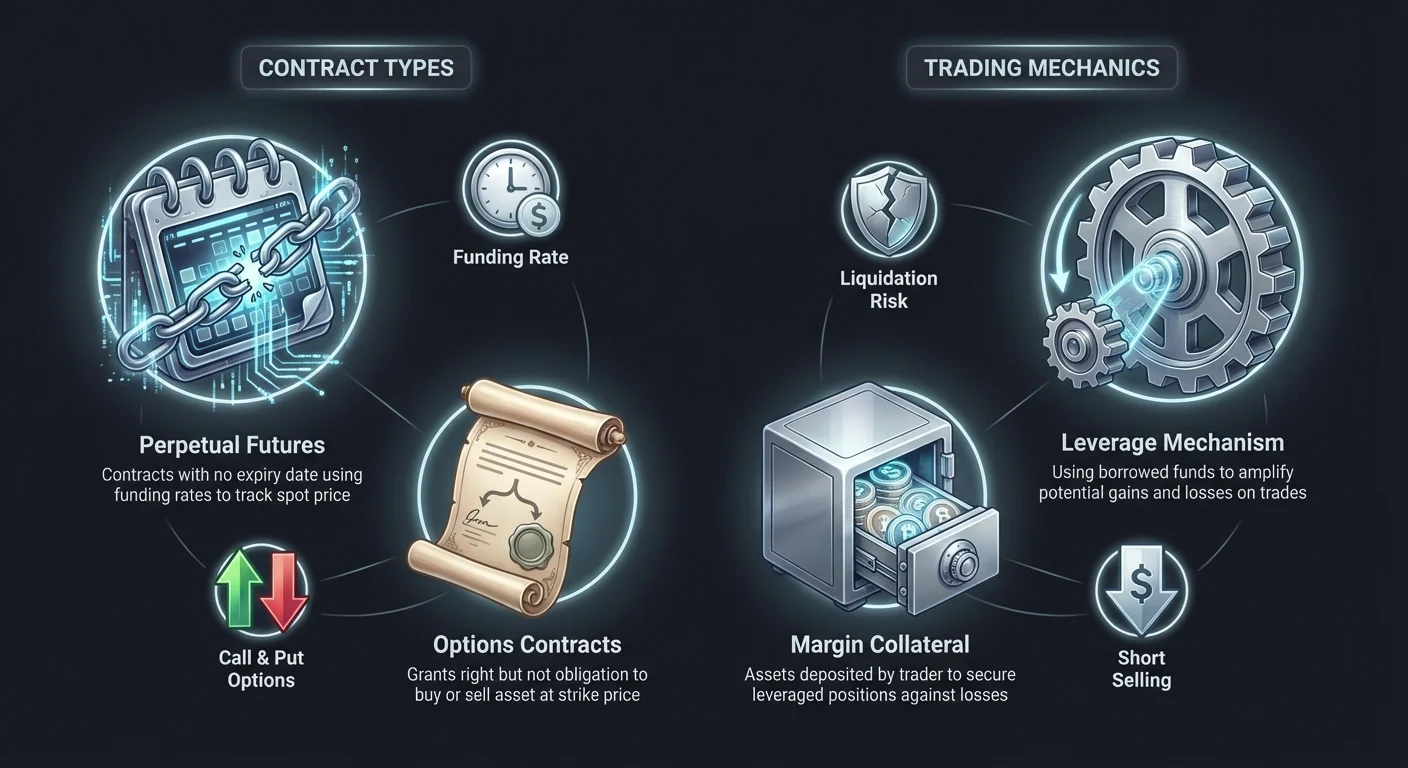
While traditional futures have expiry dates, the cryptocurrency market popularized a unique instrument known as the perpetual futures contract, or "perp." As the name suggests, these contracts do not have an expiration date. Traders can hold a perpetual position for as long as they wish, provided they have sufficient margin to keep the position open.
Perpetual futures have become the most common type of derivative in the crypto ecosystem. They offer a trading experience that feels very similar to trading the spot market but with the added benefits of leverage and the ability to short sell. Because there is no expiry date, the contract never settles in the traditional sense.
This lack of an expiry date creates a challenge: keeping the contract price tethered to the underlying spot price. Without a settlement date to force convergence, the price of a perpetual contract could theoretically drift far away from the actual price of the asset. To solve this, exchanges utilize a mechanism called the funding rate.
The Funding Rate Mechanism
The funding rate is a periodic payment exchanged between buyers (longs) and sellers (shorts). It is the primary mechanism that ensures the perpetual contract price stays close to the spot price.
When the contract price is trading higher than the spot price, the funding rate is positive. In this scenario, traders holding long positions must pay a fee to traders holding short positions. This incentivizes longs to close their positions and shorts to open new ones, pushing the contract price down toward the spot price.
Conversely, when the contract price is lower than the spot price, the funding rate becomes negative. In this case, short position holders pay fees to long position holders. This encourages shorts to close and longs to open, driving the price back up. These payments typically occur every eight hours, though intervals can vary by platform.
Benefits for Active Traders
Perpetual contracts are particularly attractive to active traders due to their flexibility. Day traders and scalpers prefer them because they do not need to worry about "rolling over" contracts to the next month, which is a requirement with traditional futures.
The liquidity in perpetual markets is often significantly higher than in dated futures markets. This high liquidity ensures that traders can enter and exit large positions quickly without causing significant price impact.
Furthermore, the ability to use high leverage with perpetuals allows traders to amplify their exposure to small price movements. This aligns with strategies that seek to capture profit from the inherent volatility of the cryptocurrency market without committing large amounts of capital upfront.
Options Trading Explained
Options are another major category of crypto derivatives. Unlike futures, which obligate the parties to transact, options provide the right, but not the obligation, to buy or sell an asset. This distinction is crucial and changes the risk profile of the options derivative instrument.
An option contract specifies a "strike price" and an "expiration date." The buyer of the option pays a fee, known as the premium, to the seller. This premium is the maximum amount the buyer can lose, which provides a defined risk profile for the buyer.
The seller of the option, however, takes on the obligation. If the buyer chooses to exercise their right, the seller must fulfill the contract. In exchange for taking on this risk, the seller keeps the premium paid by the buyer, regardless of whether the option is exercised.
Call and Put Options
There are two fundamental types of options: calls and puts. A call option gives the holder the right to buy the underlying asset at the strike price. Traders buy call options when they believe the price of the cryptocurrency will rise significantly above the strike price before the contract expires.
A put option gives the holder the right to sell the underlying asset at the strike price. Traders purchase put options when they anticipate a decline in the market. If the price drops below the strike price, the put option becomes valuable because it allows the trader to sell the asset at a price higher than the current market value.
American Versus European Options
Options contracts are further categorized by when they can be exercised. American-style options offer maximum flexibility, as they can be exercised at any point up until the expiration date. This allows traders to react to market changes immediately.
European-style options are more rigid. They can only be exercised on the exact date of expiration. While they offer less flexibility, they typically come with lower premiums. The choice between these styles depends on the trader's strategy and the specific offerings of the exchange.
Binary Options
A distinct subset of the options market is the binary option. These are straightforward instruments with a fixed payout structure. The outcome is binary: either the trader is correct and receives a pre-determined payout, or they are wrong and lose their initial investment.
For example, a trader might purchase a binary option predicting that Bitcoin will be above $50,000 at noon tomorrow. If Bitcoin is $50,001, the trader receives the full payout. If it is $49,999, they lose the capital wagered on that trade. This "all-or-nothing" structure appeals to traders looking for simple, defined outcomes.
Understanding Leverage and Margin
Leverage is a powerful tool available in most crypto derivatives trading platforms. It allows traders to control a position size that is larger than their actual account balance. This is achieved by borrowing funds from the exchange or other liquidity providers.
For instance, with 10x leverage, a trader with $1,000 can open a position worth $10,000. If the price of the asset moves in the trader's favor by 5%, the gain is calculated on the full $10,000 position, not just the initial $1,000. This would result in a $500 profit, which is a 50% return on the initial capital.
However, leverage is a double-edged sword. It magnifies losses just as it amplifies gains. In the same example, a 5% move against the trader would result in a $500 loss, wiping out half of their initial capital in a single trade.
Margin Requirements
To use leverage, traders must post collateral, known as margin. There are two critical types of margin requirements to understand: initial margin and maintenance margin.
Initial margin is the amount of capital required to open the position. It acts as a good-faith deposit. The higher the leverage used, the lower the initial margin requirement as a percentage of the total position value.
Maintenance margin is the minimum balance that must be kept in the account to keep the position open. If the market moves against the trader and their account equity falls below this level, the position is at risk of liquidation.
Cross Versus Isolated Margin
Trading platforms typically offer two modes for managing margin: cross margin and isolated margin. These modes dictate how the trader's collateral is utilized to support their open positions.
In cross margin mode, the entire balance of the account is used as collateral for all open positions. If one position is losing money, funds from the general balance can cover the margin requirements. This helps prevent premature liquidation but puts the entire account balance at risk.
Isolated margin limits the risk to a specific amount allocated to a single position. If that position fails, the losses are capped at the isolated amount, and the rest of the account balance remains unaffected. This is a preferred method for risk management when trading highly volatile assets.
Short Selling Mechanics
Short selling, or "shorting," is a trading strategy used to profit from a decline in an asset's price. In the spot market, traders can only profit if the asset increases in value. Derivatives markets empower traders to profit during bear markets by taking short positions.
The mechanics of shorting involve selling an asset that the trader does not currently own. In the background, the platform lends the asset to the trader, who immediately sells it at the current market price. The trader's goal is to buy the asset back later at a lower price.
When the trader repurchases the asset, they return the borrowed amount to the lender. The difference between the selling price and the repurchase price represents the trader's profit. If the price rises instead of falls, the trader must buy back the asset at a higher price, resulting in a loss.
Inverse Futures
Some derivatives platforms offer inverse futures contracts. These are designed specifically for traders who wish to accumulate more of the cryptocurrency rather than fiat currency. In an inverse contract, the settlement is made in the underlying coin (e.g., Bitcoin) rather than a stablecoin like USDT.
This is particularly useful for long-term holders who are bearish in the short term. By shorting via an inverse contract, they can increase their coin holdings if the price drops, effectively hedging the dollar value of their portfolio.
| Feature | Long Position | Short Position |
|---|---|---|
| Objective | Profit from price increase | Profit from price decrease |
| Mechanism | Buy low, sell high | Sell high, buy low |
| Market Outlook | Bullish | Bearish |
Risks Associated with Derivatives
While derivatives offer enhanced profit potential and strategic flexibility, they introduce significant risks that are not present in simple spot trading. The most prominent of these is the risk of liquidation.
Liquidation occurs when a leveraged position incurs losses that consume the trader's maintenance margin. To prevent the trader from falling into debt, the exchange automatically closes the position. In high-leverage scenarios, a very small price movement can trigger a total loss of the initial investment.
Market volatility is another major risk factor. Crypto markets are notoriously volatile, with rapid price swings occurring within minutes. This volatility increases the likelihood of margin calls and liquidations. During "flash crashes," prices can plummet and recover quickly, potentially wiping out leveraged positions in the process.
Regulatory and Technology Risks
Beyond market mechanics, traders face regulatory and technological risks. The regulatory landscape for crypto derivatives is varying and evolving across different jurisdictions. Sudden changes in laws can restrict access to platforms or alter the legality of certain trading activities.
Technological risks involve the reliability of the trading platforms. During periods of extreme market stress, exchanges may experience outages or lag. If a trader cannot access the platform to close a position or add margin during a crash, they may suffer unavoidable losses.
Additionally, reliance on smart contracts in decentralized derivatives protocols introduces code risk. Bugs or vulnerabilities in the protocol's code can be exploited, leading to the loss of user funds.
Contract Trading and CFDs
Contract trading is a broad term often used to describe trading financial instruments that mirror the price of an asset without conveying ownership. Contracts for Difference (CFDs) fall under this category.
A CFD is an agreement between a trader and a broker to exchange the difference in the value of an asset between the time the contract opens and closes. Like futures, CFDs allow for leverage and shorting. However, they are typically more flexible regarding contract size and duration.
CFDs are popular because they simplify the trading process. There is no need to manage digital wallets or worry about the security of private keys. The interaction is purely financial, based on price speculation.
However, CFDs are often traded on broker platforms that act as market makers. This can introduce a conflict of interest, as the broker may profit when the trader loses. Additionally, CFDs are banned in some jurisdictions, such as the United States, due to regulatory concerns.
Trading Fees and Costs
Understanding the fee structure is vital for profitability in derivatives trading. Unlike spot trading, where fees are typically a simple percentage of the transaction, derivatives involve multiple types of costs.
Transaction Fees: Like spot markets, derivatives exchanges charge maker and taker fees. Makers, who provide liquidity by placing limit orders, often pay lower fees or even receive rebates. Takers, who remove liquidity by executing market orders, pay higher fees.
Funding Fees: As discussed regarding perpetual futures, funding fees are recurring costs. Depending on the market balance, a trader might pay or receive this fee. Over time, these fees can accumulate significantly, eroding profits for long-term position holders.
Spread Costs: The spread is the difference between the buy (bid) and sell (ask) price. While not a direct fee charged by the exchange, it is a cost of trading. Wider spreads mean the price must move further in the trader's favor before the position becomes profitable.
Liquidation Fees: If a position is forcibly closed, exchanges often charge an additional liquidation fee. This is a penalty for failing to manage margin requirements and is added to the losses incurred from the trade.
Advanced Trading Strategies
Derivatives allow for complex strategies that go beyond simple directional betting. Professional traders use these instruments to construct portfolios that can profit in various market conditions.
Arbitrage
Arbitrage involves exploiting price inefficiencies between different markets. In derivatives, a common strategy is "funding rate arbitrage." This involves buying the spot asset and shorting the perpetual contract when the funding rate is positive.
In this scenario, the trader is market-neutral; price movements in the asset are hedged because the long spot position offsets the short futures position. The profit comes from collecting the funding payments from the short position. This is considered a relatively low-risk strategy compared to directional trading.
Scalping
Scalping is a high-frequency strategy where traders aim to profit from small price changes. Derivatives are ideal for scalping due to the ability to use leverage. A small movement of 0.5% can become a 5% or 10% gain with leverage.
Scalpers execute numerous trades throughout the day, holding positions for minutes or even seconds. This strategy requires low-latency platforms and tight spreads to be effective, as trading fees can quickly eat into the small profits generated per trade.
Swing Trading
Swing trading focuses on capturing medium-term market moves. These traders might hold positions for days or weeks. Derivatives allow swing traders to amplify their returns on these larger moves.
For example, if a trader identifies a trend that they believe will last for a week, they can enter a leveraged futures position. This allows them to capitalize on the trend more aggressively than if they were simply holding the spot asset.
Use Cases for Decentralized Finance (DeFi)
The rise of DeFi has brought derivatives on-chain. Decentralized protocols now offer perpetuals, options, and synthetic assets without a central authority.
These platforms use Automated Market Makers (AMMs) or on-chain order books to facilitate trades. Users connect their web3 wallets directly to the protocol. This eliminates the need for "Know Your Customer" (KYC) verification, offering a level of privacy not found on centralized exchanges.
DeFi derivatives also introduce the concept of composability. Traders can use positions in one protocol as collateral in another. For example, a tokenized futures position could theoretically be used to generate yield in a lending protocol.
However, DeFi derivatives face hurdles regarding throughput and cost. High transaction fees on networks like Ethereum can make high-frequency trading unviable. Layer 2 solutions and alternative blockchains are currently addressing these issues to make decentralized derivatives more competitive.
Security Best Practices
Given the high stakes involved in derivatives trading, security is paramount. This applies to both the security of the trading account and the management of risk.
For centralized exchanges, enabling Two-Factor Authentication (2FA) is a mandatory step. Using hardware keys or authenticator apps is far superior to SMS verification, which is susceptible to SIM-swapping attacks.
Traders should also utilize features like address whitelisting. This ensures that even if an account is compromised, funds can only be withdrawn to pre-approved wallet addresses controlled by the user.
In terms of risk management, the use of stop-loss orders is non-negotiable for prudent traders. A stop-loss order automatically sells the position if the price reaches a certain level, limiting the potential damage from a bad trade.
Key Metrics for Traders
Successful derivatives trading requires monitoring specific market data points beyond just the price.
Open Interest: This metric represents the total number of outstanding derivative contracts that have not been settled. Rising open interest indicates new money flowing into the market, suggesting a strong trend. Falling open interest indicates money leaving the market.
Volume: Trading volume confirms the strength of a price move. A price increase accompanied by high volume is more likely to be sustained than one with low volume.
Funding Rates: As mentioned, funding rates indicate market sentiment. consistently high positive funding suggests the market is overly bullish and potentially overextended. Negative funding suggests bearish sentiment.
Liquidation Data: Monitoring real-time liquidations can provide insight into potential market reversals. A cascade of long liquidations often marks a local bottom, as forced selling exhausts the selling pressure.
Tax Implications
Trading crypto derivatives can have complex tax consequences depending on the trader's jurisdiction. In many countries, profits from derivatives are treated as capital gains.
However, the classification of these gains can vary. Short-term capital gains taxes often apply to positions held for less than a year, which encompasses the vast majority of derivatives trades. These rates are typically higher than long-term capital gains rates.
It is crucial to keep detailed records of all transactions. This includes the opening and closing prices, fees paid, and the dates of every trade. Because derivatives involve leverage and potentially thousands of transactions, manual tracking is often impossible.
Many traders utilize specialized crypto tax software to aggregate their trading history and calculate their liabilities. Consulting with a tax professional who understands the nuances of digital assets and financial instruments is highly recommended to ensure compliance.
Conclusion
Crypto derivatives have fundamentally transformed the digital asset landscape, offering sophisticated tools that extend far beyond simple buy-and-hold strategies. By enabling leverage, shorting, and hedging, these instruments provide market participants with the ability to manage risk and capitalize on volatility in ways that spot markets cannot match. Whether through perpetual futures, options, or decentralized protocols, the mechanisms of these contracts drive much of the liquidity and price discovery seen in the modern crypto ecosystem.
However, the power of these tools comes with commensurate risks. The ability to amplify gains is mirrored by the potential for amplified losses, making rigorous risk management and a deep understanding of market mechanics essential. As the infrastructure supporting these markets continues to mature, the line between traditional finance and crypto derivatives will likely blur further, offering even more robust opportunities for informed traders.
Derivatives are powerful financial tools that require education, discipline, and caution to use effectively.