Introduction
In the volatile world of decentralized finance, market downturns act as a severe stress test for investors. While bull markets often forgive minor strategic errors, bear markets punish them relentlessly. During these periods, simply holding assets and hoping for a recovery is rarely the most efficient strategy. This passive approach exposes portfolios to significant drawdown risks that can take months or even years to recover from.
To navigate a bear market effectively, investors must shift their mindset from accumulation to preservation. This requires a more active approach to portfolio management. It involves utilizing financial tools that allow for profit generation even when asset prices are falling. Furthermore, it requires a robust defense against the systemic risks unique to the blockchain ecosystem.
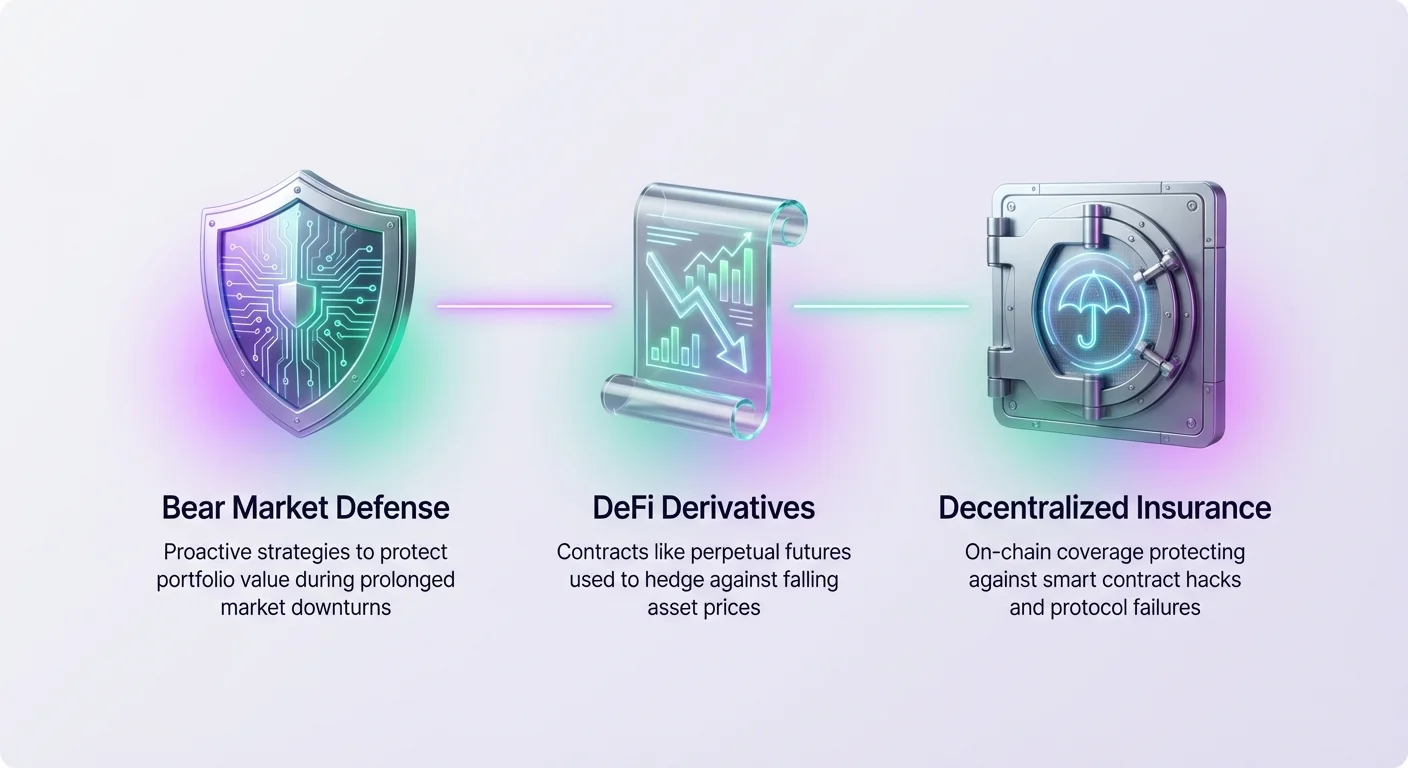
The concept of a "bear market playbook" involves two distinct but complementary strategies. The first is the use of Crypto Derivatives Explained to express bearish views or hedge existing positions. This allows an investor to neutralize the impact of falling prices. The second is the integration of decentralized insurance to protect capital against technical failures.
When prices fall, the reliability of the underlying protocols becomes paramount. Smart contract bugs or hacks can compound market losses, leading to total capital depletion. By combining short positions with insurance coverage, a DeFi user creates a fortified position. This article explores the mechanisms of these tools and how they function together to safeguard digital wealth.
The Fundamentals of DeFi Derivatives
Understanding Value Derivation
Derivatives serve as a cornerstone of advanced financial strategies in the crypto space. At their core, these are financial contracts that derive their value from an underlying asset. This is a distinct departure from spot trading. In spot trading, an investor purchases the actual cryptocurrency.
When buying the underlying asset on the spot market, the investor implicitly expresses a view that the value will rise. If the asset depreciates, the investor loses value immediately. There is no native mechanism in spot trading to profit from a decline without selling the asset first.
Derivatives decouple the price action from the necessity of ownership. They allow traders to speculate on price movements in either direction. In decentralized finance, protocols allow users to deposit collateral to trade these contracts. This capability transforms a portfolio from a directional bet on growth into a flexible instrument capable of adapting to any market condition.
The Role of Perpetual Futures
Among the various types of derivatives, perpetual futures are the most prevalent in DeFi. These contracts resemble standard futures contracts but come with a critical difference. They do not have an expiration date. A trader can hold a position indefinitely, provided they maintain sufficient margin.
This structure is ideal for hedging strategies that may need to be held for indeterminate periods during a prolonged bear market. The mechanism that keeps the price of the perpetual contract aligned with the spot price is known as funding.
Funding payments are exchanged between long and short position holders. This occurs periodically to ensure market balance. Understanding this mechanism is vital for anyone maintaining a long-term hedge. It represents a carrying cost or a potential revenue stream, depending on market sentiment.
Capital Efficiency Through Leverage
Derivatives provide access to leverage, a tool that significantly alters the risk and reward profile of a trade. Leverage allows an investor to control a position size that exceeds their deposited collateral. For example, with 1,000 USDC, a trader using 10x leverage can control 10,000 USDC worth of contracts.
In a defensive context, leverage increases capital efficiency. An investor does not need to lock up the full value of a hedge to protect their portfolio. Instead, they can deposit a fraction of the value as collateral.
However, this efficiency introduces the risk of liquidation. If the market moves against the leveraged position, the protocol may forcibly close the trade to preserve solvency. Understanding the relationship between leverage and liquidation price is the most critical technical skill in derivative trading.
Executing Short Strategies
The Mechanics of Going Short
Going short is the primary method for profiting from asset depreciation. When a trader goes short, they are selling a perpetual contract with the expectation that the price will fall. If the price drops as anticipated, the trader can buy back the contract at a lower price. The difference between the selling price and the buying price represents the profit.
In a bear market, this mechanism is used to offset losses in a spot portfolio. If an investor holds Bitcoin and fears a short-term drop, they do not need to sell their Bitcoin. Selling triggers taxable events and removes the investor from their long-term position.
Instead, the investor can open a short position on a derivative platform. If Bitcoin drops 10%, the spot holding loses value. However, the short position gains value. If sized correctly, the gains from the short can completely neutralize the losses from the spot holding.
Calculating Risk and Liquidation
The danger of shorting lies in the potential for infinite loss in theory, though DeFi protocols mitigate this via liquidation. When an asset price rises, a short position loses value. If the price rises high enough, the collateral backing the trade is exhausted.
Consider a scenario where a trader creates a short position on Bitcoin at 20,000 USD. They use 100 USD of collateral. If they use 1x leverage, they are effectively selling 100 USD worth of Bitcoin. The price would need to nearly double for them to be liquidated.
However, increasing leverage tightens the room for error. With 10x leverage on the same trade, the position size is 1,000 USD. A mere 10% rise in price could trigger a liquidation. The liquidation price moves closer to the entry price as leverage increases.
| Leverage | Position Size (100 USD Collateral) | Liquidation Price (Entry: 20k) |
|---|---|---|
| 1x | 100 USD | ~39,400 USD |
| 5x | 500 USD | ~23,400 USD |
| 10x | 1,000 USD | ~21,400 USD |
Managing Funding Rates
Funding rates act as a balancing force in the perpetual futures market. They incentivize traders to take the less popular side of the trade. In a bear market, sentiment is overwhelmingly negative. This often leads to a situation where there are more short positions than long positions.
When the price of the perpetual contract falls below the spot price of the underlying asset, the funding rate turns negative. In this scenario, short sellers must pay long holders. This acts as a tax on the majority sentiment.
For a defensive trader holding a short position, funding fees can erode profits over time. It is essential to monitor these rates. If the cost of maintaining the short becomes too high, the hedge may become inefficient. Conversely, during temporary relief rallies, funding might flip, paying shorts to keep their positions open.
Leveraging Decentralized Platforms
Introduction to dYdX
To execute these strategies, investors need a reliable venue. dYdX stands out as a leading decentralized application for perpetual futures. It operates as a layer-2 exchange on the Ethereum network. This technical architecture is significant for active traders.
Layer-2 solutions process transactions off the main Ethereum chain while securing them on the base layer. This results in vastly faster transaction speeds and significantly lower costs compared to layer-1 execution. In volatile markets, speed is a safety feature.
Unlike centralized exchanges that hold user funds, dYdX utilizes smart contracts. This allows users to trade without surrendering custody of their assets to a central third party. This non-custodial approach aligns with the core ethos of DeFi.
Order Types and Execution
Effective execution requires understanding different order types. Market orders are the simplest form of execution. They execute immediately at the current best available price in the order book. These are useful when speed is the priority, such as entering a hedge during a rapid crash.
Limit orders offer more precision. A limit order specifies the exact price at which a trader is willing to buy or sell. The order will only execute if the market reaches that price or better. This is ideal for setting up short positions at specific resistance levels.
dYdX and similar platforms enable users to place these orders directly from their self-custodial wallets. This creates a seamless experience where the user retains control of their funds until the moment the trade is executed.
The Importance of Self-Custody
Using a self-custodial wallet is a prerequisite for interacting with DeFi derivatives. Wallets like the Bitcoin.com Wallet app give users full control over their private keys. In the context of a bear market, this is a defensive measure in itself.
Centralized exchanges have a history of pausing withdrawals or facing insolvency during market stress. By trading on decentralized protocols through a self-custodial wallet, the investor eliminates counterparty risk associated with centralized intermediaries.
The wallet acts as the bridge to the DApp. Through technologies like WalletConnect, users can link their mobile or desktop wallets to trading interfaces. This ensures that collateral is only deposited into the smart contract when the user explicitly authorizes the transaction.
The Necessity of DeFi Insurance
Identifying Smart Contract Risks
While derivatives protect against market price movements, they introduce a new vector of risk. This is known as smart contract risk. DeFi protocols are built on code. If that code contains bugs or vulnerabilities, it can be exploited by malicious actors.
In a bear market, the psychological impact of a hack is magnified. Losing capital to a technical failure while already managing market drawdown can be catastrophic. Therefore, a complete defensive playbook must address the safety of the platforms being used.
The risk is not limited to trading platforms. It extends to lending protocols, yield aggregators, and any DApp where assets are deposited. Traditional insurance does not cover these on-chain events. This necessitates a crypto-native solution.
Advantages of Decentralized Insurance
Decentralized insurance platforms utilize blockchain technology to modernize the concept of coverage. They offer efficiency gains that traditional insurers cannot match. Automation via smart contracts reduces the need for large workforces and physical infrastructure.
These platforms operate without business hours or holidays. Coverage can be purchased 24/7, and the protocol is always active. This aligns with the non-stop nature of the crypto markets.
Transparency is another major advantage. In traditional insurance, the decision-making process regarding claims is often opaque. Decisions are made behind closed doors. In decentralized insurance, assessments are often performed by community members on-chain. The governance process is visible to all participants.
Governance and Community Assessment
The structure of platforms like Nexus Mutual differs radically from corporate insurers. Nexus Mutual is a discretionary mutual run on Ethereum. It is owned by its members rather than shareholders.
Funds used to pay claims are held in a risk-sharing pool. The community uses the platform's native token, NXM, to participate in governance. This includes voting on which protocols to cover and assessing the validity of claims.
This alignment of incentives ensures that the platform remains solvent while serving its members. Members are incentivized to assess risks accurately, as poor decisions could affect the value of the mutual's capital pool.
Acquiring Protection
Types of Available Cover
To build a defensive moat, an investor must select the right type of cover. Protocol cover is the most common form. This protects against value loss caused by smart contract hacks or bugs within a specific DeFi protocol.
For a trader using dYdX to short the market, purchasing protocol cover for dYdX is a logical step. It ensures that if the exchange suffers a technical exploit, the collateral deposited for the short position is protected.
Custody cover is another relevant option. While self-custody is recommended, some users may still have funds on centralized exchanges. Custody cover protects against the insolvency or hacking of these centralized custodians.
How to Purchase Cover
The process of buying insurance in DeFi is permissionless. It requires a digital wallet and cryptocurrency to pay for the premium. The user connects their wallet to the insurance DApp and selects the protocol they wish to cover.
The user then specifies the parameters of the policy. This includes the amount of cover required and the duration of the policy. The amount is typically denominated in ETH or stablecoins like DAI or USDC.
The platform calculates a premium based on the perceived risk of the protocol and the length of the cover. Once the user agrees and confirms the transaction, the cover becomes active. This process takes minutes, a stark contrast to the paperwork involved in traditional insurance.
Filing a Claim
If an incident occurs, the claim process is initiated through the DApp. The policyholder submits a claim requesting payment for their loss. The specifics of what constitutes a valid claim are defined in the policy wording.
For most DeFi insurance, the user must provide proof of loss. This might involve signing a message from the affected address or providing transaction hashes. Since the ledger is public, verifying the loss is often straightforward.
The claim is then assessed by the community or a panel of assessors. If the consensus is that the event falls under the covered terms, the payout is authorized. The funds are transferred directly to the user's wallet.
The Integrated Bear Market Strategy
Combining Shorts and Insurance
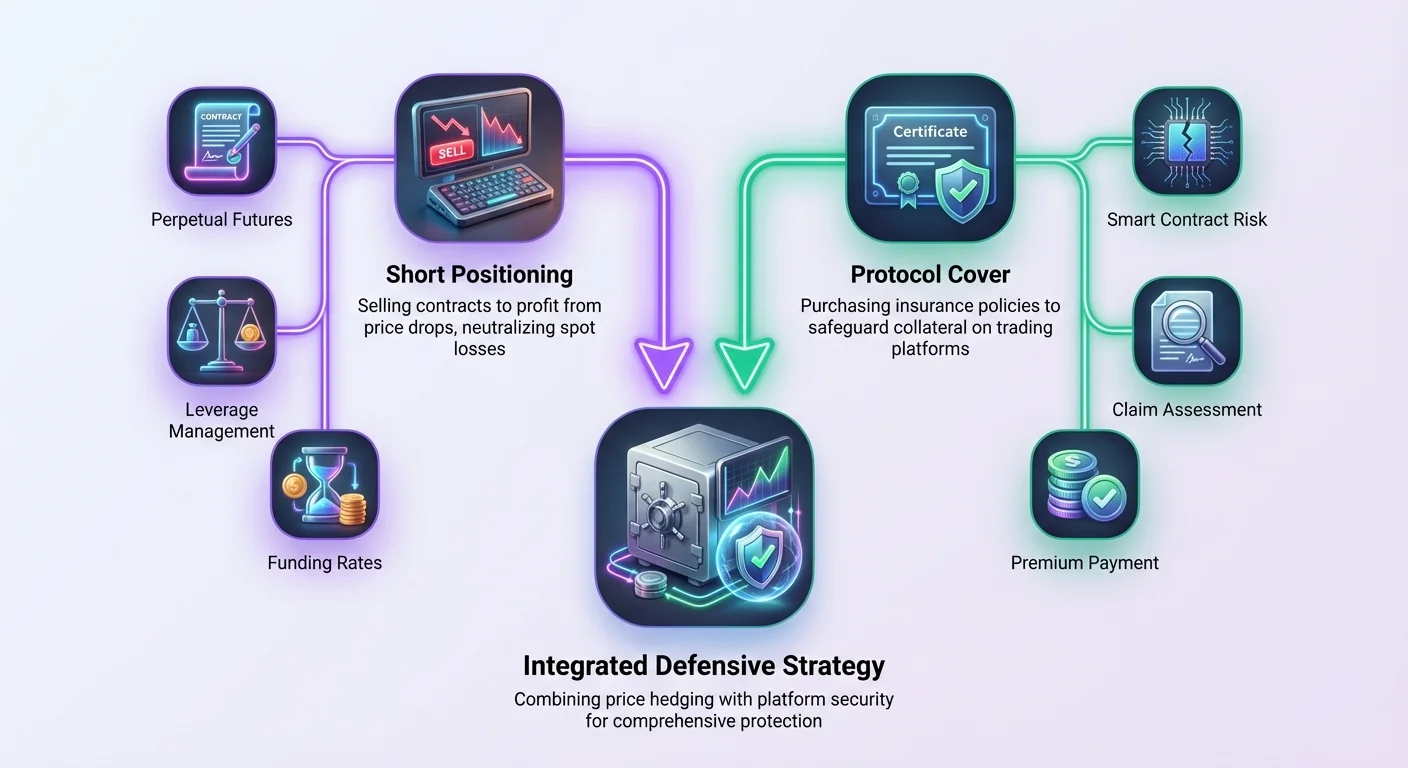
The true power of the bear market playbook lies in the integration of these two tools. A short position acts as a shield against falling asset prices. Insurance acts as a shield against platform failure. Together, they mitigate the two largest risks in the crypto ecosystem.
Consider an investor with a portfolio of ETH. They fear the price will drop 20%. They deposit a portion of their ETH into a derivative protocol to open a short position. This neutralizes the market risk.
Simultaneously, they purchase cover for that derivative protocol on an insurance platform. Now, their hedge is protected. Even if the trading platform is hacked, their collateral is insured. This creates a comprehensive safety net.
Managing Collateral Ratios
Implementing this strategy requires strict capital management. The investor must ensure they have enough free capital to manage the margin on their short position. If the market rallies unexpectedly, they may need to add collateral to avoid liquidation.
This maintenance margin is distinct from the initial margin used to open the trade. It is the minimum amount required to keep the trade open. Liquidation fees can be costly, so avoiding forced closure is a priority.
The cost of the insurance premium must also be factored into the overall strategy. It is an expense that reduces the net performance of the portfolio. However, in a bear market, the cost of protection is often far lower than the cost of exposure to catastrophic loss.
Monitoring the Ecosystem
This active defense requires ongoing monitoring. Market conditions change rapidly. Funding rates on short positions can fluctuate, altering the cost of the hedge. Insurance capacity on certain protocols can also vary.
Investors should regularly review their coverage. As the value of the portfolio changes, the amount of insurance cover may need to be adjusted. Similarly, the size of the short position should be rebalanced to match the spot exposure.
This dynamic approach keeps the portfolio aligned with the investor's risk tolerance. It transforms the user from a passive victim of market forces into an active manager of their financial destiny.
Requirements for Execution
The Digital Wallet
The foundation of this entire operation is the digital wallet. A self-custodial wallet is non-negotiable for true DeFi interaction. It serves as the passport to both the derivatives exchange and the insurance platform.
The Bitcoin.com Wallet is an example of a robust tool for this purpose. It allows users to manage their keys and interact with Ethereum-based DApps via WalletConnect. Security features like biometrics adding an extra layer of protection.
The wallet must hold not only the assets for investment but also the native currency of the blockchain. ETH is required for transaction fees on Ethereum and its Layer-2s. Without sufficient gas tokens, no trades or insurance purchases can be executed.
Connecting to DApps
The connection process relies on protocols like WalletConnect. This open standard establishes a secure link between the mobile wallet and the desktop DApp interface. It eliminates the need to type private keys into a browser, which is a common phishing vector.
When connecting to a derivatives platform like dYdX or an insurance provider like Nexus Mutual, the user scans a QR code. The wallet then prompts for approval. This ensures the user is always aware of which site is requesting access.
Once connected, the DApp can read the wallet balances and request transaction signatures. However, it cannot move funds without explicit user confirmation for each action. This keeps the user in the driver's seat at all times.
Conclusion
Surviving a bear market in decentralized finance requires more than patience; it demands a proactive defense. The integration of short positions via derivatives and coverage via decentralized insurance creates a robust framework for protection. Derivatives allow investors to decouple their portfolio value from falling market prices, turning potential losses into neutral outcomes or even gains. By mastering leverage and understanding funding rates, users can hedge effectively without selling their long-term holdings.
However, hedging market risk is only half the battle. The technical risks inherent in smart contracts remain a persistent threat. Decentralized insurance fills this gap, offering transparent and efficient protection against protocol failures. By securing the platforms where hedges are executed, investors insulate themselves from the devastating impact of hacks and bugs. This dual-layered approach addresses both the volatility of the asset and the reliability of the infrastructure.
A complete defensive strategy combines hedging price drops with insuring the platforms you use to hedge.