
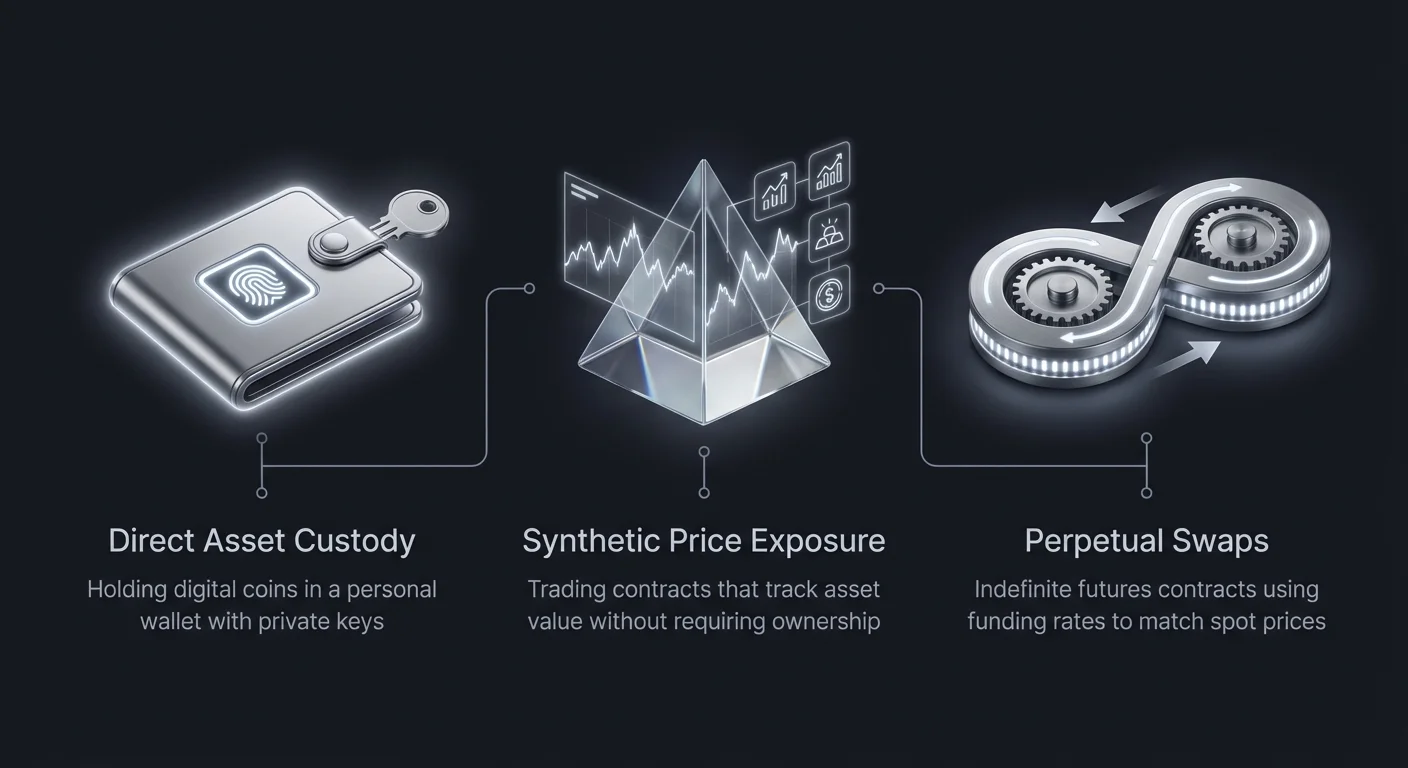
The landscape of digital currency investment has evolved significantly beyond the simple act of buying and holding coins in a digital wallet. Modern financial infrastructure now allows participants to gain exposure to price movements without ever taking custody of the underlying asset. This shift has given rise to a sophisticated market of synthetic assets and perpetual swaps. These financial instruments enable traders to speculate on value, hedge against volatility, and manage risk in ways that mirror traditional finance.
Rather than dealing with the technical complexities of private keys and blockchain storage, traders can utilize contracts that track asset prices. This approach strips away the logistical burdens of ownership while retaining the potential for profit. It opens the door to advanced strategies involving leverage, short selling, and cross-asset collateralization. As the market matures, platforms are increasingly integrating these derivative products alongside traditional spot markets to serve a diverse range of strategies.
The Evolution of Derivative Trading
The journey from basic spot trading to complex derivatives represents a maturation of the crypto ecosystem. Initially, users were limited to direct peer-to-peer exchanges or centralized order books where they exchanged fiat for digital tokens. This required setting up secure wallets and managing private keys, processes that carried significant operational risks. The introduction of derivative platforms changed this dynamic by allowing users to trade contracts based on asset prices rather than the assets themselves.
Derivatives such as futures and options were the first steps in this evolution. These contracts allowed traders to agree on a price for a future date, providing a mechanism to bet on market direction. However, traditional futures come with expiration dates, forcing traders to roll over contracts to maintain a position. This friction point led to the innovation of the perpetual swap, a contract that never expires and mimics the spot price closely through a funding mechanism.
Today, the market includes a wide array of synthetic products. Platforms like PrimeXBT allow users to trade traditional financial assets, such as commodities, forex, and indices, using cryptocurrency as collateral. This convergence of traditional finance and digital assets means a trader can use Bitcoin to speculate on gold prices or the S&P 500. It effectively breaks down the barriers between different asset classes, creating a unified trading environment.
Understanding Perpetual Swaps
Perpetual swaps have become the dominant form of derivative trading in the cryptocurrency sector. Unlike standard futures contracts, which have a set settlement date, perpetual swaps can be held indefinitely as long as the trader maintains sufficient margin. This design solves the issue of liquidity fragmentation across different expiration dates. It consolidates trading volume into a single instrument that tracks the underlying spot price.
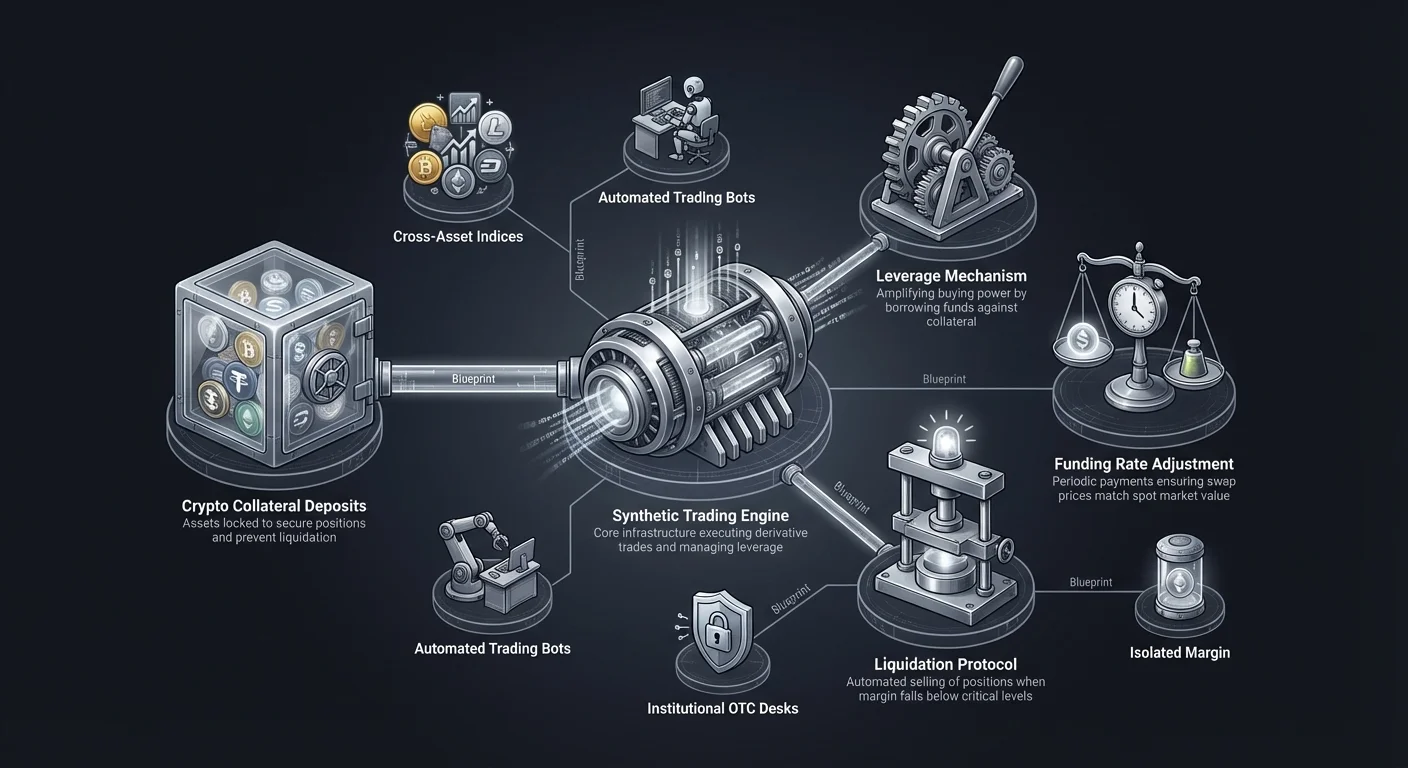
The mechanism that keeps the swap price tethered to the spot price is known as the funding rate. This is a periodic payment exchanged between long and short position holders. If the swap trades at a premium to the spot price, longs pay shorts. Conversely, if the swap trades at a discount, shorts pay longs. This financial incentive ensures that the derivative price does not deviate significantly from the actual market value of the asset.
Traders gravitate toward perpetual swaps for their capital efficiency. These instruments allow for high leverage, meaning a trader can control a large position with a relatively small amount of collateral. For instance, platforms like Kraken and Bitget offer futures trading that empowers users to amplify their market exposure. This capability is a double-edged sword, offering the potential for significant gains while introducing the risk of rapid liquidation.
Mechanics of Synthetic Exposure
Synthetic assets represent a category of financial instruments that simulate the value of another asset. In the crypto space, this often involves using digital tokens to track the price of real-world assets like stocks, fiat currencies, or commodities. The primary utility of a synthetic asset is to provide price exposure without the regulatory or logistical hurdles of owning the actual item.
Cross-Asset Trading Opportunities
One of the most powerful applications of synthetic assets is the ability to trade across different markets using a single currency base. A trader holding Bitcoin might want to hedge against a market downturn by taking a position in gold or a stable fiat currency. In a traditional setup, this would require selling the crypto, withdrawing fiat, and opening a brokerage account.
Synthetic platforms streamline this process. By utilizing crypto collateral, users can instantly open positions in foreign exchange markets or commodity indices. This fluidity allows for sophisticated portfolio management where capital can flow rapidly between sectors. It creates a trading environment where the only limiting factor is market insight, rather than banking infrastructure or settlement delays.
The Role of Collateral
Collateral is the bedrock of trading without ownership. In synthetic and derivative markets, the trader deposits a base asset, often a stablecoin like USDT or a major cryptocurrency like Bitcoin, to secure their positions. This collateral acts as a security deposit against potential losses. The amount of collateral required depends on the leverage used and the volatility of the asset being traded.
Platforms enforce strict maintenance margins to protect the system’s solvency. If a trade moves against the user and their collateral value dips below a certain threshold, the position is liquidated. This automated risk management is crucial for 24/7 markets where human intervention is too slow. It ensures that winning traders can be paid out even if the losing side of the trade defaults.
Indices and Bundled Assets
Synthetic trading also facilitates the creation of indices, which are baskets of assets tracked by a single instrument. Instead of buying ten different decentralized finance tokens, a trader can buy a single DeFi index token or contract. This provides instant diversification and reduces the transaction fees associated with executing multiple individual trades.
Indices are particularly useful for thematic investing. If a trader believes the gaming sector will grow but is unsure which specific project will succeed, they can trade a gaming index. This reduces idiosyncratic risk associated with single projects while maintaining exposure to the broader sector trend. It simplifies the research process and allows for broader macro-strategy execution.
Leverage and Margin Trading
Leverage is a fundamental component of trading synthetic assets and perpetual swaps. It allows traders to borrow funds to increase the size of their trading position. For example, with 10x leverage, a trader with $1,000 can open a position worth $10,000. This amplifies both potential profits and potential losses, making it a tool that requires careful risk management.
Margin Requirements and Safety
Crypto exchanges utilize two main types of margin: isolated and cross margin. Isolated margin restricts the collateral allocated to a single position. If that position is liquidated, the trader only loses the funds specifically assigned to it. This is a protective measure that prevents a single bad trade from draining an entire account balance.
Cross margin, on the other hand, uses the entire account balance as collateral for all open positions. This is useful for hedging, as profits in one position can offset losses in another to prevent liquidation. However, it carries the risk of total account depletion if the market moves violently against multiple positions simultaneously. Understanding these mechanics is vital for survival in leveraged markets.
The Impact of Volatility
Cryptocurrency markets are notoriously volatile, and leverage acts as a multiplier on this volatility. A 5% move in the spot price becomes a 50% move for a trader using 10x leverage. This heightened sensitivity means that synthetic traders must be extremely disciplined with stop-loss orders and position sizing.
Professional platforms provide tools to manage this risk. Features like OCO (One Cancels the Other) orders allow traders to set take-profit and stop-loss levels simultaneously. Additionally, educational resources provided by exchanges like Coinbase help users understand the mathematical realities of leverage before they risk significant capital.
The Role of OTC Trading in Derivatives
While retail traders typically operate on public order books, institutional players often utilize Over-the-Counter (OTC) desks to manage large derivative positions. OTC trading involves direct transactions between two parties, bypassing the public exchange. This is critical for large-volume trades that would otherwise cause significant price slippage on a standard order book.
Minimizing Market Impact
When an institution wants to enter a massive long position using perpetual swaps or synthetic contracts, executing this on a public exchange could drive the price up immediately, resulting in a worse entry price. OTC desks facilitate these block trades by matching buyers and sellers privately. This ensures that the trade is executed at a predictable price without disrupting the broader market.
Platforms like Coinbase Institutional and Kraken offer these services to high-net-worth individuals and corporate clients. They provide deep liquidity and personalized service, ensuring that large-scale moves into synthetic assets are handled with discretion. This segment of the market is essential for maintaining stability, as it absorbs shocks that would otherwise destabilize retail order books.
Customization and Settlement
OTC trading also allows for more customized contract terms. While public perpetual swaps have standardized funding rates and margin requirements, private OTC agreements can be tailored to specific needs. Institutions might negotiate different settlement times or collateral types to fit their internal risk frameworks.
Settlement speed is another advantage. Services like CoinFlip and Gemini prioritize swift settlement for their OTC clients. This efficiency is crucial for arbitrageurs and market makers who need to move capital quickly between different venues to capture price discrepancies in the derivative markets.
Swap Platforms and Asset Conversion
In the context of synthetic trading, the ability to quickly swap between different collateral types is essential. Swap platforms have emerged as a distinct category of exchange that focuses on speed and simplicity. Unlike traditional trading interfaces with complex charts and order books, swap platforms offer a straightforward conversion service.
Instant Non-Custodial Swaps
Platforms like ChangeNOW and CCE Cash exemplify the non-custodial swap model. They allow users to exchange cryptocurrencies without creating an account or depositing funds into a centralized wallet. This is particularly relevant for traders who wish to maintain control of their assets until the moment of execution.
For a synthetic trader, these platforms provide a way to quickly rebalance a portfolio. If a trader needs to shift from Bitcoin to a stablecoin to meet a margin call or to enter a new position, an instant swap service can facilitate this in minutes. The absence of lengthy registration processes removes friction, allowing for rapid response to changing market conditions.
Fee Structures and Efficiency
Cost efficiency is paramount when frequently rotating collateral. Swap platforms often compete on transaction speed and fee transparency. Many incorporate the network and service fees directly into the exchange rate, eliminating surprises. For traders managing tight margins on leveraged positions, knowing the exact cost of conversion is vital for accurate profit and loss calculations.
Some services offer fixed-rate swaps, which guarantee a specific exchange rate for a set period. This protects the trader from price slippage during the transaction process, a common issue in volatile markets. This feature is valuable when moving large amounts of capital to fund a derivative position, as even small price changes can impact the final collateral amount.
| Feature | Spot Trading | Perpetual Swaps | Synthetic Assets |
|---|---|---|---|
| Ownership | Direct asset custody | No asset ownership | No asset ownership |
| Expiration | None | None | None |
| Leverage | Typically Low/None | High Leverage | Variable Leverage |
Zero-Fee Trading and Profitability
Trading without underlying ownership often involves high-frequency strategies, where traders execute a large volume of transactions to capture small price movements. In this environment, trading fees can erode profitability significantly. Zero-fee exchanges have risen in popularity as a solution for active traders looking to maximize their returns.
Impact on High-Frequency Strategies
Scalping and algorithmic trading rely on the ability to enter and exit positions rapidly. If an exchange charges a standard fee of 0.1% per trade, a trader needs the market to move more than 0.2% just to break even on a round trip. Zero-fee platforms eliminate this hurdle, allowing traders to profit from even the smallest market fluctuations.
Platforms offering zero-fee structures often monetize through other means, such as the spread between the buy and sell price or through premium subscription tiers. For derivative traders, understanding the fee schedule is as important as analyzing the chart. A zero-fee environment encourages liquidity provision, as market makers can place orders without fear of incurring costs on every execution.
Strategic Considerations
While zero fees are attractive, traders must assess other factors such as liquidity and slippage. A platform with no fees but poor liquidity may result in worse execution prices, effectively costing the trader more than a fee-based exchange. Therefore, the ideal venue for trading synthetic assets combines competitive fee structures with deep order books.
Promotional periods and VIP tiers are common ways for exchanges to offer reduced fees. High-volume traders often qualify for significant discounts, making institutional-grade platforms more accessible. Being aware of these programs allows traders to optimize their operational costs over the long term.
Security in Non-Ownership Markets
Trading derivatives and synthetic assets introduces specific security considerations distinct from spot trading. Since the trader does not hold the underlying asset in a personal wallet, they are exposed to counterparty risk. This refers to the risk that the platform or the other side of the trade will default on their obligations.
Custodial vs. Non-Custodial Risks
Centralized derivative exchanges act as custodians of the collateral. Users must deposit funds into the exchange’s smart contracts or wallets. This concentration of funds makes these platforms prime targets for hackers. To mitigate this, top-tier exchanges employ cold storage solutions, where the vast majority of assets are kept offline and inaccessible to internet-based attacks.
Reviews of platforms like Kraken and Coinbase highlight the importance of robust security protocols, including two-factor authentication and strict identity verification. These measures protect user accounts from unauthorized access. For traders, choosing a platform with a proven track record of security is the first line of defense.
Contract and Liquidation Risk
Beyond external hacks, there are internal systemic risks. In times of extreme volatility, the liquidation engine of an exchange must function perfectly to maintain solvency. If the system cannot liquidate losing positions fast enough, the insurance fund may be depleted, leading to "clawbacks" where profitable traders have their gains reduced to cover the losses of others.
Understanding a platform’s insurance fund policies and liquidation mechanisms is crucial. Reputable exchanges publish details about their insurance funds and how they handle insolvency events. This transparency allows traders to assess the systemic risk of the venue before committing significant capital to perpetual contracts.
Regulatory Compliance
The regulatory landscape for derivatives is complex and varies by region. Platforms operating in jurisdictions like the US or Australia must adhere to strict financial standards. For example, Bitget’s compliance with Australian regulations ensures a level of oversight that protects local investors. Similarly, platforms licensed by the NYDFS, like Gemini, offer a higher degree of trust due to rigorous auditing.
Trading on regulated platforms provides legal recourse in the event of disputes. It also ensures that the exchange maintains separate accounts for client funds and operating capital. For institutional traders and risk-averse individuals, regulatory compliance is a non-negotiable factor when selecting a venue for synthetic asset trading.
Tools and Features for Advanced Trading
The ecosystem for trading without ownership is supported by a suite of advanced tools designed to enhance decision-making and execution. These features empower traders to automate strategies and analyze market data with precision.
Copy Trading
Copy trading has democratized access to advanced derivative strategies. Platforms like Bitget and PrimeXBT allow users to automatically replicate the trades of experienced professionals. This is particularly beneficial for newcomers who want to participate in perpetual swap markets but lack the technical expertise to manage their own risk.
Users can browse the performance history of master traders, looking at metrics like win rate, drawdown, and total return. Once a trader is selected, the system automatically mirrors their buy and sell orders in the user’s account. This creates a passive investment vehicle within the active trading environment.
Automated Trading and Bots
For those who prefer a systematic approach, automated trading bots offer a way to execute strategies 24/7 without human intervention. These programs can be programmed to trade based on specific technical indicators, such as moving averages or RSI levels. In the fast-paced world of synthetic assets, bots can react to market changes in milliseconds, capturing opportunities that a human would miss.
Many exchanges provide API access, allowing developers to connect custom bots to the trading engine. Additionally, some platforms offer built-in grid trading bots that profit from sideways market movement. These tools are essential for managing the intense workload of high-frequency derivative trading.
Conclusion
The shift towards synthetic assets and perpetual swaps represents a fundamental change in how market participants interact with value. By decoupling price exposure from asset ownership, these instruments provide unparalleled flexibility and efficiency. Traders can hedge portfolios, speculate on diverse asset classes, and utilize leverage to amplify their capital, all within the digital asset ecosystem. This accessibility is breaking down traditional barriers to entry for complex financial strategies.
However, the power of these tools comes with heightened responsibility. The mechanisms of leverage and funding rates introduce risks that are not present in simple spot trading. Success in this arena requires not just market intuition, but a deep understanding of platform mechanics, margin management, and security protocols. As the infrastructure supporting these products continues to mature, they will likely become the standard for sophisticated value exchange.
True ownership in modern trading is defined by control over exposure, not just custody of the asset.