
The world of decentralized finance (DeFi) offers countless opportunities for users to earn passive income, moving far beyond the simple act of holding assets. However, many high-yield opportunities—like yield farming or staking—come with unpredictable risks, such as variable token rewards or severe impermanent loss.
For investors who seek higher returns than traditional savings accounts but need more defined risk parameters than pure DeFi liquidity provision, a specialized area of financial engineering has emerged: crypto structured products. These products are pre-packaged financial strategies designed to offer specific payoffs under specific market conditions.
Among the most popular and accessible structured products available to retail investors is Dual Investment (DI). This mechanism allows investors to leverage short-term price movements to achieve high annualized percentage yields (APYs) in markets that are consolidating or moving within a defined range. Understanding Dual Investment requires dissecting its core components, which are complex derivatives simplified into a user-friendly product. This guide will walk you through the mechanics of DI, its risk profile, and how to use this powerful tool to maximize your returns in virtually any market environment.
What Are Crypto Structured Products?
Structured products are sophisticated financial instruments that combine a traditional asset (like a cryptocurrency or stablecoin) with one or more derivatives (like options or futures contracts). They are designed to address a specific investment objective, such as generating yield, enhancing returns, or providing defined downside protection.
Think of a structured product as a pre-built house. Instead of buying lumber, wiring, and roofing separately (which is what institutional traders do with individual derivatives), you buy the finished house, which comes with a clear blueprint (the payout structure).
Derivatives in a Box: Understanding the Components
To understand Dual Investment, we must first briefly touch upon the derivative components that make it work. A derivative is simply a contract whose value is derived from an underlying asset, such as Bitcoin (BTC) or Ethereum (ETH).
When you enter a Dual Investment product, you are essentially engaging in a simplified options contract. An option gives the holder the right, but not the obligation, to buy or sell an asset at a predetermined price (the strike price) on or before a certain date (the maturity date).
In Dual Investment, the user sells an option to the platform, receiving the option premium (the yield) upfront. This structure creates a contractual obligation where the investor agrees to either buy or sell the underlying asset at the strike price if the market conditions trigger the contract. This embedded derivative is the source of the high yield.
Principal-Protected vs. Non-Principal-Protected Structures
Structured products are categorized based on whether the initial capital investment is guaranteed.
- Principal-Protected Products: These aim to ensure the investor gets their initial capital back, regardless of market movement. They typically use derivatives to cap potential losses, often in exchange for capping potential profits. The yields on these products tend to be lower due to the safety guarantee.
- Non-Principal-Protected Products (Dual Investment): These products do not guarantee the return of your initial investment in the same currency you started with. While you are guaranteed your principal plus yield, the payout currency might be converted based on the contract terms. For example, if you start with USDC, you might end up with BTC instead, and if BTC's price has fallen significantly, the dollar value of your principal could be lower. Dual Investment falls squarely into this category. The high yield compensates the investor for taking on this conversion risk.
Dual Investment Explained: How Yield is Generated
The dual investment crypto strategy is a versatile tool designed for investors who believe the market will remain stable, move moderately, or who have a specific price target for either buying or selling an asset.
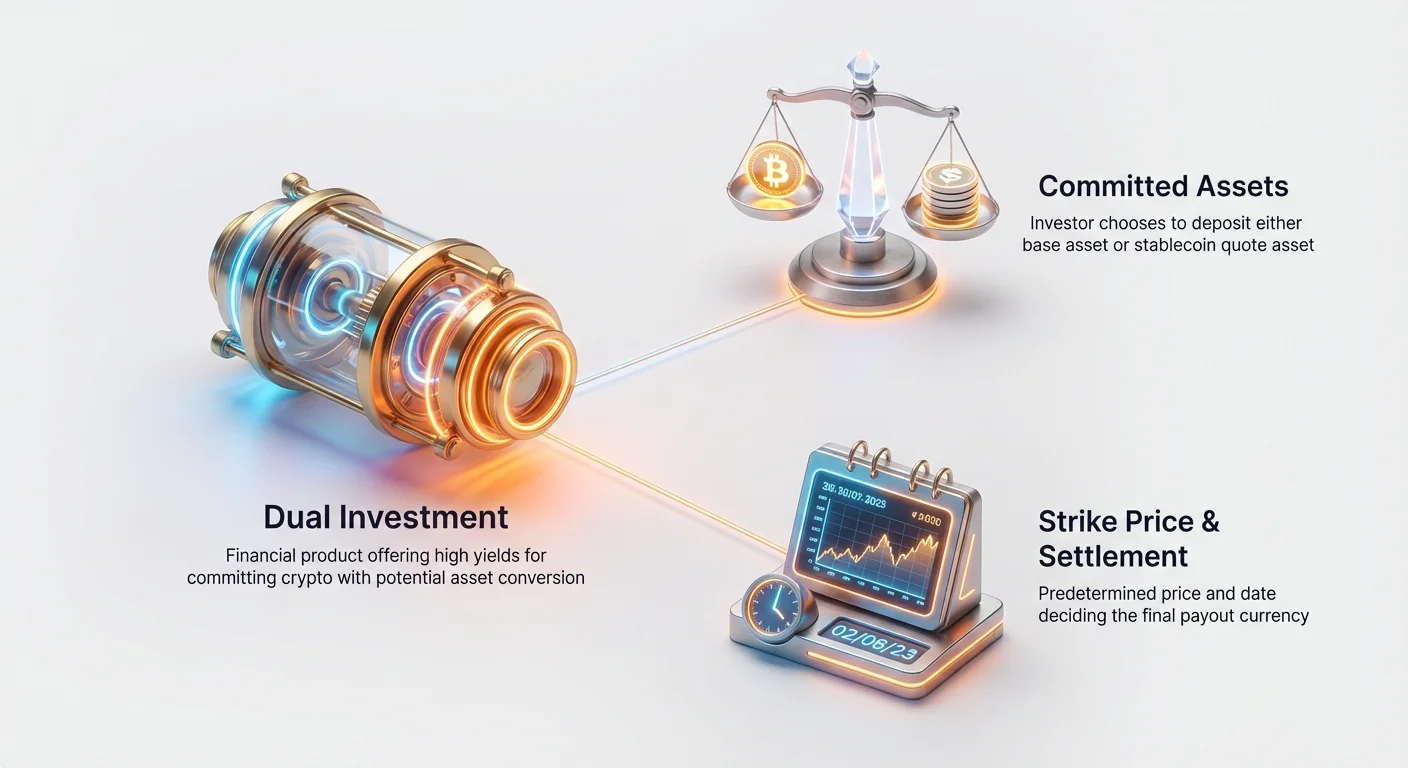
The mechanism is called "dual" because the investor commits capital that may be paid out in one of two currencies: either the base currency (e.g., BTC, ETH) or the quote currency (e.g., a stablecoin like USDC, USDT).
The Core Mechanics: Committing Two Assets
When you subscribe to a Dual Investment product, you choose one of two primary commitment types:
- Commit Base Asset (e.g., BTC): You start with BTC and are aiming to earn stablecoins. If the market rises significantly, you will receive stablecoins (effectively selling your BTC at a higher price plus the earned yield).
- Commit Quote Asset (e.g., USDC): You start with USDC and are aiming to earn the base asset (BTC). If the market falls significantly, you will receive BTC (effectively buying BTC at a lower price plus the earned yield).
In both cases, you earn a fixed APY regardless of the outcome. The yield is determined at the time of subscription and paid out upon settlement.
The Strike Price and Settlement Date
Two critical variables govern the entire Dual Investment product:
- Settlement Date (Maturity): This is the fixed time and date when the product expires, and the payout calculation is performed. DI products are generally short-term, often ranging from 1 to 90 days.
- Strike Price: This is the predetermined price used to decide the payout currency. At the settlement date, the actual market price of the asset is compared to the strike price.
If the market price crosses the strike price, the payout currency is converted. If the market price stays on the "favorable" side of the strike price, you receive your initial asset plus the yield.
The Embedded Options Contract
The high yield earned through Dual Investment is directly related to the user selling an option to the platform.
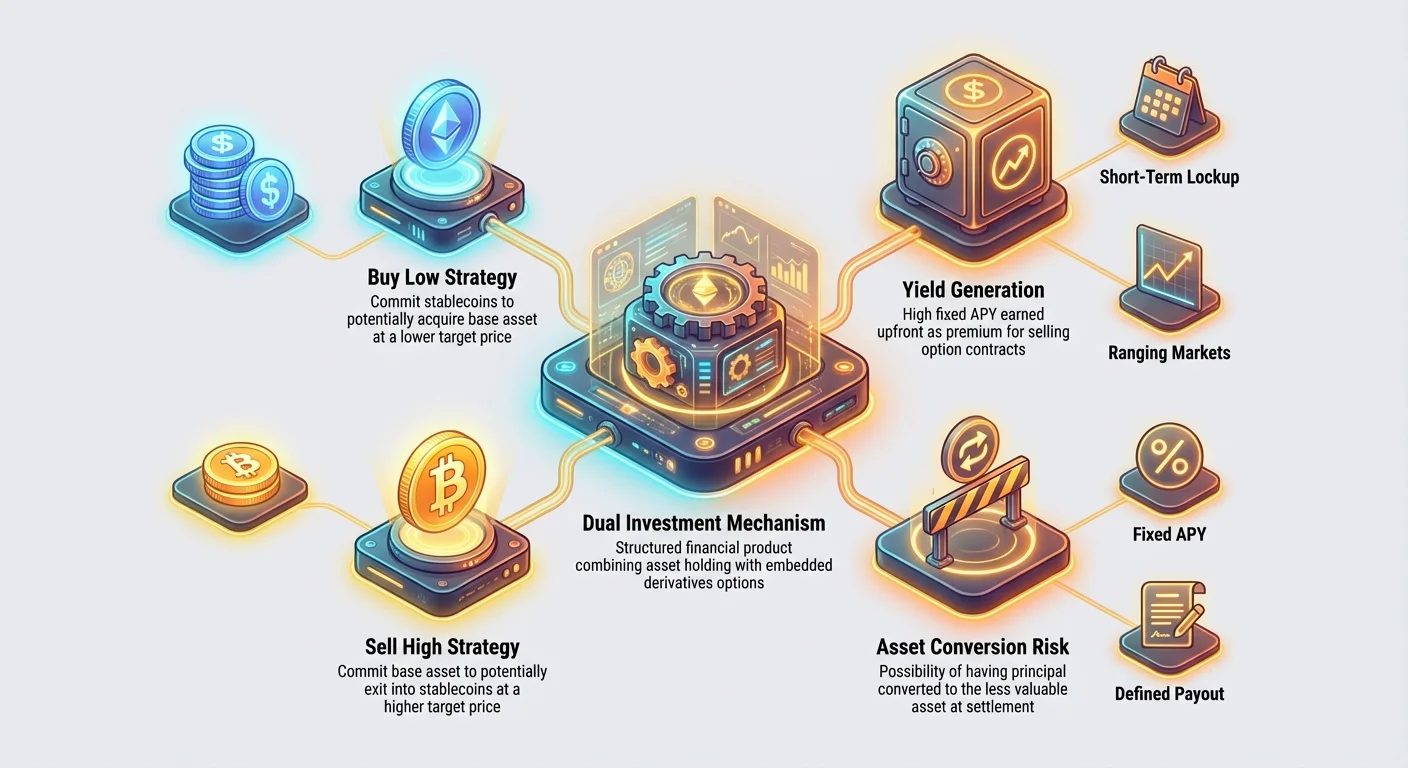
- When you commit USDC (Buy Low Strategy): You are selling a Put Option. You are agreeing to buy the underlying asset (BTC) if its price falls to or below the strike price. In exchange for taking on the obligation to buy the asset, you receive a premium (the yield).
- When you commit BTC (Sell High Strategy): You are selling a Call Option. You are agreeing to sell the underlying asset (BTC) if its price rises to or above the strike price. In exchange for taking on the obligation to sell the asset, you receive a premium (the yield).
This understanding is crucial: the APY isn't just interest; it is the option premium paid to you for taking on the specific risk of asset conversion.
Yield Generation in Dual Investment: Calculating Potential Payouts
The simplest way to understand the mechanism is through specific scenarios involving the most common commitment type: committing a stablecoin like USDC.
Practical Example: The $25,000 BTC Commitment
Imagine the current market price of Bitcoin (BTC) is $30,000. You decide to subscribe to a 7-day Dual Investment product using 1,000 USDC with the following terms:
- Committed Asset: 1,000 USDC
- Tenure: 7 Days
- Strike Price: $28,000
- Fixed APY: 40% (high due to the risk taken)
- Yield Calculation (7 days): $1,000 * (40% / 365) * 7 $\approx$ $7.67 USDC.
- Total Principal + Yield: 1,007.67 USDC.
On the Settlement Date, we check the market price of BTC against the Strike Price ($28,000).
Scenario 1: Price Rises Above Strike (Successful Yield Only)
If BTC settles at $32,000 (above the $28,000 strike price):
The condition for conversion (price falling to $28,000) was not met.
- Payout: You receive your principal plus the yield, all in the original asset.
- Result: You receive 1,007.67 USDC.
- Investor’s view: You earned 40% APY on your stablecoins, which is highly profitable.
Scenario 2: Price Falls Below Strike (Asset Conversion + Yield)
If BTC settles at $27,000 (below the $28,000 strike price):
The condition for conversion was met. The platform uses the committed USDC to buy BTC at the Strike Price of $28,000 (plus the yield).
- Conversion Rate: The total payout (1,007.67 USDC) is divided by the Strike Price ($28,000).
- Payout: 1,007.67 USDC / $28,000/BTC $\approx$ 0.035988 BTC.
- Investor’s view: Your total payout in BTC is worth $971.68 (0.035988 BTC * $27,000 market price). Although you earned a high yield, the dollar value of your principal decreased from $1,000 to $971.68 because you were forced to buy BTC at $28,000 when the market price was $27,000. This is the conversion risk you accepted.
This example clearly illustrates the inherent trade-off in DI: you secure a high yield, but you risk receiving a less valuable asset if the market moves against your strike price.
Comparing Risk: Yield Farming vs. Dual Investment
When seeking passive income in crypto, investors often compare Dual Investment strategies with traditional liquidity provision methods, known as yield farming. While both generate yield, their risk profiles are fundamentally different.
Volatility and Impermanent Loss in Traditional Farming
Traditional yield farming involves depositing two assets into a liquidity pool (e.g., 50% BTC and 50% ETH) to facilitate trading.
- Risk: The primary risk is impermanent loss (IL). If the price ratio between BTC and ETH changes significantly, the automatic rebalancing of the pool means you are left with less of the asset that appreciated more, compared to if you had just held the two assets in your wallet.
- Time Horizon: IL is often undefined and increases with market volatility. Your potential yield (paid in trading fees and governance tokens) is variable and unpredictable.
- Suitability: Best for investors who are bullish long-term on both paired assets and who are comfortable managing volatile, unpredictable APYs.
Defined Risk and Time Horizon in Dual Investment
Dual Investment completely eliminates the volatility and unpredictability associated with traditional IL.
- Risk: The risk is precisely defined by the Strike Price and the Settlement Date. You know exactly the worst-case conversion price for your asset at the outset.
- Time Horizon: The contracts are short-term (fixed maturity), meaning your capital is locked for a defined period, allowing for efficient financial planning.
- Yield: The APY is fixed and guaranteed. You know exactly how much yield you will earn (in currency terms), regardless of the outcome.
Maximizing Yield in Ranging Markets
The unique value of the dual investment crypto strategy shines brightest during ranging markets—periods when the asset price moves sideways or within a confined band.
In a ranging market:
- Yield farming pools may see low trading volume, resulting in minimal fee generation and depressed APYs.
- Dual Investment offers high, guaranteed APYs because the market is hovering around predictable levels, making the selling of options (the embedded derivative) attractive.
If BTC is trading consistently between $29,000 and $31,000, an investor can commit USDC to buy BTC at a $28,000 strike price. Since the price is unlikely to fall that far, the investor collects the high 40% APY in stablecoins without conversion risk. This is the mechanism for maximizing yield ranging market conditions.
Advanced Applications: Using Dual Investment for Hedging and Entry/Exit
Dual Investment should not be viewed only as a high-yield savings account. It is a powerful tool for strategic inventory management and defining price entry/exit points in volatile markets.
"Sell High" Strategy (Committing the Base Asset)
If you are holding a large amount of Bitcoin (BTC) and you anticipate a moderate price rally but are happy to exit a portion of your holdings if a specific high price is reached, you use the "Sell High" DI product.
Use Case: BTC is $30,000. You believe it might hit $32,000 but not much higher.
- Action: Commit BTC to a DI product with a Strike Price of $32,000.
- Outcome 1 (Price Stays Below $32,000): You keep your BTC and earn high APY on that BTC inventory. You effectively got paid to hold.
- Outcome 2 (Price Hits or Exceeds $32,000): Your BTC is converted to stablecoins at $32,000 (plus the yield). You successfully sold high, exactly where you wanted to, and earned an extra yield premium on the sale.
This strategy is effective for reducing inventory risk at targeted high prices while still generating income if the price target is missed.
"Buy Low" Strategy (Committing the Quote Asset)
If you are holding cash (USDC) and you want to accumulate more BTC, but only if the price drops to a specific level, you use the "Buy Low" DI product.
Use Case: BTC is $30,000. You only want to buy if the price drops to $28,000.
- Action: Commit USDC to a DI product with a Strike Price of $28,000.
- Outcome 1 (Price Stays Above $28,000): You keep your USDC and earn high APY on your cash. You missed the opportunity to buy, but you were paid to wait.
- Outcome 2 (Price Falls Below $28,000): Your USDC is converted to BTC at $28,000 (plus the yield). You successfully bought BTC at your target price, and the yield effectively made your average purchase price even lower than the $28,000 strike.
Hedged Staking and Inventory Management
Sophisticated traders can use Dual Investment to hedge risks associated with staked assets. If you have staked ETH (stETH) but are worried about a short-term drop in the ETH price, you can commit a small portion of your stETH inventory to a "Sell High" DI product.
This helps you:
- Generate Extra Yield: Earn the DI premium on top of the staking rewards.
- Pre-Liquidity: If the price hits your target, a portion of your staked rewards are automatically converted to stablecoins, providing immediate liquidity without having to unstake or sell on the open market at an unfavorable time.
Critical Risks and Best Practices for Beginners
While Dual Investment products are highly structured and straightforward to subscribe to, they carry inherent risks that are different from standard holding or staking. New users must fully understand the risk of asset conversion.
Understanding Conversion Risk (The Biggest Danger)
The primary risk in Dual Investment is being forced to accept an asset conversion at an unfavorable price, which can result in a loss of fiat value, despite earning the guaranteed yield.
Example Revisited (Buy Low Strategy): You committed 1,000 USDC with a $28,000 strike. The price drops to $20,000.
- You are forced to buy BTC at $28,000.
- Your 1,000 USDC purchases 0.0359 BTC.
- If you immediately tried to sell that BTC on the open market, it would only net you $718 (0.0359 BTC * $20,000).
- Your loss in fiat value is substantial, even though you received the 40% APY.
Best Practice: Only subscribe to the "Buy Low" strategy if you genuinely want to accumulate the underlying asset (e.g., BTC) at the strike price, regardless of how much lower the market might fall. Treat the conversion as a successful accumulation event, not a failure.
Liquidity and Lock-up Risks
Dual Investment products are time-locked. Once you subscribe, your assets are locked until the settlement date.
- No Early Withdrawal: If the market suddenly offers an incredible opportunity (or starts crashing) during the 7-day lockup, you cannot access your committed capital.
- Time Value of Money: Ensure the yield offered is high enough to compensate you for illiquidity over the lockup period.
Best Practice: Start with short tenures (3–7 days) to minimize lock-up risk until you are comfortable predicting short-term market movements.
Navigating the APY Illusion
Platforms often advertise extremely high APYs (sometimes 100%+). Remember that these are Annualized Percentage Yields. The actual return over a short 7-day period is much smaller, but the high APY reflects the high risk of conversion.
Furthermore, APYs are typically higher for strike prices that are aggressively far away from the current market price, reflecting the greater risk the investor assumes in that options contract.
Best Practice: Do not chase the highest APY. Instead, choose a Strike Price that aligns with your realistic market expectations or your desired entry/exit point. A lower APY on a conservative strike price may offer a much safer return.
Conclusion
Dual Investment and crypto structured products represent the bridging of traditional financial engineering with decentralized assets. They allow everyday investors to utilize sophisticated derivative mechanisms—specifically, selling options—to generate high, fixed yields, far surpassing typical crypto savings rates.
While this approach offers transparency regarding maturity and potential conversion price, it is critical that beginners fully grasp the core risk: the involuntary conversion of their principal. By treating Dual Investment not as a passive savings tool, but as a strategic derivative instrument for inventory management and defining price targets, investors can successfully use the crypto structured products explained here to capture maximum yield, particularly when markets are moving within predictable ranges. Always start small, match your strike price to your trading conviction, and remember that the high APY is your compensation for accepting conversion risk.