
Entering the world of institutional crypto investment means moving beyond buying Bitcoin on an exchange. It involves sophisticated financial engineering, precise legal planning, and deep regulatory compliance. For individuals looking to launch their own investment vehicle—whether to manage capital for high-net-worth clients or institutional limited partners (LPs)—understanding the proper fund structure is the first and most critical step.
A well-structured crypto fund provides legal clarity, optimizes tax efficiency, and establishes trust with investors. A poorly structured fund, conversely, can lead to compliance nightmares, double taxation, and the immediate rejection of potential capital commitments. This guide is designed for aspiring General Partners (GPs), fund administrators, and serious investors who need to understand the architectural blueprints behind professional digital asset investment vehicles.
We will break down the complex legal entities, explain why certain jurisdictions dominate the market, and detail the roles and economics that define the partnership between those who manage the money and those who supply it.
Foundational Concepts: What is a Crypto Venture Fund?
A crypto venture fund is a pooled investment vehicle specifically designed to deploy capital into digital assets, blockchain companies, and Web3 protocols. Unlike a hedge fund, which typically focuses on publicly traded assets and high-frequency trading, a VC fund primarily seeks long-term, illiquid investments in early-stage projects.
These funds act as the financial engine of the decentralized economy, providing the necessary fuel for developers and founders to build the next generation of technology.
The Role of Venture Capital (VC) in Crypto
Venture Capital provides "risk capital" to startups and early-stage companies that traditional banks or lenders would deem too volatile. In the crypto sector, VC funds participate in several unique ways:
- Equity Investment: Buying shares in a company that is building blockchain software or infrastructure (e.g., investing in a crypto exchange startup).
- Token Investment: Purchasing native tokens directly from a protocol before they are launched to the public market (often via a Simple Agreement for Future Tokens, or SAFT). This gives the fund exposure to the network's potential growth.
- Ecosystem Participation: Providing governance or operational support to the projects they invest in, often by participating in decentralized autonomous organizations (DAOs).
The long-term nature of these investments means the fund structure must be robust enough to operate effectively over 7 to 10 years, which is the typical lifespan of a VC fund.
Key Players: The General Partner (GP) and Limited Partner (LP)
The relationship between the GP and LP is the cornerstone of virtually every professional investment fund structure. This relationship defines who manages the money and who is owed the returns.
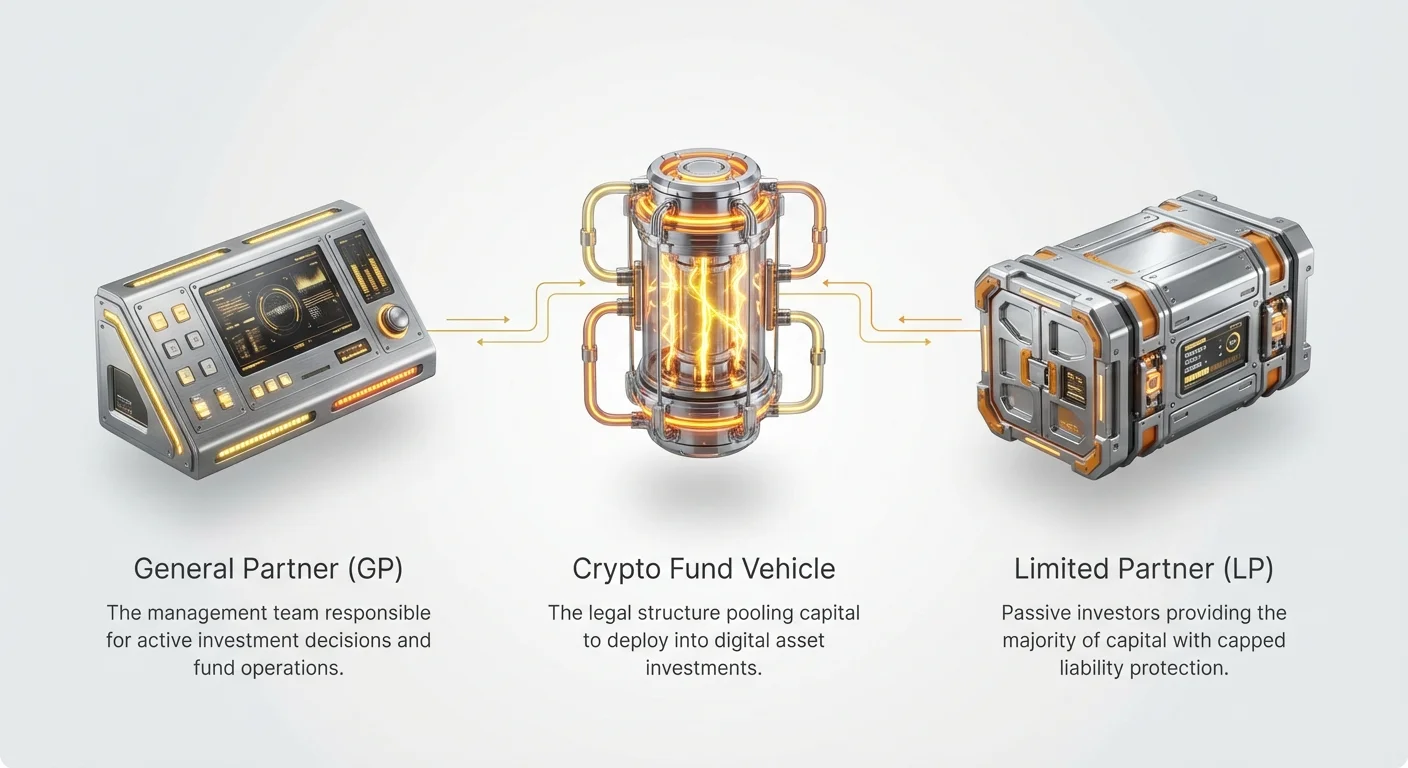
- The General Partner (GP): The GP is the management team responsible for finding, evaluating, and executing investments. They actively manage the fund’s assets, handle operations, and make strategic decisions. GPs typically commit a small percentage of their own capital to the fund, ensuring their interests are aligned with the LPs. Crucially, the GP assumes unlimited liability for the fund’s debts (though this liability is almost always mitigated by structuring the GP entity as an LLC).
- The Limited Partner (LP): The LP is the passive investor. They provide the vast majority of the capital commitment (usually 99%) and have limited involvement in the fund's day-to-day operations. Their liability is legally capped at the amount of capital they commit, meaning their personal assets are protected even if the fund faces bankruptcy or large losses. LPs are typically institutional investors (pension funds, endowments), large family offices, or high-net-worth individuals.
Defining Fund Terms: Capital Commitment, Drawdowns, and Management Fees
Before a fund begins investing, the GP and LPs agree on the basic economic terms, formalized in a Private Placement Memorandum (PPM) and the Limited Partnership Agreement (LPA).
- Capital Commitment: This is the total amount of money the LP promises to invest over the life of the fund. For example, an LP might commit $10 million to a fund.
- Drawdowns (or Capital Calls): Unlike a mutual fund where all money is invested upfront, a VC fund calls for capital as needed. When the GP identifies a new investment opportunity, they issue a "capital call," or "drawdown," and the LP is legally obligated to send the requested funds (e.g., 5% of their $10 million commitment) within a specific timeframe.
- Management Fees: These are annual fees paid by the LPs to the GP to cover operational costs, salaries, research, and administrative expenses. Standard VC funds often charge 2.0% to 2.5% of the committed capital per year.
The Core Structure: GP/LP Model Explained
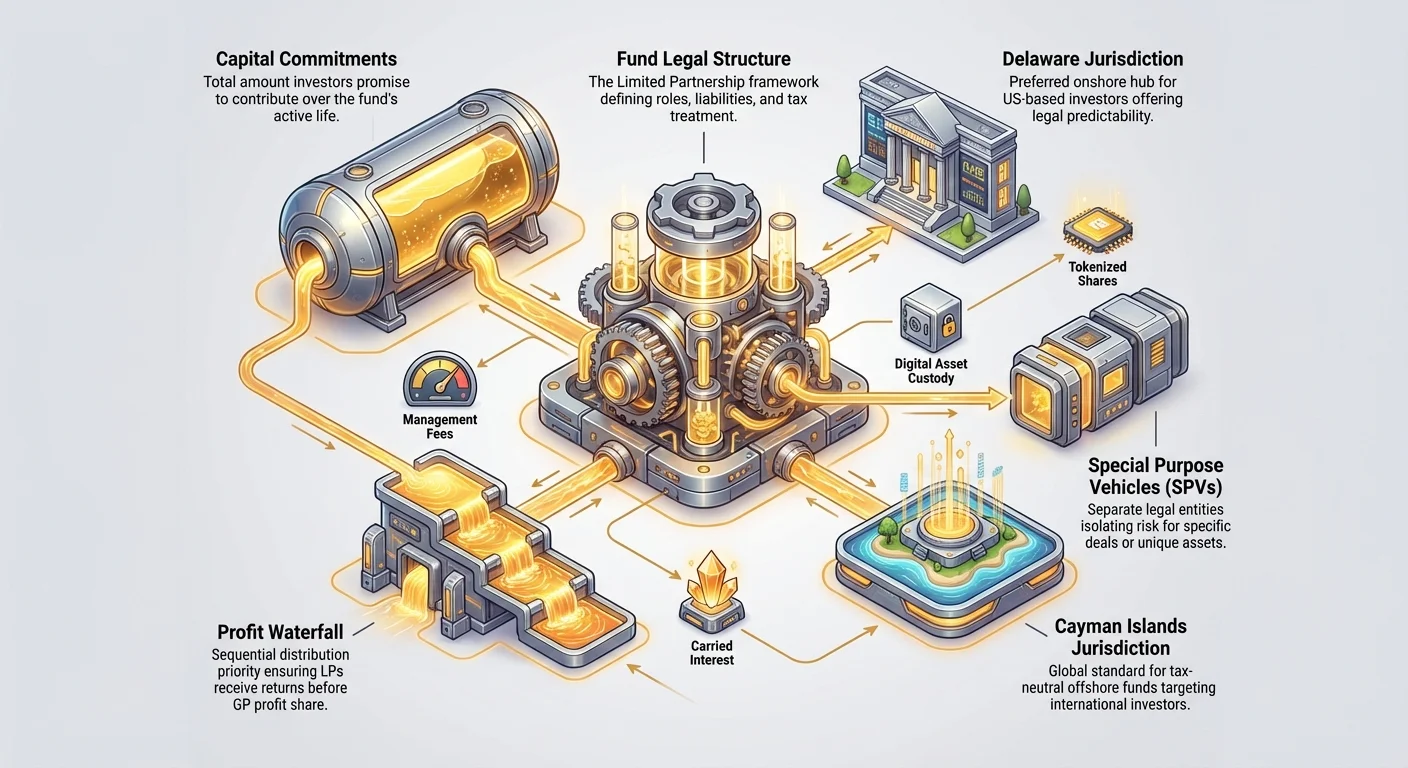
The Limited Partnership (LP) structure is overwhelmingly favored for venture capital because it offers LPs protection from liability and allows all profits and losses to "pass through" directly to the investors without being taxed at the fund level. This avoids the problem of double taxation.
The GP: The Brains and the Manager
The GP typically structures itself as a Limited Liability Company (LLC) or a corporation. This organizational choice is critical because while the fund itself is a Limited Partnership, the managing entity needs its own legal shield.
The GP performs several operational functions:
- Investment Sourcing: Finding prospective portfolio projects (e.g., researching emerging Layer 1 protocols or Web3 gaming studios).
- Due Diligence: Vetting the technical, legal, and financial viability of the target investment.
- Portfolio Support: Helping portfolio companies grow, which might include offering strategic advice, making key introductions, or even helping with token economic design.
Because the GP takes on this intense operational responsibility, they are entitled to two streams of compensation: the management fees and the profit share.
The LP: The Capital Provider and Passive Investor
LPs are fundamentally focused on return on investment (ROI) and minimizing risk exposure. Their passivity is protected by law. If an LP becomes too active in the management decisions of the fund, they risk losing their limited liability status, potentially exposing them to the fund's debts.
Key considerations for LPs when choosing a fund include:
- Track Record (or "Thesis"): Does the GP have a proven history of selecting successful crypto assets or early-stage companies?
- Liquidity Horizon: How long will the capital be locked up? Crypto VC funds typically have a decade-long lock-up, though some may use vesting schedules or secondary markets to provide earlier liquidity.
- Co-investment Rights: Do LPs get the option to invest additional capital directly into specific portfolio companies alongside the fund?
Economic Alignment: Understanding Carried Interest (Carry)
Carried Interest, or "Carry," is the mechanism used to align the financial interests of the GP with the LPs. It represents the GP’s share of the fund’s profits.
The industry standard for carry is 20%, meaning that after the LPs get their initial committed capital back, the GP takes 20% of the remaining profit, and the LPs receive the remaining 80%.
However, carry only kicks in after the LPs meet a certain threshold return, known as the Hurdle Rate (or Preferred Return).
The Profit Distribution "Waterfall"
The distribution of profits follows a strict order, often called the "waterfall." This process ensures LPs are paid first:
- Return of Capital: All capital called by the GP is first returned to the LPs.
- Preferred Return: LPs receive returns equal to the hurdle rate (typically 6-8% annual compounded return on their invested capital).
- Catch-up: Once the hurdle rate is met, the GP receives 100% of subsequent profits until they "catch up" to their 20% share of all realized profits (including the preferred return profits).
- Split: After the catch-up, all remaining profits are split according to the agreed-upon carry structure (e.g., 80% to LPs, 20% to GP).
In crypto funds, where profits can be volatile, the waterfall structure provides robust protection for the LPs while highly incentivizing the GP to seek massive returns.
Choosing the Legal Entity: Why Structure Matters
Selecting the correct legal structure and jurisdiction is arguably the most important decision a new fund manager will make. This choice dictates the fund’s tax treatment, regulatory oversight, and administrative costs.
Limited Partnerships (LPs) and Limited Liability Companies (LLCs)
While Limited Partnerships (LPs) are the dominant legal structure for the fund itself, other entity types are utilized for specific components:
| Entity Type | Function in Fund Structure | Key Benefit |
|---|---|---|
| Limited Partnership (LP) | The Main Fund Vehicle | Pass-through taxation; limits liability for passive investors (LPs). |
| Limited Liability Company (LLC) | The General Partner (GP) Entity | Protects the individual managers from unlimited fund liability; simplicity in US taxation. |
| Corporation (C-Corp/S-Corp) | Fund Administrator/Advisor or Equity Holder | Used when the fund needs to raise money from certain non-US investors or tax-exempt entities. |
The overwhelming choice for the fund vehicle is the LP because it allows the tax burden to pass directly through to the LP investors. This means the fund itself does not pay corporate income tax; the LPs pay taxes based on their personal or institutional tax jurisdiction. This avoids the scenario where profits are taxed once at the fund level and again when distributed to the investors.
The Critical Role of Side Letters and Governing Documents
The fund's operation is governed by the Limited Partnership Agreement (LPA), which outlines the GP/LP relationship, the fee structure, the investment mandate, and the waterfall. However, large institutional LPs often require specific, negotiated terms that differ from the standard LPA. These terms are formalized in Side Letters.
In crypto, side letters are essential for addressing unique operational concerns, such as:
- Custody Requirements: An institutional LP might demand that their portion of the fund's assets be held by a specific regulated, third-party qualified custodian, rather than a multisig wallet controlled solely by the GP.
- Transparency: Requirements for quarterly updates detailing token vesting schedules or staking yields that go beyond the standard financial reports.
- Regulatory Exposure: Clauses limiting the fund’s ability to invest in assets that are deemed high-risk or prohibited by the LP’s internal compliance rules.
Special Purpose Vehicles (SPVs) in Crypto Investing
A Special Purpose Vehicle (SPV) is a separate legal entity created for a single, specific purpose. In VC, SPVs are typically used to hold investments in a single portfolio company or asset, isolating that investment from the main fund.
In the crypto space, SPVs serve several critical functions:
- Deal-Specific Risk Isolation: If a fund invests a massive sum into a highly experimental protocol, they might use an SPV to shield the main fund’s assets from any legal or regulatory risk associated with that single token or project.
- Managing Unique Assets: Cryptocurrencies present assets that are not easily standardized. If a fund acquires a large collection of non-fungible tokens (NFTs) or highly illiquid assets that require unique vesting or transfer mechanisms, an SPV provides the legal wrapper needed to manage and ultimately distribute those assets efficiently.
- Accommodating Co-Investors: SPVs are vital when a fund wants to allow a specific group of LPs or external investors to participate only in one particularly promising deal without committing capital to the entire fund.
Example Use Case: A major crypto fund, Fund I, raises $500 million. One of their portfolio companies, Alpha Labs, conducts a successful token launch. The fund wants to allow LPs who missed the initial commitment to invest specifically in Alpha Labs’ public round. The GP creates an SPV: Alpha Labs Co-Invest to facilitate this deal, keeping the finances and regulatory reporting separate from Fund I.
Jurisdiction Deep Dive: Cayman vs. Delaware
The choice of jurisdiction for a crypto fund often comes down to two dominant players: Delaware in the United States (Onshore) and the Cayman Islands (Offshore). This decision hinges on tax efficiency, regulatory predictability, and investor familiarity.
The Onshore Hub: Delaware (US Focus)
Delaware is the preferred jurisdiction for US-based funds and those primarily raising capital from US taxable investors (like US-based family offices).
Advantages:
- Familiarity and Precedent: Delaware law is highly specialized and mature regarding corporate and partnership law. Investors and lawyers trust its legal framework.
- Predictability: The legal process is predictable, and disputes are handled efficiently in the Delaware Court of Chancery, which specializes in corporate matters.
- Tax Efficiency (Pass-Through): Delaware LPs offer "pass-through" tax status, avoiding corporate-level tax, which is ideal for US investors.
Disadvantages:
- Regulatory Burden: Funds domiciled in the US are subject to US securities regulations (SEC, CFTC), which can be complex, especially when dealing with ambiguous digital asset classifications.
- Foreign Investor Taxes: If a Delaware fund invests in US businesses (which many crypto startups are), non-US LPs face significant withholding taxes and cumbersome IRS filings (often related to 'Effectively Connected Income,' or ECI).
The Offshore Standard: The Cayman Islands
The Cayman Islands, particularly its structure utilizing the Exempted Limited Partnership (ELP), is the global gold standard for funds raising capital globally, especially from non-US investors and institutional LPs.
Advantages:
- Tax Neutrality: Cayman imposes no corporate, income, capital gains, or withholding taxes on the fund itself. This structure makes it ideal for pooling capital from investors in various tax jurisdictions.
- Regulatory Flexibility: The regime is structured to attract global funds. While still requiring registration, the regulatory environment is streamlined and highly efficient for investment vehicles.
- Addressing US Tax Concerns: The Cayman structure can often be paired with a Delaware GP to effectively separate the fund's investment operations from the tax liabilities of its global LP base.
The "Master-Feeder" Structure: Most major crypto funds utilize a master-feeder setup that involves both jurisdictions to satisfy diverse investor needs:
- Master Fund (Cayman): This is the main investment vehicle that holds all assets and executes all trades.
- US Feeder Fund (Delaware): Used for US taxable investors. It pools US capital and feeds it into the Master Fund.
- Offshore Feeder Fund (Cayman): Used for non-US investors and US tax-exempt investors (like pension funds). It also feeds capital into the Master Fund.
This arrangement ensures that all investors, regardless of their location, achieve the optimal tax treatment for their specific regulatory environment, while the Master Fund benefits from simplified trading execution.
Navigating Regulatory Ambiguity and Tax Compliance
Crypto funds face unique tax hurdles because digital assets generate taxable events in ways traditional equity does not (e.g., staking rewards, airdrops, DeFi yields).
The compliance challenge is twofold:
- Jurisdictional Risk: Regulators worldwide (SEC in the US, ESMA in Europe) are still determining whether specific crypto assets are securities, commodities, or currencies. The fund structure must be flexible enough to navigate sudden classification changes.
- Tax Complexity: Every transaction—from selling a token for fiat to exchanging one token for another (token-to-token swap)—is a taxable event. Funds must employ specialized crypto accounting and tax software that integrates with blockchain data to accurately track cost basis, realized gains/losses, and wash sale rules across multiple jurisdictions.
Best Practice: Successful GPs hire specialized fund administrators and external counsel from the outset who are fluent in both traditional VC law and digital asset taxation to maintain compliance.
Operationalizing the Crypto Fund: Portfolio Management and Accounting
Once the fund structure is legally established, the ongoing challenge is managing the unique characteristics of digital assets, which differ significantly from traditional stocks and bonds.
Dealing with Digital Assets: Custody and Security
Unlike holding shares of stock, where the brokerage handles custody, a crypto fund is directly responsible for securing its private keys. Custody is a primary concern for institutional LPs.
Fund managers have three main custody options:
- Self-Custody (Multi-signature Wallets): The fund retains control of the keys, often using a multi-signature arrangement requiring 3 out of 5 key holders (GPs, legal counsel) to approve any transaction. This offers maximum control but demands rigorous internal security protocols.
- Third-Party Custodians: Using regulated, institutional-grade custodians (like Coinbase Custody or Anchorage) that offer high levels of insurance, cold storage, and comprehensive security audits. This is often mandated by institutional LPs.
- Hybrid Solutions: Splitting assets between self-custody (for active, high-frequency trades) and institutional custodians (for long-term, cold-storage assets).
For a fund to demonstrate professionalism, it must adopt a rigorous internal control framework, including detailed key management policies and procedures for handling operational risk like smart contract failure or human error.
Valuation Challenges: Tokens, Equity, and SAFTs
One of the most difficult aspects of running a crypto fund is accurately valuing portfolio assets for quarterly LP reports. Unlike public companies, which have daily market prices, early-stage crypto investments are often illiquid.
- Equity Investments: Valued using standard VC metrics (e.g., comparable company analysis, discounted cash flow).
- Vested Tokens: Tokens received through SAFTs (Simple Agreements for Future Tokens) or other private agreements often have lock-up periods and vesting schedules. These assets must be valued at a discount reflecting their lack of immediate liquidity. Valuation is typically based on the last funding round price, adjusted for public market fluctuations, or highly discounted if the token is not yet liquid.
- Staking and Yield: Income generated from staking or DeFi yield protocols must be tracked as income and requires careful accounting to differentiate between capital appreciation and operational income.
To ensure fairness, funds typically adhere to the International Private Equity and Venture Capital (IPEV) Valuation Guidelines, adapting them for the unique volatility and illiquidity of the crypto market.
Compliance and Tax Reporting
The volume of transactions in a crypto fund (e.g., claiming airdrops, executing token swaps, paying gas fees) creates an exponential administrative burden compared to traditional VC.
Key tax considerations specific to crypto funds include:
- Wash Sale Rules: The US IRS has rules preventing investors from claiming a loss on a security if they buy a substantially identical security shortly after. While cryptocurrency is currently often treated as property, not security, the rules around wash sales are complex and subject to change. Funds must operate conservatively.
- Airdrops and Forks: Receiving airdropped tokens or new coins from a hard fork is generally considered a taxable income event based on the asset’s fair market value at the time of receipt.
- Entity-Level Tax (for non-pass-through structures): If a fund is structured as a corporation, or if a specific investment generates income that is deemed "Effectively Connected Income" (ECI) to a US trade or business, it can trigger corporate-level taxation, severely impacting LP returns.
Fund managers must rely on integrated, automated crypto tax platforms that can synchronize data from on-chain wallets, multiple exchanges, and DeFi protocols to produce accurate tax reports (such as K-1s for US LPs).
The Future of Fund Structuring: Tokenization and Decentralization
As blockchain technology matures, it is fundamentally changing the way funds are organized, managed, and offered to investors. The next evolution of fund structuring centers on increasing liquidity and transparency through tokenization.
Tokenized Fund Shares: Increasing Liquidity for LPs
Tokenization refers to issuing a digital token that legally represents ownership of a traditional asset, in this case, a share or interest in the Limited Partnership.
How it Works:
- The crypto fund (the LP) is established under a traditional legal structure (e.g., Cayman ELP).
- The GP works with a regulated securities token platform to issue tokens (Security Tokens) representing LP interests in the fund.
- These tokens are distributed to LPs and are often subject to regulatory transfer restrictions (e.g., only accredited investors can hold them).
Benefits:
- Liquidity: Traditionally, an LP is locked in for 10 years. Tokenization allows the LP to sell their fund shares to other eligible investors on a regulated secondary market before the fund liquidates, dramatically increasing liquidity.
- Fractionalization: Tokens can represent fractions of a fund share, potentially opening up access to smaller accredited investors who couldn't meet the high minimum commitment of a traditional VC fund.
- Automated Compliance: Smart contracts embedded in the token can automate compliance tasks, such as enforcing lock-up periods, ensuring only whitelisted investors hold the asset, and automating the distribution of carried interest.
Decentralized Autonomous Organizations (DAOs) as Investment Structures
A DAO is an organization governed by code and smart contracts, not traditional hierarchical management. While most professional VC funds still require a centralized legal entity (the GP) to satisfy regulators, some experimental structures are using DAOs as hybrid investment vehicles.
In a hybrid model:
- The Investment Club: A DAO might function as an unincorporated investment club, pooling capital from members (token holders) and voting on investment decisions.
- The Legal Wrapper: A traditional legal entity (LLC or Foundation) is still required to handle regulatory compliance, sign contracts (like SAFTs), and pay taxes.
The DAO handles governance—deciding what to invest in and when—while the centralized legal entity handles execution and compliance. This model offers increased transparency and distributed decision-making power, although regulatory clarity for purely decentralized funds remains elusive.
Regulatory Hurdles for Tokenized Funds
The primary challenge facing the tokenization of fund shares is securities regulation. When a fund issues a token representing an LP interest, that token is legally defined as a security in most jurisdictions.
Key hurdles include:
- Registration: The token issuance and any secondary trading platform must comply with complex securities registration or exemption requirements (like Regulation D and Regulation S in the US).
- KYC/AML: The platform must enforce strict Know Your Customer (KYC) and Anti-Money Laundering (AML) checks on every potential buyer of the tokenized share, both at issuance and upon secondary transfer.
- Enforcement: Because the underlying asset is regulated by traditional financial law (e.g., a partnership interest), the smart contract must be capable of responding to legal enforcement, such as freezing or seizing tokens if mandated by a court order.
Conclusion
Structuring a successful crypto fund demands more than just identifying promising digital assets; it requires marrying advanced financial strategy with precise legal engineering. The choice between a Delaware or Cayman structure, the careful negotiation of the Limited Partnership Agreement, and the creation of the profit waterfall are the critical foundations upon which a multi-million or billion-dollar fund is built.
For aspiring General Partners, understanding the nuances of the GP/LP relationship, utilizing SPVs efficiently, and integrating specialized crypto compliance systems are not optional—they are prerequisites for attracting institutional capital. While future innovation in tokenization and DAOs promises greater liquidity and transparency, the current landscape still relies heavily on time-tested structures like the Limited Partnership. By mastering these foundations, fund managers can focus their energy on the core mission: driving innovation and maximizing returns in the rapidly evolving digital asset ecosystem.