
Welcome to the cutting edge of decentralized finance (DeFi). Becoming a Liquidity Provider (LP) means supplying assets to decentralized exchanges (DEXs) so others can trade, and in return, you earn a portion of the transaction fees. For many years, this was a straightforward, if somewhat passive, endeavor.
However, the LP landscape has evolved dramatically. The introduction of mechanisms like concentrated liquidity—most famously utilized by platforms like Uniswap V3—has transformed LPing from a passive investment into an active, strategic job. While modern LPing offers the potential for significantly higher returns than older models, it also introduces complex risks that require constant monitoring and advanced strategy.
This guide is designed to move you beyond the basics of depositing two tokens. We will explore the mechanics behind modern Automated Market Makers (AMMs), dissect the high risks and high rewards of concentration, and provide a framework for managing your LP portfolio effectively to maximize fee generation while mitigating the threat of impermanent loss.
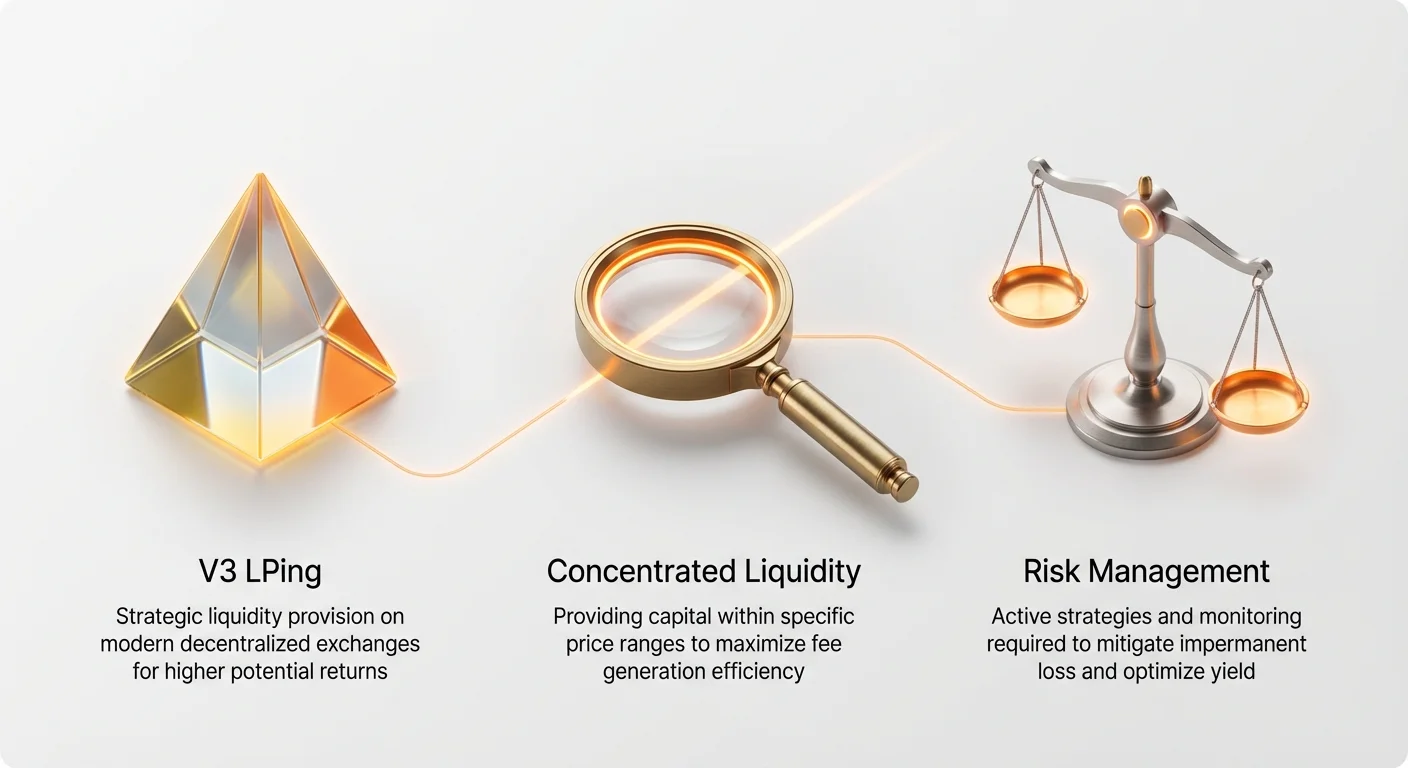
The Evolution of LPing: From V2 to V3 AMMs
To understand advanced liquidity provision, we must first understand the foundation: the Automated Market Maker (AMM). AMMs are smart contracts that hold liquidity pools, allowing assets to be traded automatically without traditional buyers and sellers.
How Traditional Automated Market Makers (AMMs) Work (V2)
The earliest and most common form of AMM, often called "V2" (referencing Uniswap V2 or similar early protocols), operated using a simple mathematical formula: the constant product market maker ($x * y = k$).
Imagine a pool containing two tokens, Token X (ETH) and Token Y (USDC).
- x is the quantity of ETH.
- y is the quantity of USDC.
- k is the constant product.
This formula requires that the product of the two reserves must always remain constant. When a trader buys ETH from the pool (decreasing x), the formula forces the price of ETH to rise relative to USDC to keep the product (k) the same. This system works perfectly to ensure perpetual liquidity, but it has a major drawback: capital inefficiency.
Why V2 Was Inefficient (Capital Utilization)
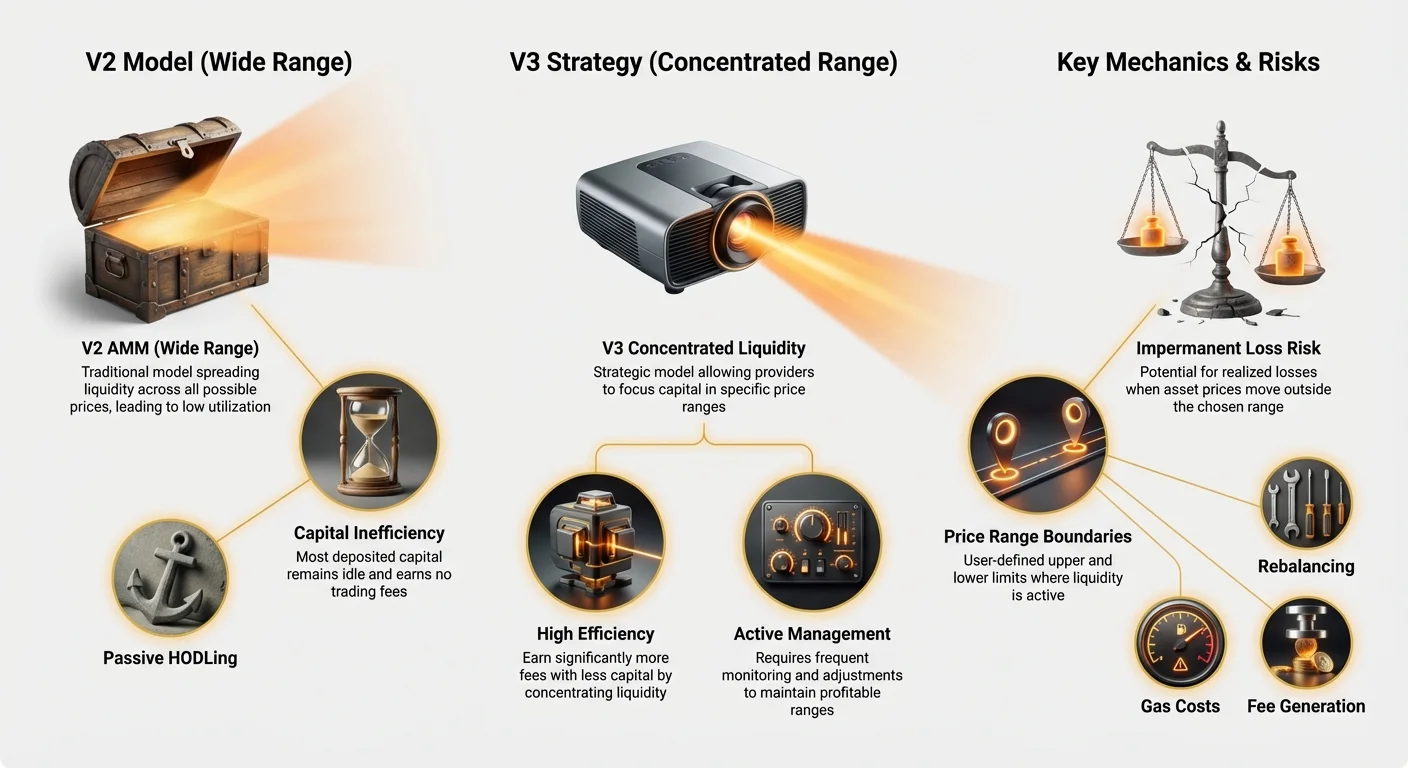
In the V2 model, the liquidity you deposited was spread across the entire possible price range, from zero to infinity.
If ETH is currently trading at $3,000, the vast majority of the liquidity provided (the capital you deposited) is sitting idle, ready for trades that might happen if ETH hits $100 or $10,000. Since trading typically occurs only around the current market price, most of the capital deposited into V2 pools was never utilized, meaning LPs earned fewer fees relative to the total amount of assets they staked.
Introducing Concentrated Liquidity (The V3 Shift)
Concentrated liquidity revolutionized this model by allowing LPs to define specific, custom price ranges where their capital will be active. This is the fundamental shift of the V3 architecture:
Instead of providing liquidity from (), a sophisticated LP might choose to only provide liquidity for ETH between $2,500 and $3,500.
The Benefits:
- High Capital Efficiency: Only the capital required for the specific price range is deployed, meaning LPs can earn the same fees as a V2 LP using a fraction of the capital.
- Higher Returns: Because the capital is highly efficient, a V3 LP focusing on the current price range captures a significantly larger share of the trading fees than a V2 LP providing the same nominal value.
The Catch: While V3 maximizes returns when the price stays within the chosen range, it introduces a severe penalty when the price moves outside the range, fundamentally changing the risk profile of LPing.
Mastering Concentrated Liquidity: Strategy and Mechanics
The key to successful advanced LPing lies in managing the boundaries of your chosen price range. Unlike V2, where you could essentially deposit and forget (if you were willing to accept low returns), V3 requires constant vigilance and strategic decision-making.
Defining Your Price Range: The Core V3 Decision
Choosing your range is a predictive decision. You are essentially betting on the future volatility of the asset pair.
| Range Type | Example (ETH @ $3,000) | Characteristics | Fee Potential | Risk/Management |
|---|---|---|---|---|
| Tight/Narrow | $2,900 – $3,100 | High capital efficiency, liquidity focused directly around the current price. | Highest | Extreme risk; requires constant active management and rebalancing. |
| Medium | $2,500 – $3,500 | Balanced efficiency, offers some buffer against short-term volatility. | Moderate/High | Ideal for experienced LPs who monitor daily. |
| Wide | $1,000 – $5,000 | Low capital efficiency, acts similarly to V2. | Low | Minimal management required; similar risk profile to HODLing the assets. |
Understanding Range Risk (Becoming Unilateral)
The primary risk unique to concentrated liquidity is the danger of the price moving outside your specified range. This is known as Impermanent Loss realization or exiting the range.
- How it Works: When the asset price moves beyond your defined upper or lower boundary, your liquidity position becomes unilateral—meaning 100% of your pooled funds are converted into the less valuable of the two tokens.
- If ETH (your asset) rises above the upper limit, you are left holding 100% USDC (the stablecoin).
- If ETH falls below the lower limit, you are left holding 100% ETH.
- Stopping Fee Generation: When the price exits your range, your capital is no longer contributing to the pool, and you stop earning transaction fees.
- Realized Loss: If you leave the unilateral position and the asset price never returns to your range, the impermanent loss (the opportunity cost compared to simply holding the assets) becomes a permanent loss relative to the current market price, realized upon withdrawal.
Example Scenario: You pool ETH and USDC in a range of $2,000 to $3,000. ETH is currently $2,500. ETH suddenly drops to $1,800.
- Your position automatically converts 100% of your USDC into ETH at an average rate above the current $1,800 market price.
- You stop earning fees.
- You are now holding 100% ETH, and if you withdraw, you realize the loss compared to if you had held USDC.
The Fee Multiplier Effect
Concentrated liquidity works because LPs who choose tighter ranges capture a disproportionately high amount of the trading fees.
Imagine 10 LPs are providing $10,000 each to an ETH/USDC pool.
- Nine LPs use the wide V2 range ().
- One sophisticated LP uses a tight range ($2,900-$3,100) with only $1,000.
When trades occur at $3,000, 100% of the sophisticated LP’s $1,000 is active. Conversely, only a fraction of the wide-range LPs' capital is active in that specific price area. As a result, the tight-range LP captures the majority of the transaction fees, generating very high Annual Percentage Rates (APR) on their concentrated capital.
The Trade-off: Higher Fees vs. Higher Impermanent Loss
The central strategic challenge in V3 LPing is finding the perfect balance between risk and reward:
| Strategy | Fee Potential | Impermanent Loss Risk | Capital Required |
|---|---|---|---|
| Tight Range | Very High | Very High (requires constant monitoring) | Low |
| Wide Range | Low | Low (similar to V2) | High |
Choosing a tight range amplifies your returns, but it also amplifies the effects of volatility and the speed at which you must rebalance your position to prevent major impermanent loss realization. If you are aiming for high yields, you must accept that you are entering a high-frequency trading environment that requires continuous active management.
Advanced Risk Management for Concentrated LPs
Effective risk management for concentrated liquidity is less about complicated math and more about diligent monitoring and timely execution.
Active Management vs. Passive HODLing
In the world of concentrated liquidity, there is no truly "passive" strategy unless you choose an extremely wide range that mimics V2.
Passive HODLing (V2/Wide V3): You deposit funds and let them sit, accepting lower fees but avoiding the gas costs and time commitment associated with rebalancing.
Active Management (Tight V3):
- Continuous Monitoring: You must check the market price frequently relative to your range boundaries.
- Rebalancing: If the price approaches the edge of your range, you must withdraw your capital (paying gas fees) and then immediately re-deposit it into a new, centered range (paying gas fees again).
- Compounding Fees: You must decide how often to withdraw and re-stake your earned fees to compound your position—balancing the desire to compound against the cost of the gas fees required to do so.
For most retail investors, tight V3 ranges are only profitable if the asset is expected to remain stable, or if the fees generated are high enough to outweigh the repeated gas costs of rebalancing.
Calculating the Break-Even Point (Fees vs. Impermanent Loss)
The greatest trap for V3 LPs is earning large fees only to have those earnings wiped out by impermanent loss (IL). Before setting a concentrated position, you need to estimate your break-even point.
The goal is simple: Total Fees Generated > Net Impermanent Loss + Total Gas Costs.
- Net Impermanent Loss: This is a dynamic calculation, but generally, the further the price moves from your initial entry point, the higher the IL.
- Total Gas Costs: Includes the cost to deposit, the cost to withdraw/rebalance, and the cost to withdraw fees.
Actionable Tip: If the estimated fees you will earn over the expected duration (e.g., one week) do not significantly exceed the expected gas costs of entering and potentially rebalancing the position, the strategy is likely not worth the effort. Tight ranges only make sense if they are generating extremely high fees daily.
Mitigating Exiting-Range Risk
When the price moves outside your boundaries, you face a strategic choice: wait or cut.
1. Waiting for the Price to Return (The Hope Strategy)
If you believe the price excursion is temporary, you might leave the position unilateral, earning no fees, and wait for the asset to return to your range. If the price returns, your position reactivates, and you begin earning fees again, potentially mitigating the IL. The risk here is opportunity cost—your capital is sitting idle, and if the price moves further away, your IL deepens.
2. Cutting and Rebalancing (The Active Strategy)
If the price breaks a key support or resistance level and you anticipate a significant trend change, you must rebalance.
- Withdraw: Pull the unilateral assets out of the pool.
- Swap: Convert half of the assets back into the other token (e.g., sell half of the 100% ETH back to USDC) to achieve a 50/50 ratio.
- Re-deposit: Create a new range centered around the new, lower (or higher) market price.
This locks in the impermanent loss realized from the first move but allows your capital to become active again in the new price environment, immediately beginning to generate fees. This is crucial for long-term profitable LPing.
Practical Execution: Optimizing Transactions and Monitoring
Executing a sophisticated LP strategy requires careful asset selection and meticulous tracking of performance metrics.
Choosing the Right Asset Pair
Your success as an advanced LP depends heavily on the pair you choose to concentrate liquidity in.
1. Stablecoin Pairs (e.g., USDC/DAI or USDC/USDT)
- Risk Profile: Low volatility, minimal impermanent loss risk.
- V3 Strategy: Ideal candidates for extremely tight ranges (e.g., $0.999 to $1.001). Since the assets are designed to stay pegged, you can maximize capital efficiency and capture high fees for minor movements around the peg with very little fear of exiting the range.
- Management: Low-to-medium management, primarily needed if a stablecoin briefly loses its peg.
2. Volatile Pairs (e.g., ETH/wBTC or ETH/MATIC)
- Risk Profile: High volatility, high impermanent loss risk.
- V3 Strategy: Requires a wider range to avoid being forced to rebalance daily, or requires extreme active management based on technical analysis (TA). Use concentrated liquidity here only when you have a strong short-term prediction about consolidation or sideways movement.
- Management: High management required; high gas costs are likely due to frequent rebalancing.
3. New/Long-Tail Asset Pairs
Avoid using concentrated liquidity with brand-new or highly illiquid tokens. While these pairs may offer extremely high transaction fee percentages, their extreme volatility makes accurate range setting nearly impossible, and a sudden 50% drop could wipe out all fee earnings instantly.
Transaction Fee Optimization (Gas Costs)
Gas fees are the silent killer of concentrated liquidity profitability. Every action—initial deposit, withdrawal, fee harvesting, and rebalancing—incurs a gas fee (especially on congested Layer 1 networks like Ethereum mainnet).
Strategies for Minimizing Gas Impact:
- Use Layer 2 Solutions: Wherever possible, utilize concentrated liquidity on scaling solutions like Arbitrum, Optimism, Polygon, or zkSync. These chains offer V3 LP functionality with gas costs that are orders of magnitude lower than the Ethereum mainnet, making frequent rebalancing financially viable.
- Batch Actions: If you need to rebalance, try to harvest accumulated fees and adjust the range simultaneously to minimize the number of required transactions.
- Gas Awareness: Only perform actions when network gas fees are low (e.g., during off-peak hours). A single $100 rebalancing fee can easily negate several days of earned yield in a low-volume pool.
Essential LP Monitoring Tools
Successful advanced LPs do not rely on the simple pool metrics displayed on the exchange interface. They use specialized tools to track real performance.
- P&L (Profit and Loss) Tracking: You need tools (often external LP tracking dashboards) that compare your current portfolio value and fees earned against a baseline "HODL" portfolio (a portfolio where you simply held the initial 50/50 tokens without pooling).
- Impermanent Loss Measurement: The most crucial metric is IL. If your cumulative IL begins to exceed your cumulative fees earned, your LP position is underperforming the simple act of holding the assets. This is the clear signal that a strategy pivot (rebalancing or withdrawal) is necessary.
- Price Alerts: Set automated alerts for when the market price nears your chosen upper or lower range boundary. This enables you to take immediate action before your position becomes completely unilateral and stops earning fees.
Conclusion: Becoming a Sophisticated LP
Advanced liquidity provision is a powerful tool for generating yield in DeFi, but it is not a set-and-forget investment. The shift to concentrated liquidity models fundamentally changed the game, demanding active management and a deep understanding of market volatility.
By mastering the mechanics of V3, strategically defining your price ranges, and rigorously tracking your performance against the backdrop of impermanent loss and gas costs, you move beyond the novice level. A sophisticated LP treats their position like a business, constantly evaluating the risk-reward ratio and making informed decisions to ensure that the high fees earned from concentration consistently outweigh the costs of risk and required maintenance.