
Ethereum serves as a global, decentralized computing platform that goes far beyond simple currency transactions. While Bitcoin was designed primarily as a digital store of value and medium of exchange, Ethereum was built to function as a shared world computer. This network is capable of executing any type of computation through the use of smart contracts. These are self-executing agreements where the terms are directly written into code. To operate this massive decentralized machine, the network relies on a native currency known as Ether (ETH).
ETH acts as the lifeblood of the ecosystem. It is used to pay for the computational resources required to run applications and process transactions. Every action on the network, from sending funds to a friend to interacting with complex decentralized finance protocols, requires a specific amount of computational effort. This effort must be compensated to the network participants who validate and process these actions.
Without a cost attached to these operations, the network could easily be spammed with infinite loops or useless data, clogging the system. By requiring a fee in ETH for every operation, the protocol ensures that resources are allocated efficiently. This mechanism secures the network and incentivizes validators to maintain the integrity of the blockchain. As the ecosystem has grown, managing these costs has become a central focus for users and developers alike.
The Mechanics of Ethereum Gas
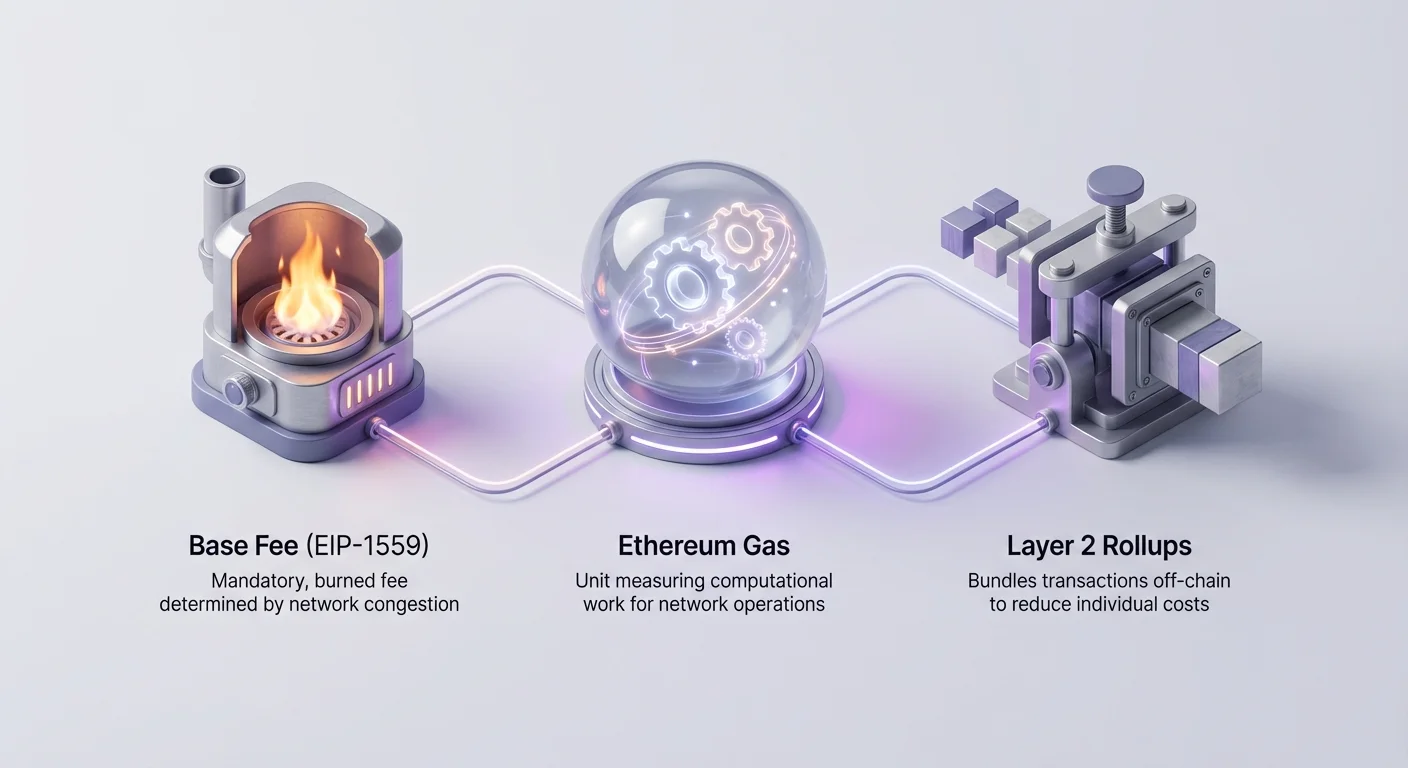
The concept of "gas" is fundamental to understanding how Ethereum fees are calculated and optimized. Gas is not a token you can hold in your wallet. Instead, it is a unit of measurement used to quantify the computational work required for a specific task. Different types of transactions require different amounts of gas depending on their complexity.
For instance, a standard transfer of ETH from one wallet to another is one of the simplest operations possible. This action consistently consumes 21,000 units of gas. However, interacting with a decentralized application or executing a complex smart contract requires significantly more computational power. Therefore, these actions consume higher amounts of gas units. The total fee a user pays is derived from the amount of gas used multiplied by the price per unit of gas.
Pricing Computation in Gwei
The price of gas is denominated in a fractional unit of Ether called "gwei." One gwei equals 0.000000001 ETH. Because the amounts of ETH used for fees are often very small, using gwei allows for more readable and manageable numbers when discussing transaction costs. When the network is congested, the demand for block space increases. This drives up the price of gas in gwei, making transactions more expensive.
Users effectively bid for space in the next block. During periods of high demand, such as a popular NFT mint or a market crash where users are rushing to sell, the cost per unit of gas can skyrocket. Conversely, during quiet periods, the price drops significantly. Understanding this dynamic is the first step in optimizing the costs associated with using the Ethereum network.
The Impact of Network Congestion
Network capacity is limited. The Ethereum blockchain can only process a certain amount of data in each block, which is mined approximately every 12 to 15 seconds. When more users want to transact than there is space available, a backlog occurs. This creates a competitive environment where users must pay higher fees to ensure their transactions are processed promptly.
Those who are unwilling or unable to pay the prevailing market rate may find their transactions stuck in a pending state for hours or even days. This congestion issue has been a primary driver for the development of scaling solutions. These innovations aim to increase the number of transactions the network can handle without exponentially increasing the cost for end users.
Fee Market Dynamics and EIP-1559
In August 2021, the Ethereum network underwent a significant upgrade known as the London hard fork, which included Ethereum Improvement Proposal 1559 (EIP-1559). This proposal fundamentally overhauled the way transaction fees are calculated and paid. Prior to this update, the fee market operated on a "first-price auction" model. Users simply attached a fee to their transaction, and miners selected the transactions with the highest fees. This system often led to users overpaying significantly due to a lack of clarity on the optimal price.
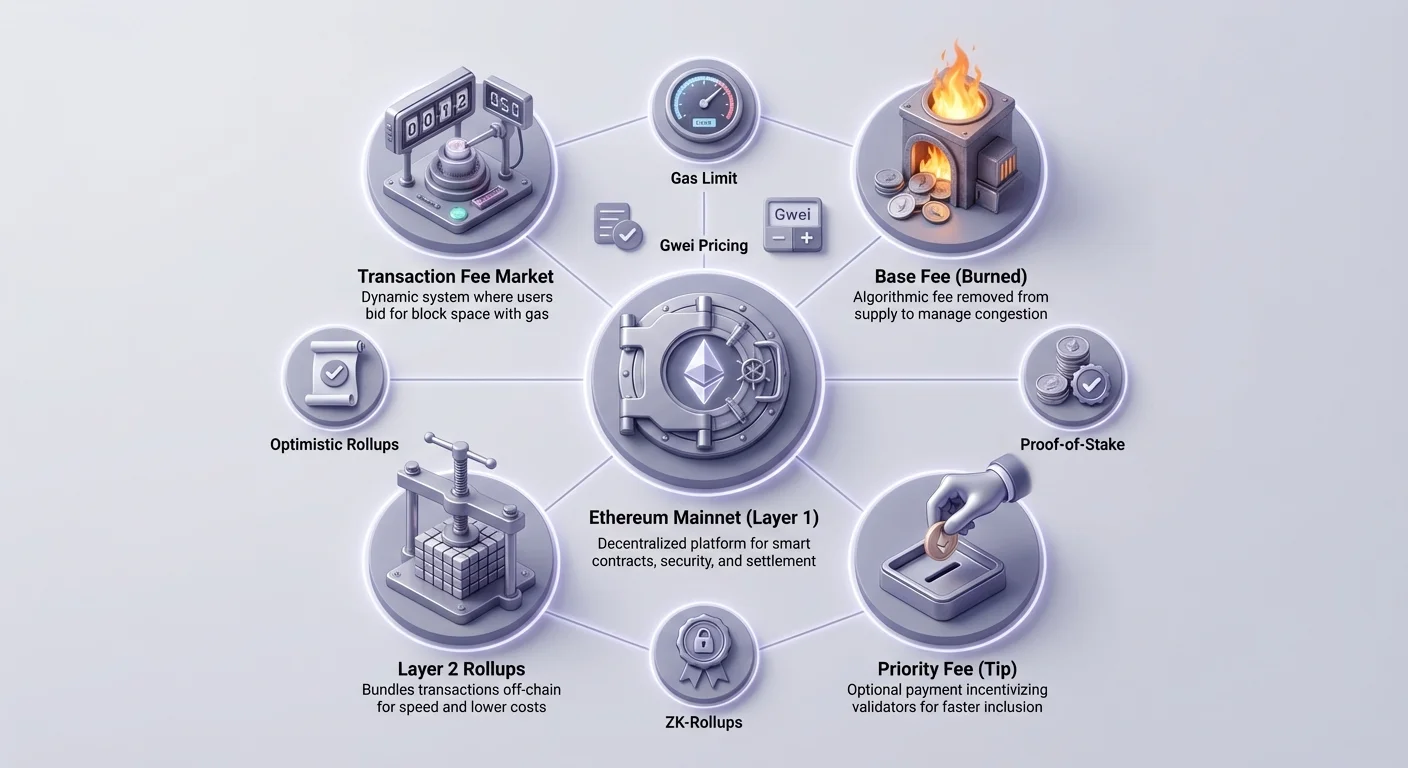
EIP-1559 introduced a dual-fee structure that makes costs more predictable. The total fee is now composed of two distinct parts: the base fee and the priority fee. This split has important implications for both the user experience and the economic policy of the Ethereum network.
The Base Fee Mechanism
The base fee is a mandatory charge required for a transaction to be included in a block. This fee is determined algorithmically by the protocol based on the congestion level of the previous block. If the previous block was full, the base fee increases for the next block. If it was less than half full, the base fee decreases. This automated adjustment provides a predictable market rate for gas, removing much of the guesswork for users.
Crucially, the base fee is not paid to the validators. Instead, it is "burned," meaning it is permanently removed from the circulating supply of ETH. This burning mechanism ties the usage of the network directly to the scarcity of the asset. As network activity increases, more ETH is destroyed. This constant removal of tokens from circulation acts as a counterweight to the issuance of new ETH, influencing the overall inflation rate of the currency.
The Priority Fee
The second component of the transaction cost is the priority fee, often referred to as a "tip." This is an optional fee paid directly to the validators to incentivize them to prioritize a specific transaction. While the base fee guarantees that a transaction is valid for inclusion, the tip encourages validators to include it in the block sooner rather than later.
During times of normal network activity, a small tip is usually sufficient to get a transaction processed quickly. However, during moments of extreme congestion, users may increase their priority fee to jump ahead of others in the queue. The formula for calculating the total transaction cost is the gas limit multiplied by the sum of the base fee and the priority fee.
| Fee Component | Recipient | Purpose |
|---|---|---|
| Base Fee | Burned (Destroyed) | Manages network congestion |
| Priority Fee | Validator | Incentivizes faster processing |
| Gas Limit | N/A | Caps computational effort |
Layer 2 Scaling and Rollup Solutions
As the popularity of Ethereum grew, the limitations of the main network, often referred to as Layer 1, became apparent. The limited throughput led to high fees that priced out many everyday users. To address this, developers created Layer 2 scaling solutions. These technologies operate on top of the Ethereum blockchain, handling transactions off the main chain while still deriving security from it.
Layer 2 solutions aim to increase transaction speed and throughput while drastically reducing costs. They achieve this by processing transactions separately and then reporting the results back to the main Ethereum network. This approach reduces the burden on Layer 1, allowing it to focus on security and decentralization while Layer 2 handles the volume.
How Rollups Function
Rollups are currently the most prominent form of Layer 2 scaling. They work by "rolling up" or bundling hundreds or thousands of transactions into a single batch. This batch is processed off-chain, and only the compressed data or a proof of validity is submitted to the Ethereum mainnet.
By splitting the transaction fee associated with the Layer 1 submission across hundreds of users in the batch, the individual cost per user is reduced significantly. There are different types of rollups, such as Optimistic Rollups and Zero-Knowledge (ZK) Rollups, each with unique technical approaches to validation. However, they share the common goal of compressing data to save space and gas.
Security and Finality
One of the key advantages of Layer 2 rollups is that they inherit the security properties of the main Ethereum blockchain. Unlike completely separate blockchains, which must bootstrap their own validator sets and security models, rollups rely on Ethereum for data availability and settlement.
This means that once a batch of transactions is settled on Layer 1, it is as secure as any standard Ethereum transaction. Users can benefit from the low fees and high speed of the Layer 2 network without sacrificing the censorship resistance and immutability provided by the core Ethereum protocol. This creates a robust ecosystem where high-frequency, low-cost transactions can occur safely.
Token Standards and Interoperability
To ensure that applications and wallets can interact seamlessly, the Ethereum community developed technical standards for tokens. The most widely adopted of these is the ERC-20 standard. This standard defines a common list of rules that Ethereum tokens must adhere to, allowing developers to build applications that can predict how a token will behave.
ERC-20 tokens are "fungible," meaning each token is identical to another of the same type. This is similar to how one dollar bill is interchangeable with another. This interchangeability makes ERC-20 tokens ideal for currencies, voting rights, and staking tokens. The widespread adoption of this standard has been instrumental in the growth of the decentralized finance ecosystem.
The Role of Wrapped Ether (WETH)
Interestingly, Ether (ETH) itself was created before the ERC-20 standard was established. As a result, native ETH does not conform to the rules set out by the ERC-20 standard. This creates a technical mismatch when trying to use ETH in decentralized applications that are built to handle ERC-20 tokens.
To solve this, the community introduced Wrapped Ether (WETH). WETH is an ERC-20 compatible version of Ether. It is created by depositing native ETH into a smart contract, which then mints an equivalent amount of WETH. This token can be used seamlessly in decentralized exchanges and lending protocols. The process is reversible, allowing users to unwrap their WETH back into ETH at any time. This ensures a one-to-one value parity between the two assets.
EVM Compatibility Across Chains
The success of Ethereum's architecture has led to the rise of EVM-compatible networks. The Ethereum Virtual Machine (EVM) is the software engine that executes smart contracts. Other blockchains, such as Avalanche, Polygon, and BNB Smart Chain, have adopted this same engine. This allows developers to deploy Ethereum-based applications onto these other networks with minimal changes.
For users, this means that the same ERC-20 tokens and tools used on Ethereum can often be used on these alternative chains. These networks often offer lower fees and faster transaction times, providing additional options for users looking to optimize their costs. By utilizing bridges, users can move assets between Ethereum and these EVM-compatible chains to take advantage of different economic environments.
Monetary Policy and Supply Dynamics
The economic model of Ethereum has evolved significantly since its inception. Unlike Bitcoin, which has a hard cap of 21 million coins, Ethereum does not have a fixed maximum supply. Instead, the supply is determined by the balance between the issuance of new ETH and the burning of existing ETH via transaction fees. This dynamic monetary policy allows the network to adapt to changing conditions.
The transition from Proof-of-Work to Proof-of-Stake, known as "The Merge," reduced the issuance of new ETH by approximately 90%. In the previous system, miners received substantial block rewards to cover their energy costs. Under Proof-of-Stake, validators have lower operating costs, allowing the network to maintain security with much lower issuance.
Inflation and Deflation
The interaction between reduced issuance and the fee-burning mechanism of EIP-1559 has profound implications for the supply of ETH. When network activity is high, the amount of ETH burned through base fees can exceed the amount of new ETH created. This results in periods of deflation, where the total circulating supply of ETH decreases over time.
This deflationary pressure correlates directly with network usage. The more applications are used, and the more transactions are processed, the scarcer ETH becomes. This creates a direct link between the utility of the network and the economic scarcity of the asset. Conversely, during periods of low activity, issuance may exceed the burn rate, leading to slight inflation. This self-regulating mechanism ensures the network remains economically sustainable.
Long-Term Economic Security
The shift to Proof-of-Stake also introduced staking as a core component of the network's security model. Users can lock up their ETH to become validators, earning rewards for processing transactions and proposing blocks. This creates a base demand for the asset, as it is required to participate in the consensus mechanism.
By aligning the incentives of validators with the health of the network, Ethereum aims to create a robust economic system. The combination of staking rewards, fee burning, and efficient scaling solutions creates a complex but balanced ecosystem. As the network continues to upgrade, these economic variables will likely continue to be fine-tuned through community governance.
Conclusion
The optimization of fees on the Ethereum network is a multi-faceted challenge that involves improvements at both the base layer and secondary layers. The introduction of EIP-1559 transformed the fee market into a more predictable and economically significant mechanism, directly tying network usage to asset scarcity through the burning of base fees. While this improved the user experience regarding fee predictability, the absolute cost of transactions on the mainnet remains a hurdle during peak times.
Layer 2 solutions, particularly rollups, have emerged as the primary method for scaling Ethereum without compromising its security. By batching transactions and processing them off-chain, these technologies offer a practical path toward lower fees and higher throughput. The widespread adoption of token standards like ERC-20 and the utility of Wrapped Ether further grease the wheels of this ecosystem, ensuring seamless interoperability across decentralized applications and compatible networks.
As Ethereum continues to evolve, the interplay between Layer 1 security, Layer 2 efficiency, and the underlying monetary policy will define its trajectory. The shift to Proof-of-Stake has already altered the supply dynamics, creating the potential for a deflationary asset. For users, understanding these mechanics—from gas pricing to rollup economics—is essential for navigating the network efficiently and cost-effectively.
Understanding gas mechanics and utilizing Layer 2 solutions allows you to transact efficiently while minimizing costs.