
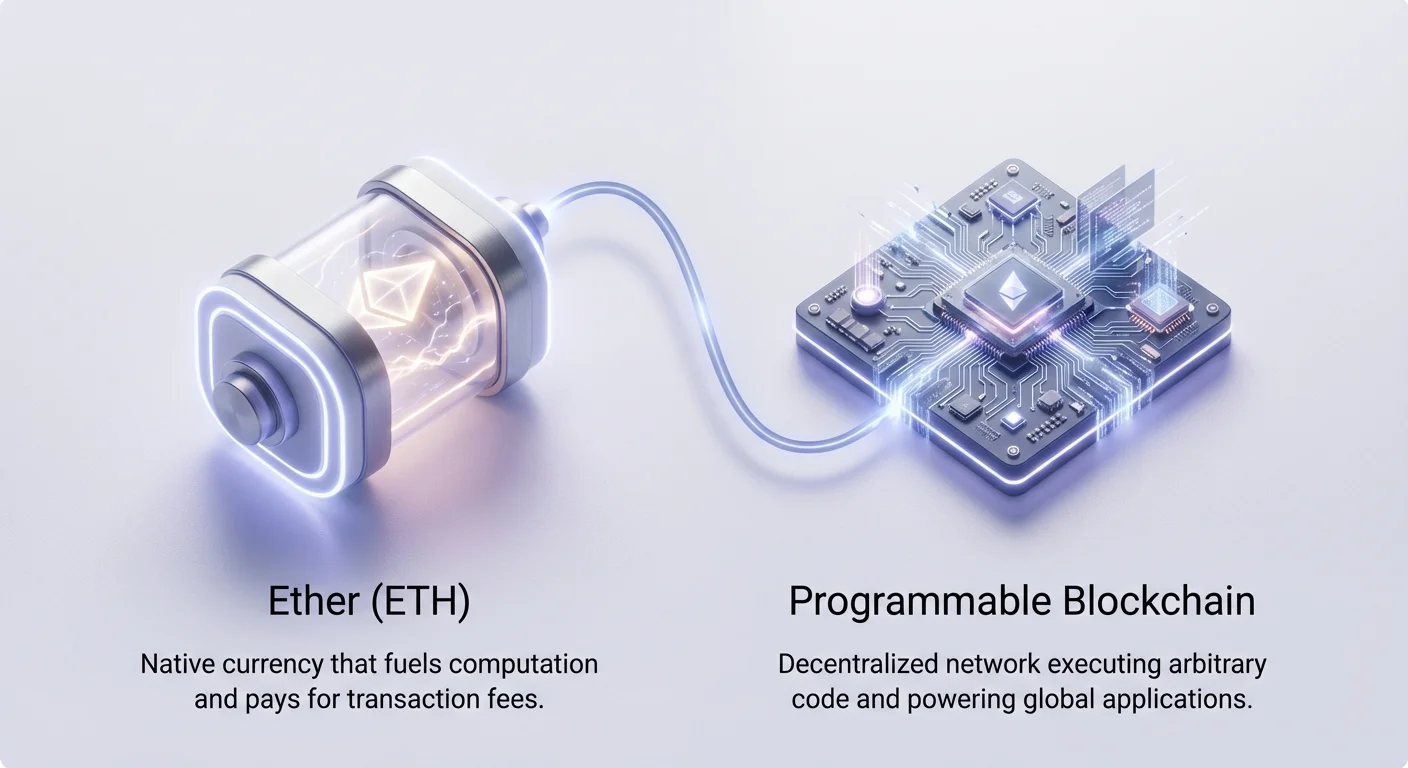
Ethereum is often described not merely as a cryptocurrency but as a world computer. Unlike Bitcoin, which was primarily designed as a digital currency and store of value, Ethereum was built to execute arbitrary code. This network functions as a shared, decentralized computing engine that is accessible to anyone with an internet connection. At the core of this system is Ether (ETH), the native currency that powers the network. ETH serves as the fuel for this global machine, paying for the computational resources required to process transactions and run applications.
Using ETH acts as a peer-to-peer digital currency that is permissionless. This means users do not rely on intermediaries like banks or payment processors to authorize funds. You are free to send and receive value to anyone, anywhere, at any time. These transactions occur pseudonymously, ensuring that a user's real-world identity is not directly tied to their digital wallet address. While it shares these currency characteristics with Bitcoin, the utility of ETH extends far beyond simple value transfer.
The primary function of ETH within the ecosystem is to pay for the resources of the Ethereum network. Every action taken on the blockchain, from a simple transfer of funds to the execution of a complex financial agreement, requires a fee paid in ETH. These fees compensate the network participants, known as validators, who ensure that transactions are processed correctly and according to the protocol rules. This mechanism prevents spam and allocates scarce network resources efficiently.
The Ethereum Virtual Machine and Smart Contracts
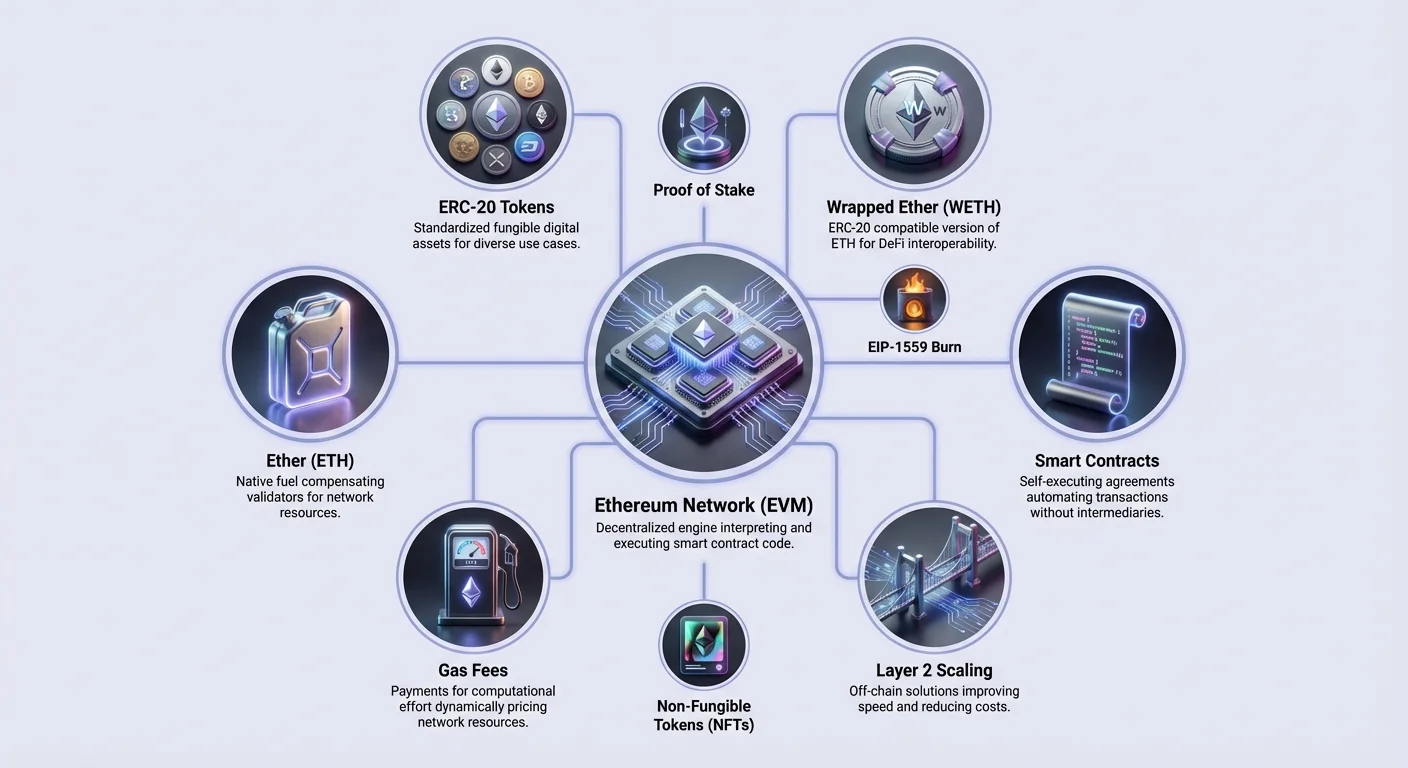
The infrastructure that enables Ethereum to function as a global computer is known as the Ethereum Virtual Machine, or EVM. This decentralized computing engine is the heart of the network. It interprets and executes the code written in Ethereum's programming languages, such as Solidity. The EVM ensures that every node in the network runs the same instructions, maintaining the integrity and consensus of the blockchain.
Global Computation Engine
The EVM acts as a runtime environment for smart contracts. When a developer writes a program for Ethereum, the EVM is responsible for executing that logic. Because the EVM is decentralized, no single entity controls the execution of code. Instead, the code runs across a distributed network of computers. ETH is used as "gas" to power these operations. This compensates the network for the computational work required. The flexibility of the EVM has allowed developers to build a vast array of applications that were previously impossible.
Self-Executing Agreements
Smart contracts are the software that runs on this network. These are self-executing contracts where the terms of the agreement between buyer and seller are directly written into lines of code. They run on the Ethereum blockchain and automatically enforce agreements when predefined conditions are met. This eliminates the need for intermediaries to facilitate or verify the exchange. For example, a smart contract could automatically release funds to a seller once a digital asset is transferred to a buyer.
Decentralized Applications
Smart contracts enable the creation of decentralized applications, commonly referred to as dApps. These applications operate on a peer-to-peer network rather than a single centralized server. dApps can serve a wide range of purposes, from financial tools and games to complex data management systems. Because they are built on Ethereum, they benefit from the network's security and decentralization. Users interact with these dApps using ETH to pay for transaction fees and execute contract functions.
The ERC-20 Token Standard
While ETH is the native currency, the Ethereum network supports the creation of distinct digital assets known as tokens. To ensure these tokens can interact seamlessly with exchanges, wallets, and other smart contracts, the community developed the ERC-20 standard. This technical standard defines a common list of rules that Ethereum tokens must adhere to.
Understanding Fungibility
ERC-20 tokens are "fungible" digital assets. Fungibility means that each token in a set is indistinguishable from every other token in that same set. This is similar to traditional currencies like the US Dollar. One specific dollar bill is effectively equal in value and utility to any other dollar bill. In the digital realm, one ERC-20 token from a specific project is identical to another token from the same project. This property makes them ideal for use as currencies, voting shares, or representations of other uniform assets.
Creating Digital Assets
The barrier to entry for creating ERC-20 tokens is relatively low. It involves deploying a smart contract to the Ethereum network that implements the standard's rules. These rules dictate how tokens can be transferred, how transactions are approved, and how the total supply is managed. For example, a developer can write a contract that creates a set of 10 million tokens. The contract logic determines how these tokens are distributed, such as minting them automatically when users send ETH to the contract address.
Diverse Use Cases
The standardization provided by ERC-20 has led to a vibrant ecosystem of tokens. These tokens can represent a wide variety of value. Some act as governance tokens, granting holders voting rights in decentralized protocols. Others function as stablecoins, which attempt to mirror the value of fiat currencies like the US Dollar. Tokens can also represent loyalty rewards or reputation points within a specific platform. The ability to trade these tokens on the Ethereum network endows them with liquidity and value beyond their original ecosystem.
Wrapped Ether (WETH) and Interoperability
A unique challenge exists within the Ethereum ecosystem regarding its native currency. ETH predates the ERC-20 standard. As a result, ETH itself does not conform to the rules set out for ERC-20 tokens. This creates friction when trying to use ETH in decentralized applications that are designed specifically to handle ERC-20 assets. To solve this, the community utilizes Wrapped Ether, or WETH.
The Technical Gap
Decentralized Finance (DeFi) platforms rely heavily on smart contracts to facilitate trading and lending. These contracts are typically essentially blueprints designed to handle ERC-20 tokens. Writing custom code to handle ETH separately from ERC-20 tokens would be inefficient and complex for developers. Since ETH is not ERC-20 compatible, it cannot be traded directly against other tokens in many decentralized exchange (DEX) pools without a workaround.
The Wrapping Process
WETH serves as this workaround. It is an ERC-20 token that represents Ether at a 1:1 ratio. The process of creating WETH is known as wrapping. Users deposit ETH into a specific smart contract, and the contract creates an equivalent amount of WETH and returns it to the user. This process is reversible. A user can deposit WETH back into the contract, which then destroys the WETH and returns the original ETH.
Facilitating DeFi
No single entity controls the WETH smart contract. It operates autonomously to ensure that every unit of WETH in circulation is backed by an equivalent amount of ETH. This makes WETH almost indistinguishable from ETH in terms of market price. By using WETH, users can interact with decentralized applications that require the ERC-20 standard. This interoperability is crucial for the smooth functioning of the DeFi ecosystem, allowing ETH to be used as easily as any other token on the network.
Analyzing Ethereum Gas and Fees
Transactions on Ethereum are not free. The concept of "gas" is used to measure the computational effort required to execute specific operations on the network. More complex transactions consume more gas, while simpler transfers consume less. This system ensures that the finite resources of the decentralized network are priced appropriately.
Measuring Computational Effort
Gas is a unit of measurement for work. Sending ETH from one wallet to another is one of the simplest actions and typically consumes 21,000 units of gas. Interacting with a smart contract or swapping tokens involves more complex code execution and therefore requires significantly more gas. The total fee a user pays is derived from the amount of gas used multiplied by the price of gas at that moment.
The Fee Structure
Following the implementation of EIP-1559 in August 2021, the fee structure consists of two parts: the base fee and the priority fee (or tip). The base fee is a mandatory charge set by the protocol that adjusts dynamically based on network demand. If the network is busy, the base fee rises. If it is quiet, the base fee falls. Crucially, this base fee is burned, meaning it is permanently removed from the total supply of ETH.
Calculating Total Costs
The priority fee is an optional tip added by the user to incentivize validators to include their transaction in the next block. The total fee is calculated as the gas units multiplied by the sum of the base fee and the tip. Gas prices are denominated in "gwei," where one gwei equals 0.000000001 ETH. During periods of high congestion, users may need to pay higher tips to get their transactions processed quickly. Wallets often allow users to customize these fees, offering options like "Eco," "Fast," or "Fastest" depending on the urgency of the transaction.
| Fee Component | Recipient | Function |
|---|---|---|
| Base Fee | Burned (Destroyed) | Manages network congestion |
| Priority Fee | Validator | Incentivizes transaction inclusion |
| Gas Units | Protocol Measure | Quantifies computational work |
Monetary Policy and Supply Dynamics
Unlike Bitcoin, which has a hard cap of 21 million coins, Ethereum does not have a fixed maximum supply. Its monetary policy is flexible and has evolved significantly over time through community governance and protocol upgrades. The supply of ETH is determined by two opposing forces: issuance (the creation of new ETH) and burning (the destruction of existing ETH).
Historical Issuance Changes
When Ethereum launched, the network used a Proof of Work (PoW) consensus mechanism similar to Bitcoin. Miners were rewarded with new ETH for validating blocks. Initially, the block reward was set at 5 ETH per block. As the network matured, this issuance rate was reduced through governance decisions. The reward dropped to 3 ETH in 2017 and then to 2 ETH in 2019. These reductions helped to lower the inflation rate of the asset over time.
The Impact of EIP-1559
A major shift in monetary policy occurred with the activation of EIP-1559. By introducing the fee-burning mechanism, this upgrade created a direct link between network usage and ETH supply. When the network is highly active, more base fees are burned. In periods of intense demand, the amount of ETH burned can exceed the amount of new ETH created. This dynamic allows the network to experience periods of deflation, where the total circulating supply decreases.
Proof of Stake Transition
The transition to Ethereum 2.0 and Proof of Stake (PoS) marked another turning point. This shift eliminated the need for energy-intensive mining and replaced miners with validators who stake ETH. The issuance of new ETH under PoS dropped by approximately 90% compared to the PoW era. This drastic reduction in new supply, combined with the burn mechanism from EIP-1559, has fundamentally altered the economic model of Ethereum. The asset is now potentially deflationary, depending on the level of activity on the network.
Non-Fungible Tokens and Digital Ownership
While ERC-20 tokens represent fungible assets, the Ethereum blockchain also supports Non-Fungible Tokens (NFTs). These unique digital assets represent ownership or proof of authenticity for specific items. Unlike cryptocurrencies or ERC-20 tokens, which can be exchanged on a one-to-one basis, each NFT has a distinct value. One NFT cannot simply be swapped for another in the same way one ETH can be swapped for another ETH.
Unique Value Propositions
NFTs can represent a wide range of tangible and intangible items. This includes digital art, music, virtual real estate, and collectibles. The Ethereum blockchain records the ownership history and attributes of each unique item. This transparency allows for the verification of authenticity and provenance, which is critical for digital collectibles. The smart contract functionality of Ethereum enables these assets to be bought, sold, and minted using ETH as the medium of exchange.
Transforming Digital Content
The rise of NFTs has highlighted Ethereum's role in pioneering new forms of digital ownership. Creators can monetize digital content directly without relying on centralized platforms to manage rights. The ability to program royalties into the smart contract means that artists can earn a percentage of future sales automatically. This innovation extends the utility of the Ethereum network beyond finance and into the realms of culture, art, and identity.
The Role of Layer 2 Scaling Solutions
As the popularity of Ethereum has grown, the network has faced challenges regarding capacity. High demand for block space leads to higher gas fees and slower transaction times. To address this, the ecosystem has developed Layer 2 scaling solutions. These technologies operate on top of the main Ethereum blockchain (Layer 1) to improve efficiency.
Off-Chain Processing
Layer 2 solutions, such as rollups, handle transactions off the main chain. They process and batch multiple transactions together before recording the final state on the main Ethereum blockchain. This method significantly reduces the amount of data that needs to be stored on Layer 1. By doing so, it increases the transaction throughput of the overall network while retaining the security guarantees of Ethereum.
Improving Accessibility
These scaling solutions make transactions faster and cheaper for users. They are essential for making Ethereum accessible for everyday applications that require frequent, low-cost interactions. ETH remains integral to these operations, as it is often required for fees or collateral within Layer 2 protocols. The continued development of these solutions is a key part of Ethereum's roadmap to support global adoption.
Conclusion
The Ethereum ecosystem has evolved into a complex and multifaceted digital economy. From its origins as a platform for decentralized computation, it has grown to support a diverse range of assets and applications. The interplay between the native currency ETH, the EVM, and token standards like ERC-20 provides the foundation for this growth. Mechanisms like WETH bridge the gap between legacy protocols and modern standards, ensuring liquidity and interoperability across the network.
Furthermore, the economic model of Ethereum continues to adapt. The shift to Proof of Stake and the introduction of fee burning have transformed ETH into an asset with dynamic supply characteristics. As the network scales through Layer 2 solutions and continues to support innovations like NFTs and DeFi, the utility of the underlying token remains central. The governance processes driven by the community ensure that the protocol remains responsive to the needs of its users and the broader technological landscape.
Ethereum is a programmable blockchain where ETH powers a growing economy of digital money, applications, and unique assets.