
The fundamental architecture of Bitcoin and similar decentralized networks relies on a specific data organization method known as the blockchain. At its core, this technology is a public ledger that records every transaction ever made in the network’s history. However, unlike a continuous scroll of data, this ledger is divided into distinct segments called blocks.
These blocks function like individual pages in a record book. Each page contains a specific list of confirmed transactions and a set of metadata that identifies the page itself. When a page is filled and validated, it is cryptographically sealed and bound to the previous page. This creates an unbroken chronological chain.
Understanding the internal structure of a block is essential for grasping how cryptocurrencies maintain security without a central authority. The block is not merely a container for data. It is a complex cryptographic puzzle piece that ensures the integrity of the entire network.
The organization of data within a block dictates how transactions are processed, how miners reach consensus, and how the network prevents fraud. By examining the components of a block, we can see how digital scarcity and trustless verification are technically achieved.
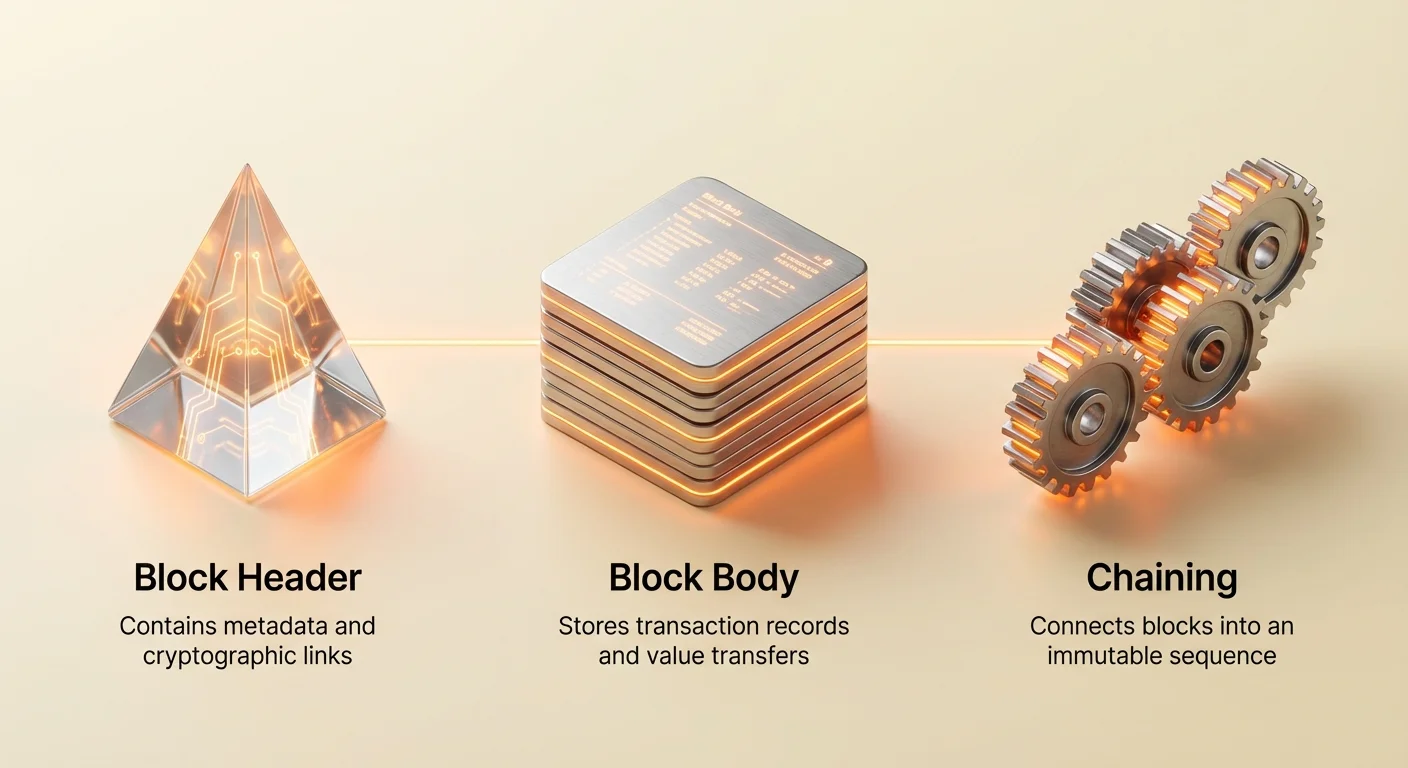
The Two Primary Components of a Block
A Bitcoin block is primarily composed of two distinct sections. These are the block header and the block body. The relationship between these two parts is crucial for the efficiency and security of the network.
The block body is the section that contains the actual transaction data. This is the ledger information that users care about most, such as who sent funds to whom and how much was transferred. It is typically the largest part of the block in terms of data size.
The block header, in contrast, is much smaller. It is a fixed-size set of metadata that summarizes the information contained in the body. The header is the part of the block that is actually "mined" during the Proof of Work process.
This separation allows for efficient verification. Nodes on the network can verify the integrity of the chain by checking the headers without needing to download the entire history of transaction data immediately. This structure enables different types of participation in the network.
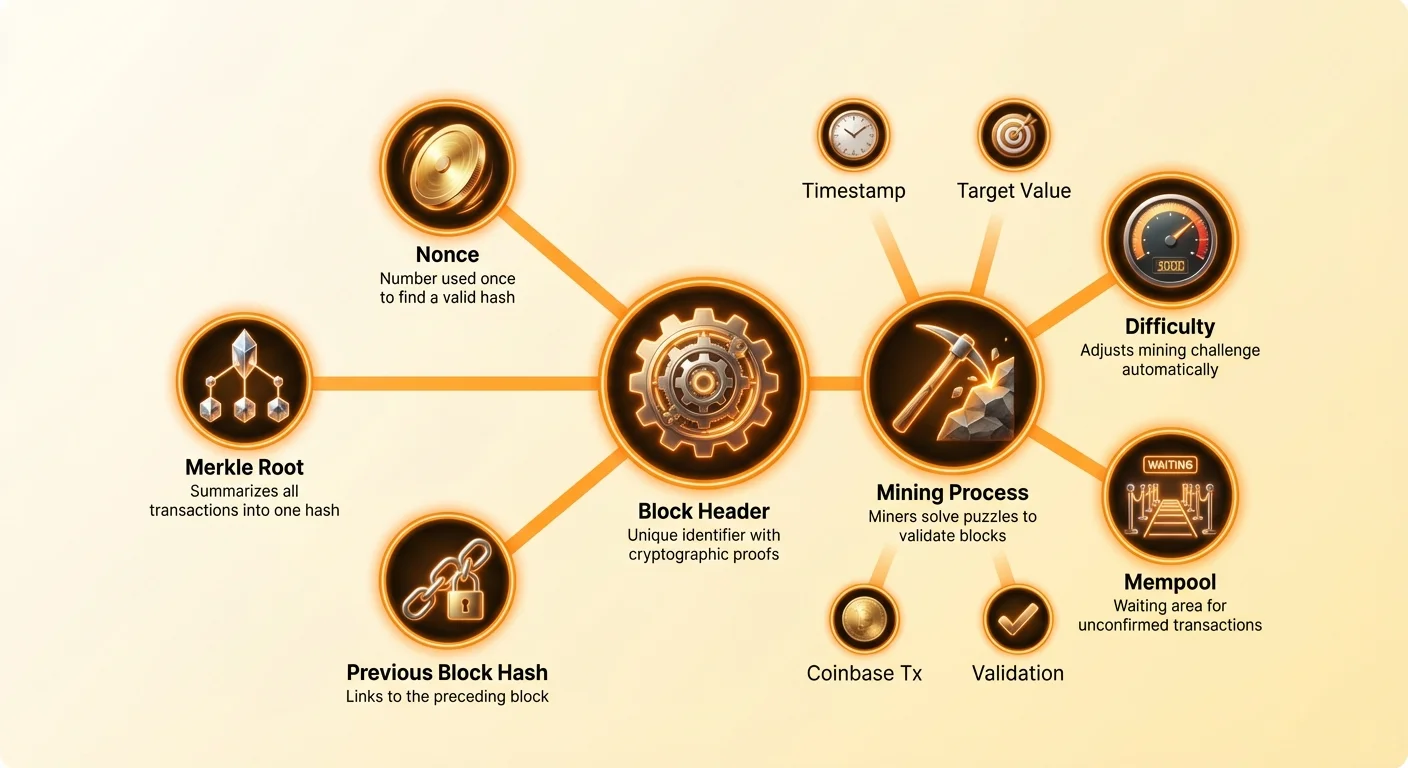
The Block Header: The Digital Fingerprint
The block header acts as the unique identifier for a block. It contains several specific fields that link the block to the rest of the chain and prove that the necessary work has been done to secure it.
One of the most critical components of the header is the reference to the previous block. This is a cryptographic hash of the preceding block’s header. This reference is what physically links the blocks together in a specific order.
If a malicious actor attempts to change a transaction in a block from five years ago, that change would alter the block’s hash. Because the next block includes that hash in its own header, the subsequent block would also change.
This domino effect would continue all the way to the present day tip of the blockchain. This mechanism ensures that history cannot be rewritten without redoing the immense amount of energy expenditure required to mine all subsequent blocks.
Another vital field in the header is the timestamp. This records the approximate time the block was created. The network uses this data to adjust the difficulty of mining to ensure blocks are produced consistently.
The Merkle Tree and Root
Within the block header lies a piece of data known as the Merkle root. This 32-byte hash is the cryptographic summary of every single transaction contained in the block body. It serves as a fingerprint for the transaction set.
The Merkle root is constructed using a data structure called a Merkle tree. The process begins by taking the hash of each individual transaction in the block. These hashes are then paired and hashed together repeatedly.
This pairing and hashing process continues upward until only a single hash remains. This final hash is the Merkle root. If even a single bit of data in one transaction changes, the change propagates up the tree and completely alters the Merkle root.
This structure is incredibly efficient for verification. It allows a node to verify that a specific transaction is included in a block without downloading every other transaction. The node only needs the specific transaction hash and the "branches" of the tree required to reconstruct the root.
The Nonce and the Mining Puzzle
The block header also contains a field called the nonce. The term stands for "number used once." This field is the variable that miners change repeatedly during the mining process.
In the Proof of Work system, miners take the block header data and run it through a hashing algorithm known as SHA-256. The goal is to produce a resulting hash that is lower than a specific target value set by the network.
Since the other data in the header is mostly fixed for that specific moment, miners must change the nonce to get a different hash result. This is a process of trial and error that requires significant computational power.
Miners may iterate through billions or trillions of nonce values per second. They are effectively buying lottery tickets by expending energy. When a miner finds a nonce that results in a valid hash, the block is considered solved.
This valid hash serves as the proof that work was performed. It acts as a barrier to entry for anyone trying to spam the network or rewrite history. The nonce makes the creation of a block costly and difficult.
Difficulty and Target Adjustments
The target value that miners must hit is determined by the network’s difficulty setting. This setting is not static. It adjusts automatically every 2,016 blocks, which occurs roughly every two weeks.
The goal of this adjustment is to keep the average time between blocks at approximately ten minutes. If more miners join the network and total computing power increases, blocks might be found too quickly.
In response, the network increases the difficulty. This makes the target hash smaller and harder to find. Conversely, if miners leave the network, the difficulty decreases to ensure the network does not stall.
This self-regulating mechanism ensures the predictable supply of new coins. It prevents the network from being overwhelmed by rapid block production or freezing due to a lack of miner participation.
The Transaction Data Payload
The body of the block consists of the transactions themselves. In the Bitcoin network, these are not simple debit and credit adjustments to account balances. Instead, they rely on a model involving inputs and outputs.
Each transaction references previous incoming funds, known as inputs, and creates new destinations for those funds, known as outputs. This is often referred to as the Unspent Transaction Output, or UTXO, model.
When a user sends bitcoin, they are actually unlocking specific chunks of digital currency that were sent to them in the past. They then relock these chunks to the recipient’s address.
This chain of ownership is traced back through the history of blocks. A transaction is only valid if the inputs exist and have not been spent previously. This validation prevents the double-spend problem.
Inputs, Outputs, and Scripts
Bitcoin uses a scripting language to define the conditions under which funds can be spent. This language is simple and stack-based, designed deliberately without complex loops to ensure security and prevent infinite processing loops.
When a transaction is created, it includes a locking script for each output. This script essentially places a digital padlock on the funds. The most common requirement is that the spender must prove ownership of a specific private key.
To spend these funds later, the owner must provide an unlocking script. This usually involves a digital signature generated by their private key and their corresponding public key.
The network nodes run these scripts to validate the transaction. If the unlocking script successfully satisfies the conditions of the locking script, the funds are moved. This programmable nature allows for features like multi-signature wallets.
The Coinbase Transaction
The very first transaction in every block is unique. It is called the coinbase transaction. Unlike standard transactions, it does not consume existing UTXOs from previous blocks.
Instead, the coinbase transaction generates new bitcoin from nothing. This is the mechanism by which new currency enters circulation. It is the reward paid to the miner who successfully solved the block.
The amount of new bitcoin created in this transaction is determined by the network’s halving schedule. Initially, this reward was 50 bitcoins per block. It cuts in half every 210,000 blocks, or roughly every four years.
In addition to the block subsidy, the coinbase transaction also collects the transaction fees from all other transactions in the block. This total sum serves as the economic incentive for miners to secure the network.
| Component | Function | Importance |
|---|---|---|
| Header | Metadata container | Links blocks and enables mining |
| Body | Transaction list | Records value transfer history |
| Coinbase Tx | Reward payout | Mints new coins for miners |
The Mempool: The Waiting Room
Before transactions are organized into a block, they reside in a holding area known as the mempool, or memory pool. This is a collection of unconfirmed transactions that have been broadcast to the network but not yet mined.
The mempool is not a single, centralized queue. Each node on the network maintains its own version of the mempool. When a user initiates a transaction, it propagates across the network from node to node.
Miners view the mempool as a menu of potential transactions to include in their next block. Because block space is limited to a specific size (historically 1MB for Bitcoin), miners cannot include every waiting transaction immediately.
This limitation creates a fee market. Users attach a fee to their transactions to incentivize miners. Miners, acting rationally to maximize profit, generally select the transactions with the highest fees per byte of data.
Network Congestion and Fee Dynamics
When the network is busy, the mempool fills up. Competition for block space intensifies. Users who need their transactions confirmed quickly must offer higher fees to outbid others.
Conversely, when the network is quiet, fees drop. Transactions with lower fees may sit in the mempool for longer periods, waiting for a lull in traffic.
If a fee is set too low, a transaction might remain in the mempool for days. Eventually, if it is never picked up, it may be dropped from the mempool entirely. The funds effectively return to the sender's control as the transaction was never finalized.
This dynamic ensures that scarce block space is allocated efficiently to those who value it most. It also prevents spam attacks, as flooding the network with transactions becomes prohibitively expensive.
Validation by Nodes
Once a miner solves a block, they broadcast it to the rest of the network. However, the other participants do not simply accept this block on blind faith. Independent validation is a cornerstone of the system.
Thousands of nodes across the globe receive the new block. They perform a series of rigorous checks to ensure the block follows every rule of the protocol.
Nodes verify that the block hash is correct and meets the difficulty target. They check that the Merkle root matches the transactions in the body. They ensure that every transaction in the block is valid and that no inputs have been double-spent.
If a block violates even a single rule, honest nodes will reject it. They will not propagate it to their peers. The miner who expended energy to create that invalid block loses their reward.
Types of Nodes
There are different types of nodes that participate in this validation process. Full nodes maintain a complete copy of the blockchain. They enforce all rules of the consensus protocol independently.
Full nodes are the ultimate arbiters of the network. They do not trust miners or other nodes; they verify everything themselves. This redundancy ensures that no central entity can force invalid changes onto the network.
Lightweight nodes, or SPV (Simplified Payment Verification) clients, operate differently. They download only the block headers. They rely on full nodes to verify the specific transaction data.
While lightweight nodes are useful for mobile devices with limited storage, they do not contribute to the security of the network in the same way full nodes do. They trust the longest chain of headers they see.
Chaining and Immutability
The security of the block structure comes from the interdependence of its parts. Because each block header includes the hash of the previous block, a chain is formed.
This chaining mechanism creates immutability. To modify a record, an attacker would have to modify the block containing the transaction. This changes the block’s hash.
The attacker would then have to re-mine that block to find a new valid nonce. But because the hash changed, the link to the next block is broken. The attacker must essentially re-mine that block as well.
To succeed, the attacker must redo the Proof of Work for every block from the point of modification up to the current tip of the chain. They must do this faster than the honest network is extending the legitimate chain.
Confirmations and Finality
The deeper a block is buried in the chain, the more secure it becomes. This concept is measured in confirmations. When a block is first mined, the transactions inside have one confirmation.
When the next block is added on top, those transactions have two confirmations. With each additional block, the computational effort required to reverse the transaction increases exponentially.
For Bitcoin, six confirmations is generally considered the standard for absolute finality. This represents about one hour of accumulated Proof of Work. At this stage, a reversal is considered statistically impossible for any realistic attacker.
This probabilistic finality is a unique feature of blockchain systems. It contrasts with instant settlement in some centralized systems but offers superior security against systemic corruption or reversal.
Scaling Solutions and Block Structure
The strict size limit of blocks has led to scalability challenges. With limited space, the network can only process a certain number of transactions per second. This has driven the development of Layer 2 solutions.
The Lightning Network, for example, allows users to transact off-chain. These transactions are not recorded in a block immediately. Instead, users open a payment channel with a single on-chain transaction.
They can then exchange thousands of payments instantly between themselves. Only the final net result is recorded in a block when the channel is closed. This effectively expands the capacity of the network without increasing block size.
Sidechains act as separate blockchains that run parallel to the main chain. They can have different block structures or faster block times. Assets can be moved between the main chain and sidechains, alleviating pressure on the primary blocks.
The Role of Transaction Accelerators
Sometimes, users may underestimate the required fee for a transaction. This results in the transaction getting stuck in the mempool during periods of high congestion.
Transaction accelerators are services designed to address this. They are often run by mining pools. Users can pay a fee directly to the accelerator service to prioritize their specific transaction ID.
The mining pool then manually prioritizes that transaction in their next block attempt, regardless of the network fee attached to it. This bypasses the standard fee market mechanics.
While useful for emergencies, reliance on accelerators highlights the importance of proper fee estimation. Most modern wallets include algorithms to estimate the necessary fee for timely inclusion in a block.
Block Rewards and the Economy
The block structure is also the engine of the cryptocurrency's monetary policy. The issuance of new coins is strictly controlled by the software code governing the block subsidy.
The halving events, occurring every four years, ensure that the currency is deflationary. As the reward for finding a block decreases, the supply of new coins slows down.
This creates a scarcity model similar to precious metals like gold. The predictable nature of the block reward stands in contrast to fiat currencies, where central banks can increase supply at will.
Eventually, the block subsidy will drop to zero. This is expected to happen around the year 2140. At that point, miners will be compensated entirely by transaction fees collected from the block body.
Energy Consumption and Security
The process of building blocks through Proof of Work requires significant energy. This energy consumption is often a point of criticism. However, it is also the source of the network's security.
The energy expenditure creates a physical cost to attack the network. It bridges the digital world with the physical world. To control the ledger, one must control physical resources.
This "unforgeable costliness" ensures that the ledger represents a consensus based on objective work. It removes the need for political trust or subjective governance in the validation of the block structure.
As the network matures, the mix of energy sources powering this process is shifting. Miners seek the cheapest electricity, which often leads them to stranded renewable energy sources that would otherwise be wasted.
Future Developments in Block Technology
The structure of blocks continues to evolve through soft fork upgrades. Recent improvements like Taproot have changed how data is stored within the block script.
Taproot allows for more complex transactions and smart contracts to look like standard transactions on the blockchain. This improves privacy and efficiency. It allows more data to be compressed into the limited block space.
Innovations like Schnorr signatures allow multiple digital signatures to be aggregated into one. This saves space in the block body, effectively allowing more transactions to fit into the same 1MB limit.
These upgrades demonstrate that while the fundamental block structure remains stable, the efficiency of how data is organized within it can be improved. The network adapts to handle more volume while maintaining decentralized verification.
Decentralization and the Block Size Debate
The size of the block has been a subject of intense debate in the crypto community. Keeping blocks small ensures that the data burden on nodes remains low.
If blocks were massive, only large data centers could afford the storage and bandwidth to run a full node. This would centralize the network, as fewer individuals could verify the ledger.
By restricting block size, the network prioritizes decentralization over raw throughput. It ensures that an average user with a standard computer can still participate in validation.
This philosophy protects the censorship-resistant nature of the system. If validation becomes too expensive, the network becomes susceptible to regulation and control by the few who can afford to run it.
Conclusion
The structure of a block is a marvel of computer science that solves the double-spend problem without a central intermediary. By combining a header containing cryptographic proofs with a body containing transaction records, the system creates a tamper-evident history. The interaction between the Merkle tree, the nonce, and the previous block hash ensures that every record is secure and verifiable.
As the network grows, the mechanisms surrounding block creation—such as the mempool, fee markets, and mining difficulty—ensure the system remains stable and self-regulating. Whether through Layer 2 scaling or efficiency upgrades, the fundamental chain of blocks remains the bedrock of the decentralized economy. It transforms energy and mathematics into a system of trustless value transfer.
The block structure transforms raw data into immutable history, securing digital value through cryptography and consensus.