
When you enter the world of self-sovereign finance, your 12- or 24-word seed phrase becomes the single most critical asset you possess. It is often called your "master key," the ultimate backup that can restore your funds on any compatible wallet, anywhere in the world.
But few users truly understand the sophisticated cryptographic mechanics that underpin this simple string of words. Your seed phrase is not merely a random set of common nouns; it is the human-readable representation of immense cryptographic randomness, carefully structured to allow secure and efficient management of potentially hundreds of different private keys and assets.
This guide moves beyond the basic definition of a wallet and delves into the 'how': How is true cryptographic randomness generated? How do numbers become words? And most critically, how does one short phrase control all your separate crypto addresses without having to back up each one individually? By understanding the processes standardized by Bitcoin Improvement Proposals (BIPs), you gain the knowledge necessary not just to use a wallet, but to implement security and ownership with confidence.
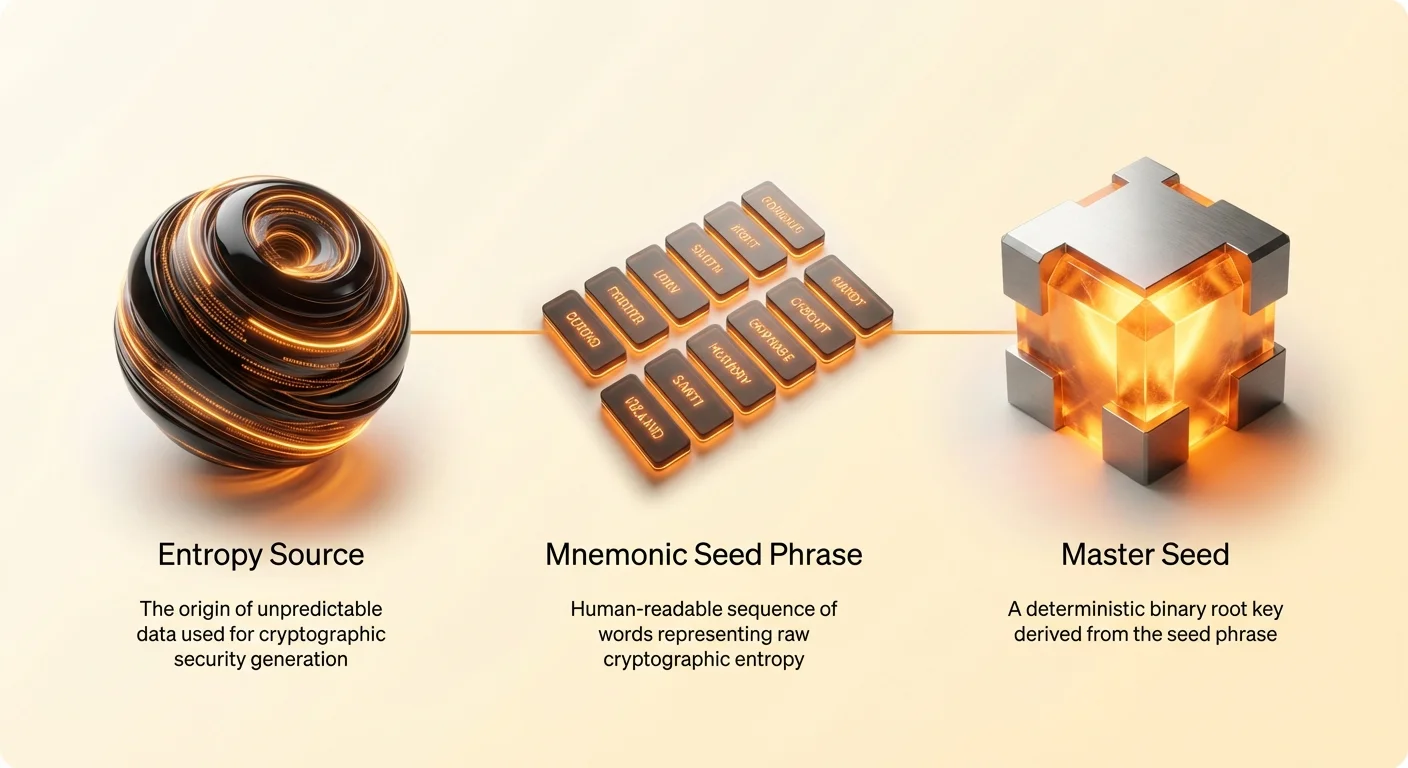
The Foundation of Security: Entropy and Randomness
The entire security framework of cryptocurrency rests on one simple principle: true randomness. If the numbers used to generate your private keys were predictable, anyone could guess them. Cryptography relies on generating numbers so large and random that guessing them is statistically impossible. This concept is called entropy.
What is Entropy in Crypto?
Entropy, in the context of cryptography, is a measure of the unpredictability or randomness present in a system. When you create a new wallet, the software or hardware device must gather enough unpredictable data to ensure the resulting seed phrase is unique and unrecreatable by chance.
Think of entropy as the quality of the "ingredients" used to bake your security key. High-quality entropy means the ingredients are diverse and mixed thoroughly, making the final product impossible to reverse-engineer. Sources of entropy can include environmental factors like minute variations in computer hardware timing, mouse movements, keyboard presses, or even thermal noise captured by a device’s internal sensors.
If a random number generator (RNG) is flawed or predictable—meaning it has low entropy—an attacker could theoretically narrow down the pool of possible seed phrases, putting your funds at risk. This is why trusted hardware wallets go to great lengths to gather robust, hardware-based entropy.
Measuring Security: The Bit Count
The strength of your seed phrase is quantified by the number of bits of entropy used to generate it. The industry standard provides two main lengths:
- 12-Word Seed: This corresponds to 128 bits of entropy. The total number of possible combinations is . To put this in perspective, is a number far larger than the estimated number of atoms in the known universe. For practical purposes, 128 bits of entropy are considered secure against brute-force attacks.
- 24-Word Seed: This corresponds to 256 bits of entropy. This offers an astronomical increase in security, doubling the complexity. While 12 words are highly secure, 24 words provide the maximum standard level of defense available today.
The more bits of entropy used, the larger the search space for an attacker, making the funds exponentially safer.
Sources of Entropy: Software vs. Hardware
The method by which entropy is collected is a major differentiator between wallet types:
- Software Entropy (Software Wallets): A software wallet (like an app on your phone) relies on the operating system’s (OS) pseudo-random number generator (PRNG). This PRNG pools entropy from various sources like network latency, hard drive activity, or process IDs. While generally adequate, this method is susceptible to vulnerabilities if the OS itself is compromised or if the entropy sources are insufficient.
- Hardware Entropy (Hardware Wallets): Specialized hardware wallets contain dedicated True Random Number Generators (TRNGs). These chips measure physical, natural phenomena—such as thermal noise or quantum fluctuations—which are inherently unpredictable. This provides cryptographically superior entropy that never touches the potentially compromised general operating system, offering a crucial layer of security for the initial key generation.
Introducing BIP39: The Language of the Seed Phrase
A private key is fundamentally a massive number. Writing down this 256-bit binary string (a sequence of 0s and 1s) is extremely error-prone. Imagine trying to transcribe a 78-digit hexadecimal number perfectly.
To solve this problem and make the backup process manageable for humans, BIP39 (Bitcoin Improvement Proposal 39) was created. BIP39 dictates the process for converting a high-entropy random number into a sequence of easy-to-read words—the mnemonic seed phrase.
Why We Use Words, Not Numbers
BIP39 maps the entropy data onto a pre-defined list of 2,048 English words (or other languages, provided the wordlist is standard).
The process works like this:
- The raw entropy (128 or 256 bits) is generated.
- The entropy is divided into chunks.
- Each chunk is mapped to a specific word on the BIP39 wordlist.
For example, if you have a 12-word seed, each word represents 11 bits of data (). This is far more user-friendly than dealing with the raw binary data, dramatically reducing the chance of human transcription errors.
The Role of the Checksum
Not all combinations of 12 words are valid BIP39 seed phrases. If you accidentally misspell one word, or choose an entirely invalid 12th word, the wallet software needs a mechanism to detect that error before you try to restore your funds. This is the purpose of the checksum.
When the raw entropy is generated, a small fraction of it (a few bits) is used to calculate a checksum. This checksum is appended to the data before the words are mapped. This final piece of data determines the last word in the mnemonic phrase.
How the Checksum Ensures Integrity:
- Generation: If your seed is 12 words long, the first 11 words are derived from the 128 bits of entropy, and the 12th word is derived from the checksum calculation.
- Validation: When you try to restore your wallet, the software validates the first 11 words, recalculates the checksum based on that data, and checks if it matches the 12th word you provided.
- Error Detection: If you enter
apple...instead ofapply..., the checksum calculated from the first 11 words will not match the 12th word you entered, and the wallet will immediately tell you the seed phrase is invalid. This prevents the disastrous scenario of thinking you have a valid backup when you do not.
From Seed Phrase to Master Seed
The seed phrase itself is still not the final key. It must first be processed into a highly secure, deterministic binary output called the Master Seed.
This conversion step uses a cryptographic function known as PBKDF2 (Password-Based Key Derivation Function 2). This function takes the seed phrase and performs intense mathematical hashing (often tens of thousands of rounds of computation) to produce the highly complex and large Master Seed.
The Master Seed is the single source of truth for your entire crypto estate. It is the cryptographic root from which every single private key and public address will be derived.
Hierarchical Deterministic (HD) Wallets and BIP32
If the Master Seed is the single source of truth, how does one seed phrase control multiple different assets, like separate Bitcoin addresses, Ethereum addresses, and perhaps even testnet keys, without ever needing separate backups?
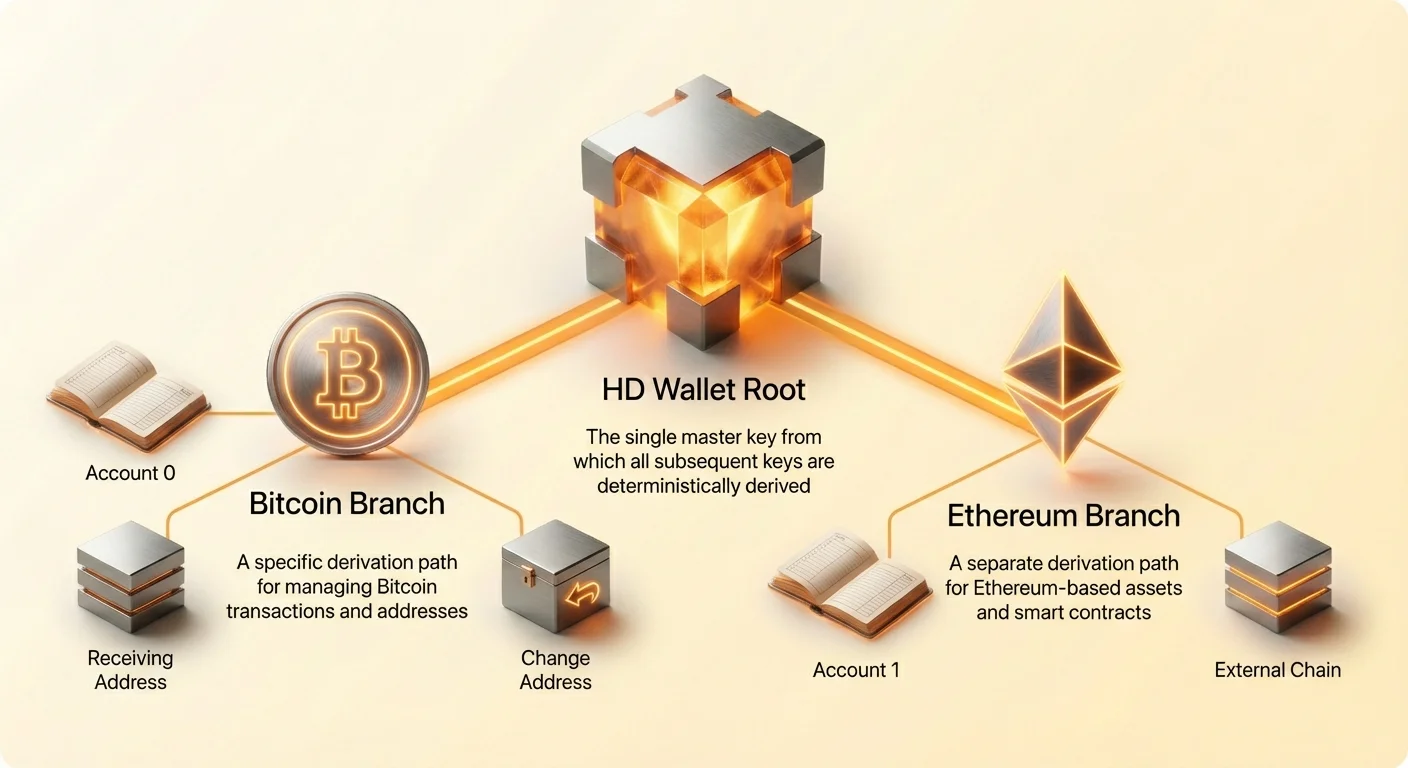
This is the power of the Hierarchical Deterministic (HD) Wallet structure, standardized by BIP32.
The Problem HD Wallets Solve
Before HD wallets became standard, every time a user needed a new Bitcoin address (which is good practice for privacy), they had to back up a completely new private key. Managing dozens of private keys was impossible and led to poor security practices.
The HD standard introduced the concept of determinism: every subsequent key is mathematically derived from the preceding key and, ultimately, from the single Master Seed. This creates a predictable tree structure.
The Parent-Child Relationship
The HD wallet structure can be visualized as a family tree where the Master Seed is the root ancestor.
- Master Seed (Root): Generated directly from the BIP39 seed phrase.
- Master Private Key: Derived from the Master Seed.
- Child Keys: The Master Key can generate "child" private keys. Each child key is unique and mathematically linked to its parent.
- Grandchild Keys: Those child keys can, in turn, generate "grandchild" keys, and so on.
The hierarchy allows a wallet application to generate an infinite number of private key/public address pairs, all derived deterministically. If you have the Master Seed, you can regenerate the entire tree exactly, guaranteeing access to all funds.
Advantages of Determinism
The HD structure provides several critical benefits for the self-custody adopter:
- Single Backup: You only need to secure the BIP39 seed phrase. Losing the Master Seed means losing everything, but protecting that single phrase grants you access to all current and future derived addresses.
- Privacy: Since a new public address can be generated easily for every transaction, you reduce the ability of onlookers to track your complete financial activity.
- Organization: The hierarchical structure allows wallets to categorize keys logically (e.g., separating keys for Account 1, Account 2, etc.).
- Extended Public Keys (xPubs): BIP32 allows for the generation of "extended public keys." An xPub can be shared with an external party (like an accountant or a cold storage device) and allows that party to see all transactions and addresses associated with a specific branch of your tree, but they cannot spend the funds because the xPub contains no private key information.
Standardizing the Path: BIP44
While BIP32 defines the mechanics of the hierarchical tree, it doesn't specify how the different assets (Bitcoin, Ethereum, Litecoin) or different accounts within those assets should be organized within that tree.
BIP44 provides this organization. It is a further standardization built atop BIP32 that defines a strict, multi-level Derivation Path. This path ensures that if you restore your seed phrase on any BIP44-compatible wallet, that wallet will look in the exact same place for your Bitcoin addresses, Ethereum addresses, etc.
Reading the Derivation Path
The derivation path is a string of numbers separated by slashes, defining where in the deterministic key tree a specific private key lives. It typically looks like this:
m / purpose' / coin_type' / account' / change / address_index
Let's break down the five critical levels of the path:
| Level | Name | Purpose | Example Value (Bitcoin) |
|---|---|---|---|
| 1 | m | Denotes the Master Seed (Root). | m |
| 2 | Purpose | Defines the BIP standard being used (usually 44' for HD wallets). | 44' |
| 3 | Coin Type | Identifies the cryptocurrency (e.g., 0' for Bitcoin, 60' for Ethereum). This is crucial for cross-chain compatibility. | 0' |
| 4 | Account | Allows users to separate funds into logical accounts (Account 0, Account 1). | 0' |
| 5 | Change | A binary value (0 or 1). 0 for receiving addresses (external) and 1 for addresses used for change during transactions (internal). |
0 or 1 |
| 6 | Address Index | The sequential index of the key being generated (Address 0, Address 1, Address 2, etc.). | 0, 1, 2... |
Note on the Apostrophe ('): The apostrophe after a number (e.g., 44') indicates that this step involves hardened derivation. This is a critical security measure where the derivation process ensures that even if an intermediate public key is leaked, the subsequent derived child private keys cannot be calculated.
Why Standardization is Essential
BIP44 solves the interoperability crisis. Imagine you use Wallet A today, which organizes Bitcoin addresses under path m/44'/0'/0'/.... If you later want to switch to Wallet B, and Wallet B is also BIP44 compliant, it will automatically look under that exact same path for your funds.
Without BIP44, every wallet manufacturer would use a different structure, and migrating your funds would be complex, requiring you to manually import dozens of private keys. BIP44 ensures that the wallet ecosystem is unified, maximizing user freedom and redundancy.
Practical Use Cases: Utilizing Custom Paths
While most users simply rely on the default derivation path (usually starting with m/44'/), advanced users sometimes utilize the 'Account' level to manage funds:
- Example 1: Account Separation: A business might use
m/44'/0'/0'/...for operational funds andm/44'/0'/1'/...for savings, all controlled by the same Master Seed. - Example 2: Altcoin Management: A wallet needs to check separate paths for different coins. It will look for Bitcoin under
m/44'/0'/...and Ethereum underm/44'/60'/....
Understanding the path gives you control. If a specific wallet application fails to show an altcoin balance, it may simply be looking for the wrong coin type path, a problem often solved by manually configuring the path in advanced wallet settings.
The 25th Word: Securing Your Seed with a Passphrase (BIP39 Optional Feature)
For users committed to the highest level of self-custody security, BIP39 includes an optional feature known as the passphrase, often referred to as the "25th word."
This passphrase is an extra word or phrase chosen by the user that is added to the 12- or 24-word seed before the Master Seed is mathematically derived.
How the Passphrase Works
When the PBKDF2 function converts the seed phrase into the Master Seed, it incorporates the user-defined passphrase into the hashing process.
Key Mechanism:
- Seed Phrase + Passphrase = Unique Master Seed
- Any change, even a single character, in the passphrase results in a completely different Master Seed, which generates an entirely different set of private keys and addresses.
Effectively, adding a passphrase means your single 12- or 24-word seed can control an infinite number of entirely separate wallets (or "vaults"). Each unique passphrase unlocks a unique vault.
Security Implications and Best Practices
The passphrase provides immense security benefits, but introduces a new layer of risk: if you forget the passphrase, or fail to communicate it to your beneficiaries, the associated funds are mathematically lost forever, as there is no way to brute-force or recover the Master Seed derived from that specific combination.
Benefits (Plausible Deniability and Brute Force Protection)
- Brute Force Immunity: While an attacker may steal your physical 24-word seed phrase, they still cannot access your funds unless they also know the exact passphrase. Since the passphrase can be any string of characters (letters, numbers, symbols, spaces), the attacker must guess an exponentially larger number of combinations.
- Plausible Deniability (The "Decoy Wallet"): Users can establish a "decoy wallet" associated with a specific seed and no passphrase, storing a small, insignificant amount of funds. Their primary funds are stored in a hidden wallet accessed by the same seed plus the secret passphrase. If the user is ever coerced into revealing their seed, they can reveal the decoy seed, protecting the majority of their assets.
Risks (The Ultimate Single Point of Failure)
The passphrase is not recoverable by the wallet.
- Loss is Total Loss: If you forget the exact passphrase, even if you have the 24-word seed written down perfectly, your funds are permanently inaccessible. There is no cryptographic way to recover or reset this passphrase.
- Case Sensitivity: The passphrase is case-sensitive, meaning "SecretPass123" is cryptographically different from "secretpass123." Precision is non-negotiable.
Actionable Tip: If you choose to use a passphrase, treat it with the same, or even greater, security rigor as your seed phrase. Store it physically separate from the seed phrase itself, and ensure your method of storage accounts for the extreme consequences of forgetting it.
Conclusion: Mastering Your Financial Sovereignty
The mechanics underlying your crypto wallet—entropy, BIP39, BIP32, and BIP44—are not just abstract cryptographic concepts. They are the scaffolding that enables true self-custody and financial sovereignty.
Understanding these standards shifts your perspective: you are no longer just a user of a crypto app; you are the manager of a sophisticated cryptographic structure.
The BIP standards transform raw, massive cryptographic numbers into a concise, organized, and restorable system. By grasping how your seed phrase becomes a Master Seed, how that seed deterministically generates every key you need, and how standards like BIP44 ensure interoperability across the ecosystem, you take a necessary step away from simply trusting technology and toward genuinely understanding and controlling it. Your mastery of these mechanics is the ultimate defense against loss and theft.