
Bitcoin (BTC) revolutionized finance by introducing sound, decentralized digital money. However, due to its foundational design prioritizing security and immutability, the core Bitcoin blockchain is relatively slow and lacks the native smart contract capabilities necessary to participate fully in modern decentralized finance (DeFi) protocols, which often live on networks like Ethereum or Solana, highlighting fundamental differences in philosophy.
This technological separation presents a significant challenge: how do we unlock the massive liquidity and trustworthiness of Bitcoin and integrate it seamlessly into the high-speed, programmable world of DeFi?
The solution lies in scaling and bridging technologies. This guide moves beyond the basic concept of using the Lightning Network for small, fast payments and delves into its advanced application: acting as a crucial high-speed conduit for injecting BTC liquidity into complex DeFi ecosystems. We will explore the mechanisms—from trusted wrapping services to trustless cross-chain atomic swaps and novel federated custody solutions—that allow Bitcoin to become a foundational asset for cross-chain yield generation and advanced decentralized strategies.
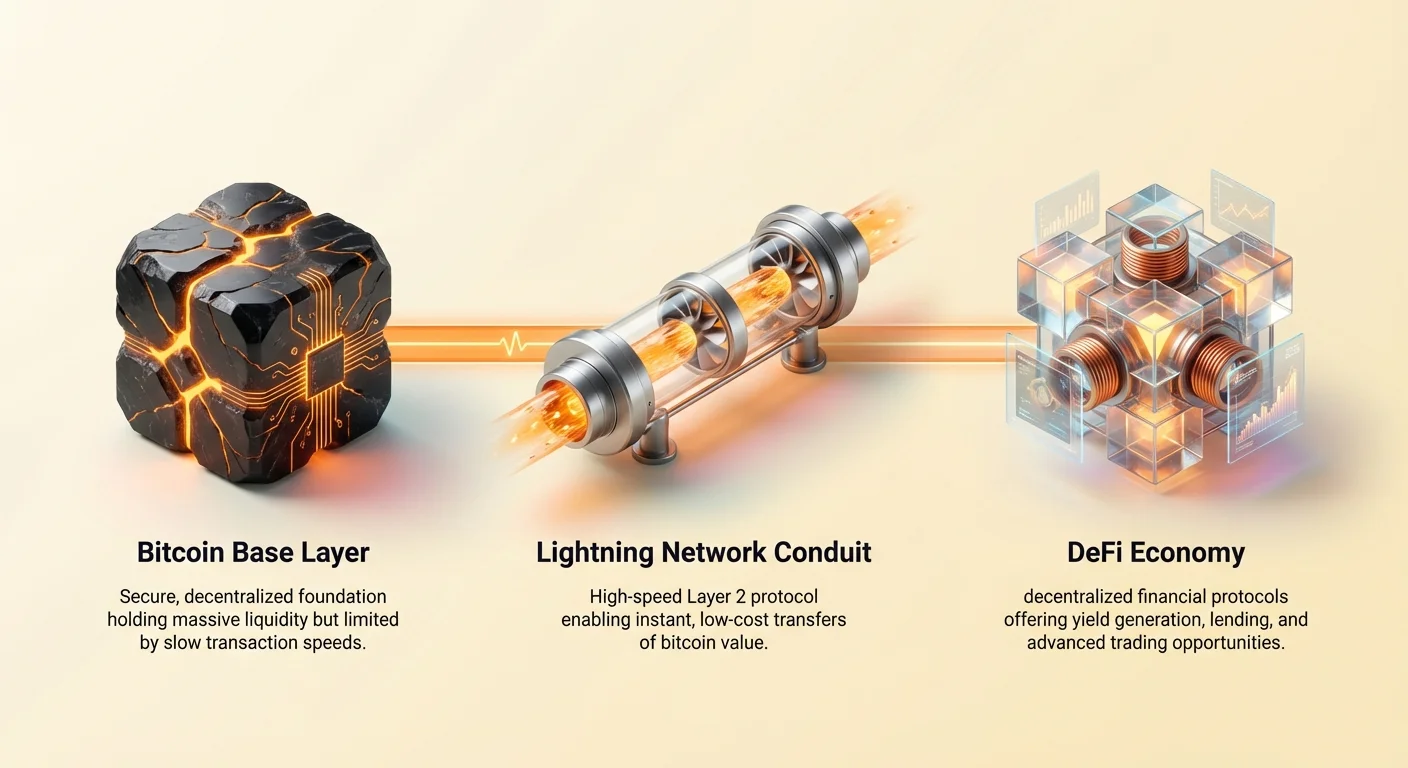
The Core Problem: Unlocking Bitcoin Liquidity
To understand the advanced applications of Lightning, we must first recognize the fundamental barrier separating Bitcoin from the rest of the DeFi world.
Bitcoin's Strength and Limitations
Bitcoin is often referred to as digital gold because its architecture is designed for maximum security and resistance to change. Transactions are validated slowly (roughly every 10 minutes) and the network intentionally limits the complexity of the scripts it can execute. This design choice makes it exceptionally secure, but inherently limits its utility in environments requiring rapid, complex transactions, such as yield farming, decentralized lending, or complex derivatives trading.
If Bitcoin liquidity—the largest pool of value in the crypto economy—remains locked on the original slow chain, the potential of the broader DeFi ecosystem is limited.
The Role of Scaling Solutions
Scaling solutions address the throughput limits of the base layer (Layer 1, or L1).
The Lightning Network (L2): Lightning is a Layer 2 (L2) protocol built on top of the Bitcoin L1. It enables nearly instant, near-zero-fee transactions by allowing users to conduct transactions off-chain through established payment channels. This speed is critical for bridging, as it reduces the time and cost associated with moving BTC to the initial conversion point, which is often a key bottleneck in DeFi integration.
DeFi L2s (Ethereum, etc.): Networks like Ethereum also utilize L2 solutions (Optimism, Arbitrum) to scale. When we discuss bridging, we are often talking about using Lightning to quickly move BTC, then converting that BTC into a format (like wrapped BTC) that can interact with an L1/L2 smart contract environment, such as Ethereum.
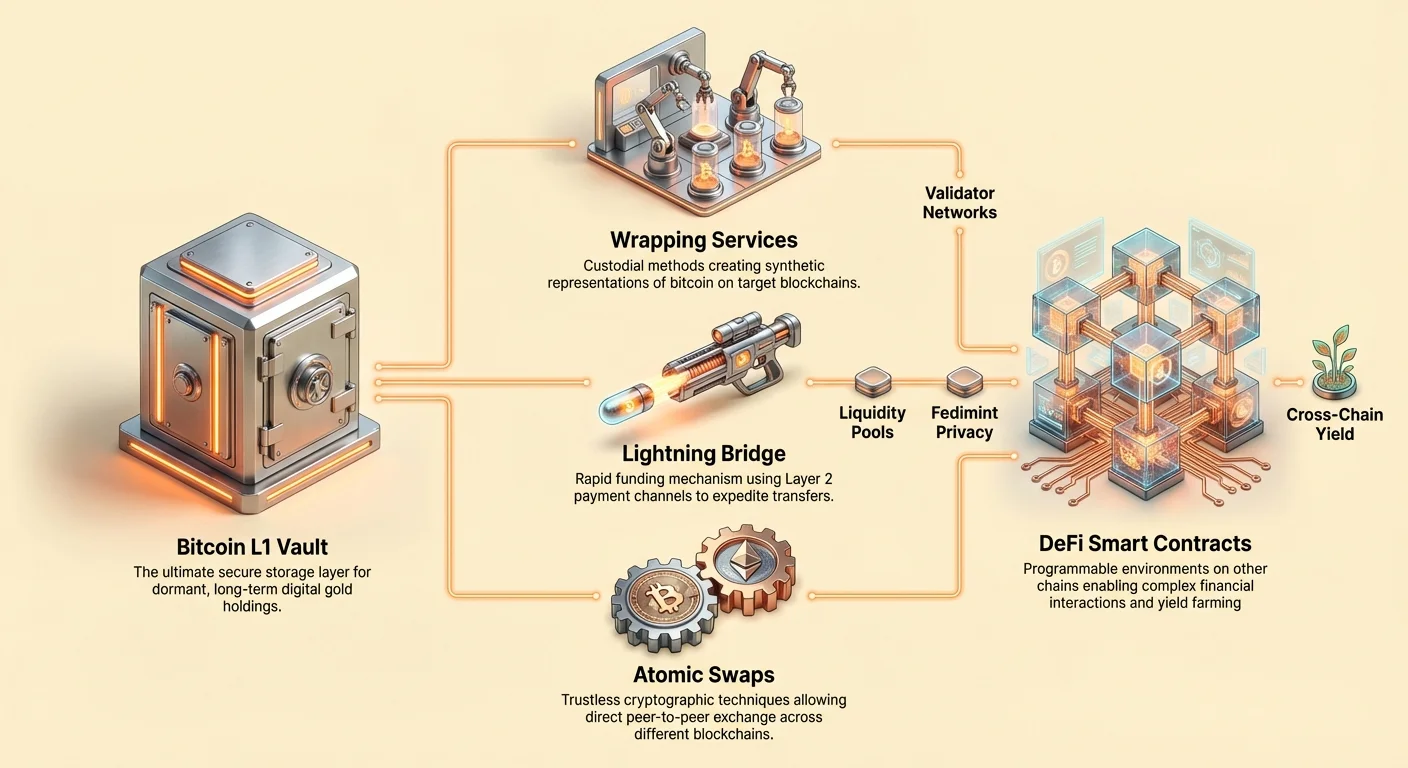
Mechanism 1: Bridging BTC to DeFi via Wrapping
The most common and currently most liquid method for bringing Bitcoin value into a separate smart contract ecosystem is through "wrapping." This process effectively creates a digital receipt representing your underlying BTC, which can then be used on other blockchains.
Understanding Wrapped Bitcoin (wBTC)
Wrapped Bitcoin (wBTC) is an ERC-20 token that is collateralized 1:1 by real Bitcoin held in custody. Think of it like taking physical gold to a secure vault and receiving a paper certificate (the wBTC token) that proves ownership. This certificate can be instantly traded, lent, or staked on Ethereum-based DeFi protocols.
The Wrapping Process:
- A user sends BTC to a custodian (or a network of decentralized custodians/merchants).
- The custodian locks the BTC in a secure vault.
- The custodian mints the corresponding amount of wBTC on the Ethereum network and sends it to the user's DeFi wallet address.
- The user can now use this wBTC just like any other Ethereum token.
The Custodial vs. Non-Custodial Debate
While wrapping is effective, it introduces a layer of trust.
- Custodial Models (e.g., wBTC): This model relies on a consortium of regulated institutions (the custodians) to ensure the 1:1 backing. The risk here is counterparty risk: the possibility that the custodian fails, is hacked, or operates fraudulently, leaving the wBTC unbacked.
- Non-Custodial/Decentralized Models (e.g., renBTC, tBTC): These protocols attempt to minimize trust by using decentralized networks, cryptography, or staking mechanisms to guarantee the collateralization. While mathematically more secure in theory, they often introduce different complexities, such as reliance on external validator networks or potentially complex smart contract interactions.
Strategic Tip: Always research the specific wrapping mechanism (the ‘bridge’) you use. Look at the asset’s market cap, audit history, and the reputation of the institutions or decentralized networks that secure the locked BTC.
Practical Use Case: Yield Generation on Ethereum
Once BTC is wrapped, its possibilities expand exponentially.
A self-custody adopter can take their BTC, wrap it into wBTC, and then participate in DeFi lending protocols. For example, they could deposit wBTC into a platform like Aave or Compound, earning passive interest. This allows the user to maintain exposure to the value of Bitcoin while simultaneously generating a yield—a powerful tool for managing capital efficiency.
Mechanism 2: True Cross-Chain Swaps (Atomic Swaps)
While wrapping requires creating a new derivative asset (wBTC), atomic swaps offer a method for users to exchange one native cryptocurrency for another native cryptocurrency on a different blockchain without needing a centralized intermediary or custodial risk.
This represents the ideal trustless integration method.
How Hashed Timelock Contracts (HTLCs) Work
Atomic swaps are based on a cryptographic primitive called a Hashed Timelock Contract (HTLC). This technology ensures that the trade either happens completely (atomically) or doesn't happen at all, providing a critical alternative to centralized exchange swaps.
Imagine Alice has 1 BTC and wants 10 LTC from Bob.
- Alice's Action: Alice creates a secret key (a preimage) and hashes it. She locks her BTC in a contract on the Bitcoin blockchain using this hash and a deadline (timelock).
- Bob’s Action: Bob sees Alice's locked contract and uses the same hash to lock his 10 LTC on the Litecoin blockchain, also with a slightly shorter deadline.
- The Swap: Alice needs to reveal the original secret key to claim Bob's LTC before her timelock expires. When she does this, the secret key is made public on the Litecoin network.
- Completion: Bob, monitoring the Litecoin network, instantly grabs the public key and uses it to claim Alice's BTC on the Bitcoin network before his shorter timelock expires.
If either party fails to complete their side or the time runs out, the funds automatically return to their original owners, guaranteeing zero counterparty risk.
The LTC to BTC Swap Example
Litecoin (LTC) is often cited in atomic swap examples because its codebase is very similar to Bitcoin's, making the implementation of HTLCs relatively straightforward.
By facilitating a direct, trustless, native swap between LTC and BTC, atomic swaps prove the technical feasibility of true cross-chain exchange. This is a foundational step toward more complex DeFi integrations.
Limitations and Advanced Atomic Swap Protocols
The primary limitation of classic atomic swaps is that they require both blockchains to support specific cryptographic operations (like HTLCs) and are cumbersome for high-frequency trading. They are also limited to direct P2P (peer-to-peer) trades, lacking the efficiency of centralized exchanges or deep DeFi liquidity pools.
Newer, advanced protocols aim to abstract this complexity, potentially allowing for atomic swaps between BTC and assets on chains like Ethereum or Solana through specialized relayers or decentralized networks that manage the timelock process across disparate environments.
Lightning Network’s Role in Enhanced DeFi Access
While wrapping handles the asset conversion and atomic swaps handle trustless exchange, the Lightning Network provides the necessary speed and low cost to make these processes economical and practical for frequent use.
Using Lightning for Rapid Wrapped BTC Acquisition
When a user decides to wrap their BTC, they typically send their L1 BTC to the custodian’s address. This transaction can take up to an hour and incur significant network fees.
Lightning changes this dynamic:
Instead of sending L1 BTC, a user can deposit L1 BTC into a Lightning wallet and then use a service (often a dedicated broker or exchange with a Lightning node) that accepts Lightning payments and instantly sends wrapped assets back on the target DeFi chain (e.g., Ethereum).
Example: A user wants to quickly acquire $1,000 worth of wBTC to capitalize on a fleeting yield opportunity. They can pay the $1,000 equivalent via a Lightning invoice, and the service, acting as the wrapper, mints and sends the wBTC to their Ethereum address almost instantaneously, bypassing the slow, expensive L1 confirmation time for the initial funding.
This integration transforms Bitcoin from a slow-moving reserve asset into a high-velocity capital asset ready for immediate deployment in DeFi strategies.
Introduction to Lightning Liquidity Pools
Lightning Network relies on "channels" being sufficiently funded. If a channel doesn't have enough liquidity on one side, payments can fail. To address this, specialized protocols are emerging that allow users to pool their BTC to provide liquidity for these payment channels.
How Liquidity Pools Facilitate Scaling:
- Efficient Channel Balancing: Users deposit BTC into a Lightning liquidity pool. This pool then dynamically opens and balances channels, ensuring that sufficient incoming and outgoing capacity exists across the network.
- Yield Generation for L2: Users who contribute their BTC to these liquidity pools earn fees from the routing payments. This means that L2 liquidity providers (LPs) are earning yield merely by keeping the Lightning Network efficient.
- Cross-Chain Benefit: These highly liquid, efficient Lightning channels make the rapid conversion and bridging process (as described above) cheaper and more reliable, enhancing the overall experience of moving BTC value into other ecosystems.
Emerging Solutions: Federated Custody and Layer 3 Integration (Fedimints)
Beyond basic L2 scaling and bridging, next-generation concepts are emerging to enhance Bitcoin's privacy and manage its use in highly sophisticated L3 (Layer 3) environments. Fedimint is a prime example of this advanced trend.
What is Fedimint and How it Works
Fedimint (Federated Mint) is a protocol that allows groups of people to custody Bitcoin collectively using a federated Chaumian Ecash system. Imagine a small digital credit union or co-op.
Key Components:
- Federation: A group of trusted individuals (guardians) who collectively manage the federation’s shared Bitcoin multisig wallet. No single guardian can steal the funds.
- Ecash: When users deposit BTC into the federation, they receive "Ecash tokens" (often referred to as blind signatures) that represent their deposit. This Ecash is highly private; the federation knows the total amount held but does not know which individual owns which specific Ecash token.
- Lightning Integration: Fedimints often connect directly to the Lightning Network, allowing members to send and receive payments rapidly using their private Ecash tokens without revealing their identity or transaction history to the federation or the public Bitcoin blockchain.
Fedimint’s Potential for Private, High-Frequency Trading
The introduction of Fedimint structures fundamentally changes the approach to BTC-DeFi integration, particularly for advanced strategies focused on privacy:
- Enhanced Privacy for DeFi: A user could move their BTC through a Fedimint, use the highly private Ecash tokens to interact with a specialized, privacy-focused DeFi bridge, and then participate in cross-chain lending or yield farming with an added layer of obfuscation.
- Micro-Transaction Scaling: Since Ecash tokens operate like internal credits within the federation, they can be used for extremely high-frequency micro-transactions required for complex trading strategies, without hitting the Bitcoin L1.
- Community-Driven Custody: This model decentralizes the custody risk compared to a single wBTC custodian, distributing trust among a smaller, community-selected group of guardians. This aligns with the self-sovereignty goals of advanced crypto adopters.
Strategic Considerations for BTC-DeFi Integration
Moving value across chains introduces risks and complexities that require careful planning, particularly for self-custody adopters and finance professionals.
Managing Counterparty Risk in Wrapped Assets
The greatest risk when bridging BTC to DeFi is the security of the locked collateral.
- Audit Protocols: Only use wrapped assets or bridges that have undergone rigorous security audits by reputable third-party firms. Review the bridge's documentation to understand the mechanism for "unwrapping" (redeeming) your original BTC.
- Decentralization Score: Evaluate how decentralized the wrapping mechanism is. Does it rely on 3 out of 5 multisig signers, or 15 out of 20? The more decentralized the control, the lower the single point of failure risk.
- Liquidity Risk: Ensure that the wrapped asset you hold (e.g., wBTC) has high liquidity on the target chain. If liquidity is low, you might face difficulties or high slippage when trying to sell or swap it back to stablecoins or unwrap it back to native BTC.
Transaction Cost Analysis (Gas vs. Lightning Fees)
The decision to use Lightning for the initial transfer versus using the L1 Bitcoin chain is purely economic, based on current network congestion.
| Transfer Method | Cost Driver | Speed | Use Case |
|---|---|---|---|
| Bitcoin L1 | Miner Fees (dependent on block space) | Slow (10 mins+) | Large, infrequent transfers; cold storage. |
| Lightning Network | Routing Fees (near zero) | Instant | Rapid funding of wrappers; small, frequent transactions. |
| Ethereum L1/L2 (for wBTC use) | Gas Fees (dependent on network congestion) | Variable | Interacting with smart contracts (lending, swapping). |
Actionable Tip: Use Lightning for any transfer under $5,000 intended for immediate deployment into a DeFi protocol. Reserve L1 transfers only for institutional-scale movements or movements directly to hardware wallets for long-term storage.
Best Practices for Securing Bridged Assets
When using Lightning to fund a cross-chain strategy, you are moving from one security model (Bitcoin's UTXO) to another (Ethereum's account model).
- Use Dedicated Wallets: Never mix the wallet you use for rapid Lightning transfers (which may be a mobile hot wallet) with the wallet holding your long-term DeFi collateral (which should be a hardware wallet).
- Verify Bridge Addresses: Before initiating any wrap or swap, triple-check the recipient address and the specific smart contract address of the wrapping service. Phishing and scam sites that redirect funds to malicious contract addresses are common risks in bridging.
- Test Small Amounts: Always test the entire process—funding the Lightning channel, initiating the wrap, using the wrapped asset, and unwrapping it back to L1 BTC—with a small, disposable amount first. This confirms the functional pathway before committing significant capital.
Conclusion
The integration of the Lightning Network with DeFi and cross-chain swaps represents the critical next phase in crypto adoption. It transforms Bitcoin from a purely static store of value into a dynamically scalable asset capable of powering high-throughput, programmable financial systems.
By understanding the underlying mechanisms—the necessary trust introduced by wrapping, the pure trustlessness offered by atomic swaps, and the speed and efficiency provided by the Lightning Network and novel structures like Fedimint—users can confidently unlock BTC liquidity. This paves the way for advanced self-custody strategies, where one's Bitcoin is not merely dormant digital gold, but active, yield-generating collateral in the global decentralized economy.