
For many newcomers to the cryptocurrency space, the journey begins and ends with price speculation. They purchase assets like Ether (ETH) on a centralized exchange, watch the market charts, and hope for appreciation. While this "buy and hold" strategy mimics the investment patterns of traditional stocks, it largely ignores the fundamental architecture of the Ethereum network. Unlike digital assets designed solely as a store of value, Ethereum functions as a global computing platform, powering the decentralized technology stack. It powers decentralized applications, financial services, and complex smart contracts.
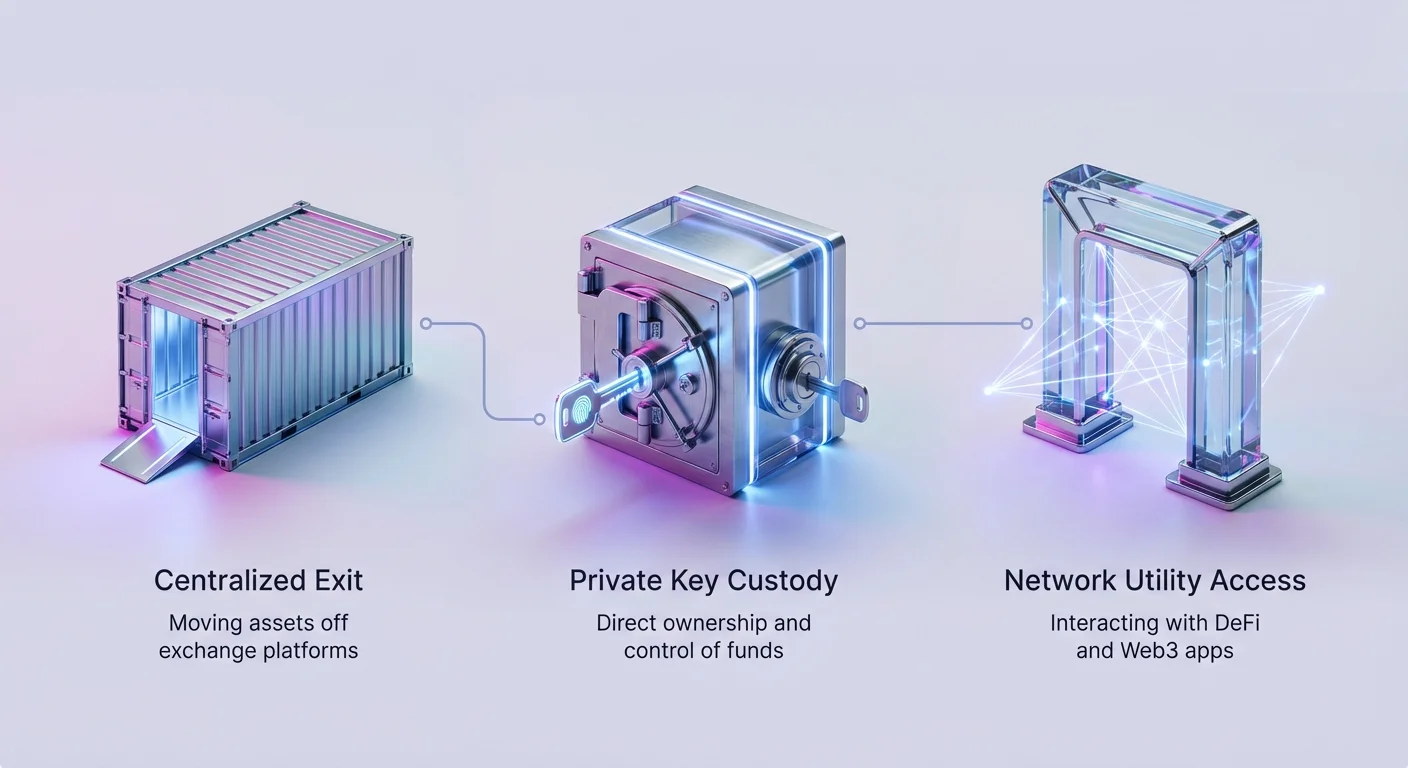
To truly utilize this network, a user must transition from a passive investor to an active participant. This shift requires moving assets off centralized trading platforms and into a self-custodial environment. On a centralized exchange, users do not technically own their cryptocurrency. Instead, they hold a claim or an IOU from the provider. The exchange retains control of the private keys and the actual assets. This introduces counterparty risk, such as the possibility of the exchange freezing accounts, suffering a hack, or facing bankruptcy. To understand the full range of security trade-offs, refer to our guide on the spectrum of custody risks and choices.
Real utility begins when you take possession of your private keys, defining the anatomy of digital ownership. This effectively turns your digital holding into a bearer asset, similar to physical cash in a leather wallet. In the digital realm, this ownership allows you to interact directly with the blockchain without seeking permission from a third party. This freedom is the prerequisite for accessing decentralized finance (DeFi), gaming, and other web3 applications. Without self-custody, you are merely an observer of the ecosystem rather than a user of it.
The Mechanics of Digital Ownership
Custodial Versus Non-Custodial Models
Understanding the distinction between custodial and self-custodial wallets is critical for advanced usage. When you buy traditional financial assets, such as a share of a company like Apple, a custodian always stands between you and the asset. This middleman adds layers of opacity and cost. For a step-by-step guide on initiating self-custody, read setting up your Ethereum wallet securely. You cannot simply send your Apple share to a friend on a Sunday night; you must ask your broker to execute the trade during market hours.
Crypto-assets are built to be permissionless. In a non-custodial model, you eliminate the custodian entirely. You interact directly with the global ledger. This allows you to send, receive, and trade 24 hours a day, seven days a week, without answering to a bank or authority. However, this freedom comes with the responsibility of managing your own security. If you lose access to a self-custodial wallet, no customer support agent can restore your funds.
The Implications of True Possession
Taking possession of your ETH changes the nature of the asset. On an exchange, your holdings are just numbers in a database maintained by a private company. Once withdrawn to a private wallet, those holdings become active entries on the public blockchain. This transition protects you from the opaque accounting practices of centralized entities.
Furthermore, holding your own keys allows for customization that exchanges rarely offer. You can choose the specific network fees you are willing to pay, prioritizing speed or cost savings depending on your needs. You can also sign cryptographic messages to prove ownership of an address, which is often required to log in to decentralized applications. This utility is impossible when funds are trapped in a custodial account.
Navigating Ethereum Addresses and Privacy
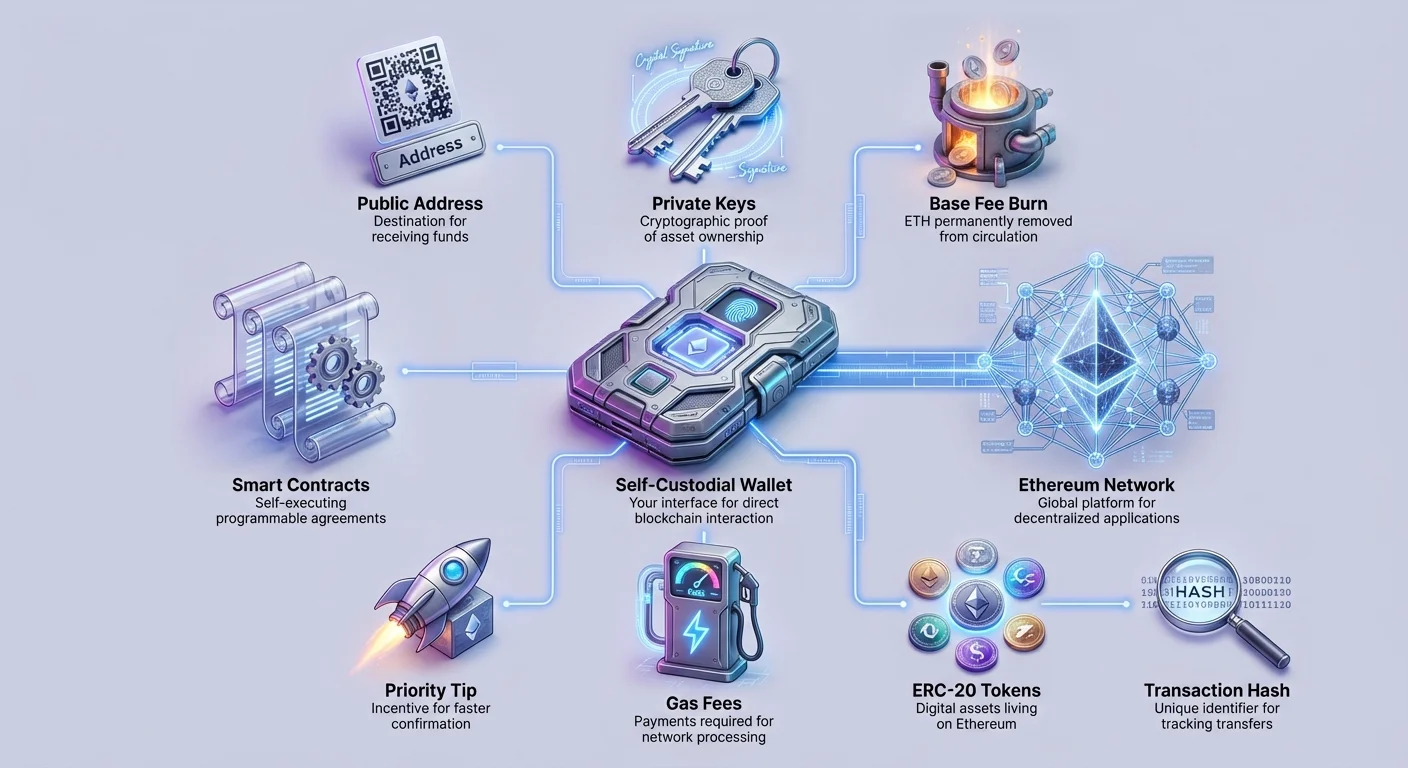
A fundamental skill for any Ethereum user is identifying and managing addresses. A typical Ethereum address appears as a long string of hexadecimal characters starting with "0x," such as 0xab41b92c.... This string functions similarly to a bank account number or an email address. It is the destination you provide to others when you wish to receive funds. While these strings are computer-readable, they can be cumbersome for humans to transcribe manually.
To solve this, many wallets offer QR code displays that allow senders to scan an address instantly. Additionally, the Ethereum ecosystem supports human-readable aliases, such as names ending in .eth. These function like website domain names, redirecting transactions to the underlying hexadecimal address. This reduces the likelihood of user error when typing out complex strings.
The Double-Edged Sword of Transparency
It is safe to share your public Ethereum address with friends, family, or business associates. No one can steal your funds simply by knowing your address; they would need your private key for that. However, safety should not be confused with privacy. The Ethereum blockchain is a completely public ledger. Once someone knows your address, they can enter it into a block explorer to view your entire financial history.
Block explorers allow anyone to see exactly how much ETH you hold and every transaction you have ever executed. For users concerned about financial privacy, this transparency can be a drawback. If you use a single address for all your activities—savings, daily spending, and trading—you create a detailed profile of your financial life that is visible to the world.
Strategies for Wallet Organization
To mitigate privacy risks, advanced users often employ a multi-address strategy. Most modern wallet applications allow you to generate an unlimited number of new addresses with the touch of a button. By using a fresh address for specific transactions or separating funds into different "buckets," you can obscure the full picture of your net worth.
For example, you might create one wallet specifically for long-term savings, often called "cold storage," which rarely interacts with external applications. You could create a separate "burner" wallet for interacting with new or experimental decentralized applications. This way, if the experimental wallet is compromised or publicly linked to your identity, your main savings remain private and secure.
| Wallet Strategy | Purpose | Privacy Level |
|---|---|---|
| Single Address | Simple management of all funds | Low (Full history visible) |
| Multiple Addresses | separating savings and spending | Medium (Funds segregated) |
| Fresh Address | One-time use for specific transfers | High (Harder to link) |
Understanding Network Fees and Gas
Transactions on Ethereum are not free. They require the payment of "gas," which is denominated in small fractions of ETH called "gwei." One gwei equals 0.000000001 ETH. Understanding how gas works is essential for avoiding overpayment and ensuring your transactions are processed quickly. The fee market was overhauled with an upgrade known as EIP-1559, which introduced a more predictable pricing mechanism.
Components of a Transaction Fee
Under the current system, every transaction fee consists of two parts: the base fee and the priority fee. The base fee is a mandatory charge determined by the network based on current demand. If the network is congested, the base fee rises. Crucially, this base fee is "burned" or destroyed, permanently removing that ETH from circulation. This mechanism connects network usage directly to the economic scarcity of the asset.
The second component is the priority fee, often called the "tip." This amount is paid directly to the network validators who process and secure the blockchain. While the base fee is automatic, users can often adjust the priority fee. paying a higher tip can incentivize validators to include your transaction in the next block faster, which is useful during times of high traffic.
Complexity and Cost
Not all transactions cost the same amount of gas. The cost is determined by the computational effort required to execute the request. A simple transfer of ETH from Alice to Bob is a standard, low-complexity action and therefore costs the least amount of gas. However, interacting with smart contracts requires significantly more data processing.
For instance, minting a non-fungible token (NFT) or swapping tokens on a decentralized exchange involves complex code execution. The network must update the state of the ledger in multiple places, verify contract conditions, and record new data. Consequently, these actions consume more gas units. Even if the price of gas (in gwei) remains stable, the total ETH paid for a complex transaction will be higher than for a simple transfer.
Acquiring ETH for Utility
Before you can explore the ecosystem, you must acquire Ether. While centralized exchanges are a common entry point, they are not the only method. Many self-custodial wallets now integrate "buy" buttons directly into their interfaces. This allows users to purchase ETH using credit cards or bank transfers without leaving the app. This method often streamlines the process of getting assets directly into a wallet you control, bypassing the withdrawal step required by centralized exchanges.
Identity Verification Realities
Regardless of the platform used, buying crypto with government-issued currency almost always triggers Know-Your-Customer (KYC) and Anti-Money-Laundering (AML) regulations. Users must typically provide identification documents to verify their identity. This applies to centralized exchanges and most in-wallet purchase providers.
For those seeking to avoid these data collection requirements, peer-to-peer (P2P) marketplaces offer an alternative. These platforms connect buyers and sellers directly. A trade is initiated, funds are locked in escrow, and the crypto is released once the seller confirms receipt of payment. P2P methods can offer greater privacy but require careful vetting of seller reputation to avoid scams.
Moving Funds for Use
If you do purchase on a centralized exchange, the final step is withdrawal. You must locate your personal wallet address and initiate a transfer from the exchange. This is the moment you officially take custody. It is important to note that exchanges often charge a withdrawal fee that is higher than the actual network gas fee. They do this to cover their own operational costs and generate revenue. Once the funds arrive in your private wallet, you are ready to interact with the network.
Sending and Verifying Transactions
Sending Ether is a precise process. Because blockchain transactions are irreversible, there is no "undo" button if you make a mistake. When sending funds, you must input the recipient's address and the amount. Most wallets allow you to paste addresses from your clipboard or scan QR codes to avoid typing errors.
Verification Procedures
Before confirming a transaction, you should always perform a visual check. Verify the first four and last four characters of the destination address. Malware exists that can swap addresses in your clipboard, so relying blindly on "copy-paste" can be risky. Ensuring these characters match the intended destination drastically reduces the chance of error.
Once a transaction is broadcast, it enters a pending state. You can track its progress using a block explorer by clicking on the "transaction hash" or ID. This unique string provides proof of payment and shows the real-time status of the transfer.
The Role of ERC-20 Tokens
Your Ethereum wallet is not limited to holding just ETH. The network supports a standard known as ERC-20, which allows developers to create different types of tokens that live on Ethereum. These can represent stablecoins like USDT, governance tokens for DeFi protocols, or other digital assets.
When you receive these tokens, they reside at the same address as your ETH. You do not need a separate address for every different token on the network. However, to send these tokens out of your wallet, you must have a balance of ETH to pay for the gas fees. You cannot pay the gas fee using the token you are sending; the network requires ETH for fuel. This is a common stumbling block for new users who move stablecoins to a wallet but forget to leave enough ETH to cover future transaction costs.
Conclusion
Transitioning from a passive holder to an active user of Ethereum unlocks the true potential of the technology. By moving assets off centralized exchanges and into self-custodial wallets, you gain censorship resistance and direct access to a global economy. This shift requires a deeper understanding of how addresses, gas fees, and transactions function. It places the responsibility for security and privacy squarely on your shoulders, removing the safety net of customer support but replacing it with sovereignty.
As you explore the ecosystem, remember that every interaction on the blockchain is permanent. The transparency of the public ledger is a powerful tool for verification, but it also demands a thoughtful approach to privacy. Managing multiple addresses and understanding the costs of complex interactions will help you navigate the network efficiently. Whether you are swapping tokens, collecting digital art, or simply securing your savings, the principles of self-custody remain the foundation of the experience.
Your keys are the only thing that guarantees your ownership, so guard them as you would your physical cash.