
Bitcoin is often misunderstood as a completely anonymous currency. In the early days of the digital asset, media portrayals frequently depicted it as an untraceable tool used by shadow markets. The reality is far more nuanced and technically specific. Bitcoin is not anonymous in the way that physical cash is anonymous. Instead, it is pseudonymous. This distinction is critical for anyone looking to master the balance between privacy and traceability within the network.
When you transact with physical cash, there is no permanent record of the exchange. If you hand a paper bill to a merchant, the transaction is peer-to-peer and leaves no digital footprint. Bitcoin shares the peer-to-peer nature of cash, as it allows direct transfer without intermediaries like banks. However, it differs fundamentally in how it records history. Every transaction ever made on the network is recorded on a public ledger known as the blockchain.
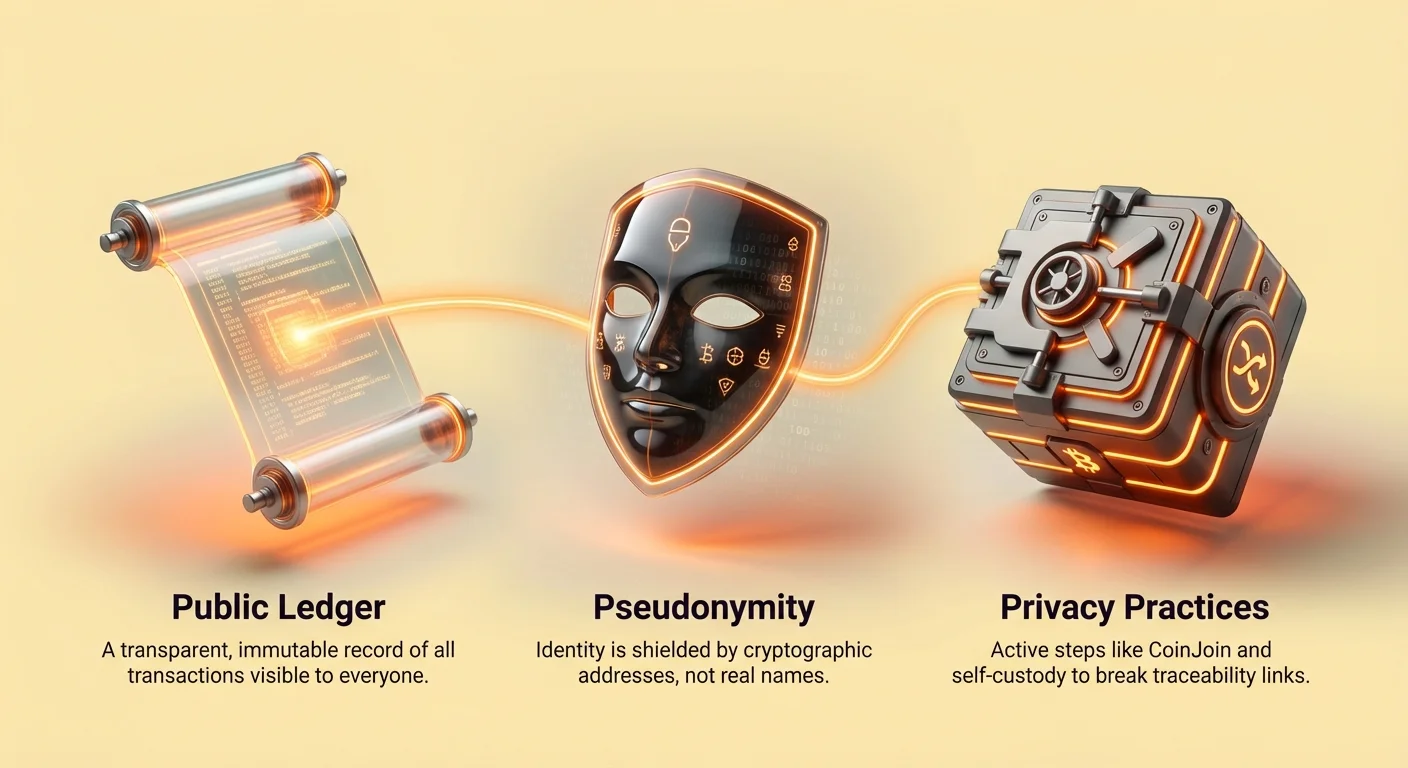
This public ledger creates a paradox for privacy seekers. On one hand, the network requires no names, email addresses, or social security numbers to use. You can create a wallet and generate a receiving address without asking for permission from any authority. On the other hand, the history of that address is visible to the entire world. Mastering Bitcoin privacy requires understanding how this public transparency interacts with personal identity.
The Architecture of Radical Transparency
To understand why Bitcoin is traceable, one must first understand how the network operates. Bitcoin is a decentralized digital asset that relies on a distributed network of computers, known as nodes, to maintain its record-keeping system. Unlike a bank that keeps a private ledger of customer balances behind closed doors, Bitcoin publishes its ledger for anyone to see.
This transparency is a feature, not a bug. It allows anyone to verify the supply of the currency and ensure that no coins are being counterfeited or double-spent. The protocol strictly limits the supply to 21 million units. To enforce this rule without a central authority, every participant must be able to audit the chain of transactions.
When a transaction occurs, it is grouped into a block. This block is cryptographically connected to the previous block, forming a continuous chain dating back to the first transaction in 2009. This creates an immutable record. Once a transaction is confirmed and buried under sufficient subsequent blocks, it cannot be altered or erased.
This immutability ensures the security of the network. It prevents bad actors from modifying balances or reversing payments. However, it also means that your financial history is etched into a permanent public record. If that history can be linked to your real-world identity, your financial privacy is compromised forever.
The Definition of Pseudonymity
Pseudonymity acts as a shield, but it is a fragile one. In the Bitcoin network, your identity is represented by your public address. This is a long string of alphanumeric characters that looks nothing like a real name. When you send or receive funds, this string is the only identifier that appears on the blockchain.
If you keep your public address unconnected to your real identity, your transactions remain private in practice. You are essentially operating under a nom de plume. The data shows that address A sent funds to address B, but it does not reveal who owns address A or B. This level of privacy is sufficient for casual observation.
However, this shield cracks if the pseudonym is ever linked to a human identity. Once that link is established, the entire history of that pseudonym becomes de-anonymized. It is similar to writing a book under a pen name. If the public discovers the author behind the name, every book written under that pseudonym is instantly attributed to the person.
The Mechanics of Traceability
The open nature of the blockchain allows for sophisticated analysis. Because the ledger is public, specialized companies and researchers can study the movement of funds. They look for patterns and connections between addresses to cluster them together. This is often referred to as blockchain analysis or heuristics.
One common method of analysis involves tracking inputs and outputs. When a user spends bitcoin, they often use multiple inputs to make up the total amount. If a transaction consumes funds from two different addresses to pay for a single item, an analyst can reasonably assume that both input addresses belong to the same person.
Over time, these clusters of addresses can build a comprehensive profile of a user's activity. Even if a user maintains multiple addresses, poor management of how those addresses interact can reveal that they are all controlled by a single entity. This creates a web of traceability that exists entirely on the public graph.
De-anonymization Vectors
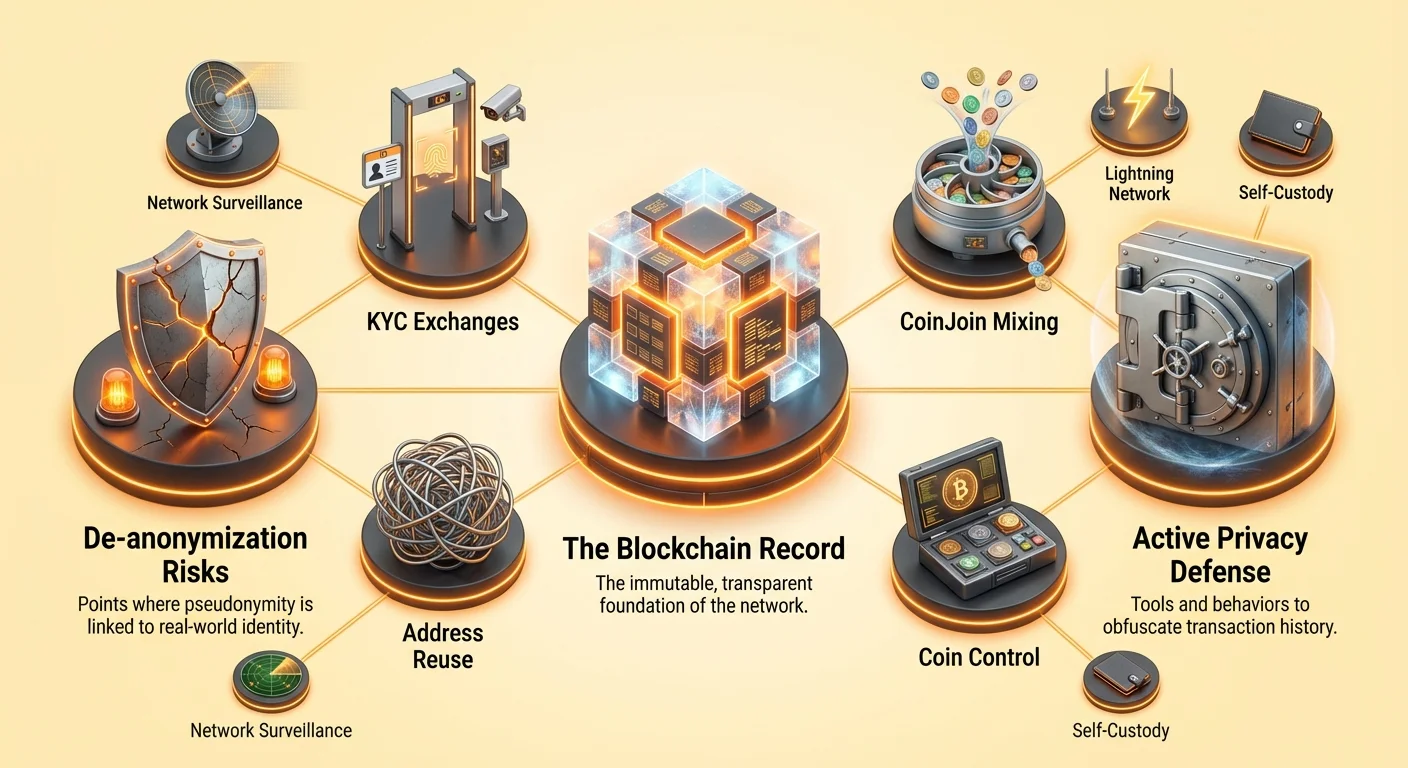
Privacy is rarely lost all at once. It is usually eroded through specific actions or points of failure where the digital world intersects with the physical world. Understanding these vectors is the first step toward mitigating them. The most common vulnerability comes from the on-ramps and off-ramps of the crypto economy.
centralized Exchanges and KYC
The primary bridge between fiat currency and Bitcoin is the centralized exchange. These platforms allow users to buy and sell digital assets using traditional money. To comply with regulations, most reputable exchanges enforce Know Your Customer (KYC) and Anti-Money Laundering (AML) policies.
When you sign up for a centralized exchange, you typically provide a government-issued ID, a selfie, and proof of residence. The exchange then links this verified identity to the Bitcoin addresses in your account. When you withdraw funds from the exchange to your personal wallet, the exchange knows exactly where the money went.
If the exchange shares this data with regulators or data analytics firms, the link between your identity and your withdrawal address is established. From that point forward, any funds moving in or out of that address can be traced back to you. This is the most direct way pseudonymity is broken.
Network-Level Surveillance
Traceability does not stop at the blockchain level. It also occurs at the network level. When you broadcast a transaction to the Bitcoin network, your computer or smartphone communicates with other nodes. This communication happens over the internet, which relies on IP addresses to route traffic.
Your IP address is a unique identifier assigned to your internet connection. It can reveal your approximate physical location and your internet service provider. If a malicious actor or a surveillance entity is monitoring the network, they may be able to log the IP address associated with a specific transaction.
Connecting your IP address to a Bitcoin transaction adds another layer of data to your profile. It transforms a purely digital financial event into a locatable physical event. This risk is particularly acute when using wallets that do not mask network traffic or when transacting over public or insecure Wi-Fi networks.
Address Reuse Dangers
A common mistake among new users is the reuse of Bitcoin addresses. It might seem convenient to use a single address for all deposits, similar to how one uses a single email address or bank account number. However, this practice is devastating for privacy.
Every time you reuse an address, you increase the amount of data associated with that single pseudonym. If you receive your salary, pay for coffee, and send money to a friend using the same address, all those counterparties can see each other's transactions on the ledger.
Your employer can see where you spend your money. The coffee shop can see how much you earn. Your friend can see your total balance. Address reuse collapses your financial history into a single, easily readable thread. It removes any ambiguity about which funds belong to you.
The Spectrum of Financial Privacy
To appreciate the importance of Bitcoin privacy, it is helpful to compare it with other forms of money. Financial privacy exists on a spectrum. Different assets offer varying degrees of protection against surveillance, confiscation, and censorship.
| Asset Type | Privacy Level | Traceability | Censorship Resistance |
|---|---|---|---|
| Physical Cash | High | Low | Moderate |
| Bank Transfers | Very Low | Very High | Very Low |
| Bitcoin (Standard) | Medium (Pseudonymous) | High (Public Ledger) | High |
| Bitcoin (Private) | High (With Tools) | Low (Obscured) | Very High |
Cash remains the gold standard for privacy in face-to-face transactions. It requires no intermediaries and leaves no record. However, cash is difficult to transport in large amounts and cannot be sent digitally. It is also vulnerable to physical seizure.
Traditional banking operates at the opposite end of the spectrum. Every transaction is recorded, monitored, and subject to approval by third parties. Banks act as trusted intermediaries, but this trust comes at the cost of privacy. Your financial life is an open book to the institution and the government bodies that regulate it.
Bitcoin sits in the middle but offers the potential to move toward the high-privacy end of the spectrum. It provides the digital portability that cash lacks while offering the potential for censorship resistance that banks cannot provide.
Censorship Resistance and Privacy
Privacy is closely linked to censorship resistance. Censorship resistance refers to the freedom to transact without permission. It ensures that no third party can prevent you from sending or receiving assets. It also protects your wealth from confiscation.
If a regime or institution can easily identify your funds, they can target them. In the traditional financial system, governments can order banks to freeze accounts or block transactions. This has happened in various countries during times of political unrest or economic instability.
Bitcoin operates without a central authority. There is no CEO to call and no database to alter. If you hold your Bitcoin in a self-custody wallet, you are the only person with access to the funds. This makes it extremely difficult for anyone to seize your assets or stop your transactions.
However, if your privacy is compromised, your censorship resistance is weakened. If an authority knows exactly which addresses you own, they may not be able to freeze the funds on the protocol level, but they can blacklist those addresses. They can pressure merchants or exchanges not to accept funds from your specific utxos (unspent transaction outputs).
Mastering Privacy: Best Practices
While the base layer of Bitcoin is transparent, users can employ specific tools and behaviors to obscure their footprint. Privacy in Bitcoin is not a default setting; it is a practice. It requires active management of how you interact with the network.
Managing Addresses and Identity
The most fundamental rule of Bitcoin privacy is to never reuse an address. Modern Hierarchical Deterministic (HD) wallets handle this automatically. When you receive a payment, the wallet software generates a fresh address for the next transaction. This scatters your activity across many different pseudonyms rather than concentrating it on one.
Users should also be mindful of information leakage. Avoid posting Bitcoin addresses on social media profiles or public forums. If you run a business and accept cryptocurrency, consider using a payment processor that generates a unique invoice address for every customer.
Separating identity from transactions is vital. If you must use a centralized exchange, treat the funds you withdraw as "tagged." Consider those funds linked to your identity. To regain privacy, you may need to pass them through privacy-enhancing tools before moving them to long-term storage or spending them.
Coin Control
Advanced wallets offer a feature known as Coin Control. This gives the user manual control over which specific pieces of Bitcoin are used in a transaction. In the Bitcoin network, your balance is actually a collection of unspent transaction outputs (UTXOs).
Without coin control, a wallet might combine a clean, private UTXO with a KYC-linked UTXO to pay for a transaction. This inadvertent mixing links the two histories together. Coin control allows you to segregate your funds. You can keep your "private" coins separate from your "public" coins, ensuring that you do not accidentally de-anonymize yourself.
Network Protection
To mitigate network-level surveillance, users can mask their IP addresses. A Virtual Private Network (VPN) is a common tool for this. A VPN routes your internet traffic through a secure server, hiding your real IP address from the nodes you connect to.
For even higher security, some wallets allow connection via the Tor network. Tor encrypts your traffic and bounces it through multiple volunteer relays around the world. This makes it incredibly difficult for anyone to trace the physical origin of the transaction broadcast.
Advanced Privacy Tools
For users who require a higher degree of anonymity than basic address management provides, specialized software solutions exist. These tools actively work to break the heuristic links that blockchain analysts use to track funds.
CoinJoin and Mixers
CoinJoin is a technique that combines transactions from multiple users into a single large transaction. In a CoinJoin, several people pool their inputs together and create a transaction with multiple outputs of equal value.
To an outside observer, it becomes very difficult to determine which input corresponds to which output. It is like putting money from five different people into a box, shaking it, and then allowing five people to take money out. The ownership history is obfuscated.
Coin mixers, or tumblers, operate on a similar principle but often involve a third-party service. Users send coins to the mixer, and the mixer sends back different coins from other users. While effective, centralized mixers carry risks. The operator could steal the funds or keep logs of the transactions. Decentralized CoinJoin protocols are generally preferred for this reason.
The Lightning Network
The Lightning Network is a second-layer solution built on top of Bitcoin. It was primarily designed to solve scalability issues by enabling faster and cheaper transactions. However, it also offers significant privacy benefits.
Lightning transactions occur off-chain. They are not recorded individually on the main public ledger. Only the opening and closing of the payment channels are recorded on the blockchain. All the intermediate transactions within the channel remain private between the parties involved.
Because these transactions do not leave a permanent public footprint, they are much harder to trace. For daily spending and smaller transfers, the Lightning Network provides a user experience that is closer to digital cash than the main chain.
Privacy-Focused Wallets
Choosing the right software is critical. Some wallets prioritize convenience over privacy, while others are built specifically to protect user anonymity. Privacy-focused wallets often include built-in Tor integration, easy coin control features, and automated CoinJoin capabilities.
Wallets like Wasabi and Samourai are examples of software designed with these features in mind. They guide users through the process of anonymizing their coins and alert them to potential privacy leaks. Using a standard wallet without these features requires much more manual effort to maintain privacy.
The Role of Self-Custody
Privacy is impossible without control. If you leave your Bitcoin on an exchange or with a custodian, you have no privacy from that custodian. They hold the private keys, and they see every movement of the funds. They can also share that data with third parties without your consent.
Self-custody means holding your own private keys. It puts you in charge of your digital assets. With a self-custody wallet, you do not need to provide personal information to create an account. There is no database of users that can be hacked or subpoenaed.
When you practice self-custody, you are the only person who knows your balance and your transaction history, provided you follow the best practices of address management. This model eliminates third-party risk and places the responsibility for privacy squarely on the user.
Future Developments in Privacy
The Bitcoin protocol is not static. It evolves through a governance process involving developers, miners, and the community. Updates to the software can bring new features that enhance privacy at the protocol level.
Recent upgrades, such as Taproot, have laid the groundwork for better privacy. Taproot enables more complex transactions to look like standard transactions on the blockchain. This makes it harder for analysts to distinguish between a simple payment and a complex multi-signature smart contract.
Schnorr signatures, introduced alongside Taproot, allow for key aggregation. This means multiple signatures can be combined into one. This has implications for CoinJoin transactions, potentially making them cheaper and indistinguishable from regular transactions.
Future proposals continue to explore ways to improve fungibility and privacy. The goal is to make all transactions look as uniform as possible. When every transaction looks the same, it becomes exponentially more difficult to single out specific users or trace flow of funds based on visual fingerprints on the blockchain.
The Ethical Debate
The drive for privacy in Bitcoin often sparks debate regarding illicit activity. Critics argue that anonymity empowers criminals, money launderers, and tax evaders. They claim that the transparency of the blockchain is necessary for law enforcement to track illegal flows of capital.
Proponents argue that privacy is a fundamental human right. They point out that bad actors will always find ways to move value, regardless of the currency used. Physical cash, gold, and the traditional banking system are all used for illicit purposes.
Furthermore, privacy is essential for security. If a business pays its suppliers using a completely transparent ledger, competitors can see their pricing and supply chain details. If an individual's net worth is visible to everyone, they become a target for kidnapping or extortion.
Democracy and freedom also rely on financial privacy. In authoritarian regimes, the state often uses financial surveillance to suppress dissent. Activists, journalists, and opposition leaders use privacy tools to protect themselves from government overreach. Bitcoin provides a lifeline for those who have been de-platformed or frozen out of the traditional banking system.
Navigating the Regulatory Landscape
Governments are increasingly focusing on the intersection of crypto and privacy. Regulations regarding Know Your Customer (KYC) rules are tightening globally. Authorities are looking closely at coin mixers and privacy-focused wallets.
This creates a complex environment for users. While holding Bitcoin is legal in most Western democracies, the tools used to maintain privacy may face scrutiny. Users must navigate these legal frameworks while trying to protect their data.
Despite these challenges, the decentralized nature of the network makes a total ban on privacy difficult to enforce. Open-source code cannot be easily un-invented or deleted. As long as the internet exists, people will have access to privacy tools.
Conclusion
Bitcoin represents a shift in how value is stored and transferred. It moves trust from centralized institutions to a decentralized code. This shift brings with it a new set of responsibilities for the user. The public nature of the blockchain ensures the integrity of the money supply, but it demands that users take active steps to protect their identity.
Privacy in this ecosystem is not a guaranteed state; it is a spectrum that varies based on user behavior and tool selection. By understanding the mechanics of the ledger, the risks of de-anonymization, and the tools available for obfuscation, individuals can reclaim their financial autonomy. The balance between transparency and privacy is delicate, yet achievable for those willing to learn.
True financial freedom requires the ability to reveal what you choose and protect what you must.