
The digital asset ecosystem is frequently misunderstood as a flat marketplace where all cryptocurrencies compete on equal footing. In reality, the architecture of this technology is deeply hierarchical. The distinction between Layer 1 and the layers built above it is the most fundamental structural element of the crypto economy. This hierarchy is defined by the relationship between independent networks and the assets that rely on them.
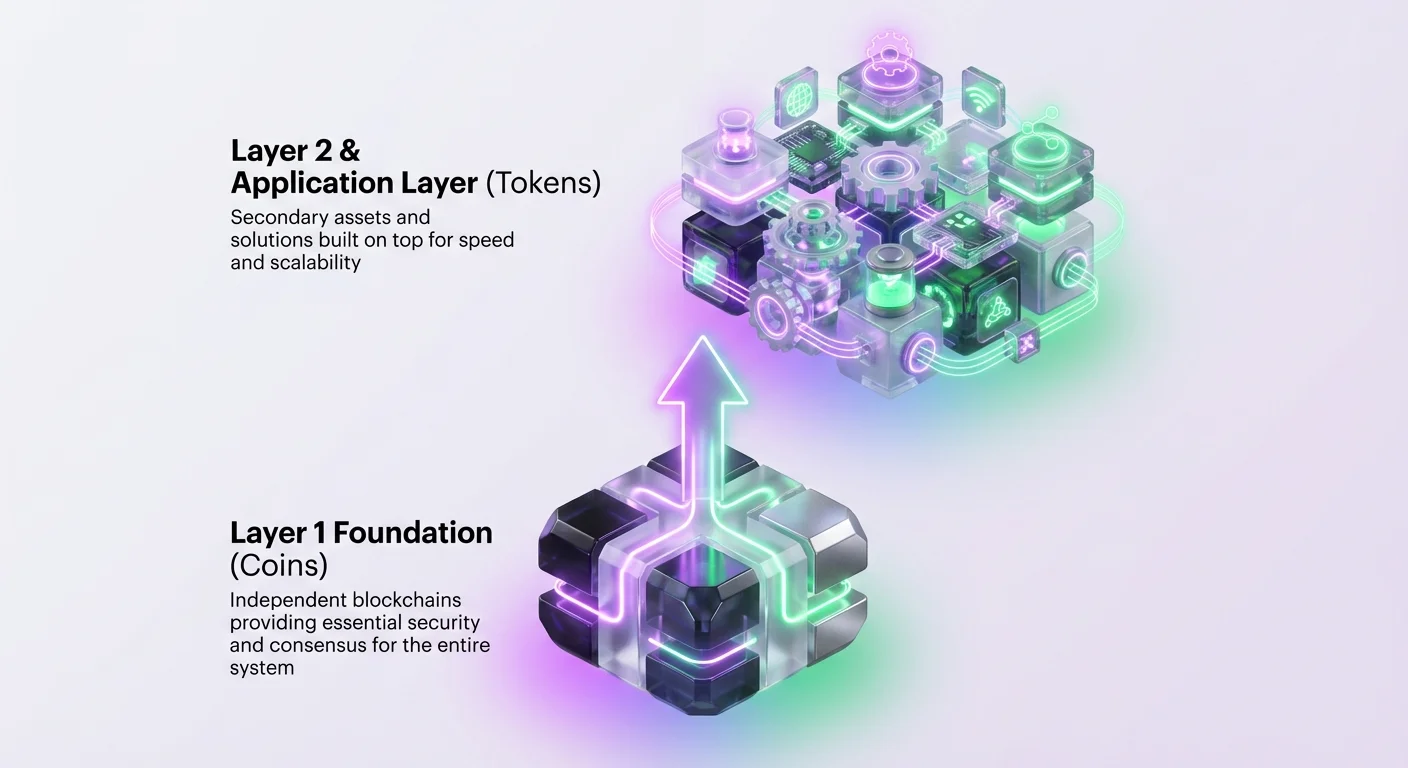
At the base of this structure lies the foundational layer. These are the independent blockchains that provide the essential security and consensus mechanisms for the entire system. Above this foundation sits a complex array of secondary assets, applications, and scaling solutions. This relationship determines everything from transaction speed to asset security.
Understanding this vertical structure is critical for navigating the modern digital economy. It explains why some assets are slower but more secure, while others offer high speed but rely on external protection. The interplay between the base layer and the secondary layers defines the value proposition of every digital asset.
The Foundation: Defining Layer 1 Coins
The bedrock of the cryptocurrency ecosystem consists of Layer 1 networks and their native assets, technically known as coins. A coin is defined by its independence. It runs on its own blockchain and does not rely on another network to process transactions or maintain its ledger. These assets are the pioneers of the industry and set the benchmark for decentralized value.
Sovereignty and Infrastructure
The defining characteristic of a Layer 1 coin is sovereignty. These assets are integrated directly into the protocol of a blockchain. They are not created by a smart contract or an external application. Instead, they are generated by the consensus rules of the network itself. For example, Bitcoin is the native coin of the Bitcoin blockchain. It exists to incentivize the miners or validators who secure the network.
This infrastructure level is capital intensive to maintain. Running a Layer 1 blockchain requires a vast network of participants to validate transactions. This makes the native coins of these networks essential utilities. They are used to pay for transaction fees and to reward the entities that keep the system secure. Without the native coin, the Layer 1 blockchain would have no economic mechanism to sustain its operations.
Consensus and Security
Security on Layer 1 is self-contained. The network relies on its own mechanism to reach agreement on the state of the ledger. This is often achieved through Proof-of-Work or Proof-of-Stake models. In a Proof-of-Work system, miners use computational power to solve complex puzzles. This energy expenditure makes it prohibitively expensive to attack the network, securing the value of the native coin.
The independence of Layer 1 coins means they carry specific risks and benefits. They are generally more established and recognized, often serving as the primary entry point for new investors. However, because they are responsible for their own security, they must maintain a high level of adoption. A Layer 1 network with few users or validators becomes vulnerable to centralization and attacks. The value of a coin is inextricably linked to the health and security of its specific blockchain infrastructure.
The Application Layer: Tokens and Smart Contracts
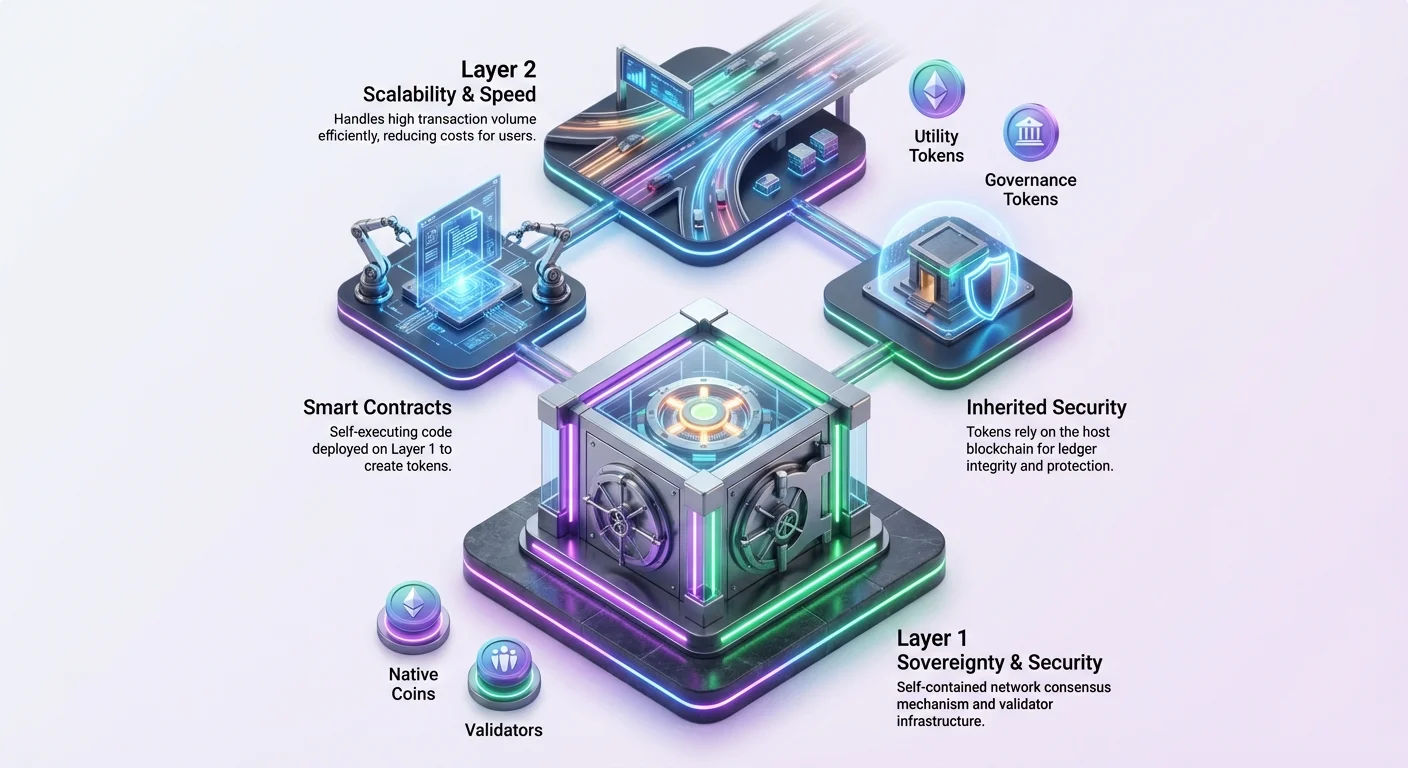
While coins build the roads, tokens represent the vehicles that travel upon them. Tokens are digital assets that do not possess their own blockchain. Instead, they are built on top of existing Layer 1 networks. This distinction creates a dependent relationship where the token relies on the host blockchain for security and transaction processing.
The Role of Smart Contracts
Tokens are brought into existence through the use of smart contracts. These are self-executing pieces of code deployed on a blockchain like Ethereum or Solana. A developer does not need to build a new network from scratch to launch a token. They simply write code that defines the rules of the asset, such as its total supply and how it can be transferred.
This method of creation allows for rapid innovation. Because the underlying infrastructure is already provided by the host Layer 1, developers can focus on functionality. This has led to an explosion of diverse assets. A single Layer 1 blockchain can host thousands of different tokens, all sharing the same security model and validator set. This efficiency is what allows the crypto market to expand so quickly compared to traditional financial systems.
Inheritance of Security
The primary advantage of a token is that it inherits the security of the host chain. A token built on Ethereum is secured by the massive network of Ethereum validators. The token creator does not need to recruit miners or set up validator nodes. The host blockchain processes every transfer and ensures the integrity of the token's ledger.
However, this dependency introduces a unique risk profile. If the host Layer 1 blockchain experiences a failure or a halt in production, the tokens built on top of it become paralyzed. They cannot be moved or traded until the foundation is repaired. Furthermore, tokens are vulnerable to bugs in their specific smart contracts. While the Layer 1 might be secure, a poorly written contract can allow hackers to drain the value of a specific token without compromising the underlying network.
Scalability and the Emergence of Layer 2
The relationship between Layer 1 and the assets built on top is driven largely by the need for scalability. Layer 1 blockchains often prioritize security and decentralization, which can lead to congestion and high fees during periods of high demand. This limitation has necessitated the creation of Layer 2 solutions and specialized tokens designed to handle transaction volume more efficiently.
The Speed and Cost Dilemma
Layer 1 networks like Bitcoin and Ethereum have limited capacity for processing transactions. When thousands of users attempt to transact simultaneously, the network becomes clogged. Fees rise as users bid against each other to have their transactions processed by miners. This dynamic makes Layer 1 chains excellent for high-value settlements but poor for small, everyday payments.
Tokens and Layer 2 networks address this by moving activity off the main chain. Layer 2 solutions bundle hundreds of transactions together and submit them to the Layer 1 as a single batch. This reduces the burden on the main network and drastically lowers the cost for individual users. Tokens facilitate this ecosystem by serving as the medium of exchange within these faster, cheaper environments.
Evolution of Network Architecture
The industry is currently witnessing a shift where the lines between layers are becoming more sophisticated. Layer 2 networks, such as rollups, technically function as secondary blockchains that settle on Layer 1. They often issue their own tokens to govern their specific protocols. This creates a multi-layered economy where value flows from the secure base layer up to the high-speed execution layers.
This evolution allows for a separation of concerns. Layer 1 can focus entirely on being a secure, immutable anchor. Layer 2 networks and tokens can focus on user experience, speed, and specific applications. This hierarchy is essential for the mass adoption of digital assets, as it allows the system to scale without sacrificing the core principles of decentralization and security.
Functional Categories of Digital Assets
Within the hierarchy of layers, tokens are tailored to perform a vast array of functions. Unlike coins, which primarily serve as digital money or network fuel, tokens are programmable. This programmability allows them to represent complex rights, assets, and utilities.
Utility and Access
One of the most common forms of tokens is the utility token. These assets function like a digital key. They grant the holder access to a specific product or service within a blockchain ecosystem. For example, a decentralized cloud storage network might require users to pay in a specific utility token to save files. These tokens are not designed to be investments in the traditional sense but are necessary tools for interacting with decentralized applications.
Governance and Control
Governance tokens represent a shift toward decentralized management. These assets function similarly to shareholder votes. Holders of governance tokens can propose changes to a protocol or vote on decisions made by the community. This might include voting on software upgrades, fee structures, or the allocation of treasury funds.
This model allows projects to be run by their communities rather than a central corporation. The value of a governance token is often tied to the influence it provides over a successful protocol. As a project grows in usage and value, the right to govern that project becomes more desirable.
Stability and Pegged Assets
Stablecoins represent a crucial category of tokens designed to eliminate volatility. These tokens are pegged to the value of an external asset, most commonly the US dollar. They act as a bridge between traditional finance and the crypto economy. Traders use stablecoins to preserve capital during market downturns without exiting the cryptocurrency ecosystem entirely.
Stablecoins are essential for the functioning of decentralized finance. They provide a reliable medium of exchange for lending and borrowing markets. Because they are built as tokens on Layer 1 blockchains, they can be transferred globally in minutes, offering a significant improvement over traditional banking wires.
Distinct Asset Characteristics
The technical differences between coins and tokens lead to distinct operational characteristics. A clear comparison helps investors and users understand what they are holding.
| Feature | Layer 1 Coins (e.g., BTC, SOL) | Tokens (e.g., USDC, UNI) |
|---|---|---|
| Infrastructure | Runs on its own blockchain | Built on an existing blockchain |
| Creation | Integrated into protocol consensus | Deployed via smart contracts |
| Security Source | Native miners or validators | Inherits host chain security |
These distinctions are not merely academic. They dictate how an asset can be used and stored. A Layer 1 coin requires a wallet that specifically supports its unique blockchain. A token, conversely, can be stored in any wallet that supports the host network. For instance, an Ethereum wallet can store Ether (the coin) and hundreds of different ERC-20 tokens simultaneously.
Investment Profiles and Risk Factors
The structural differences between Layer 1 and Layer 2 assets translate directly into different investment profiles. Layer 1 coins are generally viewed as infrastructure plays. Investing in a major Layer 1 coin is similar to investing in the internet protocols themselves. If the network grows and attracts developers, the native coin captures value through increased demand for transaction fees.
Layer 1 assets are often considered to have lower risk compared to tokens, specifically the major established networks. They have longer track records and higher liquidity. However, they also require massive energy or capital resources to secure, meaning their long-term viability depends on sustained adoption. If a Layer 1 network fails to attract applications, its security budget collapses.
The Beta Play of Tokens
Tokens are often viewed as "beta" plays or application-layer investments. They offer higher potential upside because they represent specific projects or use cases that can grow rapidly. A successful decentralized application can see its token price explode even if the underlying Layer 1 grows modestly.
However, tokens carry significantly higher risks. They are subject to smart contract vulnerabilities that coins generally avoid. A bug in a token's code can render it worthless instantly. Additionally, tokens face liquidity risks. Smaller tokens may be difficult to sell without crashing the price. Investors must also consider the regulatory landscape, as some tokens with governance or profit-sharing features may be classified differently than decentralized commodities like Bitcoin.
Market Cycles and Volatility
The volatility profiles differ substantially. During market upswings, tokens often outperform Layer 1 coins as capital rotates into higher-risk assets. In market downturns, tokens typically suffer more severe drawdowns. Layer 1 coins often act as a "flight to safety" within the crypto market itself. Investors will sell their speculative tokens back into Bitcoin or stablecoins when uncertainty rises.
Understanding this dynamic is crucial for portfolio management. A balanced approach often involves holding core positions in established Layer 1 coins while allocating smaller amounts to high-conviction tokens. This strategy attempts to capture the stability of the infrastructure layer while exposing the portfolio to the explosive growth potential of successful applications.
The Blurring Lines of Modern Infrastructure
As the technology matures into 2025, the rigid distinction between coins and tokens is beginning to blur. The industry is moving toward a more fluid model where assets can migrate and transform based on necessity. Innovations in cross-chain technology and asset wrapping are challenging the traditional definitions.
Asset Migration and Evolution
History has shown that successful tokens can evolve into Layer 1 coins. A prominent example is BNB, which began its life as a token on the Ethereum network. As the project grew, the developers launched a dedicated blockchain, and the asset migrated to become the native coin of that new network. This transition allows a project to start with the ease of a token and eventually gain the sovereignty of a coin.
This path suggests that the "token" status is not always permanent. It can serve as a bootstrapping mechanism. Projects can prove their utility and build a community on an existing chain before taking on the massive technical challenge of launching independent infrastructure.
Cross-Chain Interoperability
The rise of bridging technology means that Layer 1 coins frequently appear as tokens on other networks. Bitcoin, for example, exists primarily on its own blockchain. However, millions of dollars worth of Bitcoin exist as "Wrapped Bitcoin" on the Ethereum network. In this form, Bitcoin functions technically as a token.
This allows the value of Layer 1 assets to be used in decentralized finance applications on other chains. It creates a complex web where the economic value of a coin can be exported to competing ecosystems. While the technical definition remains—native coins run on their own chains—the functional reality is that assets are becoming platform-agnostic. Users care less about the technical classification and more about where they can use their value to earn yield or trade.
Conclusion
The hierarchy of digital assets is a fundamental concept that explains the mechanics of the crypto economy. Layer 1 coins serve as the necessary foundation, providing the security, consensus, and infrastructure upon which the entire industry rests. They are the sovereignty layer, offering robust but often slower and more expensive settlement. Tokens and Layer 2 solutions function as the application and scalability layer, leveraging the foundation to offer speed, programmability, and specialized use cases.
Distinguishing between these asset classes allows for better risk management and clearer understanding of value propositions. Coins depend on the health of their networks, while tokens depend on the success of their specific projects and the code of their smart contracts. As the industry evolves, the interplay between these layers will continue to deepen, with cross-chain technologies making the movement of value between them increasingly fluid.
Distinguishing between infrastructure coins and application tokens is the first step toward mastering digital asset strategy.