
The cryptocurrency market operates twenty-four hours a day. This continuous cycle creates immense opportunities for profit, but it also imposes a heavy burden on individual investors. No human can monitor charts, analyze news, and execute trades around the clock without rest. This physical limitation has driven the rapid rise of automated solutions that allow participants to engage with the market passively.
Among these solutions, copy trading has emerged as a dominant force. It bridges the gap between professional expertise and novice participation. Rather than spending years mastering technical analysis or coding complex algorithms, investors can simply mirror the actions of seasoned market veterans. This democratization of trading strategies has transformed how retail investors approach digital assets.
However, the simplicity of copy trading can be deceptive. While the mechanism of copying a trade is straightforward, the ecosystem supporting it is complex. It involves intricate fee structures, varying levels of platform security, and the psychological challenge of entrusting capital to a stranger. Success requires more than just clicking a button. It demands a deep understanding of how these platforms function and how to evaluate the traders leading the pack.
The Mechanics of Copy Trading Systems
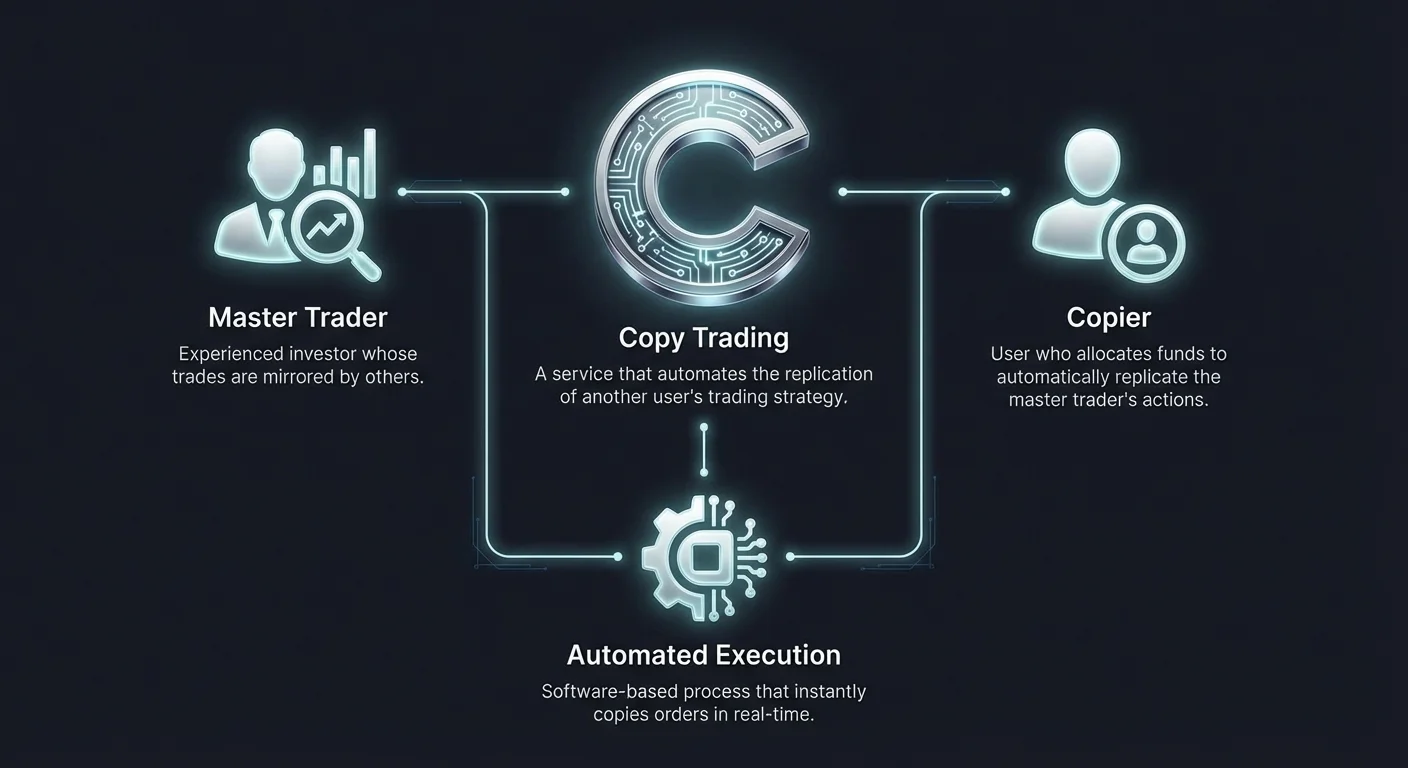
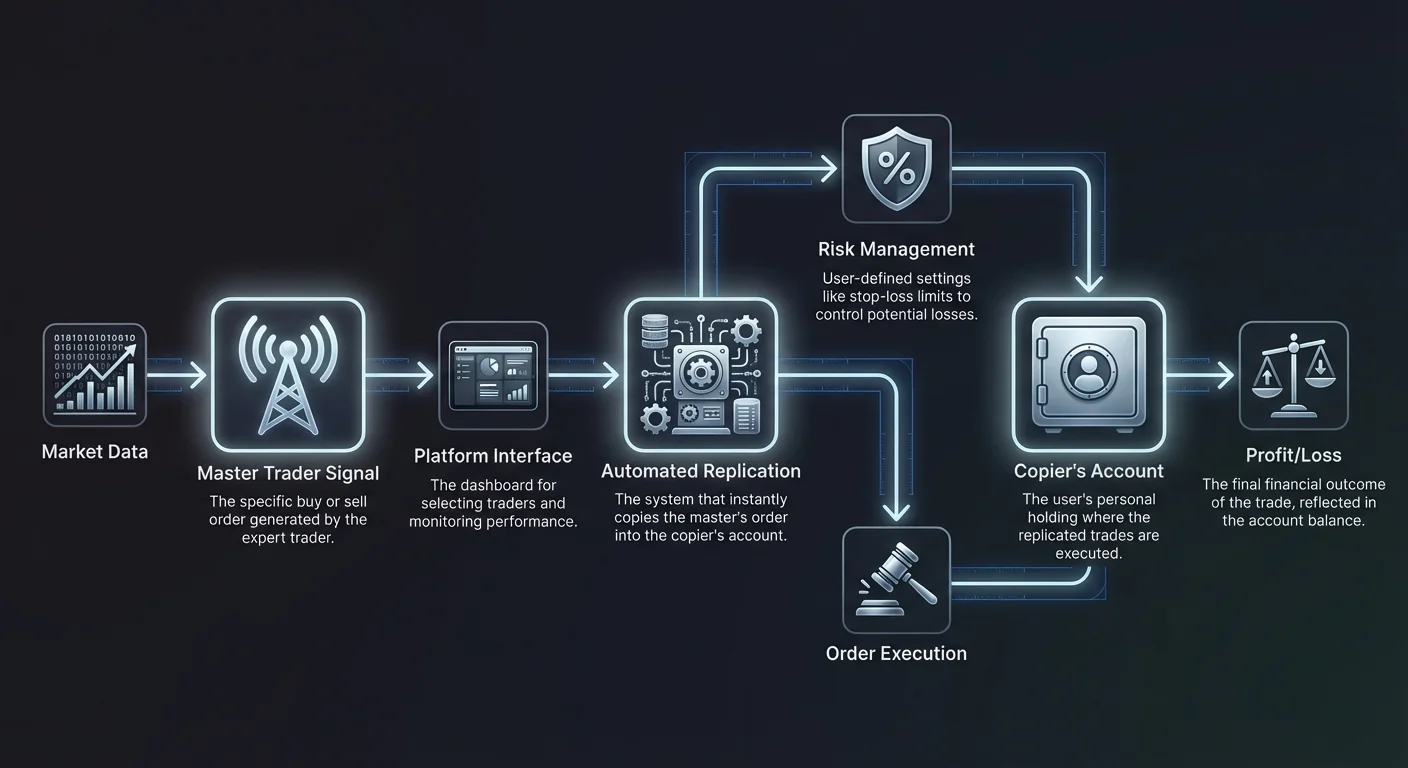
At its core, copy trading is a software-based service that links one user's account to another. The "master" trader executes buy or sell orders on their own account. The platform’s software detects this activity and instantly replicates the same order in the "copier's" account. This replication happens in real-time, ensuring that the copier enters the market at a price point very close to the master trader.
The system adjusts the size of the trade proportionally. If a master trader uses 5% of their portfolio to buy Bitcoin, the system will use 5% of the copier's allocated funds to do the same. This proportional sizing is critical. It allows investors with small balances to follow whales or institutional-grade traders without needing to match their capital dollar for dollar.
This automation extends to the closing of positions as well. When the master trader decides to take profit or cut losses, the system executes the corresponding sell order for the copier. The entire lifecycle of the trade is managed without the copier needing to intervene manually. This hands-off approach is the primary appeal for individuals with full-time jobs or limited market knowledge.
Distinguishing Copy Trading from Social Trading
The terms "copy trading" and "social trading" are often used interchangeably, but they represent different levels of engagement. Understanding the distinction is vital for selecting the right approach to the market.
| Feature | Copy Trading | Social Trading |
|---|---|---|
| Action | Automated trade execution | Manual trade execution based on ideas |
| Control | Passive (system manages trades) | Active (user decides when/what to buy) |
| Focus | Results and performance metrics | Community, discussion, and education |
Social trading functions similarly to a social network. Participants share charts, discuss market sentiment, and post their predictions. A user might read a convincing analysis from a top trader and decide to act on it. However, the execution is manual. The user must log in, set the order, and manage the exit. This retains full control but requires active attention and decision-making.
Copy trading removes the friction of manual execution. It is strictly performance-oriented. While many copy trading platforms include social features—such as news feeds or comment sections—the primary value proposition is the automation. The copier does not need to agree with the master trader’s analysis or even read it. They simply trust the results and let the software handle the logistics.
Benefits of Automated Trade Replication
The most immediate benefit of copy trading is time efficiency. Analyzing cryptocurrency markets is a time-consuming endeavor involving technical chart reading, fundamental research, and sentiment analysis. By copying a trader, an investor effectively outsources this labor. The master trader spends hours studying the market, and the copier reaps the rewards of that effort without the associated time investment.
Access to professional strategies is another significant advantage. Many successful master traders employ complex strategies that are difficult for beginners to replicate. These may involve arbitrage, scalping, or multi-leg hedging strategies. Through copy trading, a novice can utilize these sophisticated approaches immediately. It levels the playing field, allowing retail investors to deploy institutional-grade tactics.
Diversification becomes much easier with copy trading. An investor can allocate capital across multiple master traders with different styles. One trader might focus on Bitcoin stability, while another trades volatile altcoins, and a third focuses on long-term accumulation. This diversity helps spread risk. If one trader has a bad month, the gains from others can help stabilize the overall portfolio.
Evaluating the Risks of Copy Trading
Despite the potential for high returns, copy trading carries inherent risks that can lead to substantial financial loss. The most obvious is the "trader risk." Even the most successful traders have losing streaks. Past performance is never a guarantee of future results. A trader who has been profitable for six months may suddenly struggle when market conditions shift.
Loss of control is a psychological hurdle and a financial risk. When copying a trade, the investor is at the mercy of the master trader’s decisions. If the master trader panics and sells at the bottom, the copier sells at the bottom too. Copiers cannot easily intervene to save a specific trade without disrupting the synchronization of the entire system.
Technical risks such as latency and slippage can also erode profits. While platforms aim for instant replication, there is always a slight delay between the master’s order and the copier’s execution. In highly volatile crypto markets, prices can move significantly in a fraction of a second. This means the copier might get a worse entry price than the master, leading to lower profits or higher losses over time.
Choosing the Right Platform
Selecting the infrastructure for your trading activities is just as important as selecting the traders to follow. Not all exchanges are built equal. The underlying technology, security protocols, and available assets dictate the ceiling of your potential success. A platform with poor liquidity or weak security renders even the best trading strategy useless.
Security and Asset Protection
Security is the paramount concern when choosing a crypto exchange for copy trading. Centralized exchanges hold custody of user funds, making them targets for malicious actors. A reputable platform must employ advanced security measures to safeguard digital assets. This includes the use of cold storage, where the vast majority of client funds are kept offline, disconnected from the internet to prevent hacking attempts.
Two-factor authentication (2FA) is a non-negotiable feature. It adds a layer of defense to user accounts, ensuring that a compromised password does not lead to theft. Top-tier exchanges also offer withdrawal whitelisting, which prevents funds from being sent to unauthorized addresses. This feature is crucial for copy traders who may leave their accounts unattended for long periods.
Regulatory compliance is a strong indicator of a platform’s reliability. Exchanges that adhere to local financial regulations and conduct regular audits demonstrate a commitment to transparency. While regulation contradicts the ethos of some crypto purists, it provides a legal framework that can offer recourse in the event of platform insolvency or fraud.
Liquidity and Execution Speed
Liquidity refers to the ease with which assets can be bought or sold without causing drastic price changes. In the context of copy trading, high liquidity is essential. When a master trader executes a large order, and hundreds of copiers follow suit, the platform must be able to absorb this volume instantly.
If an exchange lacks sufficient liquidity, the sudden influx of orders from copiers can cause "slippage." This occurs when there are not enough sellers at the current price, forcing buyers to pay a higher price to fill their orders. Slippage directly eats into profit margins. A master trader might secure a profitable entry, but their copiers, suffering from slippage, might enter at a loss.
Top crypto exchanges typically boast high trading volumes and a significant number of active users. This depth ensures that orders are filled swiftly and at the desired price points. Before committing to a platform, investors should verify its trading volume, particularly for the specific pairs they intend to trade.
User Interface and Accessibility
The complexity of crypto trading interfaces can be overwhelming for newcomers. A good copy trading platform must balance advanced functionality with usability. The dashboard should clearly display metrics such as current profit and loss, open positions, and available margin. It should be easy to allocate funds to new traders or stop copying underperforming ones.
Mobile accessibility is increasingly important. The cryptocurrency market moves fast, and investors need the ability to monitor their positions from anywhere. High-quality mobile apps that replicate the full functionality of the web platform allow users to react to market events on the go.
Accessibility also extends to language support and customer service. Issues can arise at any time of day. Platforms offering 24/7 support through live chat or email provide a safety net for users. Being able to resolve a technical glitch or a funding issue quickly is vital in a market where minutes can equal significant financial value.
Asset Variety and Market Access
The range of supported cryptocurrencies determines the flexibility of a trading strategy. Some platforms focus heavily on Bitcoin and Ethereum, while others offer hundreds of altcoins. A platform with a wide selection allows for greater diversification. It enables master traders to hunt for opportunities in niche markets that might be overlooked by the broader public.
Beyond spot trading, many advanced platforms offer derivatives like futures and options. These financial instruments allow traders to profit from falling prices (shorting) or to use leverage to amplify their positions. While riskier, these tools are essential for professional traders to hedge against volatility. A copy trading platform that supports these markets offers more robust opportunities for profit in all market conditions.
Selecting Leading Crypto Traders to Copy
Once a secure and functional platform is chosen, the next challenge is selecting the right individuals to follow. This is the most critical variable in the equation. Platform leaderboards can be misleading, often highlighting short-term gains that are unsustainable. A rigorous evaluation process is necessary to identify traders with genuine skill rather than just luck.
Analyzing Performance Metrics
Return on Investment (ROI) is the most advertised metric, but it is often the least useful for assessing long-term viability. A trader showing 500% ROI in one month might have taken reckless risks that could just as easily have resulted in a total loss. To find sustainable success, investors must look beyond the headline numbers.
Maximum Drawdown is a crucial indicator of risk. It measures the largest percentage drop a trader’s portfolio has experienced from its peak. A trader with high returns but a 60% drawdown is extremely risky. It indicates that at some point, they lost more than half their value. Copiers must ask themselves if they can stomach seeing their balance drop by that amount, which is often tied to understanding variance.
Win Rate offers insight into consistency. It represents the percentage of trades that are profitable. However, a high win rate can be deceptive if the losing trades are massive. A trader might win 90% of the time, making small gains, but lose 10% of the time with catastrophic losses that wipe out all profits. Therefore, the win rate must be analyzed in conjunction with the risk-reward ratio of individual trades.
Consistency and Track Record
Longevity is a hallmark of a skilled trader. Anyone can get lucky during a bull market when everything is going up. The true test of skill is profitability during a bear market or a period of sideways consolidation. Investors should look for traders with a track record spanning at least six to twelve months.
Consistency is preferable to erratic spikes in profit. A trader who generates a steady 5% to 10% return every month is generally a safer bet than one who fluctuates between +50% and -30%. Steady growth allows for the power of compounding to work effectively over time.
Reviewing the trader's activity history is also important. Does the trader stick to a specific strategy, or do they seem to change their approach randomly? Traders who jump from scalping to swing trading to long-term holding without a clear reason may lack discipline. A consistent approach indicates a well-defined trading plan.
Assets Under Management (AUM)
Most platforms display the total amount of money following a specific trader, known as Assets Under Management (AUM). A high AUM can be a vote of confidence from the community, suggesting that many others trust this trader. However, a very high AUM can also be a disadvantage.
When a trader manages a massive amount of capital, their agility decreases. Entering and exiting positions becomes harder without moving the market price. This is particularly true for illiquid altcoins. A trader with millions in AUM might struggle to sell a position quickly, leading to slippage for their copiers. There is often a "sweet spot" where a trader has enough followers to be validated but not so many that their execution suffers.
Risk Scores and Strategy Alignment
Many platforms assign a proprietary risk score to each trader. This score is calculated based on factors like leverage usage, portfolio concentration, and volatility. A low risk score usually implies a conservative strategy, while a high score indicates aggressive trading.
Investors must ensure the master trader’s risk profile aligns with their own. A conservative investor looking to preserve capital should avoid traders with high risk scores, even if their returns are attractive. Conversely, an investor with risk capital who is seeking exponential growth might specifically target higher-risk traders.
Portfolio concentration is another factor. Some traders go "all in" on a single asset, while others spread their bets across twenty different coins. A highly concentrated portfolio is more volatile. Understanding the composition of the master trader's holdings helps in assessing whether their strategy fits the copier's diversification goals.
Understanding Costs and Fees
Copy trading is not free. Platforms and master traders need to be compensated for their services. These costs can significantly impact net returns and must be factored into any investment decision. Understanding the different types of fees is essential for accurate profit calculation.
Performance Fees
The most common fee in copy trading is the performance fee. This is a "success fee" charged only when the copy trade results in a profit. It is typically a percentage of the gains, often ranging from 10% to 30%. This model aligns the interests of the master trader and the copier. The master trader only gets paid if the copier makes money.
For example, if a copier makes a $100 profit on a trade and the performance fee is 20%, they keep $80, and $20 goes to the master trader. While this reduces the upside, it is generally considered a fair exchange for the expertise provided.
Management and Subscription Fees
Some platforms or specific professional traders charge a fixed management fee. This is often a percentage of the total assets being copied, calculated annually but charged monthly or daily. This fee applies regardless of performance. Even if the portfolio loses value, the management fee is still deducted.
Subscription fees are another model. Users may pay a monthly flat rate to access the platform’s copy trading features or to follow specific "VIP" traders. This model can be cost-effective for investors with large capital, as the flat fee becomes a smaller percentage of their portfolio compared to a performance fee.
Spreads and Transaction Costs
Every trade involves a transaction cost. In crypto markets, this often takes the form of a spread—the difference between the buy and sell price. Copy trading platforms may mark up the spread slightly as a way to generate revenue. While a fraction of a percentage might seem small, frequent trading can cause these transaction costs to accumulate rapidly.
If a master trader employs a high-frequency trading strategy, executing dozens of trades per day, the spread costs can be substantial. Copiers should be wary of strategies that "churn" the account, generating fees for the platform without generating significant net profit for the investor.
Withdrawal and Deposit Fees
Moving money in and out of a platform often incurs fees. While deposits are frequently free to encourage funding, withdrawals usually carry a cost. This can be a flat fee or a percentage of the withdrawal amount. Additionally, network fees for transferring cryptocurrency on the blockchain must be considered.
Investors should check if the platform charges fees for converting fiat currency to crypto. Hidden conversion fees can eat into the initial capital before trading even begins. Being aware of these logistical costs ensures that there are no unpleasant surprises when it comes time to cash out profits.
Advanced Copy Trading Strategies
Merely selecting a trader and walking away is a basic approach. To truly maximize the potential of copy trading while minimizing risk, investors can employ more advanced management strategies. These techniques allow for a more tailored and resilient investment portfolio.
Multi-Trader Diversification
Putting all capital into a single master trader is a high-risk strategy. Even the best traders can have a disastrous month. To mitigate this, investors should build a portfolio of master traders. By allocating funds across three to five different traders, the risk is spread out.
Ideally, these traders should have non-correlated strategies. If one trader focuses on long-term Bitcoin accumulation, another should focus on short-term altcoin scalping. If the crypto market crashes, the long-term holder might suffer, but the scalper might profit from shorting the market. This internal hedging creates a smoother equity curve and reduces overall volatility.
Stop-Loss and Take-Profit Settings
Many platforms allow copiers to set their own risk parameters independent of the master trader. A "hard stop" can be set on the entire copy relationship. For instance, an investor can configure the system to stop copying a specific trader if the allocated equity drops by 20%.
This feature protects the copier from a total blowout. If a master trader goes "on tilt"—making irrational, emotional decisions to recover losses—the hard stop acts as a circuit breaker, severing the link before the account is drained. Similarly, take-profit levels can be set to secure gains once a certain threshold is reached.
Manual Intervention
While automation is the goal, manual intervention is sometimes necessary. Copiers retain the ability to close individual trades manually. If a master trader is holding a losing position for too long in the hope that it will turn around, the copier can override this decision and close the trade to cut losses.
This hybrid approach combines the automated entry of the master trader with the risk management of the investor. However, it requires more active monitoring. Constant manual interference can also disrupt the strategy's mathematical edge, so it should be used judiciously and only when the master trader deviates significantly from their usual behavior.
Compounding vs. Profit Taking
Deciding what to do with profits is a strategic choice. One option is compounding—leaving the profits in the account to be used for future trades. This allows the capital base to grow, potentially leading to exponential returns. This is aggressive and maximizes exposure to the master trader.
The alternative is regular profit taking. This involves withdrawing a portion of the gains at set intervals. This strategy reduces overall risk. By "taking chips off the table," the investor ensures that they recoup their initial investment. Once the initial capital is recovered, the remaining trading is effectively risk-free, funded entirely by "house money."
Automated Alternatives: Bots and Algorithms
Copy trading is not the only form of automation available to crypto investors. Algorithmic trading bots offer an alternative path. While copy trading relies on human decision-making, bots rely on code and mathematical rules. Understanding these tools provides a broader perspective on automated investing.
Grid Trading Bots
Grid trading is a strategy designed for sideways or ranging markets. The bot places a series of buy and sell orders at predetermined intervals around a set price. As the price fluctuates up and down, the bot automatically buys low and sells high, capturing small profits from normal market volatility.
This strategy is highly effective when an asset is consolidating and lacks a clear trend. Unlike copy trading, which depends on a human predicting a direction, grid bots profit from the lack of direction. They are purely mechanical and emotionless. However, if the market breaks out of the grid range strongly in one direction, the bot can incur temporary losses or exit positions too early.
Arbitrage Bots
Arbitrage exploits price differences for the same asset across different exchanges. If Bitcoin is trading at $50,000 on Exchange A and $50,100 on Exchange B, an arbitrage bot can buy on A and sell on B instantly, locking in a risk-free profit.
These bots require speed and precision that no human can match. They offer a way to generate returns that are theoretically independent of market direction. However, competition is fierce. High-frequency trading firms dominate this space, and retail arbitrage bots often struggle to beat the speed of institutional algorithms. Furthermore, withdrawal fees and transfer times can eat into the slim margins of arbitrage trades.
Dollar-Cost Averaging (DCA) Bots
DCA is a simple long-term strategy. A DCA bot automatically buys a fixed dollar amount of a cryptocurrency at regular time intervals, regardless of the price. This smooths out the average entry price over time, reducing the impact of short-term volatility. While it doesn't offer the explosive potential of copying a leverage trader, it is a statistically proven method for building wealth in an asset class that is trending upwards over the long term, fitting into modern DCA strategies.
This is the most passive and lowest-risk form of automation. It removes the stress of trying to time the market bottom. While it doesn't offer the explosive potential of copying a leverage trader, it is a statistically proven method for building wealth in an asset class that is trending upwards over the long term.
Getting Started with Copy Trading
Embarking on a copy trading journey requires a systematic approach. Rushing in with large capital is a recipe for disaster. A step-by-step process ensures that the technical and psychological foundations are in place before significant risk is taken.
Account Verification and Security Setup
The first step is creating an account on a chosen exchange. This involves providing personal information to comply with Know Your Customer (KYC) regulations. Users will typically need to upload a government ID and a selfie. Once verified, immediate attention should be turned to security.
Enabling 2FA is mandatory. Using an authenticator app is safer than SMS verification, which is vulnerable to SIM-swapping attacks. Users should also set up strong, unique passwords and consider using a dedicated email address for their trading accounts to minimize exposure to phishing attempts.
Small Scale Testing
Before allocating significant funds, investors should conduct a "test drive." Most platforms allow for copying with small amounts. Allocating a nominal sum to a chosen trader allows the investor to see how the system works in real-time.
This testing phase reveals important details. How fast is the execution? Are the fees transparent? Does the trader’s style match their description? Watching the system operate for a few weeks provides valuable data. It allows the investor to become comfortable with the interface and the flow of funds without the stress of potential large losses.
Ongoing Monitoring and Adjustment
Copy trading is "set and forget" only to a degree. Successful investors treat it as an active management role. Checking the portfolio performance weekly is recommended. This involves more than just looking at the total balance.
Investors should review the recent trades of their masters. Has their behavior changed? Are they increasing risk to chase losses? Are they trading assets they usually avoid? If a trader’s metrics begin to deteriorate, the investor must be ready to cut the cord and reallocate funds to a better-performing alternative. The market evolves, and a trader who was a superstar last year may be obsolete today.
Conclusion
The landscape of cryptocurrency trading has been fundamentally altered by the advent of copy trading platforms. These tools have dismantled the barriers to entry that once kept retail investors on the sidelines of sophisticated market strategies. By leveraging the expertise of seasoned professionals, individuals can participate in the digital asset economy with a level of proficiency that would otherwise take years to acquire. The ability to diversify across multiple expert strategies, automate execution, and remove emotional bias offers a compelling value proposition for the modern investor.
However, this accessibility comes with the responsibility of due diligence. The ease of clicking "copy" can mask the complex risks involved. Volatility, platform reliability, and the human fallibility of master traders are constant factors that must be managed. Success is not guaranteed by the software alone; it is the result of careful platform selection, rigorous analysis of trader metrics, and disciplined risk management. The technology provides the vehicle, but the investor must still steer the course.
Ultimately, copy trading serves as a powerful bridge. It connects capital with competence. For those willing to invest the time to understand the mechanics and monitor the risks, it represents one of the most efficient ways to navigate the turbulent waters of the crypto market. It turns trading from a solitary, high-stress endeavor into a collaborative, data-driven pursuit of financial growth.
True success in copy trading comes from managing the traders you follow, not just following them.