
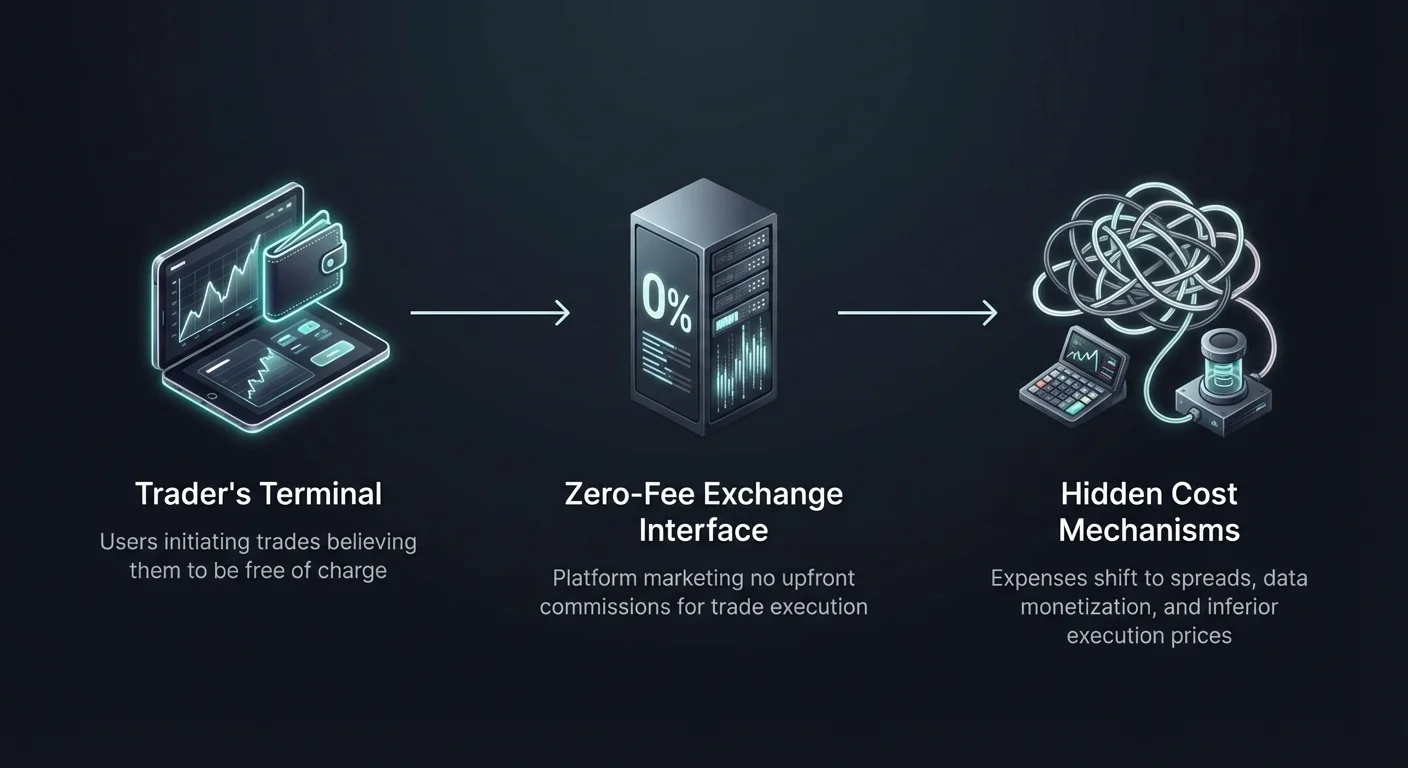
The allure of trading cryptocurrency without paying visible commissions has become a dominant marketing strategy in the digital asset ecosystem. As the industry matures, platforms increasingly compete for user attention by slashing upfront costs, offering what appears to be a free service for executing trades. However, the economic reality of financial markets dictates that services are rarely truly free. When explicit transaction fees disappear, costs often migrate to less visible areas of the trade execution process.
Understanding the mechanics behind these zero-fee models requires a deep dive into market structure, liquidity provision, and order routing. Traders who believe they are bypassing costs may actually be paying them through wider spreads, data utilization, or inferior execution prices. The shift from commission-based models to spread-based or rebate-based models fundamentally changes how an exchange operates and generates revenue.
For the average investor, these distinctions might seem academic, but they have a direct impact on profitability. A lack of transparency in how orders are handled can erode gains over time, particularly for active traders. By analyzing the infrastructure of zero-fee environments, including over-the-counter (OTC) desks and swap platforms, users can better navigate the trade-offs between convenience and cost efficiency.
The Mechanics of Zero-Fee Incentives
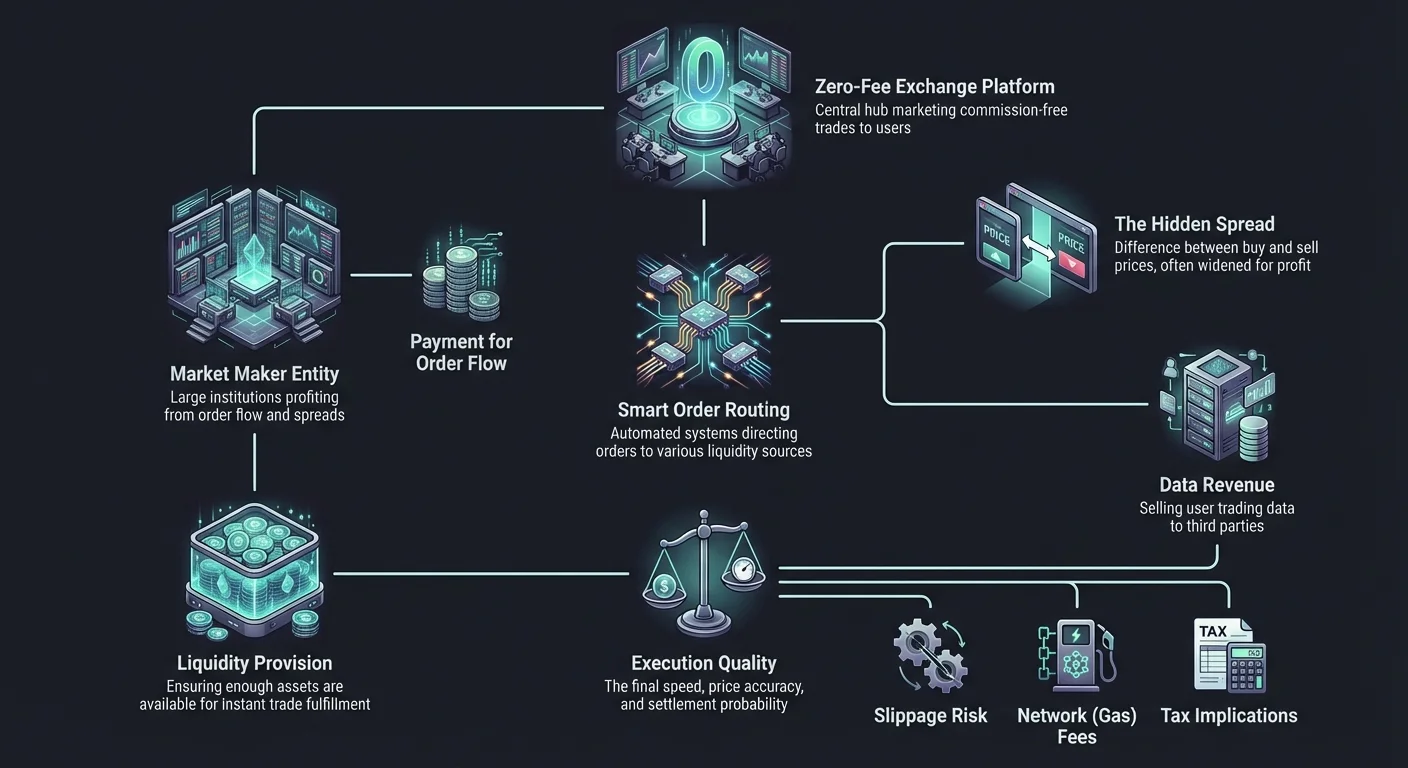
The concept of zero-fee trading relies heavily on alternative revenue streams that replace traditional commissions. In many cases, exchanges cultivate relationships with market makers and liquidity providers to facilitate this model. Rather than charging the user a fee per trade, the platform may generate revenue through rebates or incentives provided by these third parties. Market makers benefit from the order flow generated by the exchange’s user base, allowing them to profit from the difference between buying and selling prices.
This dynamic creates an ecosystem where the volume of trades becomes the primary commodity. Exchanges are incentivized to route orders to specific liquidity providers who offer rebates, a practice that can sometimes conflict with finding the absolute best price for the trader. While the user sees a transaction cost of zero on their screen, the execution price they receive may be slightly less favorable than the broader market rate.
Market Maker Incentives and Liquidity
Liquidity is the lifeblood of any zero-fee trading system. Exchanges must ensure there are enough assets available to fulfill buy and sell orders instantly. To achieve this, they offer incentives to market makers—large institutions or entities that hold significant amounts of crypto. These incentives often take the form of reduced fees or direct payments for providing liquidity to the order book.
In a zero-fee environment, the market maker effectively subsidizes the retail trader's cost. In exchange, they gain access to a steady stream of orders against which they can trade. This arrangement allows market makers to capture the spread on thousands of transactions. For the exchange, maintaining high liquidity is essential to prevent slippage, where a lack of available assets causes the price to shift unfavorably during the trade.
The Hidden Cost of Spreads
The most significant hidden cost in a zero-fee or low-fee environment is the spread. The spread represents the difference between the highest price a buyer is willing to pay (the bid) and the lowest price a seller is willing to accept (the ask). In a transparent, commission-based market, spreads tend to be tighter because the exchange makes its money from the fee, not the price discrepancy.
In zero-fee models, the exchange or the market maker frequently widens this spread. For example, if Bitcoin is trading at a market rate of $50,000, a zero-fee platform might quote a buy price of $50,100 and a sell price of $49,900. The $200 difference is effectively a hidden fee built into the price of the asset itself. Users essentially pay a premium for the convenience of not calculating a separate commission fee.
Fixed Versus Floating Rates
Cryptocurrency swap platforms often employ different rate mechanisms that can obscure these costs. Some services offer fixed rates, which guarantee a specific price for a set period, usually to protect the user from volatility during the transaction. While this provides certainty, the spread on fixed rates is typically much wider to buffer the platform against sudden market movements.
Floating rates, conversely, fluctuate with the market until the moment of execution. While generally offering a tighter spread, they expose the trader to slippage if the market moves aggressively while the transaction is processing. Understanding whether a platform uses fixed or floating rates is crucial for calculating the true cost of a digital asset swap, as the "fee" is entirely internalized within the exchange rate.
OTC Trading and Market Impact
Over-the-counter (OTC) trading represents a different segment of the market where hidden costs manifest differently. OTC desks facilitate large-volume transactions directly between parties, bypassing public order books. This method is preferred by institutional investors and high-net-worth individuals to avoid "market impact," which occurs when a large order moves the market price significantly on a public exchange.
By moving these trades off-chain or off-book, OTC platforms provide privacy and stability. However, the personalized nature of this service means the pricing is opaque. The "fee" for an OTC trade is almost exclusively found in the spread offered by the desk. Institutional clients often negotiate these rates, but the baseline cost includes a premium for the liquidity and discretion provided.
The Role of Smart Order Routing
To manage the costs associated with large trades, institutional platforms employ smart order routers. These automated systems scan multiple global liquidity pools and exchanges simultaneously to find the best available prices. By breaking a large order into smaller chunks and executing them across different venues, the router minimizes the price disruption that would occur if the entire order were dumped on a single exchange.
This technology is essential for maintaining competitive execution prices in the OTC space. Without smart routing, a massive buy order could exhaust the liquidity at a specific price point, forcing the buyer to purchase subsequent coins at progressively higher prices. The efficiency of the router directly correlates to the cost savings for the trader, masking the complexity of the underlying market mechanics.
Privacy and Discretionary Costs
Confidentiality is a primary selling point for OTC services, but it acts as a value-add service that contributes to the overall cost structure. In a public exchange environment, transparency is high, but privacy is low; everyone can see the buy and sell walls. OTC desks offer a "discreet" environment where trade intentions are not broadcast to the market.
This privacy prevents other traders from front-running a large order—placing their own trades ahead of a known massive transaction to profit from the expected price movement. The cost of this protection is embedded in the execution price. Traders essentially pay a premium to keep their strategic moves hidden from the public eye, ensuring that their own trading activity does not turn the market against them before they can finish their position.
Liquidity and Slippage Analysis
Liquidity refers to the ease with which an asset can be converted into cash or another coin without affecting its price. In the context of zero-fee trading, liquidity is the primary determinant of execution quality. A platform with low liquidity will inevitably suffer from high slippage, regardless of its fee structure. Slippage occurs when the final executed price of a trade differs from the expected price at the time the order was placed.
On platforms that claim to be fee-free, low liquidity can result in effective costs that far exceed a standard commission. If a trader tries to sell a volatile altcoin on an illiquid zero-fee exchange, they may find that the realized price is 1% or 2% lower than the market rate. This loss is a direct financial hit, functionally identical to a fee, yet it often goes unnoticed by inexperienced users who are focused solely on the "0% commission" banner.
| Factor | High Liquidity Impact | Low Liquidity Impact |
|---|---|---|
| Execution Speed | Instant fulfillment | Potential delays |
| Price Stability | Minimal slippage | High slippage risk |
| Spread Width | Tighter spreads | Wider spreads |
Swap Platforms and Network Fees
Crypto swap platforms simplify the trading process by allowing users to exchange one digital asset for another directly, often without an intermediate fiat step. While these platforms offer immense convenience and often boast "no hidden fees," they are subject to the underlying costs of the blockchain networks they utilize. These network fees, or gas fees, are paid to miners or validators to process the transaction and are entirely separate from the platform's revenue.
In times of high network congestion, such as during a bull market run or a popular NFT mint, network fees can skyrocket. A swap platform might not charge a service fee, but the user effectively pays for the transaction through the blockchain cost. Additionally, cross-chain swaps—moving assets from Ethereum to Solana, for example—involve complex bridging protocols that may incur multiple network fees, compounding the total cost of the trade.
Efficiency of the Swap
The efficiency of a swap is measured by how closely the final amount received matches the estimated return. Top-tier platforms boast high "triumph rates," meaning the vast majority of trades are executed at or better than the quoted price. However, deviations occur. If a platform has a slow response time or poor connectivity to liquidity pools, the price can drift between the moment the user clicks "swap" and the moment the transaction is confirmed.
Real-time tracking systems attempt to mitigate this by keeping users informed, but they cannot control blockchain volatility. Users must be vigilant about the estimated network fees displayed before confirmation. On some non-custodial platforms, users have the ability to adjust their "slippage tolerance," setting a maximum percentage they are willing to lose on price movement to ensure the transaction goes through.
The Risk of Counterparty and Custody
While not a direct monetary fee, counterparty risk represents a potential cost in terms of security and asset recovery. Centralized zero-fee exchanges often act as custodians of user funds. When a trader deposits capital, they are trusting the exchange's security protocols, cold storage practices, and solvency. If the exchange fails or is compromised, the "cost" of trading there becomes the total loss of assets.
Non-custodial swap platforms mitigate this specific risk by allowing users to trade directly from their private wallets. The platform never holds the funds; it merely facilitates the exchange via smart contracts. This setup grants users full control but transfers the responsibility of security entirely to the individual. Losing a private key or interacting with a malicious contract results in a total loss, highlighting that the removal of platform fees often shifts the burden of security and risk management to the user.
Comparative Analysis of Exchange Types
To fully understand the landscape of trading costs, one must distinguish between the different types of exchange architectures. Each type offers a unique value proposition that alters where and how costs are incurred.
Centralized Exchanges (CEXs)
Centralized exchanges function similarly to traditional stock markets. They maintain an order book and match buyers with sellers. In zero-fee CEX models, the costs are usually hidden in data relationships with market makers or withdrawal fees. They offer high speed and user-friendly interfaces but require users to trust the central authority. The liquidity is generally aggregated in one place, which helps stabilize prices, but the reliance on a central entity introduces a single point of failure.
Decentralized Exchanges (DEXs)
DEXs operate without a central intermediary, using automated market maker (AMM) protocols. Here, the trading fees are explicit and paid directly to liquidity providers, but there is no corporate entity taking a cut for profit. However, DEXs are notorious for high network fees on chains like Ethereum. The cost of a trade on a DEX is highly variable and dependent on blockchain traffic. While they eliminate the "middleman" markup, they introduce the raw cost of block space demand.
Hybrid Exchanges
Hybrid platforms attempt to merge the low latency of centralized systems with the security of decentralized custody. They might use a centralized order book for matching trades (speed) while settling transactions on the blockchain (security). The cost structure here is a blend; users might pay a small fee for the matching service and a separate network fee for settlement. These platforms aim to minimize the hidden costs of spreads found in CEXs while avoiding the massive gas spikes of DEXs, though they often struggle with liquidity compared to their purely centralized counterparts.
| Exchange Type | Primary Cost Driver | Privacy Level |
|---|---|---|
| Centralized (CEX) | Spreads & Withdrawals | Low (KYC required) |
| Decentralized (DEX) | Network/Gas Fees | High (No KYC) |
| Hybrid | Mixed Fees | Moderate |
Analyzing Trade Execution Quality
The true cost of a trade is not just the fee paid, but the quality of execution. This concept encompasses speed, price accuracy, and the likelihood of successful settlement. In zero-fee models, execution quality can sometimes suffer because the order flow is commoditized. If an order is routed to a specific market maker to earn a rebate for the exchange, that market maker may hold the order for a fraction of a second to evaluate it, potentially leading to a delay or a worse fill price.
Sophisticated traders analyze "fill rates" and "latency" to determine if a zero-fee platform is actually cost-effective. If a platform consistently fills orders at the bottom of the allowable slippage range, the trader is bleeding capital on every transaction. Transparency reports and third-party audits can sometimes shed light on these practices, but often the user must infer them from trading performance over time.
Regulatory and Compliance Factors
The regulatory environment also influences the hidden costs of trading. Platforms that are fully compliant with financial regulations, such as those holding specialized licenses or certifications (e.g., SOC 1/2, NYDFS regulation), often have higher operational overheads. These costs are passed down to the user, sometimes through fees, but often through slightly less competitive spreads.
However, the cost of using an unregulated, non-compliant platform carries the risk of legal intervention. If an exchange is shut down or restricted by authorities, users may face significant hurdles in recovering funds. Therefore, the "premium" paid on a regulated zero-fee platform can be viewed as an insurance cost against regulatory seizure. Users must weigh the immediate savings of using a cheaper, offshore platform against the long-term security of a compliant domestic venue.
Tax Implications of Swapping
A frequently overlooked "cost" in the swapping and trading ecosystem is the tax liability generated by frequent transactions. In many jurisdictions, swapping one cryptocurrency for another is considered a taxable event, regardless of whether the user cashes out to fiat currency. Every time a swap occurs, it triggers a capital gains calculation based on the value of the asset at the time of the trade compared to its cost basis.
Zero-fee platforms that encourage high-frequency trading or easy swapping can inadvertently lead users into a complex tax situation. A user might perform hundreds of swaps to chase small profits, only to realize that the administrative cost of tracking these events and the potential tax bill outweigh the trading gains. Detailed record-keeping is essential. While not a fee charged by the platform, the tax burden is a definitive financial consequence of utilizing high-velocity trading tools.
The Role of Education and Resources
Finally, the educational gap represents a significant cost barrier. Novice traders often lose money not through fees, but through poor decision-making facilitated by complex interfaces or misunderstood financial products. Platforms that invest in educational resources help mitigate this indirect cost. By providing tutorials, market analysis, and clear explanations of order types (limit vs. market), exchanges can help users avoid costly mistakes like fat-finger errors or misunderstanding leverage.
Access to customer support is equally vital. When a technical issue arises—such as a stuck transaction or a deposit delay—the time spent resolving it is a cost. Platforms with 24/7 support and responsive teams reduce the "opportunity cost" of being unable to trade. Evaluating an exchange should always include an assessment of their support infrastructure, as the inability to trade during a critical market move can be the most expensive cost of all.
Conclusion
The landscape of cryptocurrency trading has evolved to offer a diverse array of fee structures, from traditional commission models to innovative zero-fee and swap-based systems. While the promise of trading without upfront costs is compelling, it is imperative for investors to look beyond the marketing slogans. The absence of a visible transaction fee rarely means the absence of cost. Instead, expenses shift to spreads, data usage, potential slippage, and network fees.
Whether utilizing a massive centralized exchange, a private OTC desk for institutional volume, or a non-custodial swap platform, the economics of trade execution remain constant: liquidity providers and platforms must generate revenue. For the user, the goal is to identify where these costs lie—be it in the width of the bid-ask spread, the varying rates of fixed versus floating swaps, or the inherent volatility risks of illiquid markets. By understanding the mechanisms of order routing and market maker incentives, traders can make informed decisions that prioritize true value over superficial savings.
True cost efficiency in crypto is found not in the absence of fees, but in the transparency of execution.