
The cryptocurrency market operates continuously, creating a trading environment that never sleeps. This 24/7 cycle presents both immense opportunities and significant logistical challenges for individual investors. Unlike traditional stock markets that close in the evenings and on weekends, digital asset exchanges remain active at all times.
Human traders cannot monitor these markets indefinitely. The need for sleep, work, and other daily activities means that profitable movements often occur when a trader is away from their screen. This limitation has driven the rapid adoption of automated trading solutions.
Among these automated solutions, grid trading has emerged as a highly popular strategy, alongside dollar-cost averaging (DCA) automation. It is designed specifically to capitalize on the natural volatility of crypto assets. Rather than betting on a single directional move, grid trading profits from the "noise" of the market.
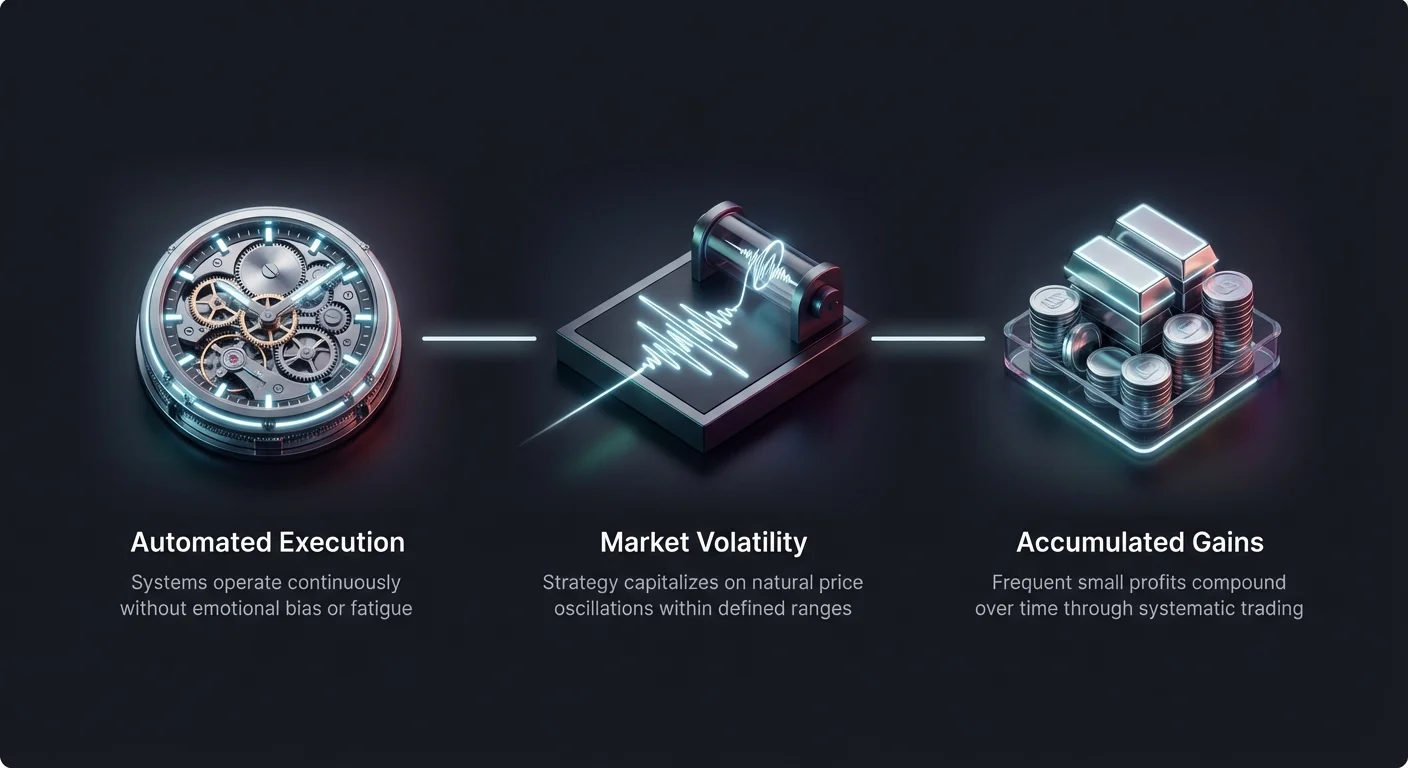
At its core, this strategy seeks to accumulate small profits frequently. It creates a mesh of orders that capture gains as prices oscillate between established levels. This approach shifts the focus from predicting the future to managing the present volatility.
To implement this successfully, traders must understand the underlying mechanics. It requires a shift in mindset from long-term holding to high-frequency systematic execution. The strategy relies on mathematics and probability rather than intuition or news cycles.
The Core Concept of Grid Trading
Grid trading is an automated strategy that places a series of buy and sell orders at predefined price intervals. These intervals create a "grid" of orders covering a specific price range. The goal is to buy an asset when its price drops and sell it when the price rises.
This mechanism works best in markets that are moving sideways or "ranging." In such environments, the price bounces between a support level and a resistance level without establishing a strong trend in either direction. The bot exploits these minor fluctuations.
For example, if Bitcoin is trading between $60,000 and $65,000, a trader can set up a grid within this range. The system will automatically place buy orders at lower increments (e.g., $60,500, $61,000) and sell orders at higher increments.
Removing Emotional Decision Making
One of the primary advantages of using a grid trading bot is the elimination of emotional bias. Manual trading is often plagued by fear and greed. Traders may panic sell during a dip or buy into a rally due to Fear Of Missing Out (FOMO).
Automated systems follow a strict set of rules. They do not hesitate or second-guess their programming. If the price hits a specific level, the order executes immediately. This consistency is crucial for long-term profitability in volatile markets.
By removing the psychological element, traders can stick to their plan. The bot executes the strategy exactly as configured, regardless of market sentiment or breaking news. This discipline is difficult for human traders to maintain over long periods.
Understanding Market Volatility and Asset Selection
Volatility is the lifeblood of grid trading strategies. Without price movement, the grid cannot generate profit. A completely stagnant asset will result in open orders that never fill, tying up capital without generating returns. Therefore, asset selection is the first critical step in setup.
Traders typically look for assets with high liquidity and established trading volumes. High liquidity ensures that orders are filled quickly and at the desired price points. Slippage, where an order fills at a worse price than expected, can eat into the thin margins of a grid strategy.
Established cryptocurrencies like Bitcoin and Ethereum are common choices. They offer significant volatility while maintaining enough liquidity to support frequent trading. However, they are not the only options available for this strategy.
Altcoins and High Variance
Altcoins often exhibit higher volatility than major caps. This increased variance can lead to more frequent grid executions and potentially higher profits. However, it also comes with increased risk.
If an altcoin crashes below the lower bound of the grid, the trader may be left holding a "bag" of depreciating assets. Conversely, if it moons (skyrockets) beyond the upper bound, the bot will sell all positions early, missing out on the rest of the rally.
Traders must balance the potential for higher yields against the risk of exiting the range. Analyzing historical price charts helps in identifying assets that tend to range rather than trend aggressively.
Stablecoin Pairs
For those seeking lower risk, grid trading on stablecoin pairs is an option. Pairs like USDT/USDC or DAI/USDT technically should trade at 1:1, but they often fluctuate slightly due to market demand and liquidity shifts.
A grid bot can profit from these microscopic de-pegs. While the profit per trade is extremely small, the risk of a major price collapse is significantly lower compared to volatile crypto assets.
This strategy essentially acts as a market-making operation. It provides liquidity to the exchange while capturing the spread between stablecoins. It is a volume game that requires substantial capital to generate meaningful returns.

The Mechanics of Order Execution
Understanding how the bot executes trades is vital for optimization. When a grid is initialized, the system places a mix of limit buy and limit sell orders. The current market price serves as the starting point.
Orders below the current price are buy limit orders. Orders above the current price are sell limit orders. As the market moves down, buy orders are filled. For every buy order filled, the bot automatically places a corresponding sell order at a higher level.
This creates a cycle of "buy low, sell high" on a micro scale. If the market moves up, sell orders are filled, and the bot places corresponding buy orders at lower levels to catch the next dip.
The Importance of Grid Spacing
Grid spacing refers to the distance between each order line. This can be set as a fixed dollar amount (Arithmetic) or a percentage (Geometric). The choice between these two defines how the grid behaves across different price levels.
Arithmetic grids maintain a constant price difference between levels. For example, placing a line every $100. This is simple to understand and calculate. It works well when the price range is relatively narrow.
Geometric grids maintain a constant percentage difference. For example, placing a line every 1%. As the price increases, the absolute dollar difference between lines grows. This ensures that the profit margin percentage remains consistent regardless of the asset's price.
Frequency vs. Profitability
There is a trade-off between grid density and profit per trade. A dense grid with many lines will execute trades very frequently. However, the profit per trade will be small because the gap between buying and selling is narrow.
Conversely, a sparse grid with fewer lines will trade less often. But, when a trade does occur, the price gap is larger, resulting in a higher profit per transaction.
Traders must find the "sweet spot" for their chosen asset. If the grid is too tight, trading fees might consume the meager profits. If it is too wide, the market might not move enough to trigger orders, leading to stagnation.
Analyzing Fee Structures and Costs
Trading fees are the silent killer of high-frequency strategies like grid trading. Since the bot may execute hundreds of trades per day or week, even a small fee can accumulate into a substantial cost. Understanding exchange fee structures is critical for profitability.
Most exchanges employ a maker-taker fee model. "Makers" are traders who provide liquidity by placing limit orders that do not fill immediately. "Takers" are traders who remove liquidity by placing market orders that fill instantly against the order book.
Grid trading bots almost exclusively use limit orders. This means they typically qualify for "maker" fees. Maker fees are usually lower than taker fees, and on some platforms, they may even be zero or provide a rebate.
Impact on Net Returns
To ensure profitability, the profit per grid level must exceed the trading fees for both the buy and the sell leg of the transaction. If the grid spacing is set to 0.2% but the exchange charges 0.1% per trade, the strategy is mathematically flawed.
In this scenario, the buy fee (0.1%) plus the sell fee (0.1%) equals 0.2%. The profit from the price movement is entirely negated by the exchange costs. The trader essentially breaks even while taking on market risk.
Therefore, calculating the "break-even grid spacing" is a mandatory step. Traders should aim for a grid spread that is at least 2x to 3x the total trading fee to ensure a healthy profit margin.
Exchange Selection Criteria
Choosing the right exchange is heavily influenced by fee structures. Platforms known for low maker fees are ideal for grid trading. Some exchanges offer tiered fee schedules where high-volume traders pay significantly less.
Running a grid bot increases a user's trading volume substantially. This can often help traders move up VIP tiers quickly, unlocking lower rates. It is worth checking the volume requirements for these tiers before launching a bot.
Additionally, deposit and withdrawal fees should be considered. While they do not affect the live trading performance, they impact the overall return on investment when moving funds in and out of the strategy.
Technical Setup and Configuration
Setting up a grid trading bot involves several distinct parameters. Modern exchanges and third-party bot platforms have simplified this process, but manual configuration often yields better results than default settings.
The first step is defining the upper and lower price limits. The lower limit is the price at which the bot stops buying. The upper limit is the price at which the bot stops selling.
Determining these levels usually involves technical analysis. Traders look at historical support and resistance levels on a chart. The grid should ideally cover the range where the asset has spent the majority of its time recently.
Determining Grid Quantity
Once the range is set, the trader must decide on the number of grids (lines). This calculation determines the density of the strategy. More grids equal higher frequency but lower profit per grid.
Most platforms will display the calculated profit per grid percentage as you adjust the number of lines. This is a helpful real-time feedback loop. It prevents setting a grid that is unprofitable due to fees.
Users must also define the investment amount. This is the total capital allocated to the bot. The system will divide this capital across the various buy orders and the initial asset purchase required to set up the sell orders.
AI and Auto-Tuning
Many platforms now offer AI-driven configuration. These tools analyze historical data over the past 7, 30, or 180 days to suggest optimized parameters. They automatically calculate the range and grid quantity based on past volatility.
While convenient for beginners, AI settings look backward, not forward. They assume past market behavior will continue. If the market shifts from ranging to trending, the AI's "perfect" parameters may fail.
Manual tuning allows a trader to incorporate their forward-looking bias. If a trader expects volatility to increase, they might widen the range. If they expect consolidation, they might tighten it.
Advanced Strategy: The Neutral Grid
A neutral grid is the standard approach described thus far. It assumes the trader has no strong opinion on whether the price will go up or down, only that it will fluctuate.
In a neutral setup, the bot usually starts by selling a portion of the base currency (like Bitcoin) to hold quote currency (like USDT). This creates a balanced portfolio capable of buying dips and selling rips immediately.
This strategy hedges the initial position. If the price drops, the bot accumulates more crypto. If the price rises, it accumulates more stablecoins. The total value fluctuates less than a pure holding strategy.
Long and Short Grids
Advanced platforms allow for directional bias. A "Long Grid" is used when a trader expects an uptrend but wants to profit from volatility along the way. In this mode, the bot only places buy orders to enter positions and sell orders to take profit.
Conversely, a "Short Grid" is used in downtrends. It effectively allows the trader to short-sell the asset at peaks and buy it back at troughs. This usually requires access to margin or futures markets.
These directional grids carry more risk. If the market moves against the bias (e.g., crashing during a Long Grid), the losses can be substantial. They combine the risks of trend trading with the mechanics of grid trading.
Futures Grid Trading
Futures grid trading introduces leverage to the equation. By using borrowed funds, traders can amplify the size of their positions. This magnifies both the profits from small grid movements and the potential losses.
Leverage allows for significant gains even in markets with low volatility. A 10x leverage on a stablecoin pair can turn a 0.1% move into a 1% gain. However, it also introduces a liquidation price.
If the price moves outside the grid range significantly, the position may be liquidated by the exchange, resulting in a total loss of funds. This strategy requires extremely careful risk management and conservative grid limits.
| Feature | Spot Grid | Futures Grid |
|---|---|---|
| Ownership | You own the actual asset | You own a contract |
| Leverage | None (1x) | Available (up to 125x) |
| Risk | No liquidation risk | Liquidation possible |
| Fees | Spot fees | Futures/Funding fees |
Dealing with Trend Breakouts
The Achilles' heel of grid trading is a strong, sustained trend. Grids thrive in chaos but suffer in order. When a market breaks out of the defined range, the strategy becomes inefficient or counterproductive.
If the price breaks above the upper limit, the bot will have sold all its crypto holdings into stablecoins. The trader keeps the profit made along the way, but they miss out on any further appreciation of the asset. This is often called "selling too early."
If the price breaks below the lower limit, the bot will have spent all its stablecoins buying the asset. The trader is left holding a bag of crypto that is losing value. The bot stops functioning because it has no more funds to buy.
Stop-Loss and Take-Profit
To mitigate breakout risks, advanced bots include stop-loss and take-profit triggers. A stop-loss order executes a hard sell if the price drops below a certain danger zone. This prevents the trader from holding a rapidly depreciating asset indefinitely.
A take-profit trigger can close the entire strategy if the price reaches a specific high. This secures the gains and converts everything back to the base currency.
Setting these triggers requires discipline. A stop-loss placed too close to the grid range might execute prematurely during a temporary wick, cementing a loss that would have otherwise recovered.
Trailing Up Features
Some bots offer a "Trailing Up" feature. This allows the entire grid range to move upward with the price. If the market trends up, the bot cancels the lowest buy orders and creates new buy/sell layers at the top.
This dynamic adjustment keeps the strategy active during a bull run. It prevents the "sold too early" problem by ensuring the bot always has skin in the game.
However, trailing features usually do not work in reverse (trailing down). Moving a grid down as price falls would result in buying more of a losing asset, which is generally considered poor risk management unless the trader has infinite capital.
The Economics of Impermanent Loss
Grid trading shares similarities with providing liquidity on a Decentralized Exchange (DEX). Both strategies involve selling winners and buying losers to maintain a balance. As such, grid traders face a phenomenon similar to impermanent loss.
When the price executes a massive run-up, a simple "Buy and Hold" strategy (HODL) often outperforms a grid. The grid sells portions of the asset incrementally, meaning the average sell price is lower than the final peak price.
The grid outperforms HODL in volatile, flat markets. If the price starts at $100, moves up and down for a month, and ends at $100, a HODL strategy makes $0. A grid strategy would have accumulated profit from every swing during that month.
Assessing Opportunity Cost
Traders must constantly evaluate the opportunity cost. Is the predictable income from the grid worth the potential missed gains of a moonshot? This depends on the trader's goals.
For aggressive growth, grids might be too conservative during a bull market. For income generation and capital preservation, grids offer a smoother equity curve than holding volatile assets.
Understanding this trade-off helps in managing expectations. Grid trading is not a magic money printer; it is a tool for extracting value from specific market conditions.
Risk Management and Diversification
Putting all capital into a single grid bot is a high-risk approach. Just as with a traditional portfolio, diversification is key to survival. Running multiple bots on different assets reduces the correlation risk.
If a trader runs bots on Bitcoin, Ethereum, and Solana simultaneously, a specific bad news event for Solana won't destroy the entire portfolio. The profits from the BTC and ETH grids can offset the losses from the SOL grid.
Furthermore, diversifying strategies matters. A portfolio might consist of 50% long-term holdings (cold storage), 30% grid trading (automated cash flow), and 20% manual trading or high-risk plays.
Position Sizing
Proper position sizing ensures that no single grid failure leads to ruin. A common rule is to allocate only a fraction of the total trading portfolio to any single bot configuration.
Traders should also avoid over-leveraging in futures grids. While exchanges may offer 100x leverage, using it in a grid is nearly guaranteed to fail. The natural volatility that makes grids work will trigger liquidation at high leverage.
Low leverage (2x to 5x) or no leverage (spot trading) is recommended for sustainable grid operations. The goal is longevity, not a lottery win.
Security Protocols for Automated Trading
Using automated tools requires interacting with exchange APIs (Application Programming Interfaces). This creates a potential security vector. If a hacker gains access to the API keys, they could theoretically execute trades or withdraw funds.
When configuring API permissions, traders should explicitly disable withdrawal access. The bot only needs permission to read data and execute trades. It never needs to withdraw funds to an external address.
Most reputable exchanges allow for IP whitelisting. This restricts API access to a specific IP address. If the bot is hosted on a cloud server, only that server's IP should be allowed to use the keys.
Platform Reliability
The security of the underlying exchange is paramount. Since grid trading requires funds to remain on the exchange (hot wallet), users are exposed to exchange risk. If the exchange becomes insolvent or is hacked, the funds are in jeopardy.
Traders should prioritize exchanges with a strong track record of security, proof of reserves, and regulatory compliance. Sources indicate that platforms with cold storage protocols and insurance funds offer better protection for user assets.
Regularly rotating API keys is another good hygiene practice. Deleting old keys that are no longer in use reduces the attack surface.
Psychological Impact of Automation
One of the underrated benefits of grid trading is the mental relief it provides. Crypto markets are notoriously stressful. Watching a portfolio swing 10% in an hour can induce anxiety and poor decision-making.
Grid trading changes the trader's relationship with red candles (price drops). For a manual trader, a price drop is a loss of value. For a grid trader, a price drop is an execution of buy orders—a necessary step to future profit.
This reframing allows traders to sleep better. They know the system is handling the volatility. The "set and forget" nature, while not entirely accurate (monitoring is needed), significantly reduces screen time and stress levels.
Avoiding Micromanagement
A common mistake is micromanaging the bot. Traders often feel the urge to stop the bot or adjust parameters every time the market moves slightly. This defeats the purpose of automation.
Bots need time to perform. A grid might look unprofitable for a few days while the price moves in one direction, only to become highly profitable when the price reverts. Patience is essential.
Constant tinkering usually leads to realizing losses and missing gains. Traders should have a predefined review schedule—perhaps once a week—to assess performance and make adjustments if the fundamental market structure has changed.
Arbitrage vs. Grid Trading
It is helpful to distinguish grid trading from arbitrage, as both are automated strategies. Arbitrage bots exploit price differences for the same asset across different exchanges. For example, buying Bitcoin on Exchange A for $60,000 and selling on Exchange B for $60,100.
Arbitrage is generally lower risk than grid trading because the profit is locked in instantly. However, it requires complex setups, multiple exchange accounts, and often competes with institutional high-frequency traders. For a deeper dive, see our complete arbitrage strategy guide.
Grid trading executes on a single exchange and relies on time-based volatility. It carries market risk (price going down) which arbitrage seeks to avoid. However, grids are much easier to set up and maintain for the average user.
Combining Strategies
Some advanced traders use a hybrid approach. They might run grid bots on their long-term holdings to generate extra yield (alpha) while waiting for price appreciation. This turns a passive holding into a productive asset.
Others might use arbitrage bots for stablecoin pairs and grid bots for volatile pairs. This diversifies the source of algorithmic returns.
Ultimately, the choice depends on the trader's technical skill, capital availability, and risk tolerance. Grid trading sits in the middle ground—more active than HODLing, but less complex than cross-exchange arbitrage.
Tax Implications of Grid Trading
The high frequency of transactions in grid trading creates a complex tax situation. In many jurisdictions, every single trade—buy or sell—is a taxable event. A grid bot running for a month could generate thousands of transactions.
This can make manual tax reporting impossible. Traders must rely on crypto tax software that can ingest API data and calculate gains and losses automatically.
The sheer volume of transactions can also impact the accounting method used (FIFO vs. LIFO). Traders should consult with a tax professional to understand how high-frequency automated trading is treated in their specific region.
Record Keeping
Maintaining accurate records is crucial. Most exchanges allow users to export trade history as CSV files. Regular backups of this data are recommended in case an exchange delists a token or restricts access to older data.
The complexity of taxes should not deter traders, but it must be planned for. Ignoring the tax burden of thousands of profitable micro-trades can lead to a surprising liability at the end of the fiscal year.
Future Trends in Grid Trading
As the crypto market matures, grid trading tools are becoming more sophisticated. We are seeing the integration of social sentiment analysis, where bots adjust grid ranges based on Twitter or news volume.
Decentralized Finance (DeFi) is also adopting grid concepts. Uniswap V3's concentrated liquidity is essentially a manual form of grid trading. Users provide liquidity within a specific range, earning fees similar to grid profits.
Dedicated DeFi grid bots are emerging, allowing users to execute this strategy directly on the blockchain without trusting a centralized exchange. This eliminates custody risk but introduces smart contract risk.
The Rise of Copy Trading Grids
Copy trading platforms now allow users to copy the grid configurations of successful bot traders. This lowers the barrier to entry even further. A novice can simply select a top-ranked "Grid Master" and replicate their parameters.
While this simplifies the process, users must remain vigilant. A strategy that worked for the past month may not work for the next. Blindly copying without understanding the range and risk settings is dangerous.
Education remains the best defense. Understanding why a grid is configured a certain way is more valuable than simply copying it.
Conclusion
Crypto grid trading represents a powerful evolution in how retail investors approach the digital asset market. By automating the process of buying low and selling high, it transforms market volatility from a source of anxiety into a source of yield. It provides a structured, disciplined framework that counteracts the emotional pitfalls of manual trading.
However, it is not a risk-free money machine. It requires a solid understanding of market mechanics, careful asset selection, and rigorous risk management. The dangers of trend breakouts, exchange fees, and security vulnerabilities must be constantly weighed against potential returns. Success lies not in setting a bot and walking away forever, but in treating the bot as a sophisticated tool that requires regular maintenance and oversight.
Grid trading succeeds best when patience meets preparation.