
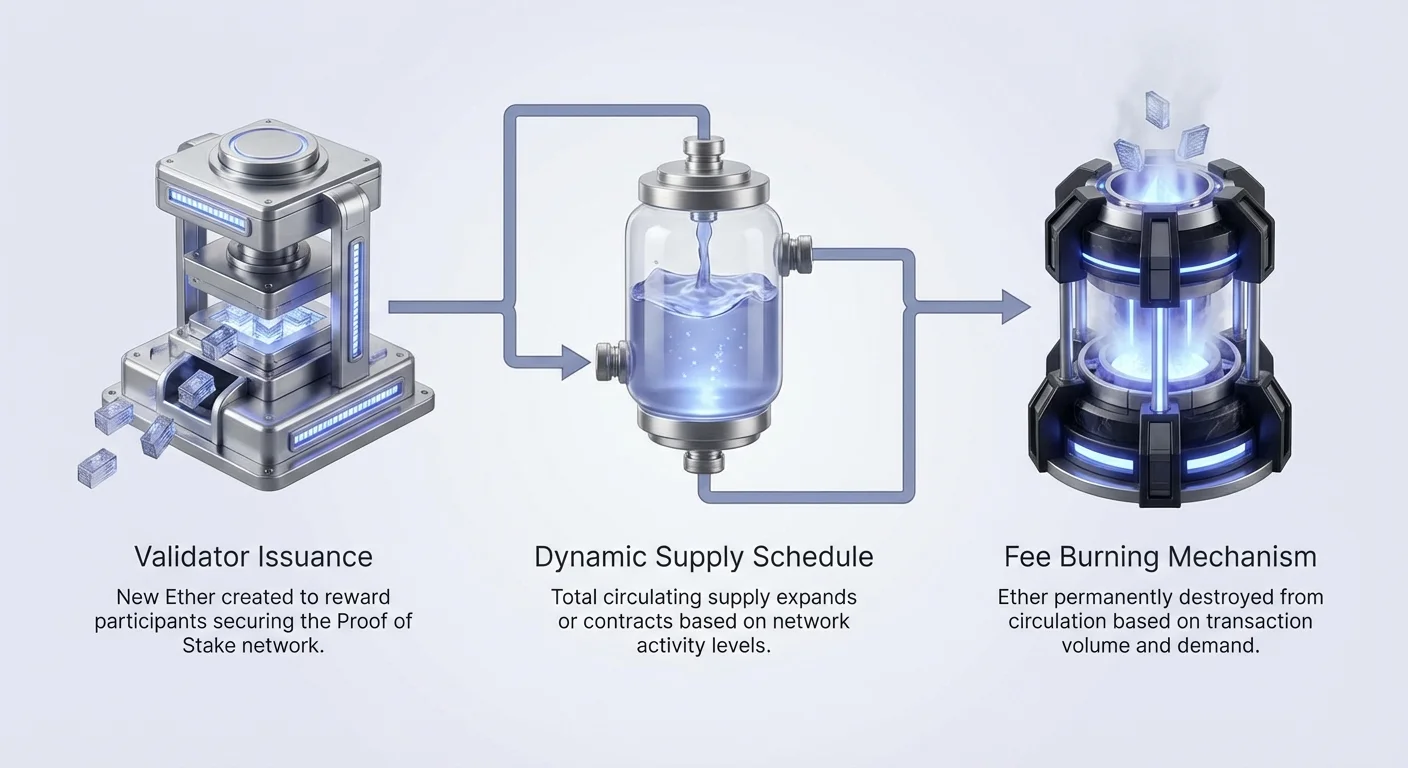
The monetary policy of Ethereum differs fundamentally from that of Bitcoin. While Bitcoin relies on a hard cap of 21 million coins established at its genesis, Ethereum utilizes a dynamic supply schedule. This schedule effectively reacts to network demand, security needs, and community governance. There is no fixed limit on the total number of Ether tokens that will ever exist. Instead, the total supply is determined by the interplay between two opposing forces: issuance and burning.
Issuance refers to the creation of new Ether. This occurs when the network rewards participants who secure the blockchain. On the other side of the equation is burning. This mechanism permanently removes Ether from circulation based on transaction volume. These two distinct processes create a fluid economic model. The supply expands and contracts over time rather than following a predetermined linear path.
Understanding this schedule requires looking beyond simple inflation rates. One must analyze the technical upgrades that have shifted Ethereum from an inflationary model toward a potentially deflationary one. The transition from Proof of Work to Proof of Stake, combined with the implementation of fee burning, has radically altered the asset's economic profile. This system ensures the network can pay for its own security while potentially increasing the scarcity of the native asset during periods of high activity.
The Evolution of Issuance Mechanics
From Proof of Work to Proof of Stake
In its early years, Ethereum operated under a Proof of Work consensus mechanism. This system required miners to expend significant energy and hardware resources to solve complex cryptographic puzzles. To compensate miners for their operational costs, the network issued new Ether at a high rate. When the network launched in 2015, the block reward was set at 5 ETH per block. This resulted in an initial annual inflation rate exceeding 20%.
The community recognized early on that this high rate of issuance was necessary for initial distribution but unsustainable for long-term value preservation. Through a series of upgrades, the issuance rate was systematically lowered. The "Byzantium" upgrade in 2017 reduced the block reward to 3 ETH. Later, the "Constantinople" upgrade in 2019 further reduced it to 2 ETH. These adjustments brought the inflation rate down to roughly 4.5% per year, yet the supply continued to grow steadily.
The most significant shift occurred with "The Merge" in September 2022. This event marked the complete transition from Proof of Work to Proof of Stake. Under this new model, the network no longer needed to subsidize expensive electricity costs for miners. Consequently, the issuance of new Ether dropped by approximately 90%. The network now only issues enough Ether to reward validators who stake their capital to secure the chain.
Validator Rewards and Staking
In the Proof of Stake era, issuance is tied directly to the amount of Ether staked. Users lock up their ETH in the protocol to act as validators. In return, they receive rewards derived from newly issued ETH and a portion of transaction fees. This system creates a circular economy where the security providers are also the asset holders.
The issuance rate is now dynamic rather than static per block. It is calculated based on the total number of validators. As more ETH is staked, the total issuance increases slightly to pay the additional validators, but the individual reward rate per validator decreases. This creates an equilibrium that discourages over-paying for security while ensuring enough incentives exist to protect the network.
This reduction in issuance creates a "triple halving" effect, referring to the drastic drop in new supply entering the market. Where miners often had to sell their rewards to pay for electricity, stakers have lower operating costs and are less compelled to sell. This structural change in how new coins are created and distributed provides a foundational pillar for Ethereum's modern supply dynamics.
Governance and Flexibility
Unlike systems where the monetary policy is immutable, Ethereum’s policy is managed through decentralized governance. Changes to issuance rates or burning mechanisms are proposed through Ethereum Improvement Proposals (EIPs). These technical documents are debated by developers, researchers, and the broader community before implementation.
This flexibility allows the network to adapt to unforeseen challenges or technological advancements. For instance, if security is threatened, issuance could theoretically be adjusted to attract more validators. Conversely, if the network becomes too efficient, rewards could be tuned. This governance process acts as a steering mechanism, ensuring the monetary policy remains aligned with the network's long-term survival and utility.
The Burning Mechanism: EIP-1559
Overhauling the Fee Market
Prior to August 2021, Ethereum utilized a simple auction system for transaction fees. Users would bid whatever amount they were willing to pay to get their transaction processed. Miners would select the transactions with the highest bids. This often led to volatile fee markets and poor user experiences, as it was difficult to predict the correct price to pay. Furthermore, all fees paid by users went directly to the miners.
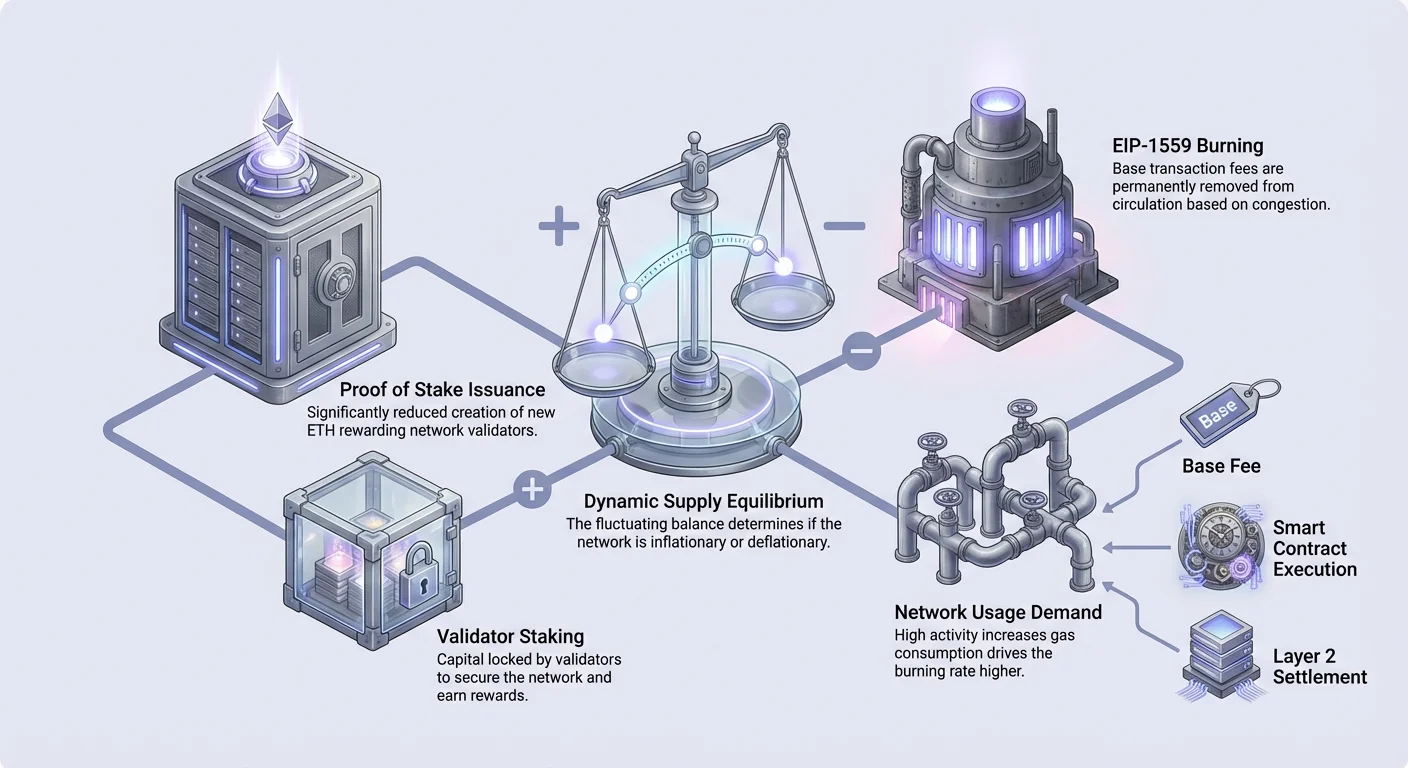
The implementation of Ethereum Improvement Proposal 1559 (EIP-1559) fundamentally changed this structure. It introduced a "base fee" for every block. This base fee is an algorithmically determined price that users must pay to have their transaction included. The fee adjusts automatically based on network congestion. If a block is full, the base fee increases for the next block; if it is empty, the fee decreases.
Converting Activity into Scarcity
The most critical economic component of EIP-1559 is what happens to the base fee. Instead of being paid to validators, the base fee is "burned." This means the Ether used to pay this portion of the transaction cost is permanently destroyed. It is removed from the ledger and ceases to exist.
This mechanism directly links the usage of the network to the supply of the asset. When the network is busy, more gas is consumed, and more ETH is burned. This creates a direct correlation between the utility of the Ethereum "world computer" and the scarcity of its currency. During periods of extreme demand, the rate of burning can exceed the rate of issuance.
Deflationary Periods
The combination of the 90% issuance reduction from the Merge and the burn mechanism from EIP-1559 has created the possibility for deflation. If the network activity generates enough transaction fees, the daily burn will outpace the daily issuance to validators. When this happens, the total circulating supply of ETH decreases.
This is not a guaranteed state but a conditional one. If network activity drops, the burn rate falls. If the burn rate drops below the issuance rate, the supply will inflate, albeit slowly. This dynamic nature means Ethereum acts as an automated central bank, tightening supply during high economic activity and loosening it during low activity.
Gas Fees and Network Resources
Understanding Gas
Gas is the unit of measurement for computational effort on Ethereum. Every action, from a simple currency transfer to a complex smart contract execution, requires a specific amount of gas. This prevents spam and infinite loops that could crash the network. A standard transfer requires 21,000 units of gas, while interacting with a decentralized finance (DeFi) protocol might require hundreds of thousands of units.
The cost of a transaction is calculated by multiplying the gas units used by the price per unit of gas. This price is denominated in "gwei." One gwei equals 0.000000001 ETH. The total fee a user pays is split into the base fee (which is burned) and a priority fee, or tip. The tip is paid to the validator as an incentive to prioritize that specific transaction within the block.
Fee Dynamics and User Behavior
High gas fees are often a point of friction for users, but they serve a critical function in the supply schedule. High fees indicate high demand for block space. Because the base fee is burned, high fees accelerate the reduction of the total ETH supply. This creates an interesting alignment where high costs for users translate into value accrual for all ETH holders through increased scarcity.
Wallets now allow users to customize their fee settings. Users can choose between "Eco," "Fast," or "Fastest" options depending on their urgency. The wallet estimates the current market rate to ensure the transaction is picked up. Advanced users can manually set their max base fee and priority fee to navigate periods of congestion precisely.
The Role of Smart Contracts
Smart contracts are the primary driver of gas consumption. These self-executing contracts run code on the Ethereum Virtual Machine (EVM). Because Ethereum is a general-purpose blockchain, it can run any type of computation. This versatility means that as developers build more complex applications, the demand for gas increases.
Complexity directly correlates to burn rates. A simple payment burns a small amount of ETH. A complex trade across multiple decentralized exchanges burns significantly more. Therefore, the growth of the developer ecosystem and the complexity of applications deployed on the network act as long-term drivers for the burning mechanism.
Utility Drivers: ERC-20 Tokens and WETH
The ERC-20 Standard
A major portion of Ethereum's network activity comes from tokens that are not ETH itself. The ERC-20 standard defines a common set of rules for creating fungible tokens on the blockchain. This standardization allows developers to create currencies, voting rights, loyalty points, and stablecoins that all interact seamlessly with wallets and exchanges.
When users transfer ERC-20 tokens, they must pay fees in ETH. The token contract does not run itself; it requires the Ethereum network to process the state change. Consequently, even if a user is only interested in trading a stablecoin like USDT or a governance token, they must hold and spend ETH to move it. This anchors the value of ETH to the success of the tokens built on top of it.
Wrapped Ether (WETH)
Despite being the native currency, Ether itself was created before the ERC-20 standard was finalized. This means ETH is not ERC-20 compliant by default. Decentralized applications, particularly trading platforms, are built to handle ERC-20 tokens uniformly. To bridge this gap, the concept of Wrapped Ether (WETH) was introduced.
| Feature | Native Ether (ETH) | Wrapped Ether (WETH) |
|---|---|---|
| Standard | Native Protocol Asset | ERC-20 Compliant Token |
| Primary Use | Gas Fees, Validator Staking | DeFi Trading, dApps |
| Creation | Protocol Issuance | Smart Contract Deposit |
WETH is created by depositing ETH into a smart contract. The contract holds the ETH and issues an equivalent amount of WETH. This token can then be used easily in decentralized finance protocols. Importantly, the wrapping and unwrapping process requires gas fees. This adds another layer of utility and demand for the native asset, further feeding the supply dynamics.
Layer 2 Scaling and Supply Impact
Off-Chain Execution
As Ethereum grew in popularity, the main network (Layer 1) became congested. This led to the development of Layer 2 (L2) scaling solutions. These platforms process transactions off the main chain. They bundle hundreds or thousands of transactions together and submit a summary to the main Ethereum blockchain.
This architecture allows for faster and cheaper transactions for users. However, it also changes the dynamics of gas consumption on Layer 1. L2 networks become the primary customers of L1 block space. They pay significant fees to post their data and proofs to Ethereum, ensuring their security is derived from the main network.
Sustaining the Burn
There was initial concern that moving transactions to Layer 2 would reduce the amount of ETH burned. However, the volume of transactions on L2s has grown exponentially. Even though the cost per transaction is lower, the sheer quantity of activity settles back to Ethereum.
L2s essentially purchase "blob space" or data availability on Ethereum. They pay for this resource in ETH. As L2 ecosystems expand to host gaming, social media, and high-frequency trading, their aggregate demand for settlement ensures that the burning mechanism continues to function. This allows Ethereum to scale its capacity without sacrificing the economic engine that regulates its supply.
Conclusion
The supply schedule of Ethereum represents a complex, living economic system. It has evolved from a simple, high-inflation mechanism designed to bootstrap a network into a sophisticated, demand-responsive policy. The shift to Proof of Stake drastically reduced the flow of new assets, while EIP-1559 introduced a constant deflationary force driven by actual usage.
This model creates a direct link between the platform's utility and the scarcity of its native currency. As the ecosystem of dApps, DeFi protocols, and Layer 2 networks expands, the demand for block space increases the burn rate. Conversely, the issuance rate remains low and stable, securing the network with minimal dilution to holders. The result is a monetary policy that is not fixed in stone, but rather fixed in code that adapts to the reality of the market.
Ethereum's supply is determined by network usage: high activity burns tokens faster than they are created, potentially reducing total supply.