
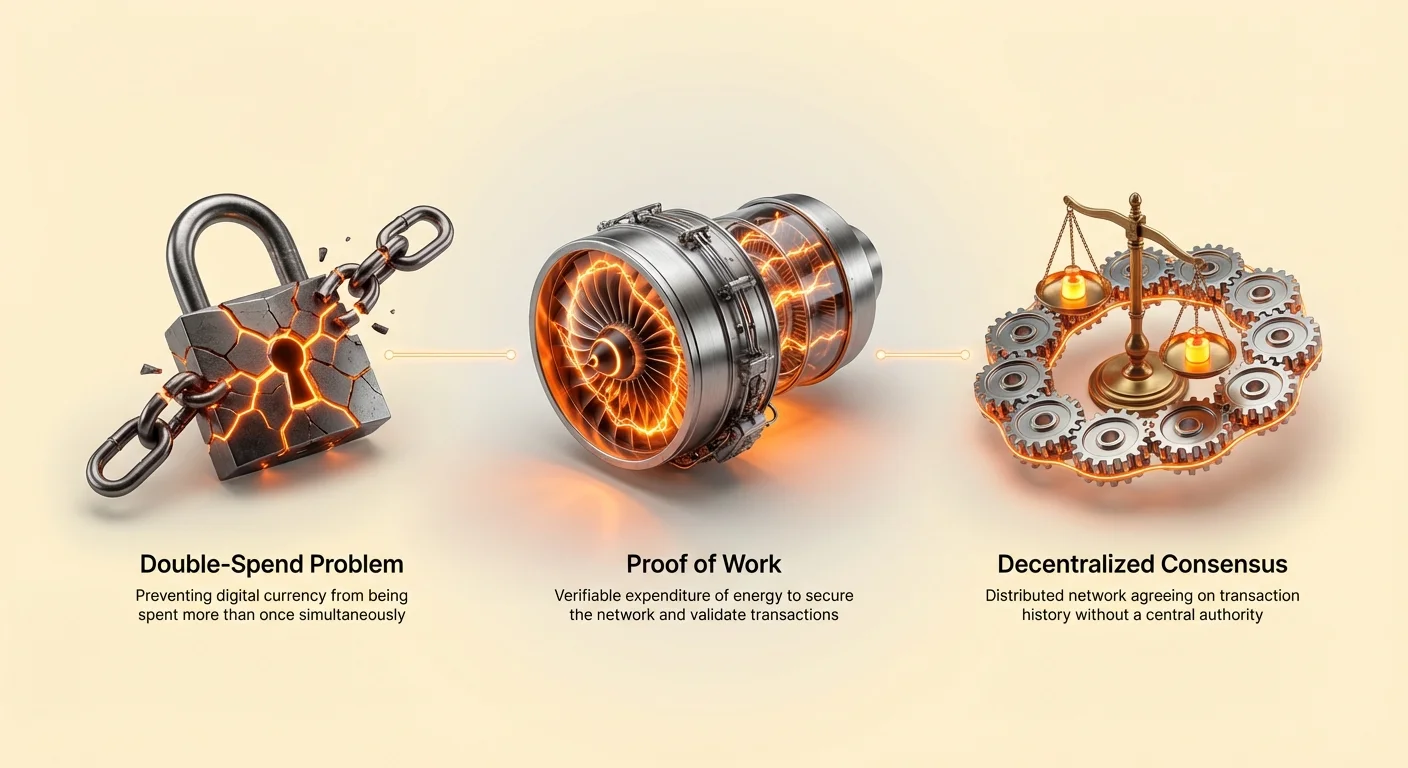
At the foundational level of the first decentralized cryptocurrency lies a mechanism designed to replace institutional trust with mathematical verification. Before the advent of Bitcoin, digital cash systems faced a critical vulnerability known as the double-spend problem. Because digital files are easily copied, there was no way to ensure that a unit of digital currency wasn't spent more than once without a central authority to verify the ledger. Proof of Work (PoW) solved this by creating a system where participating in the network requires a verifiable expenditure of energy and computational resources.
This consensus mechanism serves as the bedrock for establishing an objective, unalterable history of transactions. It transforms electrical energy into digital security, creating a barrier that makes fraudulent activity prohibitively expensive. By requiring computers to solve complex mathematical puzzles to propose new blocks of transactions, the network ensures that the creation of money and the validation of transfers are tied to real-world costs. This tethering to physical resources prevents spam and secures the network against attackers who might seek to rewrite history.
The genius of this design is that it enables a distributed network of participants to agree on the state of the ledger without knowing or trusting one another. There is no bank manager or administrator. Instead, the rules of the protocol dictate that the chain of blocks with the most accumulated work is the valid one. This simple rule allows thousands of independent nodes across the globe to stay in perfect sync, maintaining a financial system that is open, borderless, and resistant to censorship.
The Mechanics of Proof of Work
The term "Proof of Work" refers to the requirement that the service requester must perform some feasible amount of work to access the service. in the context of blockchain, this work involves miners competing to solve a computationally intensive puzzle. This process is essential for adding new blocks to the blockchain and maintaining the chronological order of transactions.
The Cryptographic Puzzle and the Nonce
The core activity in a PoW system is hashing. Miners take a batch of unconfirmed transactions, combine them with data from the previous block, and add a random number known as a "nonce." They then run this data through a hashing algorithm, such as SHA-256. The algorithm produces a fixed-length string of characters that acts as a digital fingerprint for that specific set of data.
To successfully mine a block, the resulting hash must meet a specific difficulty target set by the network. This usually means the hash must start with a certain number of leading zeros. Because the output of a hash function is unpredictable, miners cannot know which nonce will produce a valid hash. They must engage in a process of trial and error, guessing millions or billions of nonces per second.
This process is often compared to a lottery where buying more tickets increases the chances of winning. In this analogy, the "tickets" are the hash calculations performed by mining hardware. The first miner to find a nonce that generates a valid hash wins the right to append the new block to the chain. This proves they have expended the necessary computational work to secure the network.
Validation and Consensus
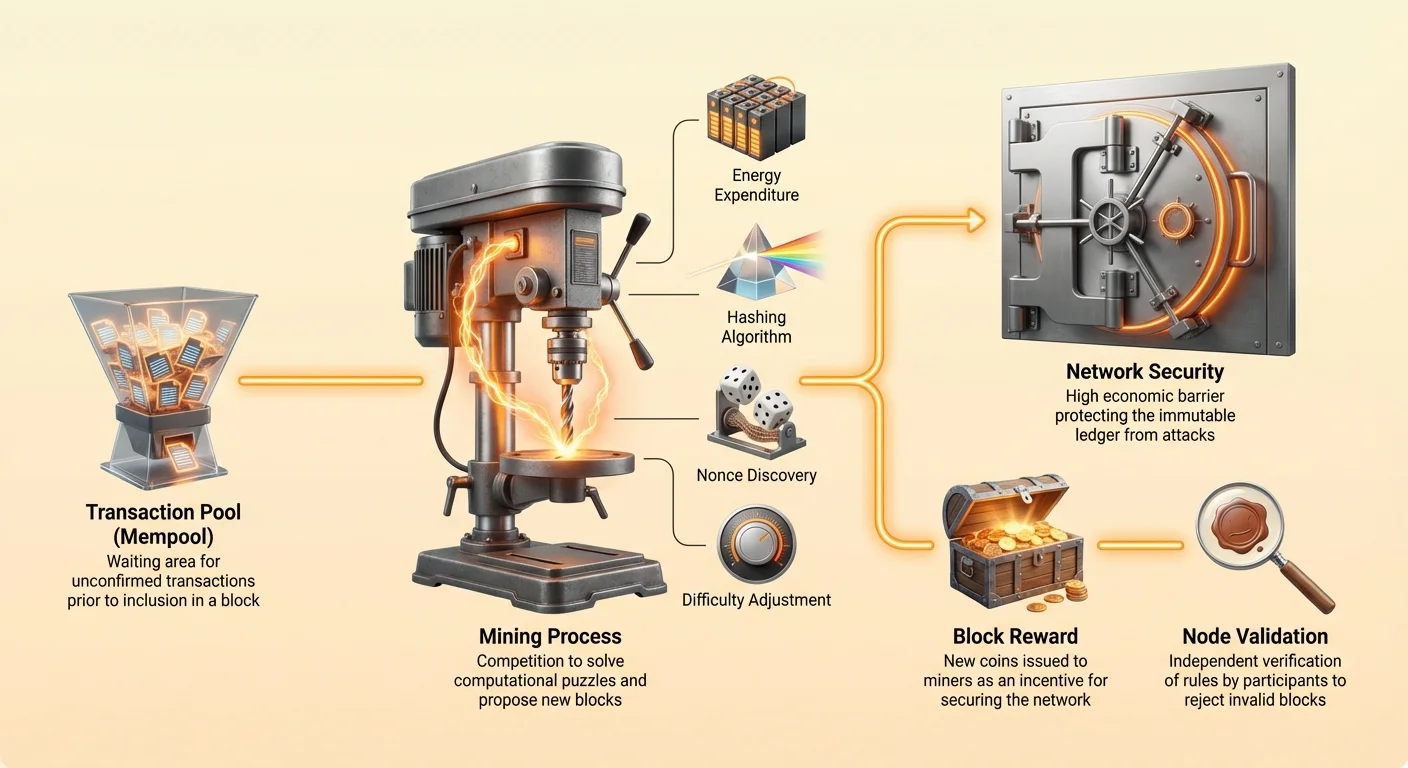
Once a miner finds a solution, they broadcast the new block to the network. Other participants, known as nodes, receive this block and independently verify the solution. Unlike the difficulty of finding the solution, verifying it is trivial and requires almost no computational power. Nodes simply run the data through the same algorithm to confirm the result matches the difficulty target.
If the solution is valid and all transactions within the block adhere to the protocol rules, the nodes accept the block and add it to their copy of the ledger. They then propagate the block to other peers. This rapid verification ensures that the network can reach consensus quickly. If a miner attempts to submit an invalid block or a block containing fraudulent transactions, the nodes will reject it, and the miner will have wasted electricity for no reward.
Solving the Double-Spend Problem
Digital currency faces a unique challenge that physical cash does not. If you hand someone a physical dollar bill, you no longer possess it. However, digital information is essentially data that can be perfectly replicated. Without a mechanism to prevent it, a user could send a digital token to a merchant and then immediately send the same token to another party. This is the double-spend problem.
Traditional financial systems solve this by using centralized intermediaries like banks. The bank maintains a private ledger and deducts funds from one account while crediting another. Bitcoin introduced a way to solve this without a central authority by using a public, immutable ledger secured by Proof of Work.
When a transaction is broadcast, it goes into a pool of unconfirmed transactions. Miners select these transactions to build a block. Once the block is mined and added to the chain, the transaction is considered confirmed. To double-spend those funds, an attacker would have to rewrite the blockchain history.
Because each block contains a reference to the hash of the previous block, changing a past transaction would require re-mining that block and all subsequent blocks. This would require an enormous amount of energy, making it economically infeasible for an attacker to reverse transactions once they are buried under enough work.
Mining: Economics and Incentives
Mining is the process of minting new coins and securing the network. It is a competitive industry where profitability depends on the cost of electricity, the efficiency of hardware, and the current market price of the cryptocurrency. The incentive structure is designed to align the interests of the miners with the security of the network.
Block Rewards and the Halving
The primary incentive for miners is the block reward. When a miner successfully solves a block, they are permitted to create a special transaction called the "coinbase" transaction. This transaction sends newly created coins to the miner's wallet. This is the only way new currency enters the supply, simulating the extraction of precious metals like gold.
To control inflation and ensure scarcity, this reward is programmed to decrease over time. Approximately every four years, or every 210,000 blocks, a "halving" event occurs. This cuts the issuance rate of new coins in half.
| Event | Year | Block Reward | Inflation Impact |
|---|---|---|---|
| Launch | 2009 | 50 BTC | Initial distribution |
| 1st Halving | 2012 | 25 BTC | Significant reduction |
| 2nd Halving | 2016 | 12.5 BTC | Maturation of market |
| 3rd Halving | 2020 | 6.25 BTC | Institutional adoption |
| 4th Halving | 2024 | 3.125 BTC | Scarcity increases |
This deflationary model ensures that the supply is capped. For Bitcoin, the total supply will never exceed 21 million coins. As the block reward decreases, the scarcity of the asset theoretically increases, which has historically influenced market cycles.
Transaction Fees and the Fee Market
In addition to the block reward, miners earn transaction fees. Every user who sends a transaction attaches a small fee to incentivize miners to include their transfer in the next block. Because blocks have a limited size, space is a scarce resource.
This creates a fee market. During periods of high network usage, users compete for space by offering higher fees. Miners, acting rationally to maximize profit, prioritize transactions with the highest fees per byte of data. As the block subsidy continues to halve and eventually reaches zero, transaction fees will become the primary compensation for miners, ensuring the network remains secure even after all coins have been minted.
Hashrate and Network Security
The total computational power dedicated to the network is known as the hashrate. It serves as a key health metric for Proof of Work blockchains. A higher hashrate indicates that more miners are participating and expending more energy to secure the ledger. This makes the network more resilient against attacks.
Hashrate is measured in hashes per second (H/s). Due to the immense power of modern mining networks, this is often expressed in quintillions or sextillions of hashes per second.
| Unit | Symbol | Value (Hashes/Second) |
|---|---|---|
| Terahash | TH/s | 1 Trillion |
| Petahash | PH/s | 1 Quadrillion |
| Exahash | EH/s | 1 Quintillion |
The security of a PoW network relies on the assumption that no single entity controls more than 50% of the total hashrate. If an attacker were to gain 51% of the mining power, they could theoretically censor transactions or perform double spends by reorganizing the recent history of the blockchain.
However, as the hashrate grows, the cost of acquiring enough hardware and electricity to overwhelm the network becomes insurmountable. This economic barrier is what protects the integrity of the ledger. For established networks, the cost to attack would run into billions of dollars, destroying the value of the asset the attacker seeks to undermine.
The Difficulty Adjustment Mechanism
Proof of Work networks must maintain a consistent issuance schedule regardless of how many miners join or leave. If thousands of new, powerful machines come online, the puzzle would be solved too quickly. Conversely, if many miners shut down, blocks might stall. To solve this, the protocol includes a difficulty adjustment mechanism.
For Bitcoin, the network targets a 10-minute average for block discovery. Every 2,016 blocks, which takes roughly two weeks, the network calculates the average time it took to mine those blocks. If blocks were mined too fast, the difficulty of the puzzle increases, requiring more computational work to find a valid hash. If blocks were mined too slowly, the difficulty drops. To solve this, the protocol includes a difficulty adjustment mechanism.
This self-regulating thermostat ensures that the network remains stable and the issuance of new currency remains predictable. It decouples the production of the asset from the resources applied to it. In gold mining, more equipment usually leads to more gold. In Bitcoin mining, more equipment simply leads to higher difficulty, keeping the supply flow constant.
The Role of Nodes in Consensus
While miners build blocks, it is the nodes that enforce the rules. A Bitcoin node is a computer running software that maintains a copy of the blockchain and validates transactions. Nodes are the ultimate arbiters of truth in the network. They act as the immune system, rejecting any block that violates the protocol, even if that block has sufficient Proof of Work.
There are different types of nodes with varying responsibilities. Full nodes download and verify every transaction and block from the beginning of the chain. They verify that the sender has sufficient funds, that the digital signatures are correct, and that no double spending has occurred.
| Node Type | Function | Storage Needs |
|---|---|---|
| Full Node | Validates all rules and history | High |
| Pruned Node | Validates all, stores recent only | Medium |
| Light Node | Verifies headers, trusts full nodes | Low |
The interaction between miners and nodes creates a system of checks and balances. Miners produce the blocks, but they cannot change the rules. If miners tried to increase the block reward or print more coins than allowed, full nodes would simply ignore their blocks. This ensures that no group, regardless of their computing power, can force unwanted changes onto the network.
The Mempool: The Transaction Waiting Room
Before a transaction is added to a block, it resides in a temporary staging area known as the mempool (memory pool). The mempool is not a single centralized queue but rather a data structure held locally by each node. When a user broadcasts a transaction, it propagates across the network and lands in the mempools of various nodes.
Miners view the mempool as a menu of potential revenue. Since they cannot include every pending transaction in a single block due to size limits, they select transactions based on profitability. This usually means picking the transactions with the highest fee rates (satoshis per byte).
If the mempool becomes congested with a backlog of transactions, the required fee to get into the next block rises. Users who pay low fees may see their transactions sit in the mempool for hours or even days until traffic subsides. This dynamic ensures that block space is allocated efficiently to those who value it most at any given moment.
If a transaction remains in the mempool for too long without being picked up, it may eventually be dropped by nodes to free up memory. In this case, the funds effectively return to the sender's wallet as the transaction never occurred on the blockchain.
Bitcoin Script and Transaction Logic
At the heart of every transaction is a scripting language that dictates how funds can be spent. Bitcoin Script is a stack-based language that is intentionally simple. It is not Turing-complete, meaning it lacks loops and complex logic capabilities found in general programming languages. This limitation is a security feature, preventing infinite loops that could crash the network.
Locking and Unlocking Scripts
When a transaction creates an output, it uses a "locking script" (ScriptPubKey) to encumber the funds. This script essentially says, "these funds can only be spent by someone who provides a specific digital signature." The most common form is Pay-to-Public-Key-Hash (P2PKH), which locks funds to a specific address.
To spend these funds later, the owner must provide an "unlocking script" (ScriptSig) in a new transaction. This includes their public key and a digital signature created with their private key. The network combines these scripts and executes them. If the result is "True," the transaction is valid, and the funds are moved.
This scripting language allows for more than just simple transfers. It enables multi-signature wallets, where funds require signatures from multiple parties to move. It also facilitates second-layer solutions like the Lightning Network by creating time-locked contracts.
Energy Consumption as a Defense
One of the most discussed aspects of Proof of Work is its energy consumption. Critics often point to the electricity usage of mining networks as wasteful. However, proponents argue that this energy usage is not a bug but a primary feature. The energy consumption represents the "unforgeable costliness" required to secure the ledger.
By anchoring the security of the digital network to physical energy resources, PoW creates a tangible cost for malicious behavior. If validation were free or cheap, spamming the network or creating fake histories would be easy. The requirement to burn electricity ensures that writing to the ledger is expensive, while reading from it is free.
This energy creates a wall of cryptographic work that protects the trillions of dollars in value stored on the network. The efficiency of miners constantly improves as they seek out the cheapest sources of power, often utilizing stranded or renewable energy sources that would otherwise go to waste.
Scalability and Layer 2 Solutions
While Proof of Work provides robust security, it comes with trade-offs regarding scalability. The process of broadcasting every transaction to every node and waiting for 10-minute block intervals limits the number of transactions the base layer can handle per second. This can lead to high fees during peak times, making small payments impractical.
To address this, developers have built Layer 2 solutions on top of the main blockchain. The most prominent example is the Lightning Network. This system uses smart contracts (via Bitcoin Script) to open payment channels between users.
Transactions on the Lightning Network occur off-chain. They are instant and carry negligible fees because they do not require miner validation for every individual payment. Only the opening and closing balances are recorded on the main PoW blockchain. This allows the network to scale to millions of transactions per second while still relying on the security of the underlying Proof of Work layer for final settlement.
Conclusion
Proof of Work represents a fundamental shift in how trust is established in a digital society. By substituting centralized intermediaries with a decentralized competition for mathematical truth, it solves the double-spend problem and enables censorship-resistant value transfer. The system relies on a delicate balance of incentives, where miners are rewarded for honesty and penalized for attempted fraud through the tangible cost of energy.
While the mechanism is energy-intensive, this expenditure provides the immutable security that gives the network its value. Through difficulty adjustments, halving events, and the vigilance of nodes, the system remains self-regulating and robust. As the ecosystem evolves with Layer 2 solutions, Proof of Work continues to serve as the secure anchor for a new global financial infrastructure.
Proof of Work turns energy into truth, ensuring digital money remains secure, scarce, and under no one's control.