
Ethereum’s transition from a Proof of Work consensus mechanism to Proof of Stake represents one of the most significant upgrades in blockchain history. This shift, often referred to as the "Merge," was designed to address the network's long-standing scalability issues and high energy consumption. While the move successfully reduced energy usage by over 99%, it introduced a new set of economic and technical dynamics that critics argue may impact decentralization. The network now relies on validators rather than miners to secure the ledger, fundamentally changing who holds power within the ecosystem.
As the protocol evolves, the introduction of Layer 2 solutions and sharding aims to further increase transaction throughput. However, these advancements come with complex trade-offs regarding security and governance. The "blockchain trilemma" posits that a network can typically only optimize for two of three variables: decentralization, security, and scalability. Ethereum’s current roadmap attempts to solve this by layering different technologies, yet each layer introduces potential points of failure or centralization that require careful scrutiny.
The ongoing debate surrounding Ethereum’s evolution centers on whether these new efficiencies compromise the network’s core value proposition. Decentralization is not merely a buzzword but the primary defense against censorship and manipulation. By analyzing the mechanics of Proof of Stake, the structure of Layer 2 scaling solutions, and the realities of protocol governance, we can better understand the risks facing the world’s largest smart contract platform.
The Mechanics of Proof of Stake
Validator Incentives and Responsibilities
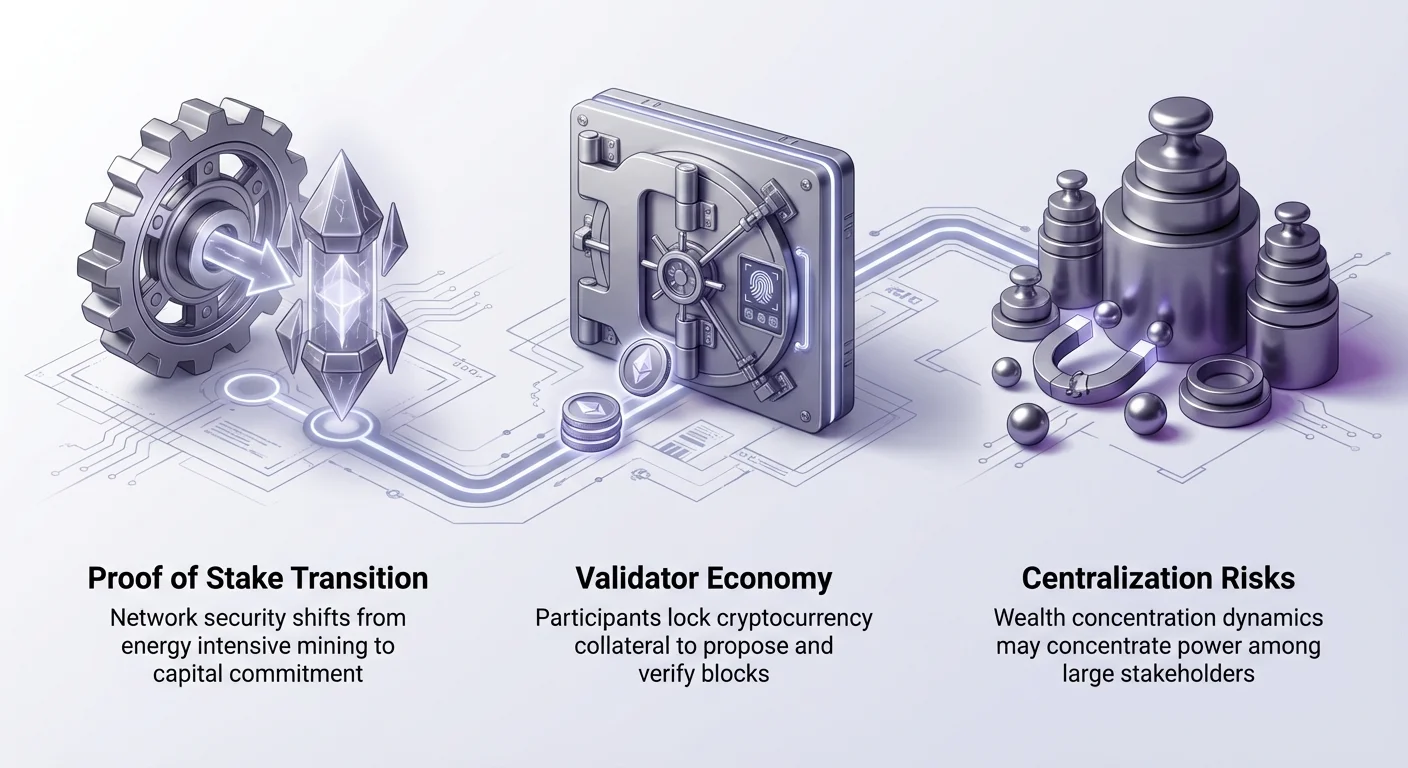
In the Proof of Stake model, the resource-intensive competition of crypto mining is replaced by a system of financial commitment. Participants, known as validators, are required to lock up, or "stake," a specific amount of cryptocurrency into a smart contract to participate in the Proof of Stake network. This capital acts as collateral ensuring their honest behavior. The protocol randomly selects these validators to propose new blocks and attest to the validity of blocks proposed by others.
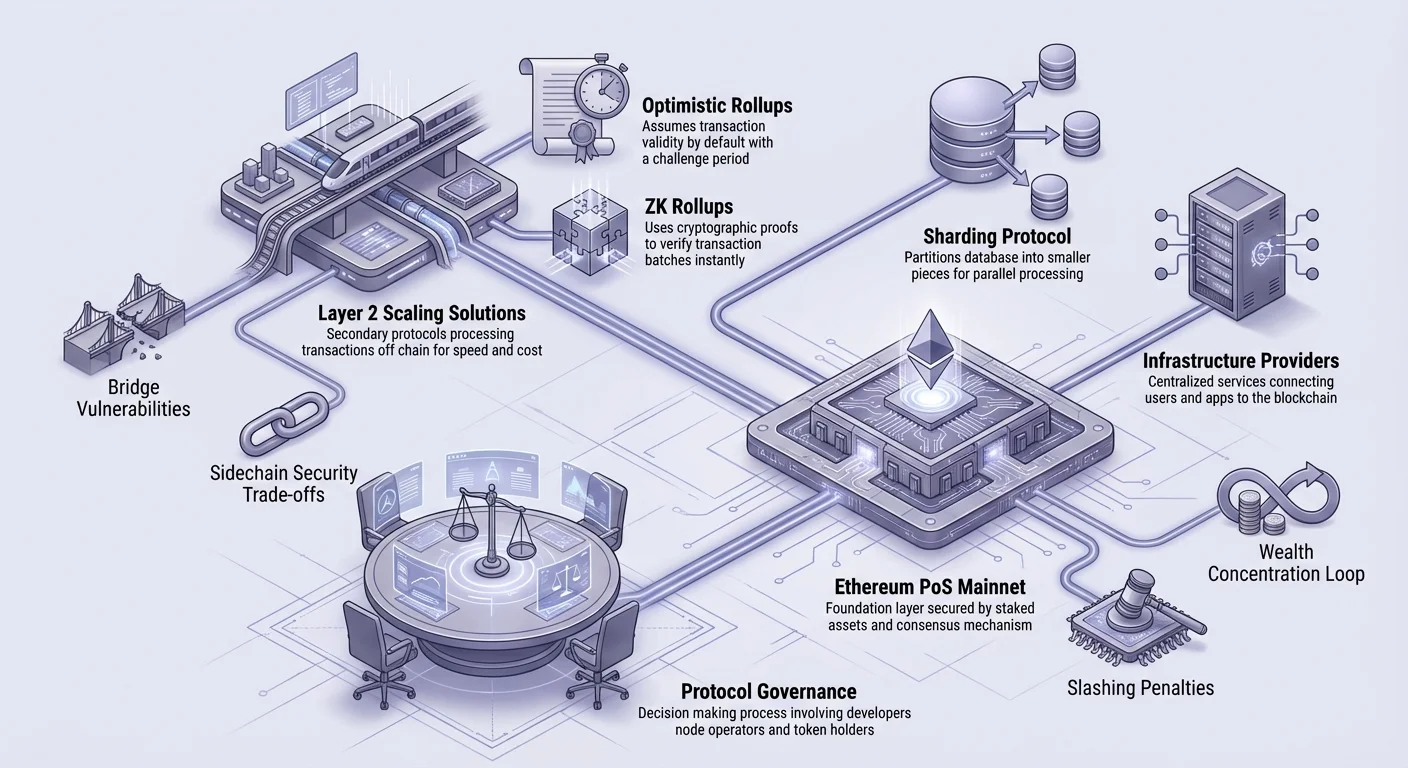
Validators are incentivized through rewards issued in newly minted cryptocurrency and transaction fees. This system is often described as a "carrot and stick" approach. The rewards serve as the carrot, encouraging active and honest participation in ordering transactions. Conversely, the stick is a mechanism known as "slashing." If a validator acts maliciously, goes offline consistently, or attempts to validate conflicting histories, a portion or all of their staked assets can be forfeited. This financial penalty replaces the physical energy cost found in Proof of Work.
The Wealth Concentration Loop
A primary criticism of this model involves the potential for wealth concentration, often summarized as the "rich get richer" problem. In Proof of Work systems like Bitcoin, mining is a capital-intensive business with narrow profit margins. Miners are forced to sell a significant portion of their earned coins to cover electricity and hardware costs. This selling pressure distributes coins back into the market, preventing miners from easily hoarding the supply.
Proof of Stake fundamentally changes this economic flow. Because running a validator node requires negligible electricity compared to mining, the operating costs are extremely low. Consequently, validators do not need to sell their rewards to maintain operations. Large stakeholders can simply compound their earnings by restaking them, continuously increasing their share of the total network supply. Critics argue this dynamic inevitably leads to a centralization of economic power among early adopters and wealthy entities.
Governance Challenges in a Staking Economy
Governance in Ethereum is a quasi-political process that relies on "rough consensus" among various stakeholders. Unlike a centralized corporation where decisions can be made unilaterally, protocol upgrades require coordination between developers, node operators, and token holders. The core of this process is the Ethereum Improvement Proposal (EIP), a document that outlines proposed changes. These proposals are debated, audited, and eventually merged into the software repository if the community agrees to adopt them.
The challenge lies in maintaining "credible neutrality," a guiding principle championed by Ethereum’s founders. Credible neutrality implies that the mechanism design should not discriminate for or against any specific people. It essentially means the rules of the game must treat everyone fairly. However, achieving this in practice is difficult when the stakeholders have vastly different capabilities. If a small group of entities controls a majority of the staked Ether, they could theoretically exert outsized influence over which proposals gain traction or how the network evolves.
Centralization risks in governance also appear when the community splits on controversial decisions. While the goal is always consensus, disagreements can lead to hard forks, as seen in the 2016 incident that birthed Ethereum Classic. The decision to alter the blockchain history to reverse a hack was viewed by some as a violation of neutrality, prioritizing the majority's financial recovery over the immutability of the code. This highlights the tension between "progressive" governance that fixes problems and "conservative" governance that strictly adheres to protocol rules.
The Infrastructure Bottleneck
Decentralization is not just about who owns the coins but also about who runs the infrastructure. For a blockchain to be truly censorship-resistant, a diverse set of participants must operate the nodes that verify the ledger. If the hardware or data requirements for running a node become too high, only large institutions will be able to participate. This scenario undermines the peer-to-peer nature of the network.
Ethereum’s blockchain is significantly larger than Bitcoin’s in terms of data storage, measured in terabytes rather than gigabytes. Running a full archival node, which stores the entire history of the blockchain, is resource-intensive. As a result, many developers and applications choose not to run their own nodes. Instead, they rely on third-party infrastructure providers like Infura to connect to the network.
This reliance creates a critical single point of failure. In November 2020, a technical malfunction at Infura caused a temporary disruption for many users and exchanges that relied on its data. While the Ethereum blockchain itself did not stop, the ability for many users to interact with it was severed. If a government or malicious actor were to target these centralized infrastructure hubs, they could effectively censor access to the network for a large portion of the ecosystem, bypassing the distributed nature of the underlying censorship resistance protocol.
Analyzing Layer 2 Scaling Solutions
The Role of Independent Sidechains
To address the congestion on the main network, developers have built various "Layer 2" solutions. One common approach is the use of independent sidechains. These are separate blockchains that run in parallel to Ethereum and connect via a two-way bridge. Sidechains are compatible with the Ethereum Virtual Machine (EVM), allowing developers to port applications easily. Because they process transactions off the main chain, they offer faster speeds and lower costs.
However, sidechains present a distinct security trade-off. They are responsible for their own security, meaning they must recruit their own set of validators or miners. They do not inherit the security guarantees of the Ethereum mainnet. Because these networks are typically smaller, it is more feasible for a coordinated group to capture the majority of the network's voting power. If a sidechain's validators conspire, they can steal assets bridged to that chain. This model prioritizes speed and cost over the robust security found on Layer 1.
Rollups and Data Availability
Rollups represent a different approach to scaling that attempts to preserve Ethereum's security. These solutions process transactions on a secondary layer but post the transaction data back to the Ethereum mainnet. By bundling hundreds of transfers into a single transaction on Layer 1, rollups significantly reduce fees while ensuring the data remains accessible and verifiable by the main network.
There are two primary types of rollups: Optimistic and Zero-Knowledge (ZK). Optimistic rollups operate on the assumption that transactions are valid by default. The network only computes the validity of a transaction if someone challenges it during a specific window. This method simplifies the cryptography but necessitates a delay, often seven days, when moving assets back to Layer 1. This waiting period is necessary to allow time for dispute resolution.
| Feature | Optimistic Rollups | ZK Rollups | Sidechains |
|---|---|---|---|
| Security Source | Ethereum Layer 1 | Ethereum Layer 1 | Independent Validators |
| Withdrawal Time | ~7 Days (Challenge Period) | Instant (after verification) | Varies (Bridge dependent) |
| Computation | Fraud proofs (on challenge) | Validity proofs (every batch) | Independent consensus |
ZK rollups use complex cryptographic proofs to verify the validity of every transaction batch before submitting it to Ethereum. This eliminates the need for a challenge period, allowing for faster withdrawals. However, the computational power required to generate these proofs is immense. Currently, the technology for ZK rollups is less mature and more difficult to implement than Optimistic solutions. As these technologies develop, they shift the bottleneck from transaction space to data availability.
The Risks of Fragmentation
As the Ethereum ecosystem expands into a multi-layer environment, liquidity and user activity become fragmented across different platforms. While this alleviates pressure on the main chain, it introduces complexity regarding interoperability. Assets moved to a Layer 2 solution are often "wrapped" or locked in bridge contracts. These bridges have historically been vulnerable targets for hackers.
Furthermore, the user experience relies heavily on the smooth operation of these secondary layers. If a Layer 2 network goes offline or experiences a bug, user funds can be trapped. While rollups are designed to allow users to withdraw funds directly from the mainnet even if the Layer 2 operator disappears, the technical knowledge required to perform such a manual exit is beyond the average user. This creates a practical dependency on the continued operation of the Layer 2 intermediaries.
The proliferation of different scaling solutions also divides the community of node operators and validators. Instead of everyone securing a single chain, resources are split among various protocols, each with its own rules and security assumptions. This fragmentation can dilute the overall security budget of the ecosystem if not managed correctly.
Sharding and Protocol Complexity
Partitioning the Network
Beyond Layer 2 solutions, Ethereum plans to implement "sharding" as a core protocol upgrade. Sharding involves partitioning the network’s database into smaller, manageable pieces called shards. Each shard operates somewhat like a separate blockchain with its own state and transaction history. This allows the network to process many transactions in parallel, rather than requiring every node to process every transaction sequentially.
The introduction of sharding drastically increases the network's capacity but adds significant complexity to the consensus mechanism. Validators are no longer responsible for the entire state of the blockchain. Instead, they are assigned to specific shards. To prevent a specific shard from being taken over by a malicious group, the protocol must randomly assign validators to shards and shuffle them periodically.
Security Implications of Sharding
The security of a sharded system relies heavily on the randomness of validator assignment. In a non-sharded system, an attacker needs 51% of the total network stake to compromise the chain. In a sharded system, if an attacker could target a specific shard, they would only need a fraction of the total stake to corrupt that specific partition. This is why the randomness mechanism is critical; it ensures that no single group can predict or control which shard they will secure.
However, the coordination required between shards introduces new attack vectors. Cross-shard communication relies on the main chain, or Beacon Chain, to maintain consistency. If this coordination layer fails or becomes congested, the state of the network could become inconsistent. The move to sharding transforms Ethereum from a single, unified ledger into a complex web of interconnected chains, raising the technical barrier for developers and auditors attempting to verify the system's integrity.
The "Nothing at Stake" Problem
A theoretical vulnerability specific to Proof of Stake systems is the "Nothing at Stake" problem. In the event of a network fork—where the blockchain splits into two competing paths—validators in early PoS implementations were incentivized to validate on both chains. Because validating costs almost nothing in terms of energy, betting on both outcomes was the rational economic choice to ensure rewards regardless of which chain won.
If all validators adopt this strategy, the network may never achieve consensus, effectively breaking the security of the blockchain. Ethereum addresses this through the slashing mechanism mentioned earlier. By enforcing penalties for validating conflicting blocks, the protocol forces validators to choose a side. This aligns their financial interests with the stability of the single canonical chain. While effective, this adds another layer of complexity to the software client, as it must detect and report these violations to enforce penalties.
Conclusion
Ethereum’s journey toward scalability and sustainability involves a delicate balancing act between competing priorities. The transition to Proof of Stake has successfully addressed energy concerns and paved the way for sharding, but it has arguably raised the barrier to entry for independent validators and introduced wealth concentration risks. Similarly, Layer 2 solutions offer necessary relief for transaction congestion but often require users to trust smaller, less tested security models or centralized sequencers.
The future of the network depends on its ability to mitigate these centralization vectors while maintaining the throughput required for global adoption. The governance process must navigate these technical upgrades without succumbing to the influence of large stakeholders. As the protocol becomes more complex, maintaining the core values of credible neutrality and censorship resistance will remain the ultimate challenge for the community.
True decentralization requires constant vigilance against the natural tendency for power and wealth to concentrate over time.