
For centuries, money has been defined and controlled by central authorities—governments and central banks. While this system has facilitated global trade, it comes with a fundamental drawback: the supply of currency is flexible and subject to political decision-making. This flexibility often leads to inflation, silently eroding the purchasing power of savings over time.
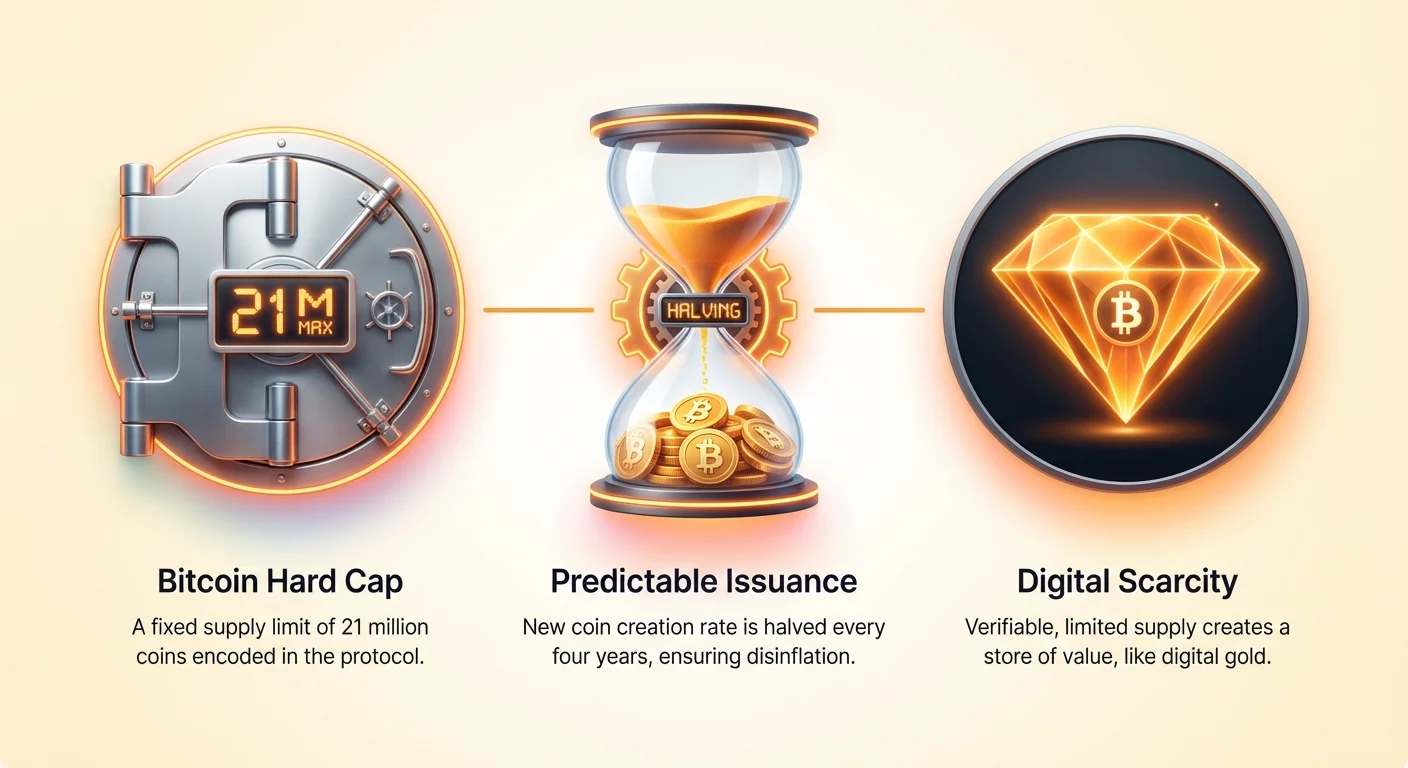
In 2009, Bitcoin introduced a radically different model. Instead of relying on trust or human decision, it relies on mathematics and computer code. At the heart of the Bitcoin phenomenon is an immutable rule known as the Hard Cap: a promise that only 21 million bitcoins will ever be created.
This hard cap is not merely a technical detail; it is the cornerstone of Bitcoin’s monetary policy. This policy is entirely transparent, globally verifiable, and, crucially, unchangeable without consensus from millions of users and nodes. By analyzing this fixed supply model, we move beyond viewing Bitcoin as just a volatile investment and begin to understand it as a potential foundation for a new, economically predictable monetary system.
The Core Mechanism: Understanding the Hard Cap
The most revolutionary aspect of Bitcoin is not the technology itself, but the economic design encoded within it. Unlike fiat currencies, which can be printed indefinitely to meet fiscal needs (often referred to as Quantitative Easing or QE), Bitcoin’s supply is definitively capped. This absolute limit defines the entire digital scarcity thesis.
The 21 Million Limit: A Programmed Economic Constraint
When Bitcoin’s creator, Satoshi Nakamoto, launched the network, they set the maximum total supply at 21 million units. This number is encoded into the protocol’s source code and governs the rate at which new bitcoins are released into circulation.
Why 21 million? The number itself is arbitrary, but the constraint is not. It creates a scarcity that mimics precious commodities like gold, but with a digital layer of verifiability. This fixed supply ensures that as demand increases, the scarcity remains constant. Economists refer to this characteristic as being inelastic in supply—no matter the price, the network cannot produce more units faster than the programmed rate.
The importance of the hard cap lies in the transfer of trust. Instead of trusting a central bank to maintain the value of the currency by promising not to overprint, users trust the mathematics and the distributed network architecture to enforce the 21 million limit.
Comparing Fiat Currency and Bitcoin Supply Dynamics
To truly grasp the significance of the hard cap, we must contrast Bitcoin’s policy with traditional fiat monetary policy.
| Feature | Fiat Currency (e.g., USD, EUR) | Bitcoin (BTC) |
|---|---|---|
| Supply Cap | Flexible; dictated by central banks | Fixed at 21,000,000 |
| Issuance Policy | Discretionary; based on economic needs (QE, interest rates) | Algorithmic; based on predictable code (Halving) |
| Inflation Risk | High, as supply can expand rapidly (inflationary) | Low to zero (disinflationary to deflationary) |
| Transparency | Moderate; decisions often made behind closed doors | Total; supply schedule verifiable by anyone |
The Quantitative Easing Contrast: When a central bank engages in Quantitative Easing (QE), it essentially creates new money to buy financial assets, injecting liquidity into the system. While this can stabilize markets, it inherently dilutes the value of existing currency. Bitcoin’s policy, conversely, is designed to be the absolute opposite of QE. Its issuance schedule is quantitatively tightening, meaning the new supply constantly decreases, making the existing supply more scarce relative to demand.
Verifying the Cap: Decentralized Enforcement
A common question among newcomers is: Can someone simply change the 21 million limit? The answer illustrates the power of decentralized governance.
A common question among newcomers is: Can someone simply change the 21 million limit? The answer illustrates the power of decentralized governance.
The Bitcoin network is run by thousands of independent nodes worldwide. These nodes follow the consensus rules, including the 21 million hard cap. For the limit to be changed, a vast majority of these independent nodes, miners, and users would have to agree to adopt the new software code simultaneously. This level of coordination, especially for a change that fundamentally undermines Bitcoin’s core value proposition (scarcity), is highly improbable. The cost of failing to reach consensus would be a "fork" or split in the network, likely destroying the value of the non-compliant coin. Thus, the hard cap is maintained by economic incentive and decentralized verification, not by an executive order.

Bitcoin’s Predictable Monetary Policy: The Issuance Schedule
If the 21 million cap is the ceiling, the Issuance Schedule is the programmed throttle that determines how quickly we reach that ceiling. This schedule is Bitcoin’s predictable monetary policy—a set of rules that governs the creation of new units.
Block Rewards and Mining
New bitcoins are introduced into circulation through the process of mining. Miners use computational power to secure the network and validate transactions, grouping them into "blocks." For every block successfully added to the blockchain (roughly every 10 minutes), the miner who solved the block receives two types of reward:
- Transaction Fees: Fees paid by users to have their transactions included in the block.
- The Block Reward: Newly minted bitcoins released by the protocol.
The block reward is the critical element of the issuance schedule. It began at 50 BTC per block in 2009.
The Halving Cycle: Programmed Disinflation
The brilliance of Bitcoin's monetary policy lies in a programmed reduction in the block reward, known as the Halving (or Halvening).
The protocol dictates that the block reward must be cut in half approximately every four years, or specifically, every 210,000 blocks.
- Year 2009: Reward starts at 50 BTC.
- 2012 (First Halving): Reward drops to 25 BTC.
- 2016 (Second Halving): Reward drops to 12.5 BTC.
- 2020 (Third Halving): Reward drops to 6.25 BTC.
- Future Halvings: The reward continues to be halved until it approaches zero.
This scheduled reduction is the mechanism that drives programmed disinflation. Disinflation means the rate of inflation (in this case, the creation of new supply) is slowing down over time. Traditional currencies often exhibit inflation (the supply rate increases or remains high); Bitcoin, by design, ensures its supply growth rate constantly diminishes relative to the existing supply.
The Supply Shock Economics
Each halving event creates a massive, predictable supply shock. Overnight, the influx of new bitcoins available to miners drops by 50%. Assuming demand remains constant or increases, this instantaneous reduction in sell-pressure from miners historically places significant upward pressure on the price.
From an investment analysis standpoint, the halving cycle allows analysts to model future supply dynamics with absolute certainty, a luxury unavailable when analyzing traditional commodities or government currencies. This predictability is a key differentiator in the Bitcoin investment thesis.
Reaching the Final Supply: The Long-Term Transition
Because of the geometric reduction inherent in the halving process, the issuance schedule extends far into the future, guaranteeing a slow and controlled release.
The block reward will continue to be halved until the year 2140. At this point, the block reward will be mathematically close to zero, and the 21 million cap will have been reached.
What happens after 2140?
Once the issuance of new coins ceases, miners will no longer rely on the block reward subsidy. Their revenue will transition entirely to Transaction Fees. This design ensures that even after the final bitcoin is minted, miners still have a strong financial incentive to secure the network and validate transactions. This transition from subsidy-based security to fee-based security is a crucial element of the long-term sustainability model baked into Bitcoin’s original design.
This certainty about the end date and the final supply is the ultimate expression of the btc hard cap analysis—it is the single factor that differentiates Bitcoin from every other form of money ever created.
The Economic Implications of Digital Scarcity
The hard cap and the predictable issuance schedule establish Bitcoin's core economic characteristics. These characteristics directly address the failings of modern monetary systems, framing Bitcoin as a superior potential store of value.
Defining a Store of Value
For any asset to function as a reliable store of value—a mechanism for maintaining wealth over time—it must possess several core qualities. Scarcity is arguably the most critical.
- Durability: Bitcoin is digital, existing across a distributed network, making it virtually indestructible.
- Fungibility: One bitcoin is interchangeable with any other bitcoin.
- Divisibility: It can be divided into 100 million smaller units (satoshis).
- Portability: It can be moved across the globe instantly and cheaply.
- Scarcity: The supply is strictly capped at 21 million.
Traditional assets like gold are valued precisely because they are scarce and difficult to mine. However, the exact total supply of gold remains unknown, and a major technological breakthrough could theoretically increase annual production significantly (the supply is unknown and potentially elastic). Bitcoin, by contrast, offers perfect digital scarcity—the supply schedule is immutable and known.
Bitcoin: Disinflationary, Not Necessarily Deflationary
It is important to clarify the terminology around Bitcoin's supply profile:
- Inflationary: The purchasing power of the currency decreases over time due to supply expansion (e.g., fiat currencies).
- Disinflationary: The rate of new supply is decreasing over time (Bitcoin during the issuance period, 2009–2140).
- Deflationary: The total supply of the currency shrinks over time, typically increasing purchasing power (Bitcoin potentially after 2140, assuming lost coins outweigh new issuance).
During its first century, Bitcoin is technically disinflationary. The rate of new supply constantly drops relative to the total supply. However, because a significant number of bitcoins have been permanently lost (due to lost keys or improper transfers), the actual circulating supply available to the market is lower than the official mined supply.
Therefore, for practical market analysis, many investors treat Bitcoin as a profoundly deflationary asset relative to assets whose supply can be expanded at will. The digital scarcity thesis posits that this disinflationary characteristic creates the strongest possible hedge against the inflation inherent in fiat monetary systems.
The Concept of Monetary Sovereignty
Bitcoin’s hard cap and algorithmic issuance schedule enable monetary sovereignty.
Sovereignty, in this context, means the freedom from external control regarding one's money. When a user holds fiat currency, their wealth is subject to the policies, debts, and political decisions of a sovereign government. If that government chooses to inflate the money supply to fund a deficit, the citizen's wealth is implicitly taxed.
Bitcoin removes this link. Its monetary policy is a fixed constant, independent of the political and economic crises of any nation-state. This separation of money and state—guaranteed by the hard cap—is the philosophical underpinning of why Bitcoin attracts investors seeking long-term preservation of capital outside traditional financial and geopolitical risks. It allows the individual to become their own bank and control their own monetary fate.
Analyzing Scarcity: The Stock-to-Flow Model
To formalize the analysis of Bitcoin’s scarcity, the financial community often turns to the Stock-to-Flow (S2F) Model. While the model has faced significant criticism, understanding its logic is essential for any rigorous bitcoin monetary policy analysis.
Explaining Stock-to-Flow
Stock-to-Flow is a ratio used to measure the abundance or scarcity of a commodity. It is calculated by taking the total existing supply (the Stock) and dividing it by the amount produced annually (the Flow).
- A High S2F Ratio: Indicates extreme scarcity. A high ratio means it would take many years of current production to double the existing stock. Assets with high S2F are typically better stores of value.
- A Low S2F Ratio: Indicates relative abundance. The supply can be easily increased, making the asset a poorer long-term store of value.
S2F in Traditional Commodities (Gold vs. Silver)
The S2F ratio provides a strong economic framework for understanding why gold has historically maintained value better than silver.
- Silver: Has a relatively low S2F ratio (historically around 20-30). This means the annual production is substantial relative to the existing supply, making silver industrial and prone to price volatility based on extraction technology.
- Gold: Possesses a very high S2F ratio (historically around 60). It would take approximately 60 years of current mining output to equal the existing stock of all mined gold. This extreme difficulty in increasing the supply makes gold a highly effective store of value.
Bitcoin’s S2F Trajectory
Bitcoin’s S2F ratio is unique because it is mathematically programmed to increase sharply every four years due to the Halving cycle.
- The numerator (Stock) grows slowly and linearly toward 21 million.
- The denominator (Flow, or annual production) is cut in half suddenly every four years.
This programmed increase in scarcity is what S2F proponents argue drives Bitcoin’s exponential price growth. After a halving, Bitcoin’s S2F ratio jumps, often surpassing that of gold, theoretically justifying a higher valuation based purely on its programmed scarcity.
Critique and Defense of the S2F Model
While S2F provides a compelling visual argument for digital scarcity thesis, it is not without critics. Finance professionals should approach it as a useful, but imperfect, tool.
The Critique
- Ignores Demand: S2F is purely a supply-side model. It fails to account for changes in global demand, technological adoption, regulatory pressures, or competition from other digital assets. The model assumes that scarcity alone dictates value, which is not always true in real markets.
- Model Limitations: Critics argue that S2F is useful for commodities like gold (where production costs stabilize value), but less effective for network-based assets like Bitcoin, whose value is also derived from network effects, utility, and consensus.
- Self-Fulfilling Prophecy: Some argue that the popularity of the S2F model itself contributes to its accuracy by creating expectations around the halving cycle, influencing investor behavior.
The Defense
- Isolation of Supply: Despite its flaws, S2F is the most effective tool for isolating and quantifying the impact of Bitcoin’s programmed monetary policy. It removes emotional arguments and focuses strictly on the verifiable supply constraints.
- Long-Term Trend Accuracy: Historically, S2F models have accurately reflected the massive orders-of-magnitude jumps in valuation that follow halving events, suggesting a strong correlation between scarcity and market capitalization.
Conclusion on S2F: For the analytical investor, S2F serves as a powerful reminder that Bitcoin’s primary source of value is its verifiable, increasing scarcity, regardless of short-term market noise.
Macroeconomic Context and Future Dynamics
The hard cap analysis must extend beyond just the issuance schedule to incorporate real-world factors affecting the true circulating supply and overall demand.
The Role of Loss: True Circulating Supply
When analyzing the 21 million limit, it is crucial to remember that the effective supply available to the market is considerably lower. Coins are permanently removed from circulation in several ways:
- Lost Keys: Early adopters or users who failed to back up their private keys have permanently locked away a significant number of bitcoins. Estimates range into the millions.
- Satoshi’s Coins: The estimated 1 million+ bitcoins mined by Satoshi Nakamoto during the network’s early days remain untouched and are widely considered permanently out of circulation.
- Accidental Sends: Coins sent to "burner" addresses or provably unspendable scripts.
This constant, irreversible loss rate reinforces the btc hard cap analysis. While the protocol guarantees only 21 million will ever be mined, the true liquid supply available for trading and investment is steadily decreasing, making Bitcoin potentially hyper-deflationary over the very long term.
Institutional Adoption and Supply Shocks
In the early years, the supply dynamics were primarily influenced by miners and retail investors. Today, massive institutionalization, particularly the introduction of Bitcoin ETFs, has fundamentally altered the demand side of the equation.
Institutionalization creates a new type of supply shock: demand absorption.
- Persistent Demand: ETFs provide an easy, regulated vehicle for large pools of capital (pension funds, wealth managers) to gain exposure to BTC. This creates large, persistent buy pressure that is far less sensitive to daily price volatility than retail demand.
- Supply Lock-up: Institutions holding billions of dollars of BTC effectively "lock up" that supply, removing it from the daily trading float. This contrasts sharply with the constantly diminishing flow of new coins from miners.
When a predictable, algorithmically decreasing supply (monetary policy) meets exponentially increasing institutional demand, the resulting pressure on the price is significant. The hard cap becomes the immovable constraint against which infinite demand potential pushes.
Factors Influencing Future BTC Value (Demand Side)
While this article focuses on the supply side (the hard cap), the ultimate value of Bitcoin is determined by the intersection of supply and demand. The hard cap provides the certainty; demand provides the fuel. Factors influencing future demand include:
- Global Macro Environment: Bitcoin thrives when trust in traditional systems (banks, governments) is low. Rising geopolitical tension or high, sustained inflation drive demand for non-sovereign stores of value.
- Network Effects and Utility: As more developers build on the network (e.g., Lightning Network, sidechains) and more people use BTC for transactions or settlement, its inherent utility increases, further strengthening demand.
- Regulatory Clarity: Clear, favorable regulation in major economies encourages broader institutional and corporate adoption, translating directly into demand for the scarce asset.
Conclusion: The Uniqueness of Bitcoin Monetary Policy
The bitcoin monetary policy, defined by the 21 million hard cap and the Halving schedule, is a historical anomaly. It represents the first form of money whose supply schedule is completely transparent, globally verifiable, and utterly immune to discretionary human manipulation.
This rigor transforms Bitcoin from a speculative digital asset into a foundational piece of economic infrastructure. By removing uncertainty about future supply, the hard cap thesis provides a level of certainty that no central bank or government currency can match.
For the newcomer, understanding this programmed scarcity explains why Bitcoin is often compared to digital gold. For the financial analyst, it provides the core valuation model—a predictable supply function that allows for rigorous long-term economic forecasting. Ultimately, Bitcoin’s lasting value hinges not on technological wizardry, but on the simple, immutable arithmetic that guarantees its digital scarcity, paving the way toward true monetary sovereignty.