
When you enter the world of self-sovereign finance, you transition from being a passive consumer of financial services to becoming your own bank. This profound shift comes with immense power, but also absolute responsibility. It requires mastering the basics of digital signatures. In the traditional financial system, banks handle physical security, cybersecurity, and insurance against fraud. In the crypto landscape, those responsibilities fall entirely on you.
Many newcomers start with basic security: using strong passwords and enabling two-factor authentication (2FA). While essential, these measures only address the lowest tier of threat. Sophisticated attackers—ranging from nation-states to highly coordinated criminal organizations—do not rely solely on brute-forcing passwords. They target the operational weaknesses, the psychological vulnerabilities, and the technical protocols surrounding your assets.
This guide is designed for the practitioner ready to move beyond generic fraud warnings. We will establish professional-grade security protocols, focusing on advanced defensive architecture (Multi-Sig), operational resilience (OPSEC), and proactive defense against sophisticated human manipulation, ensuring your assets are protected against highly targeted exploits.
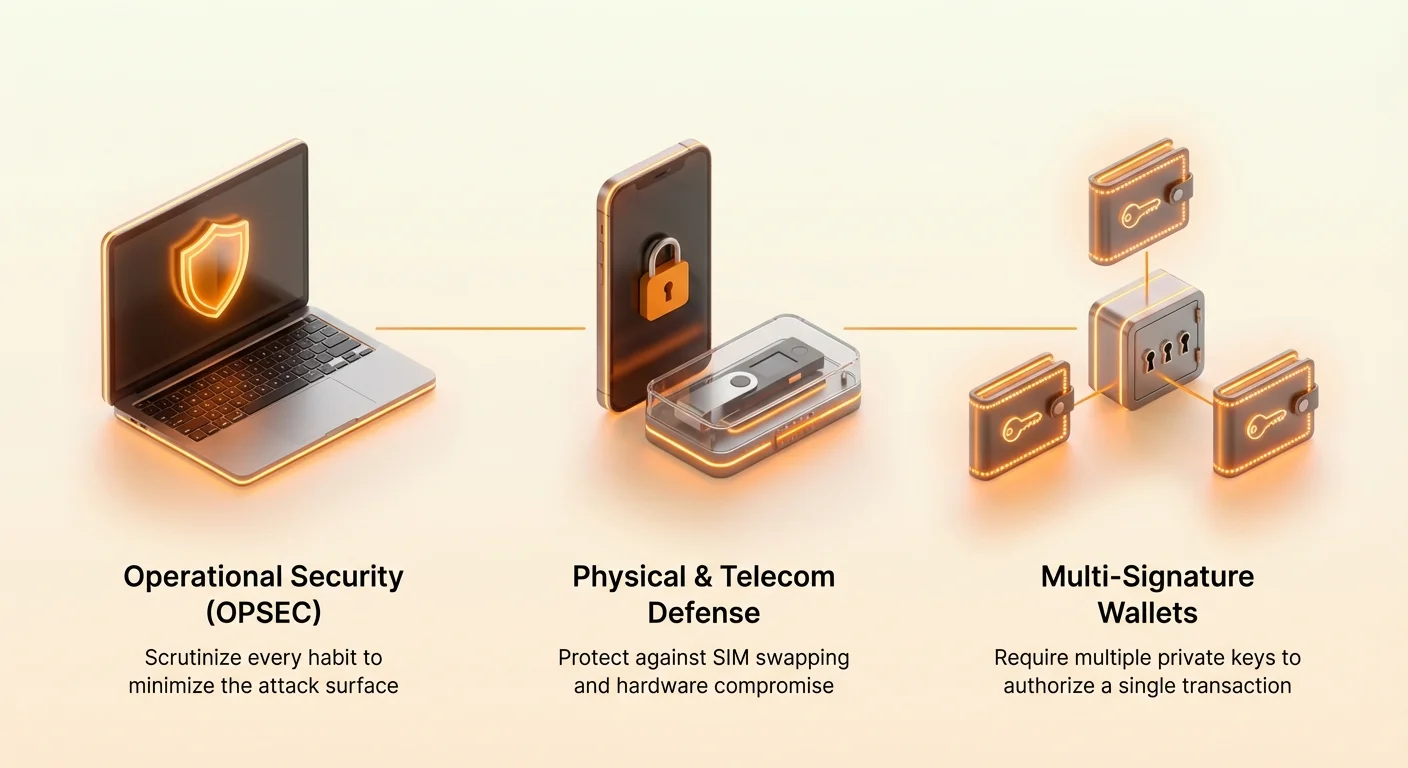
Foundational Operational Security (OPSEC): The Invisible Armor
Operational Security (OPSEC) is the discipline of protecting information and processes that, when combined, could reveal critical vulnerabilities. For crypto users, this means scrutinizing every habit, device, and communication channel to minimize the attack surface. OPSEC is not about buying software; it's about adopting a secure mindset. For a step-by-step guide, see auditing your digital security posture.
Compartmentalization: The Principle of Separation
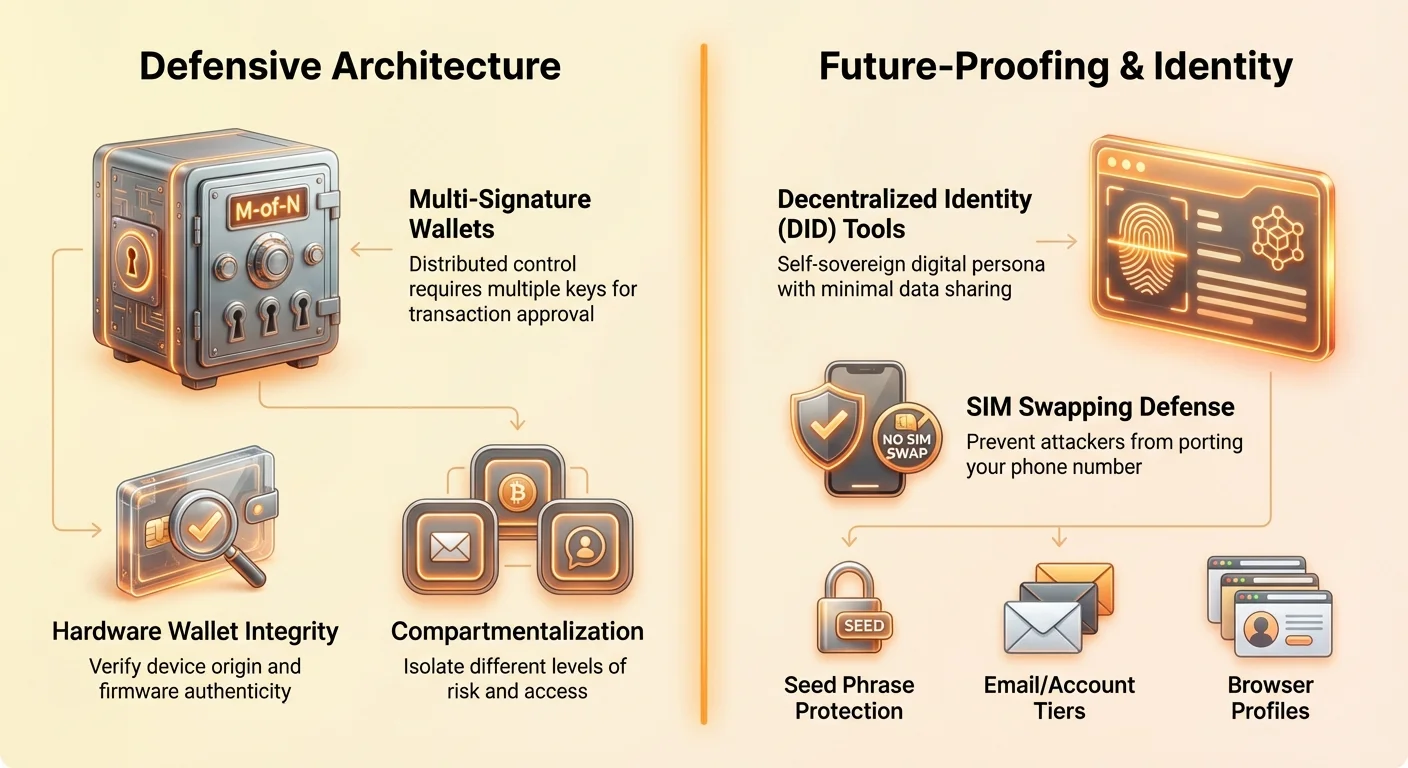
The greatest risk to any digital asset holder is a single point of failure. Attackers thrive when they can compromise one entity—be it an email account, a phone, or a specific computer—and gain access to everything. Compartmentalization is the practice of separating different levels of risk and access into distinct, isolated environments.
Practical Implementation:
- The Dedicated Finance Device: Use a clean, air-gapped (or heavily firewalled) computer or mobile device solely for signing high-value transactions. This device should never be used for general web browsing, email, or social media. This prevents malware or keylogging from being unintentionally introduced.
- Email and Account Tiers: Create separate email addresses for different purposes:
- Tier 1 (High Security): Used only for centralized exchanges (CEX) and banking 2FA recovery.
- Tier 2 (General Crypto): Used for newsletters, minor DeFi protocols, and general forums.
- Tier 3 (Public/Social): Used for everything else.
- Browser Profiles: Use different browser profiles (or even entirely different browsers) for different wallets and exchanges. If one profile gets infected by a malicious extension, the others remain protected.
The Clean Machine: Device Hygiene and Updates
Attackers often gain entry through known vulnerabilities in outdated software or through background processes running unknown code. Maintaining "clean machines" is non-negotiable for serious asset management.
Actionable Device Hygiene:
- Mandatory Automatic Updates: Ensure all operating systems, applications, and browser extensions are set to update automatically. Attackers often exploit vulnerabilities patched just days or hours before they strike.
- Minimal Software Principle: Only install software required for asset management or necessary functions. Every piece of installed software is a potential security hole. Delete old applications and run a periodic audit of browser extensions.
- Full Disk Encryption (FDE): Ensure FDE is active on all devices (e.g., FileVault on Mac, BitLocker on Windows). If your laptop or phone is lost or stolen, FDE ensures a physical compromise doesn't immediately lead to a digital compromise of local data, such as encrypted wallet files or cached API keys.
Combating Psychological Exploitation (Social Engineering)
Social engineering is the single most common and successful attack vector against high-net-worth crypto users. It relies not on technical brilliance, but on manipulating human psychology—using urgency, authority, fear, or false intimacy to coerce the victim into voluntarily surrendering private keys or access credentials.
Recognizing and Thwarting Impersonation Attacks
Sophisticated attackers don't use generic emails; they craft deep-fake identities designed to build trust or exert pressure. These attacks often masquerade as legitimate entities—from customer support to project founders.
Common Impersonation Tactics:
- Whale Phishing (Spear Phishing): Attackers research the victim deeply, often knowing their holdings, the protocols they use, and their public-facing communication style. They may impersonate a known business partner or a core developer of a protocol the victim frequently interacts with, using highly realistic email templates or direct messages (DMs).
- The Urgency Trap: Any communication demanding immediate action—"Your account is frozen; click here now," or "We found a critical vulnerability; transfer funds to a safe address"—is a red flag. Security protocols must always be handled methodically, not urgently.
- The Authority Scam: Attackers pose as IRS agents, law enforcement, or regulatory bodies, threatening penalties if the user does not comply with an instruction (e.g., validating a wallet via a malicious link). Remember: legitimate government agencies will never demand crypto transfers or sensitive key information via email or instant messaging.
Defense Strategy: Verification Protocol:
- Establish a Shared Secret: If you frequently communicate with business partners or critical contacts in the crypto space, establish a pre-arranged communication challenge or shared secret code that you use to verify identity before discussing sensitive matters.
- Out-of-Band Confirmation: Never trust links or instructions sent via the medium you received them on. If you receive a security alert via email, independently navigate to the official website of that service (e.g., Coinbase.com) and log in directly to check notifications. If the alert came via Telegram, call the person via a pre-verified phone number or use a different communication channel to confirm their identity.
The Anatomy of a Seed Phrase Extraction Scam
While standard phishing attempts ask for passwords, sophisticated scams target the ultimate prize: the recovery seed phrase (or mnemonic phrase). These attacks are often highly personalized and involve complex setups.
Tactics Used to Extract Seed Phrases:
- "Wallet Syncing" Tools: Attackers promote fake software or browser extensions claiming to improve wallet performance, migrate funds, or perform a security audit. The software’s main function is simply to ask the user to input their seed phrase "to verify access."
- Malicious Airdrop Claims: Users are directed to a site to claim a supposedly valuable token airdrop. To "authorize" the claim, the site prompts them to enter their 12 or 24-word recovery phrase. Legitimate smart contract interactions never require the input of a private key or seed phrase.
- Customer Support Impersonation: After monitoring public support channels (like Discord or Telegram), an attacker DMs a struggling user, claiming to be support staff, and asks the user to "read out" or input their seed phrase to "debug the account."
Absolute Rule: Your seed phrase is the master key. Review our guide on advanced recovery strategies. It should only be entered into a trusted hardware device (like a Ledger or Trezor) during initial setup or recovery. It must never be typed into a computer, smartphone, website, or software wallet.
Mitigating Physical and Telecom Attack Vectors
Defense is not purely digital. Attackers increasingly leverage physical access and weaknesses in centralized infrastructure, particularly telecommunications, to bridge the gap between your real identity and your digital assets.
Preventing SIM Swapping: Securing Your Digital Phone Number
SIM swapping (or SIM jacking) is one of the most devastating attacks against crypto holders. It involves an attacker convincing a mobile carrier (e.g., AT&T, Verizon) to transfer your phone number to a new SIM card under the attacker's control. Once they control your number, they can intercept SMS-based 2FA codes, account recovery links, and verification calls, allowing them to instantly bypass CEX security and gain access to highly sensitive accounts (email, banking, crypto exchanges).
Advanced Prevention Strategies:
- Stop Using SMS 2FA: Immediately switch all high-value accounts (exchanges, primary email) from SMS-based 2FA to a time-based one-time password (TOTP) app (like Google Authenticator or Authy) or, ideally, a hardware security key (like YubiKey). TOTP codes are generated locally on a device and cannot be intercepted by phone carriers.
- Carrier-Level Security: Contact your mobile provider and implement the highest level of security available:
- Port-Out Freeze/Security PIN: Request a unique, complex PIN (not your date of birth or last four digits of your SSN) that must be verbally supplied to a representative before any changes (including SIM replacement or porting) can be made to the account.
- Internal Notes: Ask the carrier to place internal notes on the account stating that requests for porting or SIM changes must be handled in person at a physical store with photo ID.
- Dedicated VoIP Number for Recovery: Consider using a Voice over IP (VoIP) service (like Google Voice or a dedicated secure phone service) for recovery purposes only, separating your primary exchange accounts from your physical cell number.
Supply Chain Risks: Verifying Hardware Integrity
Hardware wallets are the gold standard for storing private keys, but they introduce a new risk: the supply chain. A supply chain attack occurs when an attacker compromises the product during manufacturing, transit, or distribution.
Defense Against Hardware Compromise:
- Source Directly: Always purchase hardware wallets directly from the manufacturer’s official website. Never purchase a device from Amazon, eBay, or any secondary reseller, as these channels are notorious for shipping pre-tampered devices.
- Physical Integrity Check: Upon arrival, meticulously inspect the packaging. Check for broken seals, signs of re-taping, or any evidence that the device box was opened. Trusted brands often use tamper-evident holograms or stickers. If the packaging is suspicious, refuse to use the device.
- Firmware Verification: A legitimate hardware wallet will never ship with a pre-configured seed phrase. If the device displays a seed phrase on setup before you initiate the generation process, it is compromised. Furthermore, always verify the firmware signature during setup and update processes. Advanced wallets use cryptographic checks to ensure the firmware running on the device is genuine and untampered by the manufacturer.
Architectural Defense: Implementing Multi-Signature Wallets
For managing significant wealth, reliance on a single private key—even one stored on a hardware wallet—presents an unacceptable systemic risk. If that key is lost, destroyed, or compromised, all funds are immediately vulnerable.
Multi-Signature (Multi-Sig) technology mitigates this risk by requiring multiple, distinct private keys to authorize a single transaction. Explore practical use cases for Multisig. It is the gold standard for institutional and high-net-worth individual security, transforming a single point of failure into a distributed system of control.
Understanding the Multi-Sig Principle
A standard crypto transaction requires 1-of-1 authorization (one key out of one total key). A Multi-Sig setup is defined by two numbers: $M$ (the minimum number of signatures required) and $N$ (the total number of keys created).
A common, robust Multi-Sig configuration is $2$-of-$3$ ($M=2$, $N=3$). This means three separate keys are generated, but only two of those three keys are needed to sign and broadcast a transaction.
Advantages of Multi-Sig:
- Compromise Resilience: An attacker must compromise two keys (held in physically separate locations) to steal funds. If one key is lost or stolen, the funds are safe, provided the other two keys remain secure.
- Disaster Recovery: If the primary key (Key 1) is destroyed (e.g., lost hardware wallet), the user can still recover and move funds using Key 2 and Key 3.
- Governance Control: Multi-Sig ensures that major corporate or family decisions require consensus, preventing one individual from unilaterally moving assets.
Practical Multi-Sig Setup Strategies
The effectiveness of Multi-Sig depends entirely on how the $N$ keys are generated, stored, and geographically distributed. The keys must be independent, meaning compromising one storage method (e.g., a physical safe) should not compromise another (e.g., a bank vault).
Example $2$-of-$3$ Key Distribution Strategy:
| Key | Format | Storage Location | Risk Mitigation |
|---|---|---|---|
| Key 1 (Signing Key) | Hardware Wallet A | Primary Residence (Accessible, used for daily signing) | Mitigation against loss of primary hardware. |
| Key 2 (Backup Key) | Hardware Wallet B | Secure Offsite Location (Safe deposit box, trusted legal entity) | Mitigation against physical compromise of the primary residence (fire, theft). |
| Key 3 (Recovery Key) | Encrypted Paper Backup | Geographically Separate Location (e.g., Trusted relative, foreign safe deposit box) | Mitigation against regional disaster or political seizure. |
Setup Procedure:
- Independent Generation: Each key must be generated using a separate device, ideally at different times, to ensure their entropy is independent and unlinked.
- Testing: After setup, conduct a small test transaction requiring $M$ signatures (e.g., moving $10 worth of crypto) to confirm that the key distribution strategy and signing process work flawlessly before depositing major assets.
- Documentation: Document the process for signing and recovery meticulously (what key is where, what hardware wallet uses which firmware) and store this documentation securely and separately from the keys themselves.
Advanced Wallet Management and Resilience Protocols
Moving beyond simple hardware wallet use requires professional-grade protocols for verification, key maintenance, and generational succession.
Verifying Firmware and Authenticity Checks
While we discussed physical inspection, the advanced user must also verify the software layer running on the hardware wallet. This process, often called seed verification or authenticity check, ensures the device is running the official, verified code from the manufacturer.
- Secure Element vs. Open Source: Understand the architecture of your wallet. Devices using Secure Elements (chips designed to resist physical tampering) often rely on proprietary firmware, while open-source wallets allow expert users to verify the code publicly. Regardless of the architecture, always use the manufacturer’s official software bridge or dashboard to perform updates and verification.
- Hashing and Fingerprinting: When performing a firmware update, the official manufacturer software calculates a cryptographic hash (a unique digital fingerprint) of the new firmware file. Your hardware wallet must verify that this hash matches the expected value published by the company. If the hashes do not match, the firmware has been modified, and the update must be aborted. Never bypass this verification step.
- Passphrase (25th Word) Strategy: For extreme security, utilize a "passphrase" (sometimes called the 25th word). This is an optional, user-defined word that acts as a second password for your recovery seed. This passphrase never leaves your memory or your secure storage. For deep cold storage implementation, see our advanced wallet setup guide. If an attacker gains access to your 24-word seed phrase, they still cannot access your funds without the 25th word. This should be used for the largest portion of your wealth, reserving the standard 24-word derivation path for "honey pot" amounts (small, disposable funds designed to attract and occupy an attacker).
Inheriting Digital Assets: Planning for Disaster Recovery
One of the largest security failures for self-custody adopters is a lack of inheritance planning. If you pass away or become incapacitated, your security measures—designed to keep attackers out—will also lock your family out forever. Learn how to create an inheritance and contingency plan. A security strategy is incomplete without a clear succession plan.
Establishing a Digital Will:
- The Executor and the Vault: Appoint a trusted digital executor (e.g., a lawyer or close family member). This person does not need immediate access to the keys, but they need access to the instructions.
- Encrypted Data Vault: Create a secure, encrypted file containing all critical information: wallet names, login credentials for exchanges (if applicable), and clear, step-by-step instructions on how to use the Multi-Sig recovery keys (Key 2 and Key 3 from the strategy above).
- Timelock Mechanism: Store this encrypted file and the associated passwords/decryption keys with an uninterested third party (like a solicitor or a digital asset escrow service). The agreement should stipulate that the file and keys are only released to the executor upon presentation of a death certificate or notarized evidence of incapacity, thus creating a "timelock" that prevents premature access.
The Future of Identity: Decentralized Identity (DID) Tools
The highest level of operational security involves minimizing reliance on centralized entities—not just exchanges, but also internet service providers, email providers, and social media platforms that often hold the key to identity recovery. Decentralized Identity (DID) tools offer a path toward minimizing this trust requirement.
Moving Beyond Centralized Authentication
Traditional security relies heavily on centralized identifiers (your phone number, your Gmail account, your institutional login). If an attacker compromises one of these, they can often use it to pivot to the next. DID aims to give users self-ownership over their digital persona.
How DID Enhances Security:
- Self-Sovereign Identifiers: Instead of logging in with Google, a user logs in with a cryptographic identifier (a key pair) managed on their own device or wallet. The identity is not stored on a centralized server; it is stored and managed by the user.
- Reduced Data Leakage: When you interact with a service using a DID, you only share the minimal verifiable data required (e.g., proving you are over 18) rather than sharing all data associated with a login (email address, IP address, device type). This dramatically reduces the amount of personal identifying information (PII) available for social engineers to exploit.
- Decentralized Recovery: If a private key associated with a DID is lost, recovery can be structured using decentralized social recovery methods (similar to a Multi-Sig setup for identity) rather than relying on a centralized email account or phone number—both prime targets for SIM swapping.
Privacy and Compliance through Verifiable Credentials
A core component of DID is the Verifiable Credential (VC). VCs are cryptographically signed proofs of identity or status issued by a trusted organization (e.g., a university issuing a degree credential, or a government issuing an age credential).
Advanced Compliance and Privacy Use Case:
When dealing with KYC (Know Your Customer) requirements on centralized exchanges, you typically upload sensitive documents (passports, driver's licenses). These documents are a massive attack liability if the exchange suffers a data breach.
With VCs, a financial institution can issue a VC confirming your identity has been verified. When you move to a new platform, you don't submit your passport; you simply present the existing VC, proving the verification already occurred, without exposing the underlying PII. This compliance method provides necessary regulatory assurance while maintaining absolute data privacy and minimizing your exposure footprint to cyber criminals.
Conclusion: Mastering Resilient Asset Management
Achieving true self-sovereignty in the digital economy requires a commitment to continuous learning and the implementation of security protocols that rival those of specialized financial institutions.
We have moved beyond the basics—understanding that sophisticated attacks target not just software, but human psychology (social engineering), centralized infrastructure (SIM swapping), and physical supply chains (hardware compromise).
By adopting the principles outlined here—rigorous OPSEC, mandatory compartmentalization, architecting resilience through Multi-Sig setups, implementing carrier-level SIM swap prevention, and exploring the future potential of Decentralized Identity—you transform yourself from a susceptible target into a resilient practitioner. Your security posture must be active, always evolving, and built on the strategic deployment of multiple, independent layers of defense. The cost of convenience is vulnerability; the reward for diligence is financial independence and enduring security.