
The moment you move your cryptocurrency off an exchange and into a personal wallet, you become your own bank. This act of self-sovereignty—a core tenet of the crypto ecosystem—comes with a profound responsibility: absolute security of your private keys.
For most newcomers, key management starts and ends with writing 12 or 24 words onto a piece of paper and storing it in a safe. While this is a foundational step, it is insufficient for protecting significant wealth or ensuring multi-generational transfer. Fire, flood, decay, and even simple forgetfulness pose risks that standard paper storage cannot overcome.
This guide moves beyond the basics, offering a robust framework for long-term private key protection. We will explore methods used by security experts to make recovery robust, resilient, and ready for the future, ensuring your digital assets survive both physical disasters and the test of time.
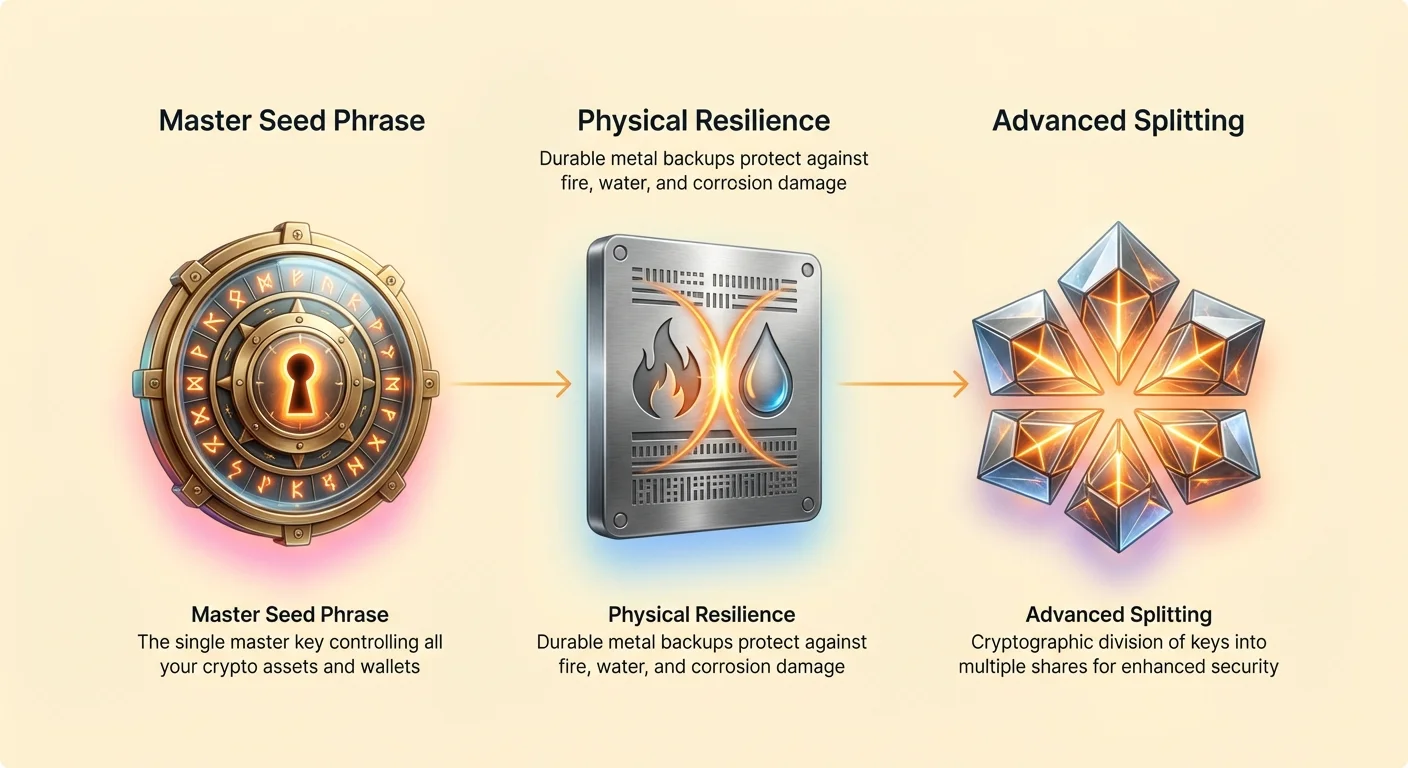
The Master Key Concept: Understanding Your Responsibility
Before implementing advanced techniques, it is crucial to firmly grasp what a seed phrase (or recovery phrase) actually represents and why its secrecy is non-negotiable.
Seed Phrases vs. Private Keys
In cryptocurrency, you technically possess private keys—the long, alphanumeric strings that grant transactional authority over specific coins. However, managing hundreds of these keys is impossible.
The Seed Phrase (or mnemonic phrase, typically 12 or 24 words) acts as a universal master key. It is an easily readable representation of the single, master private key from which all your individual wallet addresses and corresponding private keys are mathematically derived.
Key Takeaway: If a hacker or thief gains access to your seed phrase, they gain immediate and irrevocable control over all funds associated with that wallet, regardless of how strong your wallet password or PIN might be.
The Problem with Simple Backups
A single piece of paper stored in a home safe is a single point of failure. If that safe is breached, the house burns down, or the paper deteriorates due to moisture, the assets are permanently lost.
Advanced key management pivots from the strategy of "hiding" the phrase to the strategy of "making the phrase resilient and difficult to reconstitute." This means employing physical durability, geographic dispersion, and cryptographic splitting techniques.
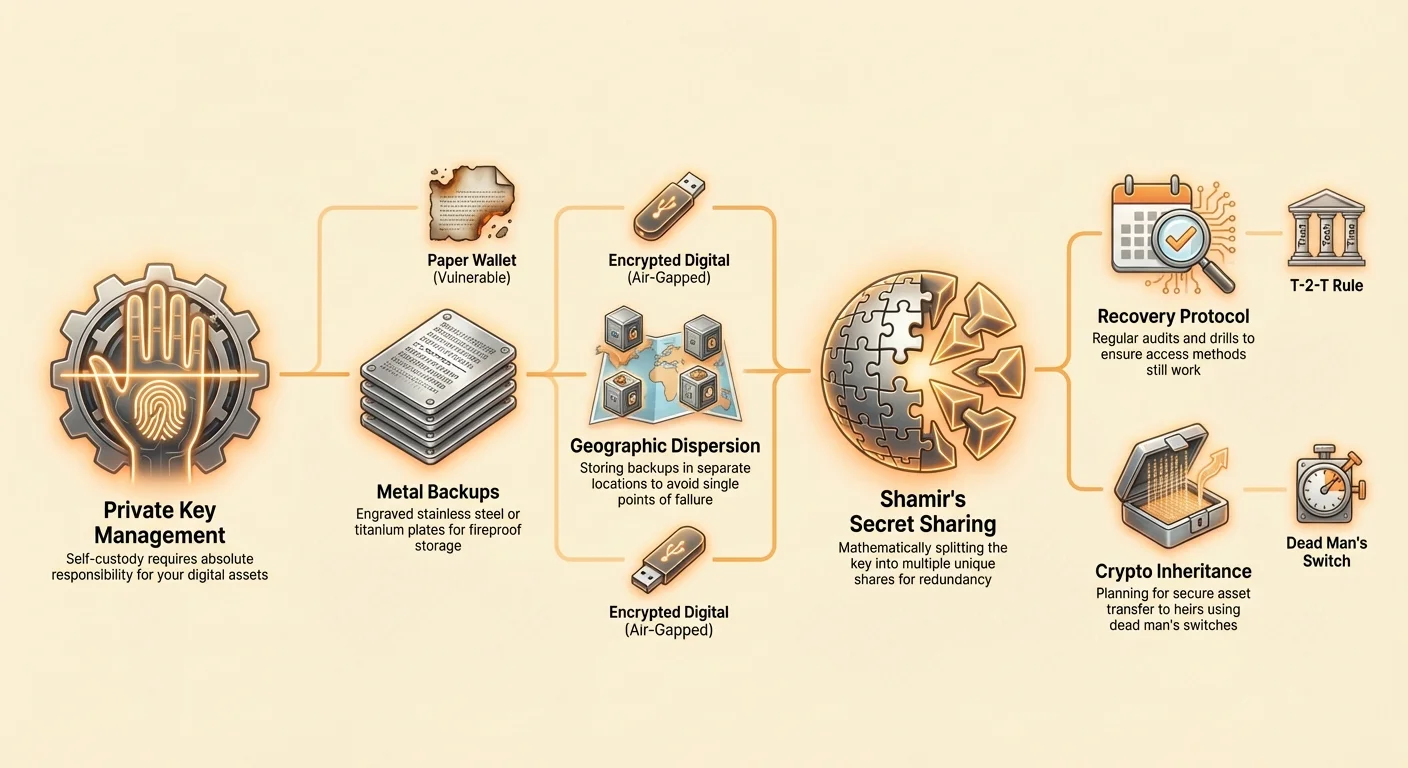
Upgrading Physical Storage Resilience: Beating the Elements
The first line of defense is ensuring the physical medium storing your seed phrase can withstand common threats, namely fire, water, and corrosion.
Material Selection: Paper vs. Metal
While paper is the standard for initial setup, it is highly vulnerable. For long-term cold storage (holding assets you don't intend to touch for years), durable materials are mandatory.
Paper Backups (Low Resilience)
Standard paper and ink can bleed, fade, or combust at relatively low temperatures (around 450°F or 232°C). If you must use paper, utilize acid-free archival paper and waterproof, archival-quality ink or pencil (graphite is highly durable). Store it in a sealed, waterproof enclosure.
Metal Backups (High Resilience)
Metal stamping or engraving is the industry standard for robust, long-term cold storage.
- Stainless Steel (304 or 316): Highly resistant to fire (melting point over 2,500°F or 1,370°C), rust, and corrosion. Seed phrases are typically stamped or etched onto specialized metal plates or cylinders.
- Titanium: Even more durable and resistant to caustic chemicals and extremely high temperatures, though often more expensive.
Practical Tip: When stamping, double-check every word before finalizing the engraving. Errors on metal are difficult or impossible to correct without starting over.
Disaster Planning and Geographic Dispersion
Even the most resilient metal plate is useless if it is sitting in your home safe when a regional flood or house fire occurs. Geographic dispersion eliminates the single point of failure tied to a physical location.
The goal is to store pieces of information across distances great enough that one natural disaster cannot destroy all copies simultaneously.
| Dispersion Strategy | Description | Best For |
|---|---|---|
| Two-Location Split | Storing two complete, identical copies in different, non-proximate secure locations (e.g., home safe and a bank safety deposit box). | Moderate risk, high-value portfolios. |
| Three-Location Split | Storing three complete copies in three distinct locations (e.g., home, bank, trusted attorney/family member in another city). | Maximum redundancy, lower privacy (more people/locations involved). |
Best Practice for Dispersion: Never label the backup explicitly as "Bitcoin Seed Phrase." Use a coded identifier only you or your heirs would understand (e.g., "M.A. Project Notes" or "Himalayan Trip Photo Backup").
The Danger of Digital Backups: Controlled Encryption
In the pursuit of convenience, some users are tempted to store their seed phrase digitally—a severe mistake if done without extreme caution. Cloud storage, emails, and notes apps are frequently targeted and scanned by malicious actors.
If you must use a digital component (perhaps for advanced key splitting or to facilitate inheritance), it must be done with robust, layered encryption, isolated from the internet, and stored in a physical location.
High-Security Digital Encryption (Veracrypt Explained)
If your setup requires storing a key component digitally, you need a full-disk or file-container encryption tool. Veracrypt is a widely respected, open-source tool that allows users to create highly encrypted virtual disk containers.
How to Use Veracrypt Securely:
- Create a Container: Use Veracrypt to create a large, encrypted file (a container) on an external USB drive.
- Strong Passphrase: Crucially, use a passphrase (a sentence or string of 15+ characters, including symbols) that is entirely separate from your crypto seed phrase.
- Store the Component: Place the seed phrase (or a component of it) inside this encrypted container.
- Air-Gap the Drive: Once created, the USB drive should be physically disconnected from all computers and stored securely alongside the Veracrypt passphrase (which should be stored separately from the drive).
Critical Warning: If you lose the Veracrypt passphrase, the data inside the container is irrecoverable.
Air-Gapped vs. Connected Storage
The safest digital storage is air-gapped storage—a device (like a USB stick or external hard drive) that has never, and will never, connect to the internet.
| Storage Type | Risk Profile | Use Case |
|---|---|---|
| Connected (Cloud/PC) | Extreme Risk. Susceptible to keyloggers, malware, and remote access. | Never use this for sensitive keys. |
| Air-Gapped (Encrypted USB) | High Security. Requires physical access to the device and knowledge of the decryption password. | Storing a component of a split key phrase or encrypted passwords. |
Advanced Key Splitting: Introducing Shamir’s Secret Sharing (SSS)
Shamir’s Secret Sharing (SSS) is a mathematically elegant cryptographic technique that allows a single secret (your seed phrase) to be divided into multiple unique pieces, or "shares."
The genius of SSS is that you only need a predetermined number of those pieces to reconstruct the whole secret. This is known as an N-of-M scheme.
How SSS Works: The N-of-M Scheme
Imagine your seed phrase is the key to a vault. You want to ensure that:
- No single person can open the vault alone (preventing theft).
- The vault can still be opened even if some pieces are lost (preventing loss).
This is achieved through the $N$-of-$M$ configuration:
- M (Total Shares): The total number of shares you create (e.g., 5 shares).
- N (Threshold): The minimum number of shares required to reconstruct the original secret (e.g., 3 shares).
In a 3-of-5 scheme:
- You create 5 unique shares.
- You distribute them to 5 trusted people/locations.
- If you lose 2 shares (or 2 people become uncooperative), the secret can still be recovered using the remaining 3 shares.
- No single person holding just 1 or 2 shares can ever reconstruct the secret.
This system provides superior resilience against both loss (redundancy) and theft (need for multiple colluding parties).
Practical Implementation of SSS
While the underlying math is complex, modern hardware wallets (like certain Trezor models) and specialized open-source tools handle the splitting automatically.
Implementation Steps:
- Determine the Scheme: Choose your desired configuration (e.g., 4-of-6 is common for family planning).
- Generate Shares: Use the wallet or specialized software to generate the 6 unique, scrambled shares.
- Physicalize the Shares: Write each share onto a durable medium (e.g., stamped metal plates).
- Distribute and Disperse: Store Share 1 in Location A, Share 2 in Location B, and so on. Ensure locations are geographically diverse.
- Test the Process: Crucially, practice reconstructing the phrase using the minimum number of shares ($N$) in a safe, offline environment to confirm the process works before relying on it completely.
SSS vs. Simple Splitting
Some users try to implement a basic version of splitting by simply dividing their 24-word seed phrase into three 8-word chunks and storing them separately. This is vastly inferior to SSS:
| Feature | Simple Word Splitting (e.g., 3x8 words) | Shamir's Secret Sharing (SSS) |
|---|---|---|
| Security | Low. If a thief gets one 8-word chunk, they only need to guess the remaining 16 words (still possible with brute force). | High. A single SSS share is mathematically worthless and provides zero information about the secret. |
| Redundancy | Low. If you lose one 8-word chunk, the entire 24-word phrase is lost forever. | High. You can lose $M-N$ shares and still recover the secret. |
For serious long-term asset protection, SSS is the only cryptographically sound method of key splitting.
Building a Robust Key Management Protocol
Advanced security requires a defined protocol—a set of rules and procedures that govern how you access, audit, and eventually pass on your keys.
The "T-2-T" Rule (Trusted Third Party, Trusted Technology, Trusted Timing)
When designing your storage and recovery protocol, structure it around three pillars of trust:
1. Trusted Third Party (TTP)
This is the person, or small group of people, who are aware of your security scheme and who hold the components (shares or dispersal location maps). This must be someone who benefits from your financial well-being but who is not capable of reconstituting the full key on their own.
Example: If using SSS (4-of-6), distribute shares to six family members, ensuring that no four people live in the same geographic area or communicate constantly.
2. Trusted Technology (TTech)
Stick to proven, open-source technology. Avoid proprietary devices or software that has not been heavily audited by the security community.
- Hardware: Use established, audited hardware wallets (like Trezor or Ledger).
- Encryption: Use audited, open-source tools (like Veracrypt).
- Physical: Use standardized, fire-resistant materials (stainless steel).
3. Trusted Timing (TT)
The "Trusted Timing" is the scheduled point in the future when your recovery plan or inheritance protocol is activated. This links directly to inheritance planning, often using a "Dead Man's Switch" mechanism (discussed below).
Regular Audits and Recovery Drills
Many people set up cold storage and forget about it for years—only to find the medium has degraded or the recovery process no longer works when they truly need it.
- Annual Verification: Once a year, remove one of your physical backups (ideally the one in the most hostile storage environment, like a dusty attic or damp basement vault) and verify that the writing is still legible and that the metal is free of severe corrosion.
- Recovery Drill (Simulated): Every two to three years, perform a simulated recovery. In an entirely offline environment, enter the seed phrase into a temporary, isolated wallet (which contains no funds) to ensure the phrase is correct. Immediately wipe the computer afterward. This verifies that your storage and transcription are accurate without exposing your real assets.
Crypto Inheritance: Planning for the Future
The biggest challenge in self-custody is ensuring your wealth is accessible to your heirs without exposing it to unnecessary risk while you are alive. If you die suddenly without an access plan, the funds are simply lost forever.
The "Dead Man's Switch" Strategy
A Dead Man's Switch is a mechanism that automatically executes a critical function (like revealing key components) if the owner fails to check in after a predetermined period.
Technical Implementation:
- Trigger Setup: Use an encrypted messaging service or specialized inheritance software that requires you to check in weekly or monthly via a secure channel (e.g., a signal from your verified hardware wallet).
- Time-Based Delay: Set a delay (e.g., 90 days). If you miss 90 days of check-ins, the switch activates.
- Encrypted Key Disclosure: Upon activation, the system releases the necessary information—often an encrypted file containing instructions and the location/decryption password for one of your key shares.
Important Note: The switch should not release the entire seed phrase, but only enough information to allow your designated executor to begin the recovery process (e.g., the decryption password for a Veracrypt file containing Share 1 of 5).
Legal Instruments vs. Technical Solutions
Crypto assets do not fit neatly into traditional legal estate planning. A will stating "I leave all my crypto to my daughter" is useless if she cannot physically access the funds.
1. Technical Solution (Preferred)
Rely on SSS and the Dead Man's Switch. The legal will should only name the executor who is designated to receive the trigger instructions and access to the TTPs holding the key shares. The will confirms the legal right to the assets, while the technical plan provides the physical access.
2. Legal Instruction Document
Create a highly detailed, legally sound Letter of Instruction (separate from the will, as the will is public record). This letter, secured in a lawyer's or executor's safe, should contain:
- A list of all wallets used (without addresses).
- The type of security system implemented (e.g., "4-of-6 Shamir Split").
- Contact information for all trusted third parties holding shares.
- Instructions on how to decrypt the first component (the Veracrypt password).
Crucial Security Measure: The Letter of Instruction must never contain the seed phrase itself, nor should it contain enough information to reconstruct the key. It only provides the map and the initial steps.
Conclusion: Commitment to Security as a Practice
Mastering private key management is not a one-time setup; it is a continuous practice of vigilance, redundancy, and foresight. Moving from a single paper backup to advanced techniques like Shamir’s Secret Sharing and geo-dispersed metal storage transforms your security posture from vulnerable to resilient.
By implementing robust physical storage, careful digital encryption for access components, and a dedicated inheritance protocol, you are not just safeguarding your wealth against hackers—you are building true, self-sovereign financial longevity for generations to come. Start small, verify every step, and continuously audit your security setup to ensure your master key remains secure.