
Managing digital assets requires a fundamental shift in how we perceive ownership and security. In the traditional banking world, security is often passive; you rely on a financial institution to guard the vault, verify identities, and reverse fraudulent transactions. In the realm of cryptocurrency, the paradigm shifts to active responsibility. You are the bank. This autonomy grants immense freedom, but it also introduces significant risks, primarily centered around the management of private key management.
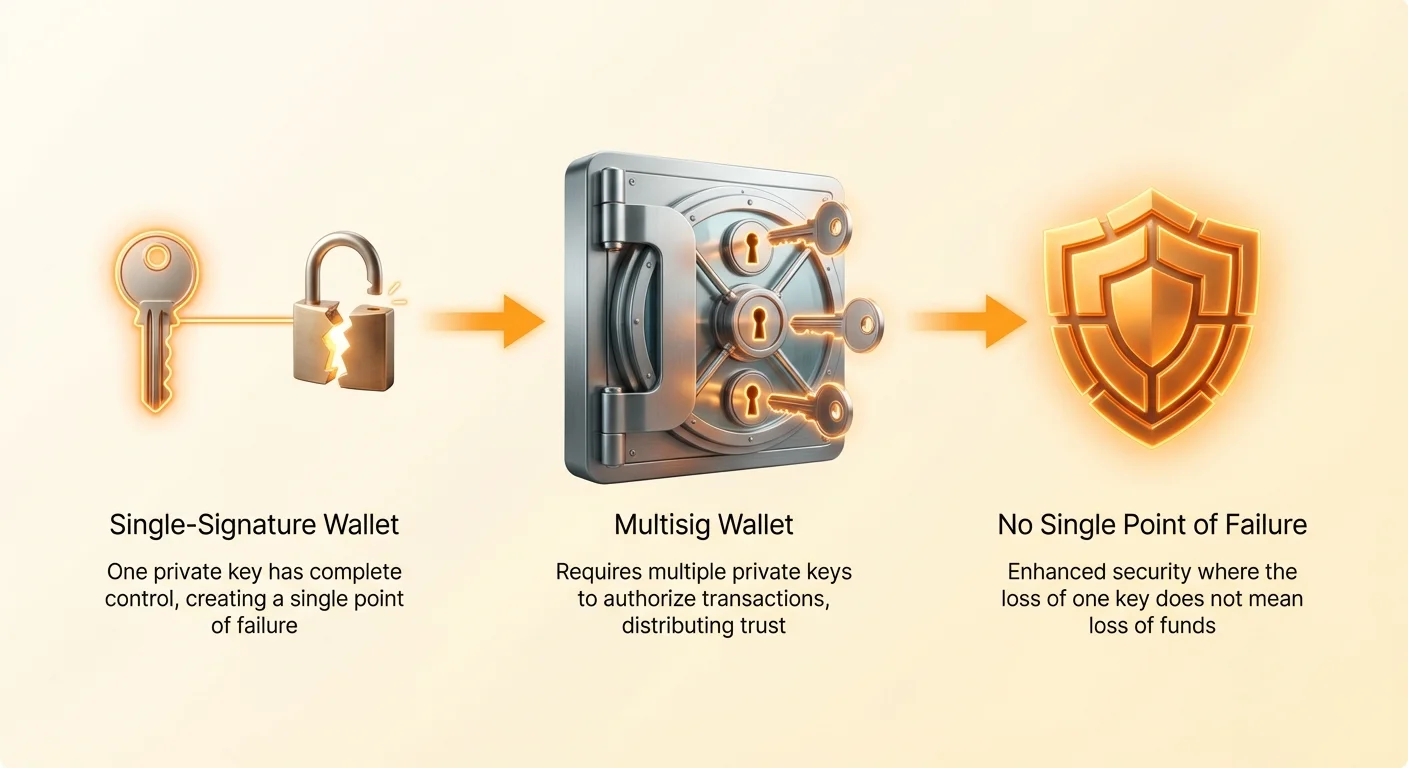
Most standard cryptocurrency wallets operate on a "single-signature" basis. This means one private key—often represented by a 12 or 24-word recovery phrase—is all that is required to access and move funds. If that key is lost, the funds are unrecoverable. If that key is stolen, the funds are gone. This binary outcome creates a single point of failure that can be nerve-wracking for individuals holding significant wealth, and completely unworkable for organizations.
To address these vulnerabilities, the concept of multisig (multi-signature) technology was developed. This approach requires multiple private keys to authorize a Bitcoin transaction, rather than just one. By distributing trust and access across different parties or devices, users can eliminate single points of failure. This creates a robust framework suitable for group security, corporate treasuries, and complex inheritance planning.
The Mechanics of Multisig
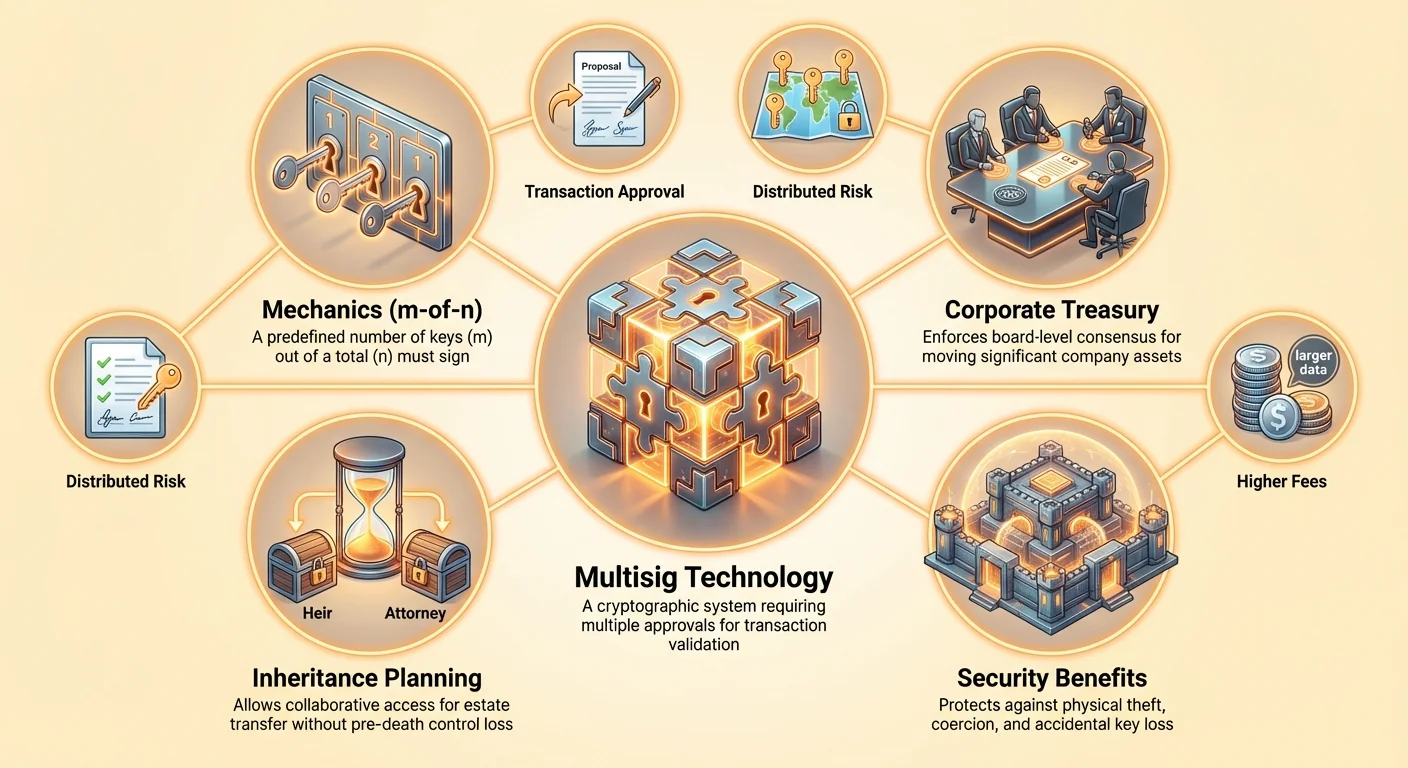
At its core, a multisig wallet functions like a digital version of a bank vault that requires two different keys to open. In technical terms, this is often referred to as an "m-of-n" scheme. The "n" represents the total number of private keys associated with the wallet, also known as the number of participants. The "m" represents the minimum number of keys required to approve a transaction.
For example, a "2-of-3" wallet has three distinct private keys associated with it. To move funds out of this wallet, at least two of those three keys must sign the transaction. If a thief manages to steal one key, they still cannot steal the funds because they lack the second required signature. Conversely, if the owner loses one key, they are not locked out of their funds, as the remaining two keys are sufficient to regain access.
This structure fundamentally changes the security model. In a standard wallet, the private key is the master access token. In a multisig setup, a single key is merely a partial authorization. This separation allows for flexibility in how security is architected, enabling users to balance convenience against extreme safety measures depending on their specific needs.
Transaction Requests and Approvals
The workflow for sending funds from a shared wallet differs slightly from a standard wallet. In a standard setup, you scan an address, enter an amount, and send. The network validates the signature, and the transaction is broadcast immediately. In a shared environment, the process is collaborative.
Any participant holding a key can typically create a "transaction request." This is a proposal to move a specific amount of cryptocurrency to a specific address. However, this request is not valid on the blockchain until the requisite number of signatures is collected. The proposal sits in a pending state until other participants review it.
Once a request is made, other key holders must use their wallets to approve (sign) or reject the transaction. For a 2-of-3 wallet, if you initiate the request, your key provides the first signature implicitly. You then need one other person—or one other device you control—to provide the second signature. Only after that second approval is recorded does the wallet software broadcast the fully signed transaction to the Bitcoin network for confirmation.
Eliminating the Single Point of Failure
The most immediate benefit of adopting a multisig strategy is the removal of the single point of failure. Physical threats to seed phrases are just as dangerous as digital threats. Fires, floods, and simple misplacement of paper backups have caused the loss of millions of dollars in cryptocurrency.
If you store your only recovery phrase in your home, and your home suffers a catastrophic event, your wealth is destroyed. A multisig setup allows for geographic distribution of risk. You might keep one key at your home, a second key in a safe deposit box at a bank, and a third key at your office or with a trusted relative.
In this distributed scenario, the destruction of your home does not result in financial ruin. You simply retrieve the keys from the other two locations to move your funds to a new wallet. This redundancy is critical for anyone treating Bitcoin as a long-term store of value rather than just spending money.
Protection Against Coercion and Theft
Beyond environmental hazards, multisig offers protection against physical coercion. This is often referred to as the "$5 wrench attack," where an attacker threatens a victim with physical violence to force them to unlock their wallet. With a standard wallet on a mobile phone, the victim can be forced to transfer everything immediately.
With a properly configured multisig setup, the victim literally cannot comply with the attacker's demands if the necessary keys are not physically present. If a user requires 2-of-3 keys to sign a transaction, and one key is in a bank vault across town, the attacker cannot force an immediate transfer. This delay mechanism can be a significant deterrent, as attackers generally prefer quick, irreversible transfers.
Organizational Treasury Management
As cryptocurrency adoption grows, more businesses are holding digital assets on their balance sheets. A standard single-key wallet is wildly inappropriate for corporate use. It concentrates immense power in the hands of a single individual, usually the CEO or CFO. If that person goes rogue, they can embezzle the entire treasury. If they are incapacitated, the company loses all its assets.
Multisig serves as the industry standard for decentralized corporate governance. It allows organizations to replicate traditional board controls on the blockchain. A company might set up a 3-of-6 wallet where the six participants are the CEO, CFO, COO, and three board members.
Board Approval Workflows
In this corporate configuration, day-to-day expenses might be managed from a smaller, separate wallet, while the main treasury requires significant consensus. To move funds from the main treasury, three distinct executives must agree. This ensures that no single executive can run off with the funds.
It also ensures continuity. If the CEO were to leave the company unexpectedly or suffer a medical emergency, the remaining five members still hold enough keys to access the funds and continue operations. The wallet configuration acts as a digital constitution, enforcing the rules of expenditure through cryptography rather than mere policy.
Departmental Budgeting
Large organizations can use different multisig setups for different departments. The marketing department might have a 2-of-3 wallet for their budget, controlled by three marketing managers. This gives them autonomy to spend without bothering the CEO for every transaction, while still preventing any single manager from spending unilaterally.
This structure also aids in auditing. Since every transaction on the Bitcoin blockchain is public, and the specific approvals can be tracked within the wallet software, there is a clear, immutable record of who signed which transaction. This transparency is vital for internal accountability and external reporting.
Inheritance and Estate Planning
One of the most complex challenges in crypto is passing assets to heirs. Traditional wills work well for bank accounts where a judge can order a bank to transfer funds. Bitcoin respects no court orders; it only respects private keys. If an owner dies without sharing their keys, the inheritance is lost. Conversely, sharing keys while alive creates a risk of theft or misuse.
Multisig offers an elegant solution to this paradox through "time-delayed" or "collaborative" access. An individual can set up a 2-of-3 wallet for their estate plan. The owner holds one key. The designated heir holds a second key. A trusted third party, such as an attorney or a specialized estate planning service, holds the third key.
The Access Dilemma
During the owner's lifetime, they can control the funds by combining their key with the lawyer's key or the heir's key (if they choose to collaborate). The heir, holding only one key, cannot access the funds alone. This prevents the heir from spending the inheritance prematurely or forcing a transfer.
Upon the owner's passing, the heir presents the death certificate to the attorney. The attorney then uses their third key in conjunction with the heir's key to meet the 2-of-3 requirement. This unlocks the funds for the heir. This system creates a cryptographic escrow that enforces the owner's wishes without requiring the owner to give up total control during their life.
| Feature | Single-Signature Wallet | Multisig Wallet |
|---|---|---|
| Security Point | Single point of failure | Distributed failure points |
| Access Control | One person has full control | Consensus required |
| Risk | High (loss = total loss) | Low (redundancy available) |
| Transaction Speed | Fast and immediate | Slower, requires coordination |
| Cost | Standard network fees | Higher fees (more data) |
Family Financial Management
On a smaller scale, shared wallets are excellent tools for family finances. A 2-of-2 wallet acts effectively as a joint checking account where both spouses must agree on large purchases. While this might be impractical for buying coffee, it is excellent for a savings account meant for a house down payment. The requirement for two signatures acts as a friction layer against impulse spending.
This structure is also useful for educational purposes. Parents can set up a 2-of-2 wallet with a child. The child can initiate transaction requests—learning how to use the interface and manage addresses—but the transaction cannot go through until the parent reviews and signs it.
Monitoring and Authorization
This parental control mechanism allows children to learn the mechanics of cryptocurrency in a safe environment. They cannot accidentally send funds to a scammer or lose the savings because the parent acts as the final gateway. It transforms the wallet into a teaching tool where financial responsibility is learned through guided action rather than theoretical lectures.
Furthermore, because these wallets can be generated easily within apps like the Bitcoin.com Wallet, families can create separate shared wallets for different goals: one for a vacation fund, one for college savings, and one for charitable giving. Each can have different participants and signature requirements.
Technical Considerations and Costs
While the benefits are clear, multisig wallets come with technical trade-offs. The primary consideration is transaction fees. Bitcoin fees are calculated based on the amount of data (in bytes) a transaction consumes on the blockchain. A standard transaction usually involves one signature.
A multisig transaction involves multiple signatures and the public keys of all participants. This creates a larger data footprint. Consequently, sending bitcoin from a multisig wallet will almost always cost more in network fees than sending from a standard wallet. Users must weigh this added cost against the security benefits. For small amounts of money, the fees might be prohibitive. For large treasury management, the fees are negligible compared to the security value.
Complexity and User Error
The other technical risk is complexity. Setting up a multisig wallet requires coordination. All participants need to generate their keys securely and back them up. If a user sets up a "2-of-2" wallet and one party loses their key, the funds are lost forever because the "m" (2) cannot be met.
It is vital to understand the difference between "2-of-3" and "2-of-2". In a 2-of-3 setup, you have redundancy. You can lose one key and still recover funds. In a 2-of-2 setup, you have increased security against theft (a thief needs both keys), but decreased security against loss (losing either key locks the wallet). Users must choose the ratio that best fits their threat model.
Selecting the Right Configuration
Choosing the correct "m-of-n" ratio is the most critical decision when creating a shared wallet. The choice depends entirely on the goal: redundancy vs. security.
- 2-of-3: The most common and versatile setup. It offers redundancy (can lose one key) and security (need two to spend). Ideal for individuals and small businesses.
- 3-of-5: Good for medium organizations. It allows for two people to be unavailable or lose keys without halting operations, while requiring a significant consensus to spend.
- 1-of-2: This is rarely used for security but can be used for convenience. It means "either of us can spend." It functions like a shared bank account where either partner can withdraw funds independently.
The Danger of High Requirements
Some users might be tempted to create a "6-of-6" wallet, thinking it offers maximum security. While it is true that a thief would need to compromise six different people, the risk of accidental loss is astronomical. If just one of the six people loses their key, or forgets their password, the funds are permanently irretrievable.
In almost all cases, it is better to have an "m" that is lower than "n" (e.g., 3-of-5 rather than 5-of-5). This gap provides a safety buffer for the inevitable human errors that occur over time, such as lost backups or forgotten passwords.
Integration with Hardware Wallets
For the highest level of security, multisig should be combined with hardware wallets. Software wallets are convenient but are connected to the internet, making them theoretically vulnerable to malware. Hardware wallets store keys offline.
A robust setup might involve a 2-of-3 multisig wallet where Key A is on a hardware device (like a Ledger or Trezor), Key B is on a different hardware device brand, and Key C is a recovery phrase stored on steel in a secure location. This setup protects against supply chain attacks. Even if one hardware manufacturer has a security flaw, the attacker would still need to compromise the second device from a different manufacturer to access the funds.
Mixing Software and Hardware
It is also possible to mix wallet types. A user could have one key on a mobile app (for ease of signing) and two keys on hardware devices. This allows the user to initiate and view transactions easily on their phone but requires them to physically access a cold storage device to approve significant movements of wealth.
This hybrid approach balances the user experience of modern mobile apps with the uncompromising security of cold storage. It is particularly effective for "active cold storage," where funds are secure but need to be moved more frequently than deep freeze vaults.
The Verification Process
Using a shared wallet requires communication. Since the blockchain does not send push notifications to other owners, participants need an off-chain method to alert each other of pending transactions. In a corporate setting, this might be an email or a Slack message saying, "Payroll transaction initiated, please sign."
For personal security, this friction is a feature, not a bug. If you receive a notification or see a pending transaction request that you did not initiate, you immediately know your security has been partially compromised. You can then use your remaining keys to sweep the funds to a new, secure wallet before the attacker can acquire the second signature needed to steal the funds.
Backups in a Multisig Environment
Backing up a multisig wallet is more involved than a standard wallet. In a single-sig wallet, you just need the seed phrase. In a multisig wallet, you generally need the seed phrase for your specific key, but you may also need the "Extended Public Keys" (XPUBs) of the other participants to restore the wallet logic in new software.
If you have a 2-of-3 wallet and your house burns down, having your seed phrase is essential. However, to restore the shared wallet view on a new computer, the software needs to know who the other two signers are. Modern wallet standards are improving this, but it is crucial to understand that you are managing a relationship between keys, not just a single key.
Privacy Implications
When you send Bitcoin from a multisig address, the transaction data on the blockchain looks different from a standard transaction. Multisig addresses often start with a '3' (P2SH) or 'bc1' (SegWit/Taproot). While this does not reveal your identity, it does reveal to the world that the funds are secured by a sophisticated setup.
Forensic analysis of the blockchain can sometimes reveal the specific "m-of-n" structure once a transaction is spent. For example, when you spend from a 2-of-3 wallet, the network reveals that three keys exist and two were used. For most users, this privacy leakage is minimal and irrelevant. However, for entities requiring extreme stealth, this on-chain footprint is a factor to consider.
Risks and Operational Complexity
The greatest enemy of security is often complexity. Multisig is undeniably more complex than single-sig. It requires understanding transaction inputs, coordinating with others, and managing multiple backups. If a user does not fully understand how the setup works, they can easily make a mistake that leads to loss of funds.
For example, a user might set up a 2-of-3 wallet with two friends but fail to back up their own key, assuming the friends will always be available. If the friends lose their keys or become uncooperative, the user loses their funds. Education and clear protocols are mandatory before moving significant amounts of capital into a multisig arrangement.
Dependency on Software Compatibility
Another risk is software dependency. Not all wallet software supports multisig, and different wallets implement it in slightly different ways. It is highly recommended to use widely adopted standards to ensure that if your wallet provider goes out of business, you can restore your keys and funds using a different software package. Using proprietary or obscure wallet implementations can lead to vendor lock-in and potential loss of access.
Conclusion
Multisig technology represents a maturation of the cryptocurrency ecosystem. It moves the industry away from the "wild west" scenario where a single lost password means total ruin, toward a more resilient, collaborative model of asset management. By distributing trust, we can create systems that survive physical disasters, internal corporate fraud, and the complexities of inheritance.
While the setup requires a deeper understanding of Bitcoin mechanics and incurs higher transaction fees, the trade-off is overwhelmingly positive for substantial holdings. Whether for a family saving for the future, a corporation securing its treasury, or an individual protecting their legacy, shared wallets provide the digital checks and balances necessary for true financial sovereignty.
Implementing a multisig wallet setup is the most effective way to eliminate single points of failure and secure generational wealth.