
Congratulations. By adopting self-custody and taking control of your private keys, you have achieved true financial sovereignty. You have removed the reliance on third parties, banks, and centralized exchanges, ensuring that your wealth is accessible only by you.
However, this freedom comes with a solemn responsibility: managing what happens when you are no longer able to access those keys, whether due to incapacitation, disaster, or death.
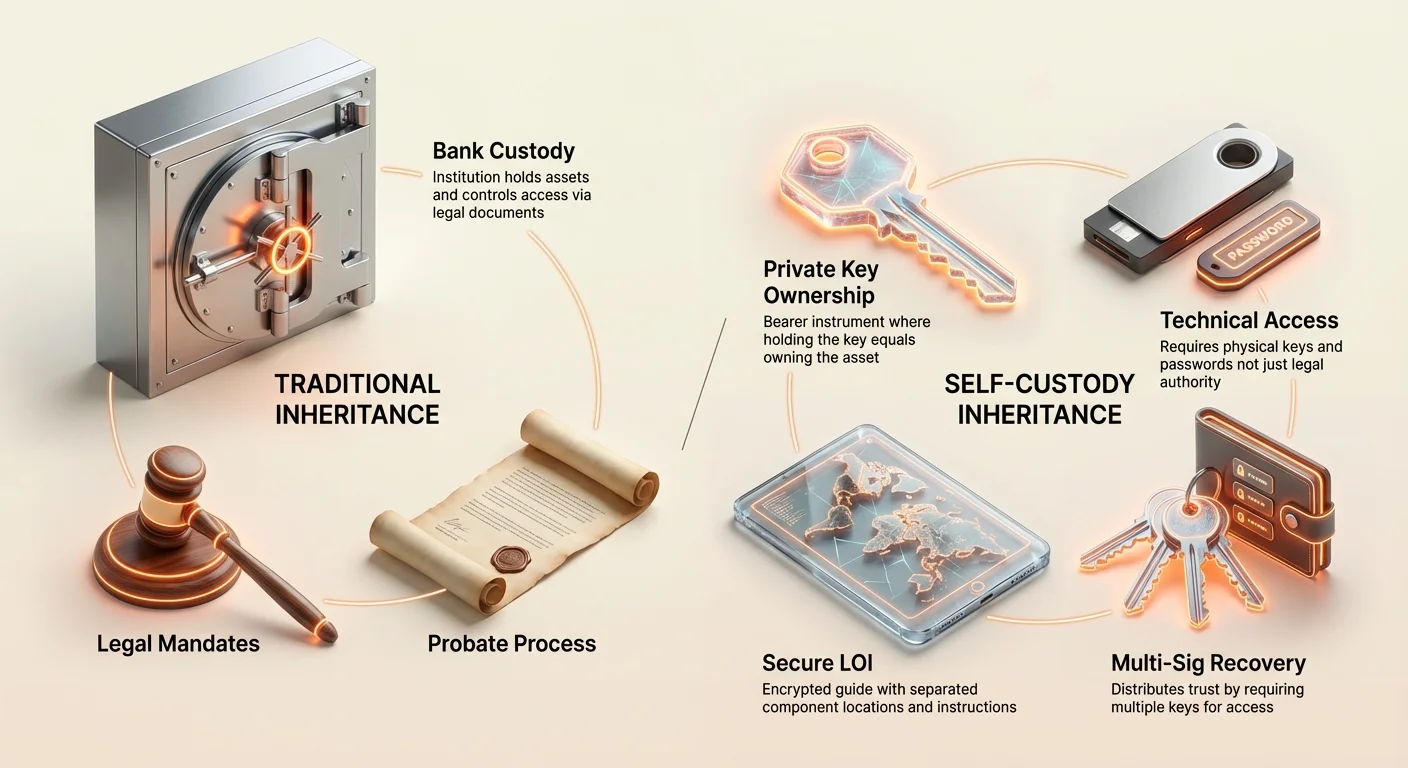
In traditional finance, the process is clear: legal documents are filed, banks comply with probate orders, and assets are transferred. In the world of self-custody, there is no bank to call. Your private key is a secret known only to you (and perhaps a handful of components you’ve secured). If that secret dies with you, the funds are permanently lost—not just to your heirs, but to the entire economic system.
This guide moves beyond foundational security and addresses the most critical long-term security challenge: establishing a robust, legally sound, and technically feasible plan to ensure your digital legacy survives you. We will focus on balancing two opposing forces: keeping your funds secure now, and making them accessible to trusted individuals later.
The Paradox of Self-Sovereignty: Why Planning is Essential
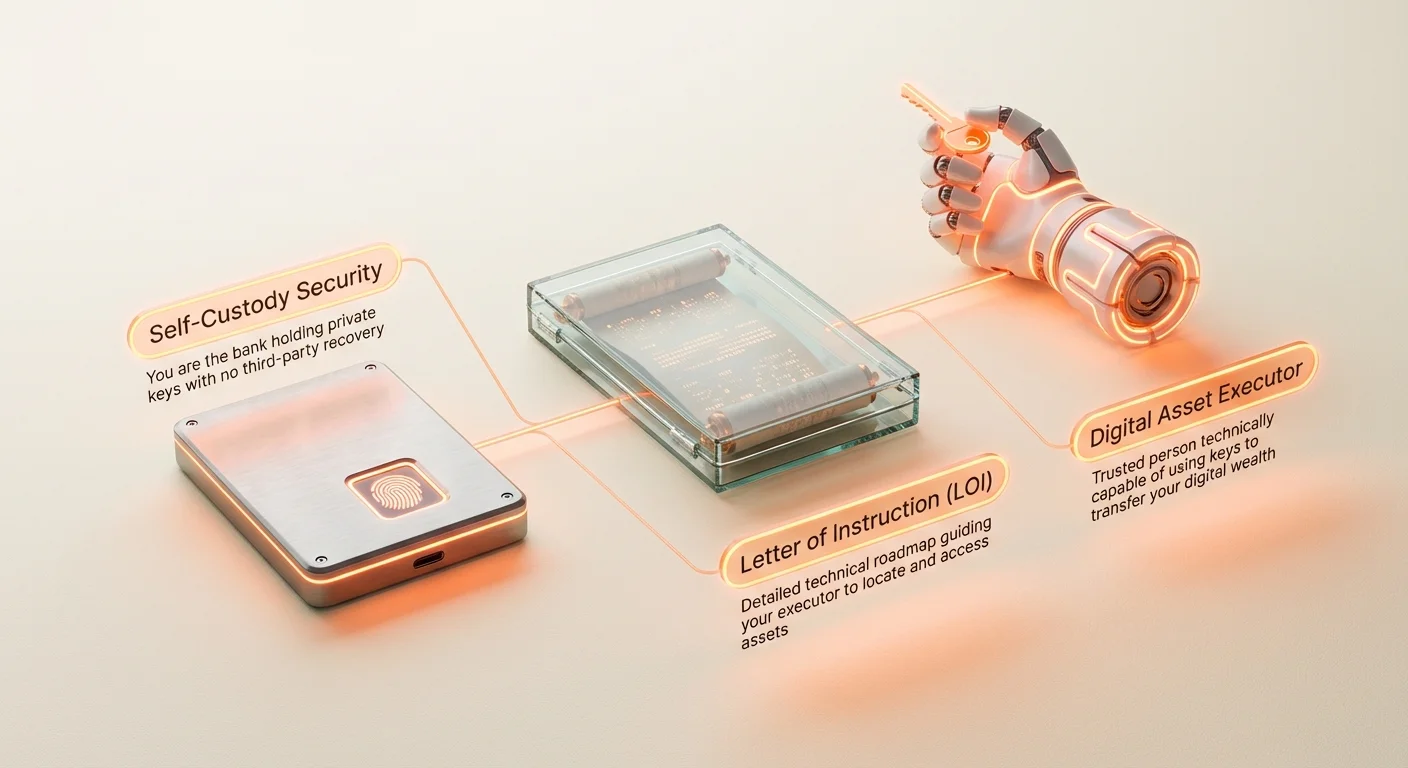
Self-custody means you are the bank. If a bank loses its vault key, the vault remains inaccessible. When you hold your own seed phrase or private keys, you become the single point of failure for your entire digital portfolio. Inheritance and disaster planning is not just about asset transfer; it is a critical component of risk mitigation.
The ‘Bus Factor’: Identifying the Single Point of Failure
The 'Bus Factor' is a concept borrowed from software development, defining the minimum number of team members who must be hit by a bus (i.e., disappear or become incapacitated) before the project fails completely. In self-custody, the bus factor is usually one: you.
If you are the only person who knows the full key location, the encryption password, or the specific hardware wallet model, your incapacitation creates an immediate, catastrophic failure for asset access. Addressing the Bus Factor requires diversifying knowledge access among trusted, pre-selected individuals, but only under specific, agreed-upon conditions.
Custodial vs. Self-Custody Inheritance Challenges
Understanding why traditional methods fail is crucial for planning new ones:
| Feature | Traditional Banking (Custodial) | Self-Custody (Non-Custodial) |
|---|---|---|
| Asset Location | Known by the bank; documented by account numbers. | Known only by the user (on-chain address is public, ownership link is secret). |
| Access Authority | The bank, which accepts legal documents (Wills, Trusts, Death Certificates). | The private key holder (you). No third party has technical authority. |
| Probate Process | Legal court order is served to the institution, mandating fund release. | A legal court order is functionally useless, as there is no entity to serve the order to. |
| Risk of Loss | Low (only if bank collapses). | High (if the key is lost, forgotten, or unknown to heirs). |
Because crypto funds are technically "bearer instruments" (whoever holds the key owns the assets), your plan cannot rely on legal mandates alone; it must rely on secure technical enablement.
Threat Modeling the Future
A robust plan must account for different types of access failure scenarios:
- Sudden Death: Requires immediate access to the seed phrase or encryption methods by a designated party. Security priority: speed of access upon triggering the event.
- Long-Term Incapacitation: Requires a mechanism to grant access to funds for maintenance (like paying staking fees, tax obligations, or managing large fluctuations) without giving up full ownership permanently. Security priority: controlled, revocable access.
- Disaster Recovery: Requires geographic redundancy of key components (e.g., if a house burns down or a safety deposit box is flooded). Security priority: physical resilience.
Foundational Pillar 1: The Secure Letter of Instruction (LOI)
The most essential component of any crypto inheritance plan, regardless of legal structure or technical complexity, is the Letter of Instruction (LOI). This document is the practical, step-by-step roadmap that guides your executor or trustee through the technical steps necessary to locate and access your digital assets.
Crucial Distinction: The LOI is not your Will. The Will tells the court who gets your assets; the LOI tells your executor how to find and access them.
What the LOI Must Contain
An effective LOI must be comprehensive, detailed, and written for a technically proficient but non-expert user.
- Inventory of Assets: A complete list of all cryptocurrencies held, noting the approximate amount and location (which blockchain/network).
- Wallet Type and Location: A list of every wallet used (Hardware Wallet 1, Hardware Wallet 2, Desktop Software Wallet, etc.). Specify the brand (Trezor, Ledger, etc.) and model.
- Seed Phrase/Key Map: Critically, the LOI should not contain the raw seed phrase itself. Instead, it should contain a clear map or guide instructing the executor where the components of the seed phrase are physically or digitally located. (E.g., "Seed Phrase Component A is in Safe Deposit Box 123; Component B is held by Attorney Smith.")
- Passwords and PINs: List all PINs, hardware wallet passphrases (25th word), or encryption passwords necessary to access the storage mediums. These must be stored separately from the LOI itself and secured via methods outlined below.
- Exchange/Account Access: If you maintain small amounts on centralized exchanges (CEXs) for trading, list the CEX URLs, usernames, and two-factor authentication (2FA) recovery methods.
- Instructions for Transfer: A clear, sequential list of instructions detailing exactly how to initiate a transaction and transfer the funds to the designated trust wallet or beneficiary addresses. Example: "To access Wallet X, retrieve the device from Location Y, enter PIN 1234, and the 25th Word stored in Vault Z."
Best Practices for Storing and Disclosing the LOI
The LOI is a single point of technical knowledge. It must be highly secure yet accessible upon the triggering event.
- Digital Encryption: The LOI should be created digitally (e.g., a PDF) and encrypted using strong, modern encryption software (like VeraCrypt or open-source equivalents). The decryption key or password must be shared with your chosen executor or stored separately in a highly secure, non-digital location.
- Physical Seclusion: A physical, printed copy of the LOI (encrypted instructions, not the seed phrase itself) should be placed inside your physical Will or Trust documentation, or secured in a solicitor’s fireproof safe. This ensures its discovery coincides with the legal process.
- Tiered Disclosure: Never give the entire LOI and all associated passwords to a single person. Your plan should use a tiered approach:
- Tier 1 (The Executor): Receives the main LOI and the location map of the physical key components.
- Tier 2 (The Key Holders): Holds physical or encrypted components of the seed phrase, but does not know what they are for, nor do they possess the LOI.
Integrating the LOI with Legal Documentation
The legal framework provides the authority, and the LOI provides the technical mechanism. They must reference each other. Your Will or Trust document should specifically state that your digital assets exist, reference the LOI (without disclosing sensitive data), and explicitly grant your Digital Asset Executor the authority to follow the instructions within that LOI.
Crucially, the Will must contain a clause that explicitly gives the Executor the power to legally bypass digital restrictions, access data, and transfer assets.
Foundational Pillar 2: Legal Structures and Executors
While the keys provide technical access, legal structures define ownership, manage tax liabilities, and ensure the transfer follows your wishes, minimizing family disputes and probate costs.
The Role of the Digital Asset Executor
This is the most specialized role in your plan. A Digital Asset Executor is often the same person as your general estate executor, but they must possess specific characteristics:
- Technical Literacy: They must understand hardware wallets, seed phrases, and basic blockchain mechanics. They need to be comfortable using private keys to sign a transaction.
- Absolute Trust: Since they will handle the actual transfer of funds outside of traditional institutional oversight, they must be the most trusted person in your life.
- Willingness to Act: They must be willing and able to execute the often stressful and time-sensitive task of securing the funds after your passing.
The Digital Asset Executor is responsible for following the LOI, aggregating the pieces of the seed phrase, securing the assets into a new wallet under the estate’s control, and then distributing the funds according to the Will or Trust.
Using Trusts and Wills for Crypto Assets
For high-net-worth crypto holders, simply naming beneficiaries in a Will may not suffice due to the time-consuming nature of probate court. Trusts offer a faster, more private, and more robust solution for digital assets.
The Testamentary Trust
A Trust allows you to transfer ownership of your assets (crypto included) to a third-party Trustee (which can be a person or a company) for the benefit of your designated beneficiaries.
- Benefit: Assets held in a well-drafted Trust bypass probate court entirely, allowing for immediate action by the Trustee upon your death. This is critical for cryptocurrency, where delays can lead to security risks or missed opportunities.
- Mechanism: Your Trust document defines the Trustee's power, including the authority to retrieve, manage, and transfer the private keys and assets. The LOI provides the technical steps the Trustee must take.
Jurisdiction and Legal Nuances
Cryptocurrency is globally decentralized, but inheritance law is strictly local.
- Domicile Matters: Your plan must be created under the laws of the jurisdiction where you primarily reside (your domicile). If you hold citizenship or assets in multiple countries, complexity increases exponentially, potentially requiring multiple Wills or Trusts.
- Specialized Legal Counsel: You must use lawyers who specifically understand digital asset law. A general estate planner may accidentally include language that is technically impossible to execute (e.g., demanding a cryptocurrency exchange comply with a transfer order when the assets are in a self-custody wallet).
- Digital Asset Disclosure: Some jurisdictions require detailed reporting of digital assets for tax and inheritance purposes. Your plan must account for accurate valuation and disclosure at the time of death.
Technical Strategies for Access and Transfer
Legal documents establish the "should," but cryptographic tools establish the "can." Technical solutions embed your inheritance instructions directly into the blockchain, often using smart contracts or advanced wallet configurations.
The 'Social Recovery' Multi-Signature Approach
Multi-signature (Multi-Sig) wallets require a specified number of private keys (signatures) out of a total possible keys (M-of-N) to approve any transaction. This is the single most effective technical tool for disaster planning.
Multi-Sig Will Structure (Example: 2-of-3):
- Key 1 (Your Primary Key): Held by you, used for day-to-day transactions.
- Key 2 (Legal Key): Held by your Digital Asset Executor or Trustee.
- Key 3 (Safety Key): Held by a solicitor, institutional custodian, or a separate family member.
Under normal circumstances, you use Keys 1 and 2 to transact. If you become incapacitated or pass away, Key 1 is inaccessible. The Executor (Key 2) can then cooperate with the Safety Key Holder (Key 3) to achieve the necessary 2-of-3 signatures to move the funds to the estate’s designated addresses.
- Benefit: This avoids requiring a single person to possess the entire master key. It distributes trust and requires consensus, minimizing the risk of a malicious or incompetent single executor.
Introduction to Time-Locked Transactions
Time-locking allows you to create a transaction that can only be executed after a specific future block height or time has passed. This is based on cryptographic protocols built into the blockchain (such as Bitcoin’s CheckSequenceVerify or smart contract logic on platforms like Ethereum).
Two common time-lock applications for inheritance:
- Delayed Access: You pre-sign a transfer transaction sending funds from your current wallet to a new wallet controlled by your executor. You set a time lock for five years from now. If you are alive and active, you periodically update the transaction, moving the time lock further out. If you stop updating it (implying incapacitation or death), the pre-signed transaction becomes valid and can be broadcast by your executor five years later, enabling them to retrieve the funds.
- Release Mechanisms: This involves a sophisticated multi-sig setup combined with a time delay. For example, Key A (yours) can access the funds immediately. Key B (Executor) can access the funds, but only after a specific time lock expires. This gives you absolute control now while providing a technical backup pathway for heirs later.
Creating a 'Dead Man's Switch'
A Dead Man’s Switch is a mechanism that automatically releases information (like the LOI or decryption passwords) if you fail to perform a periodic check-in.
Examples of Switches:
- Manual/Digital Check-ins: Using automated services that periodically email you. If you fail to click the confirmation link for 90 days, the service sends an encrypted package containing key retrieval instructions to your designated Executor’s email address.
- Blockchain Activity Monitoring: Services or bespoke code can monitor your primary wallet address. If the address remains dormant (no outgoing transactions) for a defined period (e.g., 18 months), this triggers a notification to a third party, signaling the potential need to activate the inheritance plan.
Caution: While effective, automated switches carry high risk. If accidentally triggered (e.g., due to a vacation or illness), they could expose sensitive information prematurely. Extreme caution and redundancy must be built into the trigger mechanism.
The Implementation Workflow: Building Your Plan Step-by-Step
Creating a crypto inheritance plan is a project, not a single task. It requires periodic maintenance and rigorous testing.
Step 1: Inventory and Valuation
Before writing any instructions, you must know exactly what you own and where it is located.
- Create a Comprehensive Asset Register: List every cryptocurrency, NFT, DeFi position, and the wallet address holding it. Note the chain (e.g., Ethereum Mainnet, Polygon, Solana).
- Determine Custody Status: Clearly mark which assets are in self-custody (requiring key recovery) versus assets on a centralized platform (requiring password/2FA recovery).
- Document Dependencies: Note if any assets are locked (e.g., in staking contracts, time-locked vesting schedules, or DeFi liquidity pools) and what action is required to withdraw them.
Step 2: Selecting Your Trusted Partners (The Human Element)
Your security chain is only as strong as your weakest partner. Choose partners based on trust, competence, and geographical diversity.
- The Executor: Must be highly trusted, technically competent, and aware of their responsibilities. They should receive the LOI map and the legal authority.
- The Key Holders: These individuals are responsible for holding one component of your fragmented seed phrase or multi-sig key. They should not know what the key is for, nor should they know the location of the other components. They are merely secure storage providers.
- The Witness/Advisor: A third party (often your lawyer or financial advisor) who knows the overall existence of the plan and the names of the Executor and Key Holders, but not the technical details. They act as the overseer to ensure the plan is executed smoothly.
Step 3: Test and Review the Process (The ‘Fire Drill’)
A plan that hasn't been tested is merely a hypothesis. You must perform a 'fire drill' to ensure the plan works, without exposing your actual keys.
- Simulated Retrieval: Set aside a small, temporary ‘dummy’ hardware wallet and transfer a negligible amount of crypto to it. Write the LOI for this dummy wallet.
- The Blind Test: Give the LOI and the corresponding key components to your Executor. Ask them to follow the LOI to retrieve the funds and transfer them to a designated test address.
- Review: If the Executor successfully retrieved the funds, the instructions are clear and the mechanism works. If they failed, clarify the instructions or update the process. Never use the real assets for this test, only the real process.
Step 4: Physical vs. Digital Seclusion
The fragmentation of your seed phrase and related passwords must be both secure and strategically distributed.
- Fragmentation: Never store the entire seed phrase in one place. Break the 24 words into 2-3 components (e.g., Words 1-8, 9-16, 17-24) and store them in different, geographically separated locations.
- Material Durability: Store components on fireproof, waterproof materials (like stamped metal plates). Paper degrades rapidly.
- Location Diversity: Store components in disparate locations: a home safe, a safety deposit box at a bank far away, and potentially with an international lawyer/trustee. Geographic distance protects against regional disasters.
Advanced Security Considerations
As your holdings grow or your life situation changes, your inheritance plan must evolve to maintain its efficacy and security.
Minimizing Leakage: Separating Components and Information
The fundamental principle of self-custody is the minimization of a single point of failure. This extends to your inheritance plan. If the Executor has all the LOI instructions, and they also possess Key Component A, the security is compromised.
The Rule of Three Separations:
- The Plan (LOI/Instructions): The roadmap for how to access the components.
- The Physical Components (Seed Phrase Fragments): The actual keys/words.
- The Decryption Key (Passphrase/Password): The key that unlocks the encrypted LOI or the 25th word that unlocks the hardware wallet.
Ensure that no single person or physical location holds two of these three elements.
Dealing with Changing Technology
The crypto space evolves rapidly. The hardware wallet you bought today may be obsolete in five years, or a new software update may change the recovery process.
Annual Review Cycle: Treat your inheritance plan as a "living document" that requires an annual review:
- Hardware Check: Are all hardware wallets still functional and supported by the manufacturer?
- Software Check: Are the transfer instructions still accurate (e.g., has the network fee structure or recovery wallet interface changed)?
- Personnel Check: Are your Executor and Key Holders still trustworthy, capable, and contactable? Has their life situation changed (e.g., are they getting divorced or moving internationally)?
The Incapacitation Scenario
Planning for incapacitation (a prolonged inability to make sound financial decisions due to illness or injury) is often harder than planning for death because the legal status of the user is ambiguous.
For incapacitation, the Power of Attorney (PoA) document is crucial.
- Specific Authority: Your PoA must explicitly grant your designated agent the power to manage digital assets, access encryption keys, and sign transactions on your behalf.
- Activation Trigger: The PoA should define the conditions under which it takes effect (e.g., confirmation by two licensed physicians that you are mentally or physically unable to manage your affairs).
- Limited Access: When dealing with multi-sig setups, you can configure the wallet such that your PoA agent only receives access to the secondary key, allowing them to cooperate with a third party to manage funds (pay bills, rebalance) without having unilateral control over the entire portfolio.
Conclusion
Inheritance and disaster planning is the final, non-negotiable step toward achieving true self-sovereignty. If you have spent the time and effort to remove banks from your financial life, you must also invest the time and effort to create a secure pathway for your assets after you are gone.
Start simple: create a comprehensive Letter of Instruction, secure it with strong encryption, and choose one or two individuals you trust implicitly. Then, consult with specialized legal counsel to integrate that technical plan into a robust legal structure, ideally utilizing a Trust for speed and privacy.
Your plan should be tested, reviewed annually, and treated as the most important insurance policy you own. By thinking ahead, you ensure that your adoption of the new digital economy benefits not just you today, but the future generations you intend to provide for.