The landscape of decentralized finance offers unprecedented opportunities for autonomy and financial growth, yet it introduces a complex array of risks that differ significantly from traditional banking. In the conventional financial world, centralized institutions manage custody, execution, and security, often obscuring the underlying mechanics from the user. In the decentralized ecosystem, individuals assume full responsibility for their assets. This shift requires a deep understanding of the tools available for managing exposure to market volatility and technical failure, adopting a self-custody mindset.
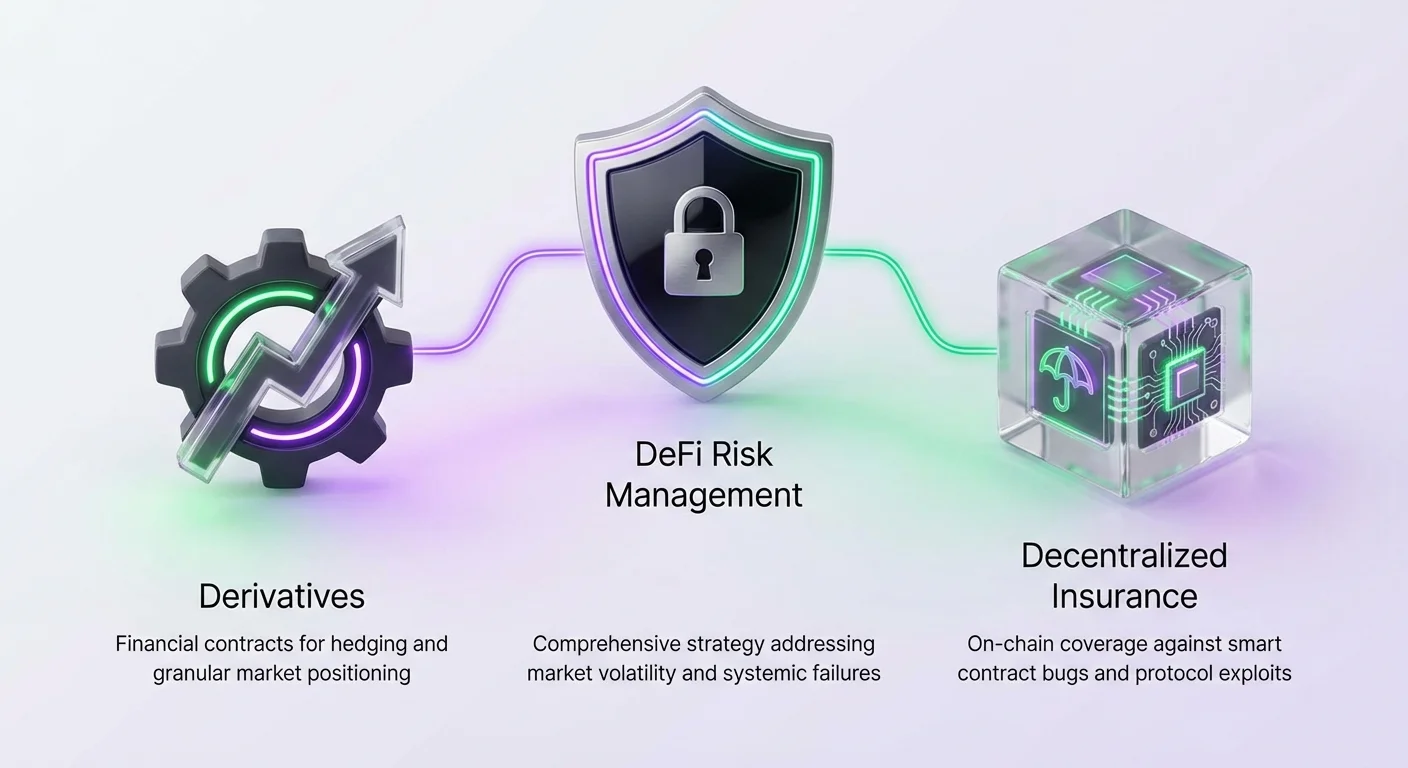
Risk in this environment is not monolithic. It spans from the financial volatility of asset prices to the structural integrity of the code governing protocols. Users navigating this space must develop a comprehensive strategy that addresses both market movements and the potential for systemic failure. This involves understanding financial instruments that allow for hedging, such as derivatives, as well as protective measures like decentralized insurance. By mastering these components, participants can construct a more resilient approach to digital asset management.
The ability to express granular views on market direction and protect against specific outcomes is central to advanced DeFi usage. Unlike simple spot holding, where a user merely hopes for price appreciation, sophisticated risk management involves active positioning. This article explores the mechanisms of derivatives trading, the mathematical realities of leverage, and the critical role of insurance protocols in safeguarding against smart contract vulnerabilities.
The Mechanics of Decentralized Derivatives
Derivatives serve as a foundational pillar for risk management in decentralized markets. These financial contracts derive their value from an underlying cryptocurrency or digital asset, such as Bitcoin or Ethereum. A crucial distinction exists between trading derivatives and trading spot markets. When buying on the spot market, a user purchases the actual asset, expressing an implicit belief that its value will rise.
In contrast, derivatives allow traders to express views on both upward and downward price movements without necessarily owning the underlying asset. This flexibility is essential for navigating volatile markets where prices can fluctuate dramatically in short periods. Through these instruments, participants can decouple their financial exposure from the requirement of custodial ownership of the specific token being traded.
Understanding Perpetual Contracts
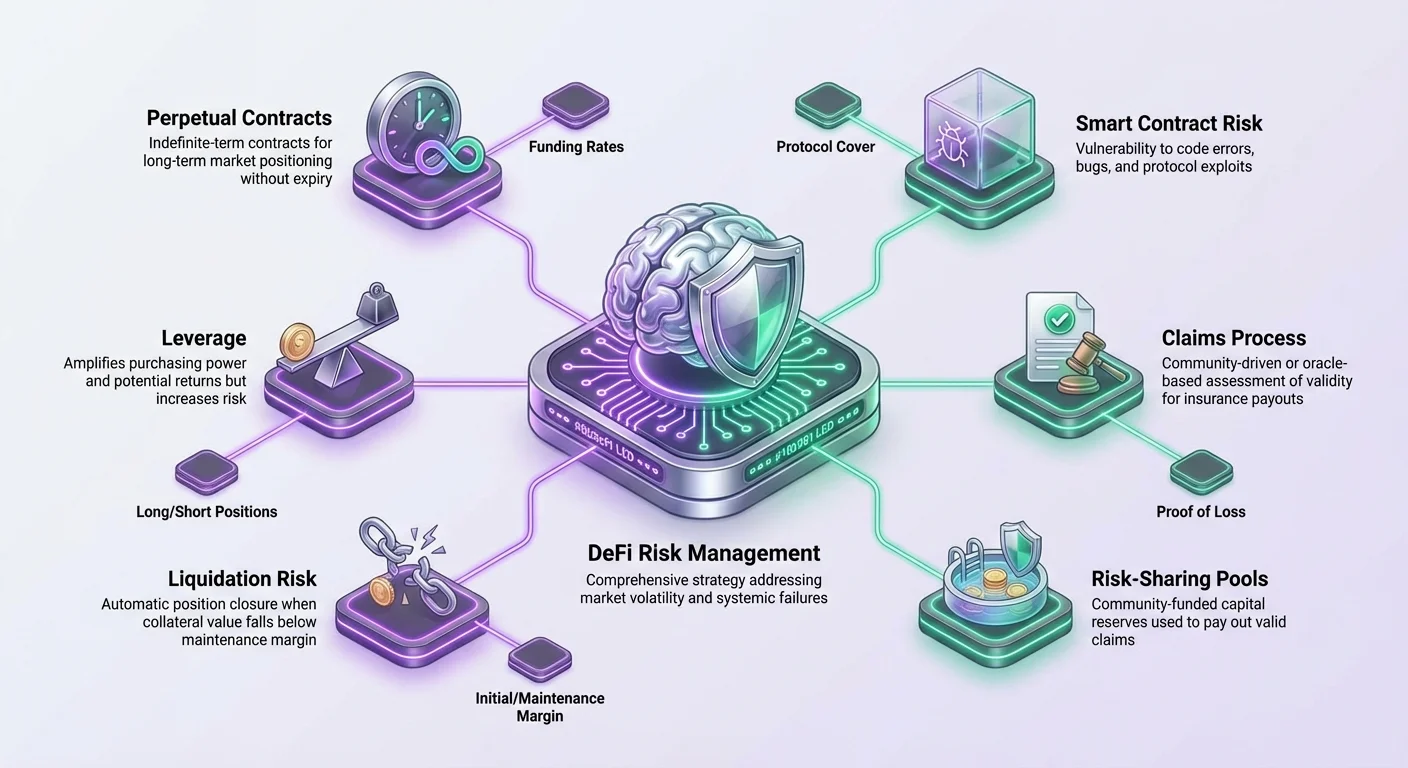
The most common form of derivative in the DeFi sector is the perpetual future. Unlike traditional futures contracts that have a set expiration date, perpetuals can be held indefinitely, provided the trader maintains sufficient collateral. This structure allows for long-term positioning without the need to constantly roll over contracts.
Perpetual contracts rely on a system of smart contracts to facilitate trading between peers. This eliminates the need for a central clearinghouse, which is a standard fixture in traditional finance. By operating on blockchain networks, these protocols offer transparency regarding order execution and fund custody.
Long and Short Positions
Trading perpetuals involves two primary actions: going long or going short. These positions allow traders to profit from market volatility in either direction. A long position represents a bullish sentiment. The trader buys a perpetual contract with the expectation that the underlying asset's value will increase over time. If the market moves up, the value of the contract rises.
Conversely, a short position represents a bearish view. The trader sells a contract expecting the asset's value to decline. This capability is particularly valuable for hedging. If a user holds a large amount of a specific token, they might open a short position to offset potential losses if the market drops. This strategy neutralizes price risk, protecting the portfolio's dollar value, mastering the mechanics of borrowing.
Leverage and Capital Efficiency
One of the primary features attracting users to derivatives is leverage. Leverage increases purchasing power, allowing traders to control a position size that exceeds their deposited capital. This mechanism can significantly amplify returns, but it simultaneously increases the risk profile of the trade.
For example, if a trader deposits 100 USDC, using 1x leverage means they control 100 USDC worth of contracts. However, applying 3x leverage allows them to purchase a theoretical maximum of 300 USDC worth of contracts. This efficiency enables traders to gain significant market exposure without committing large amounts of capital upfront.
Calculating Leverage Ratios
Understanding the mathematics of leverage is vital for survival in DeFi markets. As position size increases relative to collateral, the margin for error decreases. Different assets often have different maximum leverage limits based on their volatility. For instance, major pairs like BTC-USD might offer up to 20x leverage on platforms like dYdX, while more volatile assets like AVAX-USD might be capped at 10x.
Consider a scenario where a trader deposits 100 USDC to go long on Bitcoin. The relationship between leverage and position size is linear, but the risk scales dynamically. At 0.5x leverage, the user buys 50 USDC worth of BTC, leaving a large safety buffer. At 10x leverage, they control 1,000 USDC worth of Bitcoin using that same 100 USDC deposit.
The Double-Edged Sword of Amplified Returns
While leverage magnifies gains, it applies the same multiplier to losses. A small percentage move in the underlying asset can result in a total loss of the deposited collateral if high leverage is used. New users are generally advised to stick to 1x leverage or less to understand the mechanics before increasing risk.
The amplification effect creates a high-stakes environment. If a trader uses 10x leverage, a mere 10% move against their position effectively wipes out their equity. Conversely, a 10% move in their favor doubles their initial capital. This asymmetry requires disciplined risk management and a clear understanding of the liquidation thresholds associated with higher leverage ratios.
Liquidation Dynamics and Margin Management
Liquidation is the automatic process that occurs when a trader's collateral is no longer sufficient to support their open position. In decentralized protocols, this process is handled by smart contracts to ensure the solvency of the system. When a position is liquidated, the protocol closes the trade, and the trader loses their margin. Understanding margin calls and blow-ups is crucial.
To prevent this, traders must understand the concepts of initial margin and maintenance margin. Initial margin is the collateral required to open a new position or add to an existing one. It acts as the entry ticket to the trade.
Initial Versus Maintenance Margin
Maintenance margin is the minimum amount of equity a trader must hold to keep a position open. This threshold is lower than the initial margin but is the critical line in the sand. If the value of the collateral falls below this specific maintenance requirement due to adverse price movements, the liquidation engine triggers.
Once triggered, the system automatically sells the position to repay the debt. The trader not only loses their specific collateral but often pays a liquidation fee. This fee incentivizes the protocol or third-party keepers to execute the liquidation promptly, protecting the wider system from bad debt.
Analyzing Liquidation Scenarios
To visualize the risk, consider a trader with 100 USD of collateral buying Bitcoin at a price of 20,000 USD. The liquidation price moves closer to the entry price as leverage increases. This reduces the buffer the trader has against market volatility.
At 1x leverage, buying 100 USDC of BTC, the liquidation price is extremely low (around 600 USD), meaning Bitcoin would have to crash nearly 97% for the trader to be liquidated. However, at 10x leverage, controlling 1,000 USD of BTC, the liquidation price sits at 18,600 USD. A drop of just 7% from the entry price results in total loss.
| Leverage | Collateral | Position Size | Liquidation Price |
|---|---|---|---|
| 1x | 100 USDC | 100 USDC | ~600 USD |
| 5x | 100 USDC | 500 USDC | 16,600 USD |
| 10x | 100 USDC | 1,000 USDC | 18,600 USD |
The Funding Rate Mechanism
Funding rates are a mechanism used by perpetual futures protocols to tether the price of the contract to the spot price of the underlying asset. Since perpetuals never expire, there is no final settlement date to force the prices to converge. Funding acts as a periodic payment between traders to correct price deviations, detailing futures funding rates.
This system ensures that the derivative price does not stray too far from the real market value of the asset. It functions as a balancing act driven by market sentiment and the balance of open positions.
Balancing Price Action
When the perpetual contract price trades higher than the underlying spot price, it indicates bullish sentiment with more long positions than short positions. In this scenario, the funding rate becomes positive. Traders holding long positions must pay a fee to traders holding short positions.
Conversely, when the perpetual price is below the underlying asset price, sentiment is bearish. Shorts are dominant in the market. To incentivize balance, the funding rate turns negative, meaning shorts must pay longs. This financial incentive encourages traders to take the opposing side of the trend, helping to push the price back toward the spot value.
Impact on Long-Term Holdings
Funding payments can significantly impact the profitability of holding a position over time. If a trader is in a "consensus trade," meaning they are betting in the same direction as the majority of the market, they will likely be paying funding fees.
For a long-term holder, these fees act like a tax on the position. A trader might correctly predict the direction of the market, but if they hold a highly leveraged position for weeks while paying high funding rates, the fees could eat into or exceed their profits. Traders must monitor these rates constantly to ensure the cost of maintaining the trade does not outweigh the potential gains.
Operational and Smart Contract Risks
While derivatives allow users to manage market risk, they do not protect against the technical risks inherent in decentralized finance. DeFi relies entirely on code. Protocols are built on smart contracts—self-executing programs stored on a blockchain. If these contracts contain errors, bugs, or vulnerabilities, the funds locked within them can be compromised.
This introduces a layer of risk that is distinct from price volatility. A user could make a perfect trade, correctly predicting the market direction, yet still lose their capital if the platform they are using suffers a catastrophic failure.
The Threat of Code Failure
Smart contracts govern everything from trade execution to collateral storage. A bug in the logic can allow malicious actors to drain liquidity pools or manipulate balances. Unlike centralized systems where a database can be rolled back or a bank can intervene, blockchain transactions are immutable. Once funds are stolen via a smart contract exploit, they are typically unrecoverable.
High-quality protocols undergo audits, but audits are not a guarantee of security. As protocols add features and complexity, the surface area for potential attacks increases. This reality makes "smart contract risk" one of the most pervasive threats in the DeFi ecosystem, emphasizing smart contract risks.
Exchange Insolvency and Custodial Risk
Beyond code errors, there are risks associated with the custody of assets. While true DeFi promotes self-custody, users often interact with hybrid systems or centralized exchanges before moving on-chain. Centralized platforms carry insolvency risks, where the institution may not hold enough assets to cover user withdrawals.
Even within DeFi, risks exist regarding the solvency of lending pools or stablecoin pegs. If a protocol takes on bad debt or if the collateral backing a stablecoin fails, users holding those assets or utilizing those platforms can suffer losses. This necessitates a protective layer beyond simple trading strategies.
The Architecture of Decentralized Insurance
To mitigate on-chain risks, the DeFi sector has developed decentralized insurance alternatives. These platforms allow users to purchase cover against specific events, such as smart contract hacks or protocol failures. These decentralized applications (DApps) aim to provide the same peace of mind as traditional insurance but with the efficiency and transparency of blockchain technology.
Platforms like Nexus Mutual operate as decentralized autonomous organizations (DAOs). They are owned by their members rather than a corporate entity. This structure aligns the incentives of the insurers and the insured, as the community itself is responsible for the capital pool and claims assessment.
Comparison with Traditional Insurance
Traditional insurance companies are often criticized for high overhead costs, slow processing times, and opaque decision-making. They rely on large workforces, physical real estate, and centralized bureaucracies. In contrast, DeFi insurance protocols utilize smart contracts to automate many administrative functions.
This automation allows for continuous operation. There are no business hours or holidays in DeFi; coverage is available 24/7. Furthermore, the assessment of risk is distributed among a pool of experts and community members rather than being decided by a closed internal committee. This transparency ensures that the rules for payouts are clear and verifiable on-chain.
The Role of Risk Sharing Pools
Funds in decentralized insurance protocols are typically held in risk-sharing pools. Members contribute capital to these pools in exchange for tokens, such as the NXM token in Nexus Mutual. These funds serve as the capital reserve used to pay out valid claims.
The tokenomics of these platforms often tie governance to risk assessment. Members stake tokens to signal confidence in the security of specific protocols. If a protocol is deemed safe by the community, the cost of coverage for that protocol may decrease. This creates a market-driven approach to pricing risk, where the collective intelligence of the network determines the premiums.
Acquiring Coverage for Digital Assets
Buying insurance in DeFi is a permissionless process that requires a digital wallet and cryptocurrency. The process begins with identifying the specific risks a user wants to hedge against. Cover is generally specific to a protocol; a user buys protection for assets held on a lending platform like Aave or a decentralized exchange like dYdX.
Users must possess a self-custodial wallet, such as the Bitcoin.com Wallet, to interact with these DApps. Self-custody ensures the user retains control over the funds used to pay premiums and receive potential payouts, requiring safe interaction with DApps.
Essential Prerequisites for Coverage
Before purchasing cover, a user needs the appropriate cryptocurrency to pay for transaction fees and the insurance premium. On Ethereum-based platforms, ETH is required for gas fees. The premium itself is often priced in the platform's native token or a major asset like ETH or DAI.
The user must connect their wallet to the insurance platform's interface. Once connected, they browse the available products. It is crucial to verify that the specific DApp or protocol where funds are deployed is listed. Not every DeFi protocol has available insurance capacity, as risk assessors must first stake capital against it.
Selecting Parameters and Premiums
The purchasing interface typically asks the user to define two key variables: the amount of cover and the duration of the policy. The cover amount should match the value of the assets the user has at risk. For example, if a user has deposited 10 ETH into a lending pool, they should purchase cover for 10 ETH.
The duration can range from a few days to several months. Based on these inputs—the risk profile of the target protocol, the amount, and the time—the smart contract calculates a premium. Once the user approves the transaction and pays the premium, the cover becomes active immediately on the blockchain.
Executing the Claims Process
The value of insurance is only realized during a crisis. If a covered event occurs, such as a smart contract hack draining funds from a protocol, the policyholder must submit a claim. This process differs from traditional insurance in that it is often handled through a community vote or data oracle rather than a claims adjuster.
Cover holders generally have a specific window of time to file a claim after an incident occurs. It is vital to understand the terms of the policy, as claims submitted too late may be rejected. The transparency of the blockchain aids this process, as the exploit is usually visible on the public ledger.
Submission and Assessment
To initiate a claim, the user connects their wallet to the insurance platform and navigates to the claims section. They select the active policy and submit the request. In decentralized models like Nexus Mutual, this submission is then reviewed by other members of the mutual.
These members act as claims assessors. They review the evidence to determine if the event falls under the policy's definitions. For instance, they must verify that funds were lost due to a smart contract bug rather than a user error like losing a private key (which is typically not covered).
Proof of Loss Requirements
Depending on the platform, the user may need to provide specific proof of loss. This could involve signing a transaction from the affected address or pointing to specific on-chain data that proves the funds were stolen. Since all transactions are public, the burden of proof is often strictly data-driven.
Once the community or the oracle system validates the claim, the payout is authorized. The funds are transferred directly from the risk-sharing pool to the user's wallet. This settlement process bypasses the banking system, often resulting in faster access to capital for recovery.
Conclusion
Navigating the risks of decentralized finance requires a multifaceted approach that goes beyond simple asset selection. By utilizing derivatives, investors can manage price volatility, hedging their portfolios against downturns and utilizing leverage to optimize capital efficiency. However, these financial tools bring their own dangers, specifically regarding liquidation and funding costs, which demand vigilant monitoring and disciplined margin management.
Simultaneously, the technical foundation of DeFi requires its own layer of protection. Smart contract failures and protocol exploits remain a persistent threat. Decentralized insurance platforms provide a critical safety net, allowing users to transfer these risks to a community-backed pool. By combining hedging strategies with protocol cover, participants can engage with the DeFi ecosystem while minimizing the potential for catastrophic loss, mastering the DeFi insurance stack.
Effective risk management in DeFi is not about avoiding risk entirely, but about understanding, quantifying, and actively mitigating it through the right tools.