
When most people hear the word "wallet" in the context of crypto, they immediately think of money—Bitcoin, Ethereum, and stablecoins. However, the true innovation of Web3 lies in transforming the crypto wallet from a simple bank account into something far more powerful: a digital passport, a membership card, and a verifiable reputation system.
This evolution leads us to the concept of the Web3 Identity Wallet.
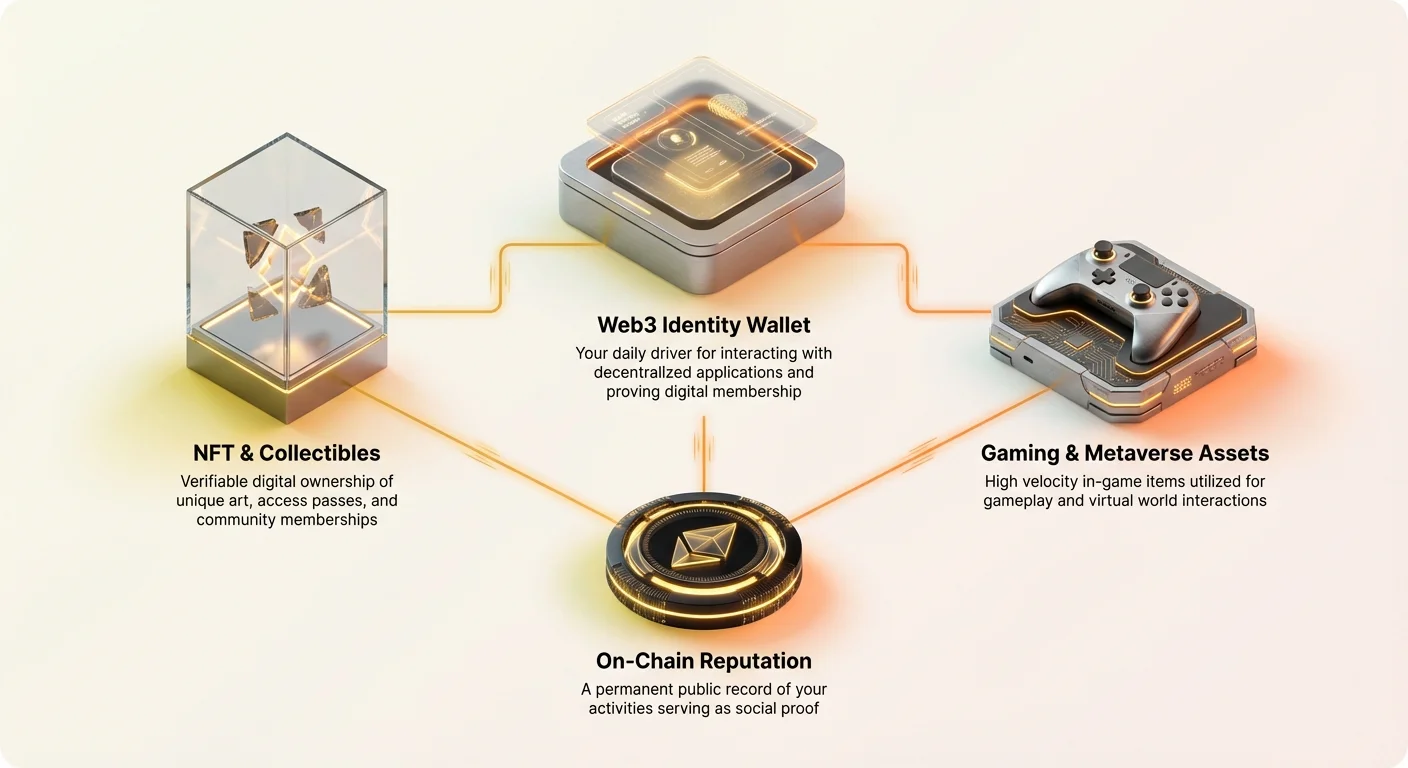
Unlike the dedicated financial wallet you might use for long-term saving or high-value DeFi activities, the identity wallet is your daily driver for interacting with the decentralized web. It holds your Non-Fungible Tokens (NFTs)—which grant access to communities, serve as collectible art, or function as in-game items. Securing this wallet requires a different set of strategies, balancing the need for frequent, low-cost transactions (like trading game assets) with the critical protection of your digital self and valuable reputation.
This guide will walk you through how identity wallets function, why segregating your identity assets from your financial assets is crucial, and the operational security (OPSEC) strategies necessary to protect your Web3 reputation from modern threats like token drainers and sophisticated phishing scams.
What is a Web3 Identity Wallet? (The Digital Passport)
In Web3, your wallet is not just a container for currency; it is your identity. Every action you take—joining a Decentralized Autonomous Organization (DAO), buying an NFT, or completing a quest in a game—is recorded and associated with your public wallet address. This address becomes your digital avatar and your history rolled into one.
A Web3 Identity Wallet is specifically designed and managed to handle these non-monetary functions. It is optimized for interaction, speed, and displaying proof of membership.
Wallets as Your On-Chain Username
Think of your Web3 address as a dynamic username. If you connect this address to a service like Lens Protocol or Farcaster, it becomes your social profile. If you hold a Bored Ape Yacht Club (BAYC) NFT, that address instantly signals membership in that high-profile community.
This association has profound implications for security. If your main financial wallet is compromised, you lose money. If your identity wallet is compromised, you lose your digital reputation, years of collected assets, access to private groups, and the ability to prove your ownership of crucial digital items (like a token-gated event ticket).
Key Identity Wallet Features:
- NFT Storage and Display: Easily viewing, showcasing, and proving ownership of digital art and collectibles.
- Token-Gating Access: Holding specific tokens (NFTs or governance tokens) required to enter private Discord channels, websites, or events.
- Reputation Building: Acting as the primary account for social interactions, forum participation, and governance voting.
- Gaming Integration: Facilitating rapid, frequent transactions needed for interacting with in-game marketplaces and claiming rewards.
The Rationale for Segregation: Why Not Use Your Main DeFi Wallet?
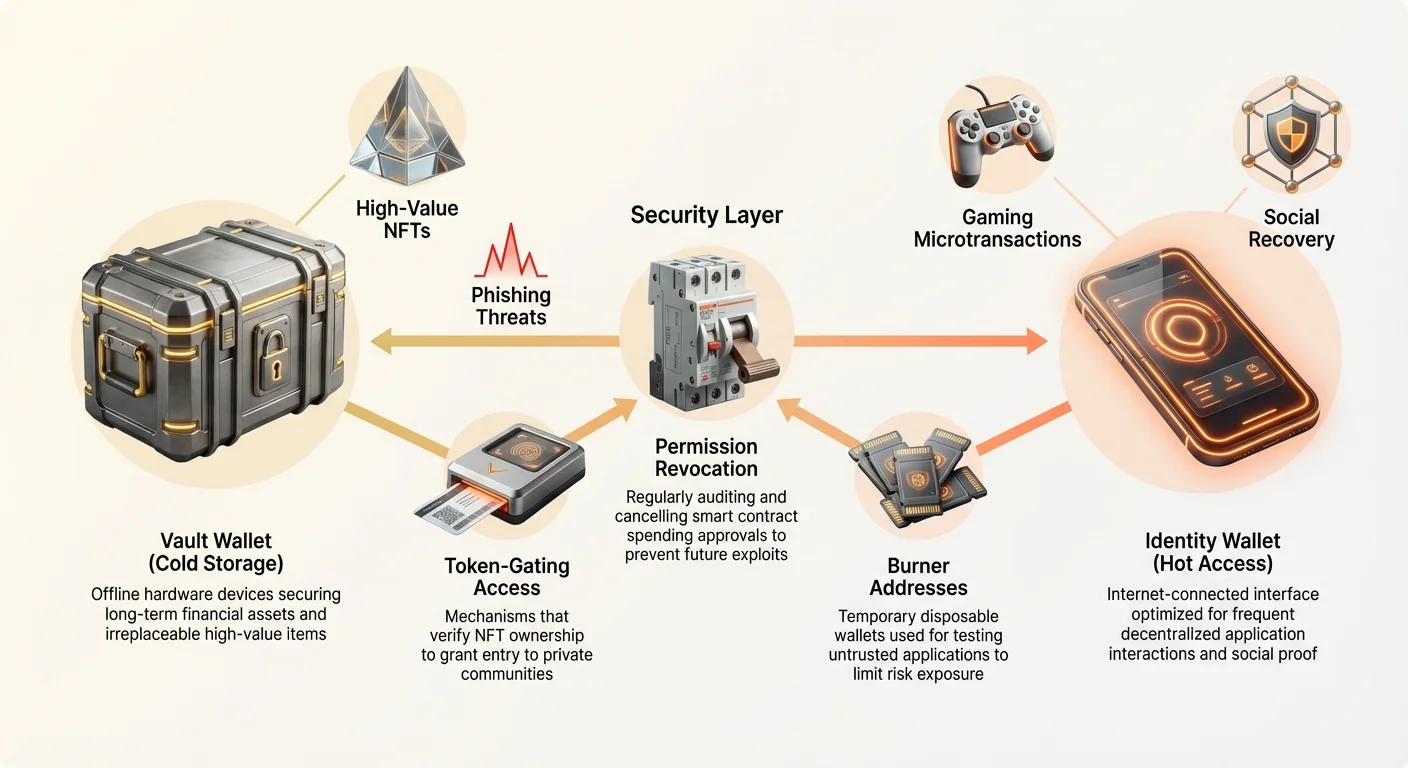
The single most important principle in Web3 identity security is segregation. You should never use the same wallet to hold your long-term savings (your "Vault Wallet") and to interact with experimental decentralized applications (DApps) or sign in to token-gated sites (your "Identity Wallet").
This strategy is often called the "hot/cold" approach, but it is better categorized by the level of risk and interaction frequency:
| Wallet Type | Primary Function | Interaction Frequency | Primary Risk | Recommended Custody |
|---|---|---|---|---|
| Vault Wallet | Long-term savings, high-value crypto | Extremely low (once per year) | Physical loss, seed phrase leak | Hardware Wallet (Cold) |
| DeFi/Degen Wallet | Active trading, yield farming, high-risk staking | High (daily/weekly) | Smart contract exploits, impermanent loss | Hardware Wallet (Semi-Hot) |
| Identity Wallet | NFTs, gaming, social media, token-gating | Very high (multiple times daily) | Phishing, malicious contract approvals (drainers) | Mobile/Browser Hot Wallet (Optimized for access) |
If you use your Vault Wallet to claim a free NFT from an unknown artist, and that free NFT requires you to sign a malicious contract, you risk losing everything in that vault. By segregating, the maximum loss from a compromised Identity Wallet is limited to the assets held within that specific, lower-value account.
Navigating the NFT Landscape: Access, Ownership, and Security
NFTs are the cornerstone of Web3 identity. They are often the most visible—and most frequently targeted—assets in a user’s portfolio. Securing NFTs requires balancing the desire to display them and use them for access with the need to protect their inherent financial and reputational value.
Token-Gating and Access Control Security
Token-gating is the mechanism where a website, Discord server, or physical event checks your wallet to confirm you hold a specific NFT or token before granting access. This is the Web3 equivalent of showing your membership card.
While token-gating is fundamental to Web3 community building, the act of connecting your wallet to an unverified third-party site for access presents a high risk of signature phishing or wallet drainers.
How Malicious Token-Gating Works:
- The Hook: A malicious actor creates a convincing replica of a legitimate token-gated community site (e.g., a fake NFT project claim site).
- The Prompt: The user clicks "Connect Wallet" and is asked to sign a transaction.
- The Danger: Instead of signing a simple non-binding message to verify ownership (which is safe), the user is prompted to sign a malicious transaction (like
setApprovalForAll), which grants the scammer complete control over all NFTs or tokens in that wallet.
Web3 Identity Wallet Security Tip (Token-Gated Access):
When connecting a wallet for token-gating, always check the exact text of the request in your wallet interface. Legitimate token-gating typically only requires you to sign a "message" or "proof of ownership" (a non-gas fee transaction) to prove you own the NFT. It should never ask you to approve a transaction that spends cryptocurrency or approves token transfers. If you see a gas estimate or an "approve spending" request, disconnect immediately.
Practical NFT Wallet Security Tips
Managing a portfolio of NFTs requires proactive security measures, especially since NFTs are often held in hot wallets for convenience.
1. Dedicate a High-Value NFT Vault
While the Identity Wallet is generally a hot wallet for daily interaction, highly valuable NFTs (e.g., assets worth tens of thousands of dollars or more) should ideally be held on a dedicated hardware device (a cold wallet).
- Strategy: Hold the NFT in the hardware wallet. Only transfer it to the Identity Hot Wallet temporarily when you need to sell it, use it for a major token-gated event, or breed/stake it. Once the activity is complete, transfer it back immediately.
2. Segregate by Risk Exposure
If you are heavily involved in multiple NFT ecosystems (e.g., one wallet for PFP collectibles, another for utility NFTs in a farming game), consider further segregating these identity assets. If a single, minor gaming DApp is exploited, the damage remains confined to that specific "gaming identity" wallet, leaving your valuable PFP assets untouched.
3. Know Your Contract Interaction History
Over time, you will inevitably grant spending permissions (approvals) to various DApps. It is critical to regularly audit and revoke unnecessary permissions. Tools like Revoke.cash allow you to view all the contracts you have approved and manually cancel those approvals, effectively taking away the risk that an exploited DApp could drain your assets months later.
Long-Term Custody vs. Active Identity
The custody strategy for NFTs must reflect their usage profile.
Active Identity Assets (High Velocity): These include digital tickets, low-value in-game items, and reputation tokens. These need to be readily accessible and are best kept in the Identity Hot Wallet. Since they are used daily, the trade-off favors convenience over maximum security.
Archival/Legacy Assets (Low Velocity): These include historic NFT drops, long-term collectibles, or high-value digital art. These are the assets you hope to keep for years. For these items, treat the hardware wallet as a safety deposit box. Even if the asset is used for identity (e.g., a lifetime membership NFT), if the utility is proving ownership rather than frequent transaction signing, it belongs on a cold device.
The Gamer's Wallet: Securing In-Game Assets and High-Frequency Activity
Gaming and decentralized finance (DeFi) share a crucial trait: they involve high-velocity microtransactions. Whether you are crafting an item, staking gold, or buying a consumable, these activities require frequent and low-cost blockchain interactions. This need for speed and low fees makes gaming environments particularly challenging for security, leading to specialized requirements for the gaming crypto wallet opsec.
Managing High-Velocity Transactions (Gaming OpSec)
Many crypto games run on high-throughput, low-fee blockchains (often Layer 2 solutions like Polygon or Arbitrum, or Layer 1 chains like Solana or Avalanche). This architecture supports the frequency required by gaming, but it also means transactions can happen so fast that users grow complacent about reviewing approvals.
The Gaming Security Paradox:
Users are trained in Web3 games to click and confirm quickly to keep up with the gameplay loop. This habit directly contradicts the cardinal rule of OPSEC: Slow down and review every signature.
Gaming Wallet Strategy:
- Use Dedicated Burner Wallets for New Games: Never connect your primary Identity Wallet (where you keep your expensive profile NFTs) to a game you are trying for the first time. Use a true "burner" wallet with only the minimum required gas fees.
- Separate Game Tokens: If a game requires you to stake or hold its native governance token (e.g., $GAME), hold that token in a completely separate wallet from your stablecoins or liquid financial assets. If the game’s smart contract is exploited, only the tokens associated with that specific project are at risk.
- Understand "Unlimited Approval" Risks: Many games, for convenience, ask for "unlimited approval" to spend your in-game tokens or NFT assets so you don't have to confirm every time you craft or trade. While convenient, this is a massive security risk. Regularly check if this unlimited approval is still active and revoke it when you take a break from the game.
Protection Against In-Game Fraud and Scams
Gaming environments are ripe targets for social engineering and fraud because players often prioritize gaining an advantage over security diligence.
Item Scamming and Marketplace Phishing
Web3 games often involve transferring rare items (NFTs) between players via marketplace contracts. Scammers thrive by creating convincing fake marketplace websites or issuing fake "claim" or "airdrop" links within community chats (like Discord or Telegram).
Protection Measures:
- Verify Official Channels: Only interact with smart contracts or websites linked directly from the official company website or verified social media channels. Never trust links provided in DMs or general chat.
- Asset Segregation: Use your Identity Wallet as a "holding area" only for the assets actively being played or traded. Any valuable reward NFTs won during a session should be immediately transferred out to a safer, less frequently connected wallet upon logging off.
The Role of Layer 2 Solutions in Gaming
The speed and low cost necessary for Web3 gaming interaction often rely on Layer 2 (L2) scaling solutions built on top of Layer 1 blockchains like Ethereum. These L2s (such as Optimism, zkSync, or specific gaming-focused chains) allow players to execute thousands of microtransactions instantly and cheaply.
From an identity security perspective, L2s are excellent because they enable the segregation strategy. It’s practical to create multiple distinct identity wallets on an L2 because the low transaction fees mean you don't need a large pool of expensive gas tokens just to move a $5 asset or approve a transaction. This efficiency fundamentally supports robust web3 identity wallet security.
Advanced Identity Wallet Features and Recovery Strategies
As the concept of the identity wallet matures, developers are integrating smarter features that offer more flexibility and security options beyond the traditional seed phrase management. This is where the custody model shifts toward "smart wallets" that use contract logic for better recovery.
Understanding Social Recovery
Traditional crypto wallets rely entirely on a 12- or 24-word seed phrase. If you lose it, you lose everything. If someone finds it, they gain everything. This binary risk is unacceptable for identity assets that represent years of accumulated reputation and digital heritage.
Social recovery is a feature, often implemented through smart contract wallets, that provides a safety net.
How Social Recovery Works:
- Guardians: The user designates several trusted people or devices (the "Guardians"). These Guardians do not have direct access to the wallet keys.
- Recovery: If the user loses access to their identity wallet (e.g., they lose their phone), they can initiate a recovery process.
- Veto Power: A majority of the designated Guardians must agree to sign a transaction approving the change of the wallet's primary key to a new one controlled by the user.
This model is ideal for an Identity Wallet because it provides a mechanism for retrieving irreplaceable assets (like NFTs) even if the hardware fails, without relying on a single point of failure (the seed phrase).
Key Management for Digital Identity (MPC and Smart Contracts)
For identity wallets that must be used frequently on mobile devices, Multi-Party Computation (MPC) wallets are gaining popularity. MPC technology allows the private key to be split into several encrypted shards and stored across multiple locations (e.g., a phone, a server, and a cloud backup).
If you need to sign a transaction, the shards come together momentarily to create the signature, but the full private key is never fully reconstructed in one place.
- Benefit for Identity: MPC wallets offer the convenience and speed of a hot wallet while significantly mitigating the risk of a single device compromise, making them a strong option for securing high-velocity identity assets.
Reputation Management: Building Trust on the Blockchain
In Web3, reputation is earned through provable on-chain activity. This can involve holding specific governance tokens, having a long-standing history of voting in DAOs, or owning a collection of high-status NFTs.
The Identity Wallet acts as the anchor for this reputation. It is essential to ensure that this reputation is maintained and not tainted by low-security activity.
Example: Using the same wallet address to conduct high-risk, experimental decentralized activity (which might result in a loss) and to participate in a high-profile DAO (which requires a high level of trust) can compromise your reputation score. If your identity wallet is linked to frequent scam attempts or failed transactions, communities may view you as a higher risk. Segregation helps keep your public identity clean and verifiable.
Operational Security (OPSEC) Best Practices for Identity Wallets
Successful management of a Web3 identity relies on robust OPSEC tailored to the high-frequency use of these accounts. The following practices are essential for minimizing exposure while maximizing utility.
The Principle of Least Privilege (Burner Addresses)
The Principle of Least Privilege dictates that any entity (in this case, your wallet) should only have access to the resources absolutely necessary to perform its task.
For the Identity Wallet, this means minimizing the amount of liquid financial value held within it.
- Gas Management: Only transfer enough crypto (e.g., ETH, SOL, MATIC) into the Identity Wallet to cover expected gas fees for the next day or week. This is the absolute minimum liquid asset necessary.
- Avoid Storing High-Value Liquid Assets: Never transfer large amounts of stablecoins, Bitcoin, or other investment assets into your identity wallet. If you need funds for an NFT purchase, transfer the exact amount immediately before the purchase and then transfer the remainder out immediately afterward.
- Burner Addresses for DApp Testing: When testing a brand new DApp, especially one that claims to be a utility for your NFTs, use an entirely fresh burner address first. Only if the burner wallet interaction is confirmed safe should you risk connecting your dedicated Identity Wallet.
Hardware Security for High-Value NFTs
While we categorize the Identity Wallet as typically "hot" for convenience, the storage medium for the keys should still be secured as strongly as possible for high-value assets.
If your Identity Wallet is a software wallet (e.g., MetaMask), consider using a hardware-connected hot wallet. This setup involves:
- Using a software interface (like MetaMask) for interaction and viewing.
- But requiring a physical hardware wallet signature (e.g., Ledger or Trezor) for every high-value transaction (like selling a valuable NFT or granting major contract approvals).
This provides the best of both worlds: the high accessibility needed for daily Web3 interaction combined with the physical security barrier for irreversible, high-impact transactions.
Auditing and Revoking Permissions
This is arguably the most critical OPSEC step for identity wallets, which are exposed to numerous DApps, marketplaces, and gaming contracts.
Every time you interact with a contract, you may grant it permission to spend a specific token. When you stop using a DApp or a game, that permission often remains active indefinitely. If the DApp’s contract is later hacked, the attacker can use the previously granted permission to drain your assets.
Actionable Steps:
- Set a Calendar Reminder: Schedule a regular review (e.g., monthly) to audit all outstanding smart contract approvals on the blockchains you use (Ethereum, Polygon, BNB Chain, etc.).
- Use Revocation Tools: Utilize free, audited tools (like Revoke.cash) that interface with your wallet to show you all outstanding approvals.
- Revoke Generously: If you haven't used a DApp in a month, revoke its spending permission immediately. The cost of the small gas fee to revoke the permission is a negligible insurance payment against catastrophic loss.
Conclusion
The Web3 Identity Wallet represents a fundamental shift in how we approach digital security. It moves beyond securing capital and focuses instead on securing your reputation, access rights, and irreplaceable digital artifacts.
By understanding the unique risks associated with frequent interaction, token-gating, and high-velocity gaming environments, you can implement the necessary segregation and OPSEC strategies. Treat your identity wallet not as a bank account, but as a carefully guarded, multi-layered digital passport. By separating your Vault, your DeFi activity, and your Identity, you minimize the blast radius of any potential exploit, ensuring your valuable Web3 identity remains secure, verifiable, and fully under your control.