
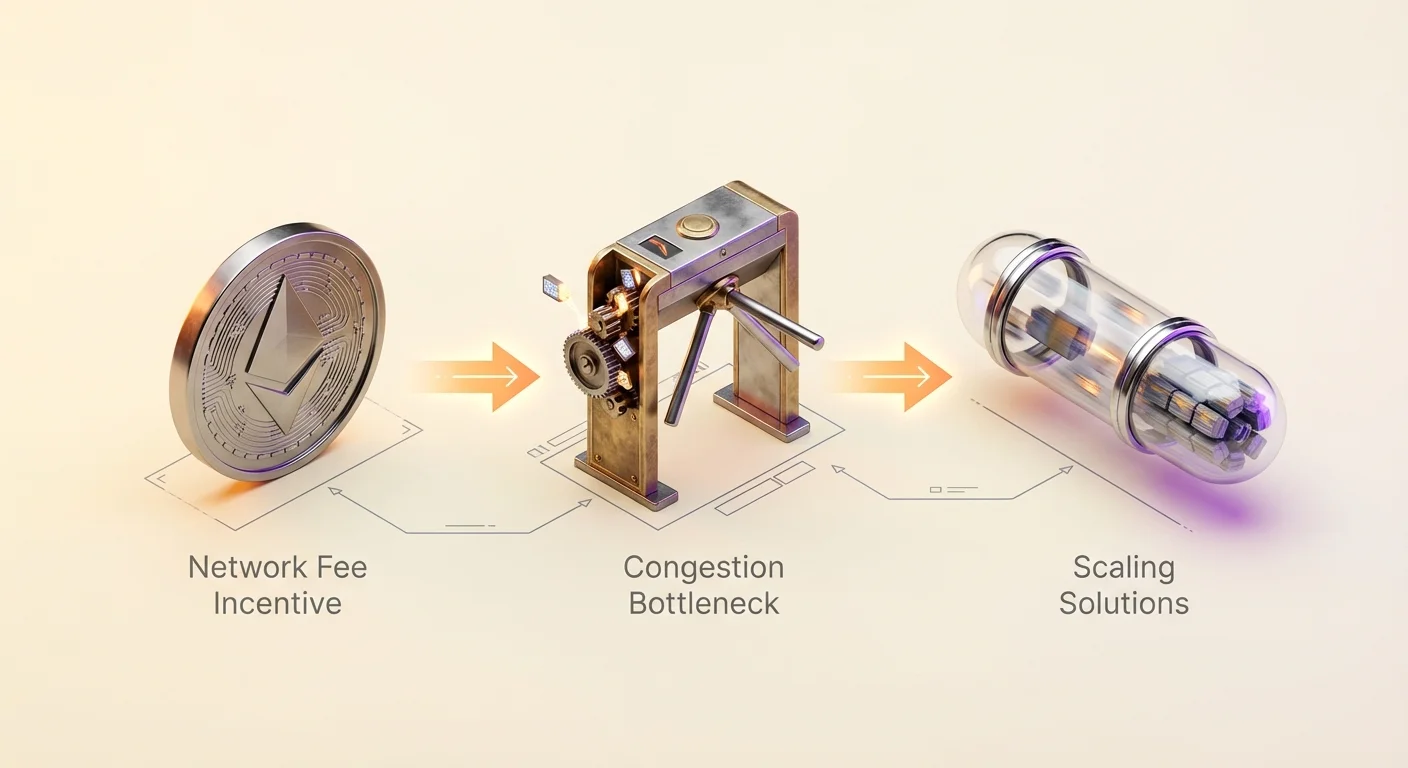
Blockchain networks operate on a fundamental system of incentives that ensures security, decentralization, and continuous operation. Unlike centralized banking systems where costs are often hidden or absorbed by the institution, crypto networks require users to pay for the computational resources they consume. These payments, known as network fees or transaction fees, serve as the primary revenue stream for the miners and validators who maintain the ledger. Without these financial incentives, the hardware operators powering the network would have no reason to process transfers or secure the blockchain against attacks.
The cost of transacting on a blockchain is rarely static. It fluctuates based on the immediate supply of block space and the demand from users seeking to have their transactions processed. During periods of intense market activity, such as a sudden price crash or the launch of a popular NFT collection, the demand for block space often exceeds supply. This congestion creates a competitive auction environment where users must offer higher fees to skip the line. Understanding this dynamic is the first step toward managing and reducing the costs associated with digital asset ownership.
The Mechanics of Transaction Pricing
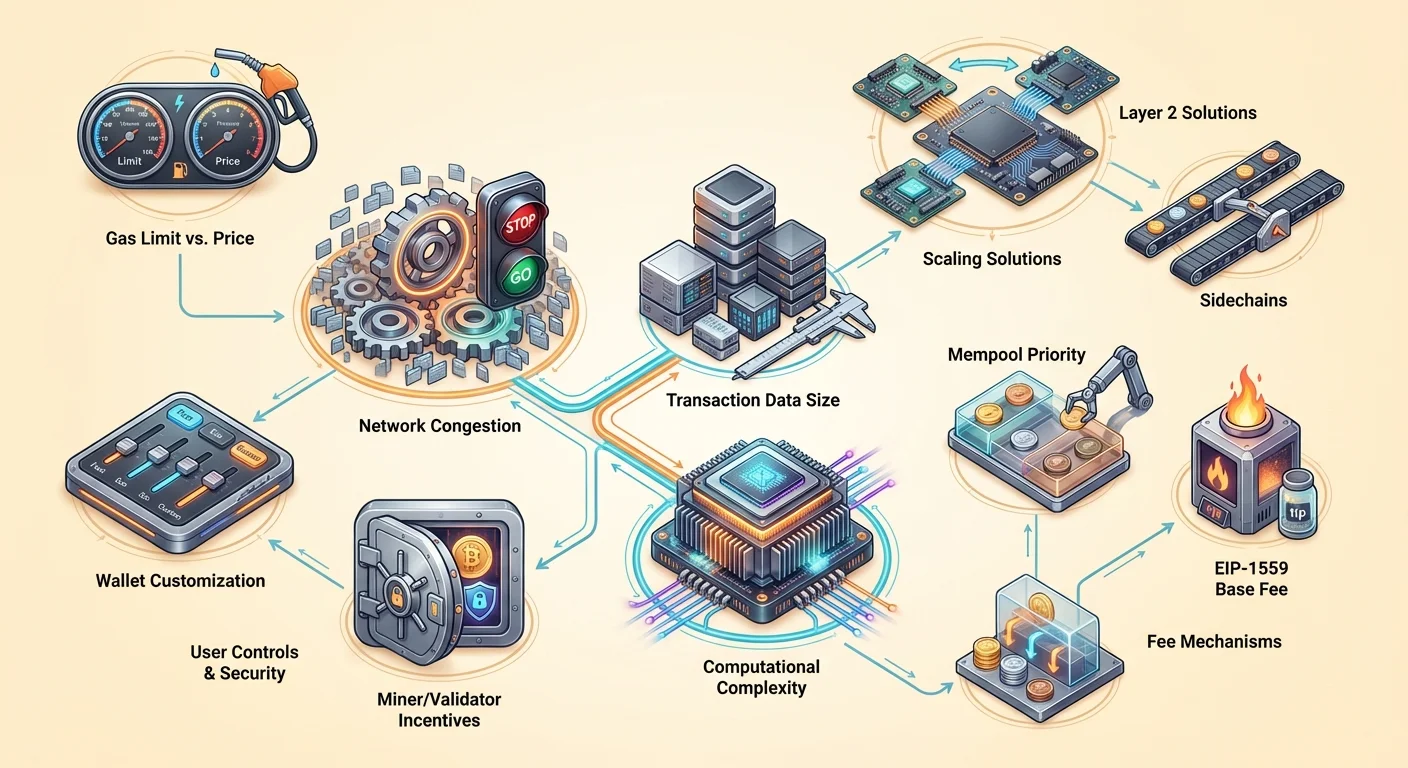
At its core, a blockchain fee is determined by two main factors: the size of the data involved and the computational complexity of the action. On networks like Bitcoin, the fee is primarily calculated based on the data size of the transaction in bytes. A standard transfer from one address to another takes up a specific amount of space in a block. If a user tries to send funds from an address that has received many small deposits, the transaction data becomes larger because the protocol must combine multiple "inputs" to equal the total amount being sent.
On smart contract-enabled blockchains like Ethereum, the calculation is more nuanced. While data size still matters, the computational effort required to execute the transaction becomes the dominant factor. This effort is measured in "gas". A simple transfer of ETH requires a standard, low amount of gas. However, interacting with a decentralized application (dApp) involves executing complex code. This consumes significantly more network resources.
Consequently, swapping tokens on a decentralized exchange (DEX) or minting a Non-Fungible Token (NFT) will always cost more than a simple peer-to-peer payment. The network must perform calculations, update balances in liquidity pools, and verify ownership records. All of these actions require the validators to perform more work, justifying the higher cost.
Urgency and the Fee Market
Beyond the technical requirements of the transaction, user behavior plays a massive role in determining the final price. Most blockchains operate on a mechanism where the highest bidder gets priority. When a user initiates a transfer, it enters a holding area known as the mempool. Miners and validators scan this area and select transactions with the highest attached fees to include in the next block.
This system allows users to trade time for money. If a transaction is urgent, such as an arbitrage trade or a critical payment, the user can attach a high "priority fee" or "tip." This incentivizes validators to process that specific transaction immediately. Conversely, users who are not in a rush can set a lower fee.
However, setting the fee too low carries risks. If the offered amount is below the current market rate, the transaction may sit in the mempool for hours or even days. In some cases, it may be dropped entirely if the network remains congested. Wallets often provide estimates to help users navigate this balance, but understanding the underlying market dynamics is crucial for manual optimization.
Navigating the Ethereum Gas System
Ethereum introduced the concept of "gas" to separate the cost of computation from the market price of the native currency. Gas is the fuel that powers the Ethereum Virtual Machine (EVM). Every operation, from a simple addition to storing a variable, has a fixed gas cost. This ensures that infinite loops cannot crash the network, as the transaction will eventually run out of the allocated gas and fail.
While the amount of gas required for a specific action is generally constant, the price of each unit of gas fluctuates wildly. This price is denominated in "gwei," which is a tiny fraction of one Ether (0.000000001 ETH). When users discuss "gas fees," they are usually referring to the current market rate in gwei.
The total transaction fee is calculated by multiplying the gas limit (the maximum fuel you are willing to use) by the gas price (the cost per unit). For example, if a swap requires 100,000 units of gas and the current price is 20 gwei, the total fee would be 0.002 ETH. During network congestion, the gas price can spike from 20 gwei to 200 gwei or more, increasing the cost tenfold.
The Impact of EIP-1559
In August 2021, Ethereum implemented a significant upgrade known as EIP-1559 to make gas fees more predictable. Before this upgrade, the fee market was a blind auction, leading to users frequently overpaying to ensure confirmation. EIP-1559 introduced a "base fee" which is algorithmically determined by the utilization of the previous block.
If the previous block was full, the base fee increases. If it was empty, the fee decreases. This base fee is mandatory and is "burned" or destroyed, effectively removing that ETH from circulation. Users can still add a "priority fee" on top of the base fee to incentivize miners, but the baseline cost is now more transparent.
This system helps smooth out volatility but does not eliminate high fees during peak demand. It merely makes the pricing mechanism more efficient. Users can now see exactly what the network requires to include a transaction, rather than guessing what others are bidding.
Layer 2 Solutions and Scalability
The most effective way to reduce transaction costs significantly is to move activity away from the congested main chain. This is where Layer 2 (L2) solutions come into play. Layer 2 protocols are built on top of the main blockchain (Layer 1) and are designed specifically to handle scalability. They process transactions off-chain, bundling hundreds or thousands of individual transfers into a single batch.
Once processed, this batch is compressed and submitted to the main chain as a single transaction. This means the high gas fee of the Layer 1 network is split among thousands of users. The result is a dramatic reduction in cost for the individual, often lowering fees by 10 to 100 times compared to the main network.
Rollups and Sidechains
There are different types of scaling solutions available. "Rollups" are the most prominent Layer 2 technology for Ethereum. They "roll up" transaction data and post it to the main chain, inheriting the security of Ethereum while providing faster and cheaper execution. Optimistic Rollups and Zero-Knowledge (ZK) Rollups are the two primary variants, each with different technical approaches to verification.
Sidechains offer another alternative. These are independent blockchains that run parallel to the main network. They have their own consensus mechanisms and validators, which allows them to prioritize speed and low costs. However, because they do not rely directly on the main chain for security, they are often considered slightly less secure than Rollups.
Networks like Polygon operate as sidechains or hybrid solutions that are fully compatible with the Ethereum Virtual Machine (EVM). This means developers can deploy the exact same smart contracts on Polygon as they do on Ethereum, but users pay a fraction of the cost in the network's native token.
| Solution Type | Primary Benefit | Trade-off |
|---|---|---|
| Layer 1 (Mainnet) | Maximum Security | High Costs, Low Speed |
| Layer 2 (Rollups) | Low Fees, High Speed | Complexity, Finality Time |
| Sidechains | Extremely Low Fees | Independent Security Model |
Actionable Strategies for Lower Fees
For users interacting directly with Layer 1 blockchains or expensive smart contracts, timing is everything. Blockchain traffic follows human patterns. Network congestion often mirrors the waking hours of major markets, particularly the United States and Europe. Weekends generally see lower volumes of institutional traffic and complex DeFi arbitrage, leading to lower gas prices.
Monitoring tools are essential for this strategy. Dedicated websites and blockchain explorers act as weather reports for network congestion. They display current gas prices in real-time, allowing users to wait for a dip. If a transaction is not time-sensitive, simply waiting for the weekend or late-night hours in Western time zones can result in significant savings.
Customizing Wallet Settings
Self-custodial wallets usually offer three tiers of fee settings: Fast, Average, and Slow (often labeled as "Eco"). The default setting is typically "Fast" to ensure a good user experience with quick confirmations. However, for non-urgent transfers, selecting the "Eco" or "Slow" option can save a considerable percentage of the fee.
Advanced users can manually input custom fees. By checking a gas tracker, a user can see the specific gwei required for inclusion in the next block versus the next ten blocks. If you are willing to wait 30 minutes instead of 2 minutes, you can set a custom fee slightly above the minimum required to enter the mempool.
It is crucial to be careful with this method. Setting the fee too low can result in a "stuck" transaction. The funds aren't lost, but they remain in limbo until the transaction is either dropped from the mempool or replaced with a higher fee.
Batching Transactions
Every distinct action on a blockchain incurs a separate fee. If a user needs to send funds to five different people, executing five separate transactions will require paying the base fee five times. Some advanced wallets and dApps allow for transaction batching, where multiple actions are grouped into one.
Similarly, users should be strategic about approval transactions. When using a decentralized exchange, users must first "approve" the protocol to spend their tokens. This is a separate on-chain transaction that costs gas. To save money, users can approve an "infinite" amount if they trust the protocol and plan to use it frequently. This avoids paying the approval fee for every subsequent trade.
Utilizing Blockchain Explorers
A blockchain explorer is more than just a search engine; it is a crucial tool for cost management. Explorers allow users to inspect the status of the network before initiating a transfer. By looking at the latest blocks, a user can see the average fee paid and the current fullness of blocks.
Explorers also help verify the complexity of intended transactions. If a user is unsure why a specific interaction is quoting a high fee, they can look up the smart contract address on an explorer. This often reveals if the contract is performing complex internal routing or logic that justifies the cost.
Furthermore, explorers provide transparency regarding "gas guzzlers." These are specific contracts or applications that are currently clogging the network. If a popular NFT mint is consuming 20% of all block space, the explorer will show this. A savvy user knows to pause all non-essential activity until the mint concludes and fees return to normal levels.
Understanding Confirmations
Patience is a virtue that saves money. A confirmation occurs when a transaction is included in a block. The more blocks that are added after that point, the more secure the transaction becomes. Services and exchanges often require a set number of confirmations before crediting a deposit.
Users who demand instant "finality" (the guarantee that a transaction cannot be reversed) must often pay a premium for immediate block inclusion. By understanding that a transaction is secure after a certain number of confirmations (e.g., 6 blocks for Bitcoin, ~30 for Ethereum), users can accept slower initial inclusion times.
If a business or recipient does not require instant settlement, there is no need to pay "Fastest" fees. The transaction will eventually be picked up by miners when the dip in traffic occurs, and the confirmations will accumulate naturally over time.
The Role of Consensus Mechanisms
The underlying architecture of a blockchain heavily influences its cost structure. The transition of major networks from Proof of Work (PoW) to Proof of Stake (PoS) has been a pivotal development for scalability and efficiency. In a PoW system, miners compete to solve energy-intensive puzzles. This process is secure but limits the number of transactions that can be processed per second.
Proof of Stake replaces miners with validators who lock up, or "stake," cryptocurrency as collateral. This method removes the physical bottleneck of energy consumption. Validators are selected to propose blocks based on their stake, allowing for a more streamlined validation process.
Sharding and Future Throughput
While the shift to PoS drastically reduces energy usage, it does not automatically solve high fees on its own. It sets the stage for further upgrades, such as sharding. Sharding is a method of splitting the blockchain database into smaller partitions, known as shards.
Instead of every validator needing to process every transaction, the workload is distributed across the network. This parallel processing capability will theoretically allow the network to handle vastly more transactions per second. When supply (block space) increases to meet or exceed demand, the auction-based price for fees naturally drops.
These protocol-level upgrades are long-term solutions. They require years of development and testing. In the interim, the combination of Layer 2 scaling and user-side optimization remains the most effective path to reducing costs.
EVM Compatibility and Interoperability
The Ethereum Virtual Machine (EVM) has become the industry standard for smart contract execution. This dominance has led to the creation of numerous EVM-compatible blockchains. These networks replicate the Ethereum environment, allowing users to use the same wallets (like the Bitcoin.com Wallet) and the same addresses across different chains.
For a user, this offers a massive advantage. If fees on the main Ethereum network are prohibitive, they can bridge their assets to an EVM-compatible chain like Avalanche or BNB Smart Chain. These networks often use different consensus mechanisms that prioritize speed and low cost, sometimes at the expense of partial centralization.
This interoperability creates a competitive market for block space. Users are no longer held captive by a single network's congestion. They can migrate their activity to a cheaper chain that supports the same applications. This "vote with your wallet" dynamic puts pressure on all protocols to optimize for efficiency.
Smart Contract Optimization
Developers also play a role in reducing costs for end-users. Poorly written smart contracts consume more gas than necessary. By optimizing code, removing redundant steps, and storing less data on-chain, developers can lower the gas limit required for interactions.
Users can identify optimized dApps by comparing estimates. If two different decentralized exchanges offer the same token swap, but one requires 30% less gas, the choice is obvious. The crypto community often audits and highlights protocols that prioritize gas efficiency, making this a key competitive differentiator for new projects.
Security Implications of Low Fees
It is important to acknowledge the security trade-offs associated with minimizing costs. High fees on Layer 1 networks like Bitcoin and Ethereum are a reflection of the immense security provided by their decentralized validator sets. Paying a high fee effectively rents the security of the most robust networks in the world.
When users move to cheaper Layer 2s or sidechains, they are often operating in an environment with different security assumptions. A sidechain might have fewer validators, making it theoretically easier to attack. A Rollup relies on the main chain for final settlement, but the immediate transaction is processed by a "sequencer" that could potentially go offline.
For small daily transactions, this trade-off is acceptable. The risk of losing $50 worth of tokens is minimal compared to the cost savings. However, for moving life-changing amounts of wealth, the premium paid for a Layer 1 transaction is often worth the peace of mind.
Conclusion
Transaction costs are an unavoidable component of decentralized ecosystems, serving as the safeguard against spam and the salary for network maintainers. While they can present a barrier to entry, especially during periods of high congestion, the crypto landscape offers numerous tools to mitigate these expenses. From utilizing Layer 2 scaling solutions that bundle thousands of transfers to simply timing transactions during off-peak hours, users have significant control over how much they pay.
As blockchain technology matures, the burden of fee management will likely shift away from the user. Future protocol upgrades, including sharding and further optimization of Proof of Stake consensus, aim to increase network throughput to levels where fees become negligible. Until that future arrives, a combination of patience, strategic wallet settings, and the use of efficient networks remains the best defense against high costs.
By understanding the mechanics of gas and utilizing scaling solutions, you can minimize expenses without sacrificing the benefits of decentralized finance.