
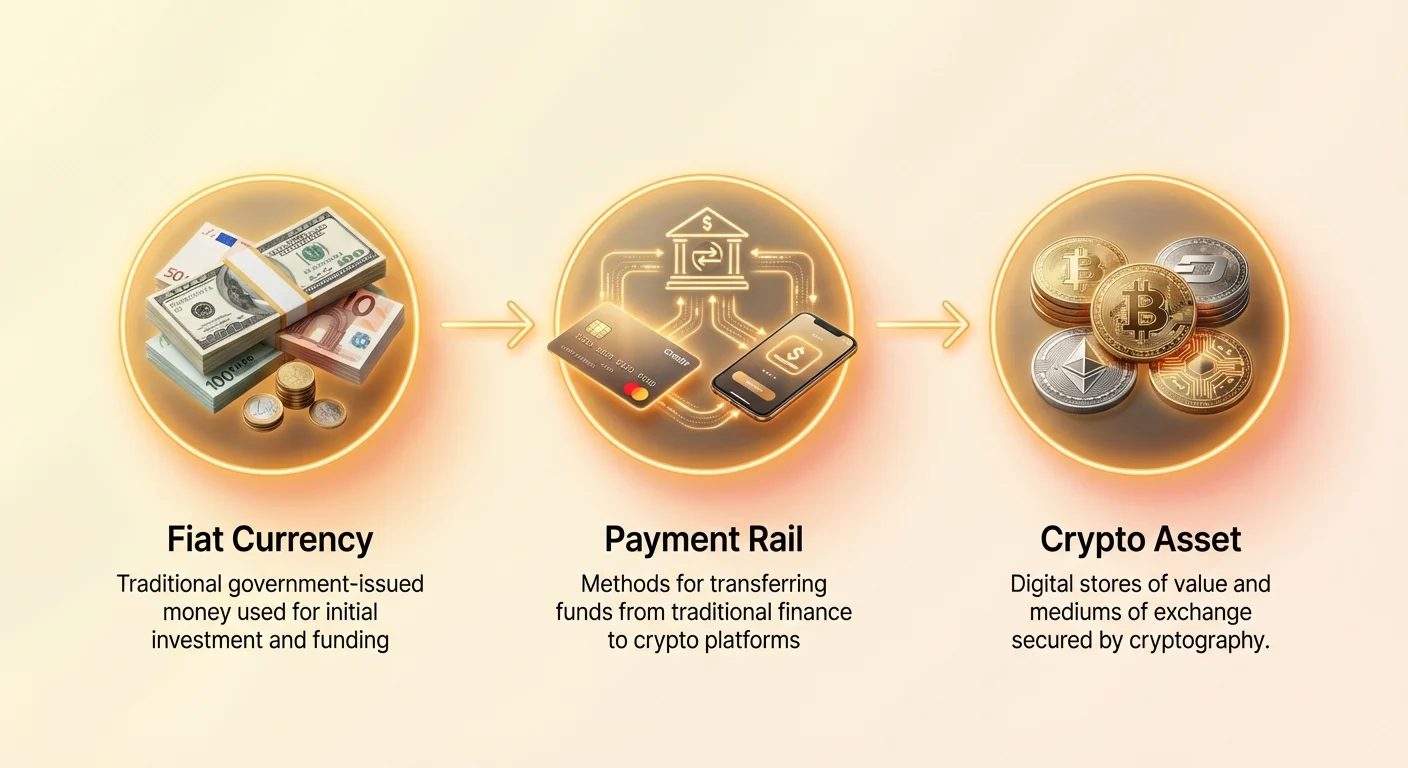
The journey into the digital asset economy begins with a critical process known as on-ramping—the secure and efficient conversion of traditional fiat currency (like USD, EUR, or GBP) into cryptocurrency. For newcomers, the immediate goal is usually just to acquire an asset. However, for those looking to build lasting self-sovereignty and manage their digital wealth strategically, the focus must shift from mere execution to pure optimization.
Every dollar spent on fees, spreads, and hidden transaction costs is a dollar that isn't working for you within your portfolio. These small percentages, often dismissed as the "cost of doing business," compound rapidly, significantly eroding capital, especially over frequent transactions or large volumes. Mastering the on-ramp is therefore the first crucial step in strategic asset management.
This guide provides an intermediate practitioner’s roadmap for navigating the centralized exchange landscape, analyzing the efficiency of different payment rails (ACH, wire, card), and building a cost-minimized strategy that optimizes speed, compliance, and ultimately, your portfolio’s starting value.
1. The Foundation: Centralized Exchange (CEX) Selection
Your choice of Centralized Exchange (CEX) is the primary determinant of your fees, speed, and overall asset security. While many beginners gravitate toward the platform with the cleanest mobile app, strategic users prioritize liquidity, regulatory compliance, and most importantly, the fee schedule.
Key Factors Beyond User Interface
While ease of use is important, high-volume traders and long-term investors must evaluate a CEX based on its structural advantages, not just its aesthetics.
Liquidity and Spreads: Liquidity refers to how easily an asset can be bought or sold without significantly affecting its price. High-liquidity exchanges allow for tighter spreads—the difference between the highest buy order and the lowest sell order. When you buy crypto using a simple "instant purchase" button, you are often paying the spread, which acts as an invisible, untracked fee. Exchanges with deep order books and high trading volumes inherently offer better pricing and tighter spreads, making them generally more cost-efficient for large transactions.
Regulatory Status and Jurisdiction: The CEX must operate under a stable and recognized regulatory framework in your jurisdiction (e.g., FinCEN registration in the US or similar licensing in Europe). A regulated exchange offers better security guarantees, consumer protection, and ensures smoother banking integrations. Attempting to use an unregulated international platform might offer lower trading fees, but it introduces significant jurisdictional risk, potential banking difficulties, and complex tax compliance issues down the line.
Security and Insurance: Prioritize exchanges with robust security protocols (two-factor authentication, cold storage reserves for a majority of assets) and consider those that offer FDIC or private insurance for fiat balances held on the platform.
Understanding Tiered Fee Structures (Maker vs. Taker)
Most advanced CEXs use a tiered fee structure designed to reward high-volume traders and those who provide liquidity to the market. Understanding this system is crucial for cost minimization:
- Taker Fees: These are paid when you take liquidity off the order book. This happens when you place a market order—an order that executes immediately at the best available price. Since you are removing an existing order, you are deemed a Taker. Taker fees are generally higher.
- Maker Fees: These are paid when you make liquidity. This happens when you place a limit order—an order set to execute at a specific price not currently available. Your order sits on the order book, providing liquidity for future Takers. If your order executes, you are deemed a Maker, and you pay a significantly lower fee, or sometimes even receive a rebate (negative fee).
Optimization Tip: Always use limit orders when on-ramping, even if the price is only slightly below the current market rate. This forces you into the lower Maker fee category, minimizing your transactional cost dramatically, especially when buying frequently.
The Role of KYC and Jurisdictional Compliance
Know-Your-Customer (KYC) requirements are mandatory for almost all regulated centralized exchanges. While often seen as a bureaucratic hurdle, KYC is the necessary link that allows the CEX to connect with the traditional banking system.
Impact on Banking Access: Completing KYC (providing government ID and proof of address) is essential for linking bank accounts, which in turn unlocks the most cost-efficient payment rails (ACH and Wire transfers). Exchanges cannot accept fiat funds from unverified sources due to anti-money laundering regulations. Skipping KYC confines you to higher-fee options like anonymous P2P services or card purchases with restrictive limits.
Impact on Volume: KYC verification often occurs in tiers. A basic tier might allow $5,000 in monthly purchases, while a fully verified professional account might allow unlimited or six-figure daily deposits. If your strategy involves large or infrequent purchases, ensure your CEX verification level supports your target volume.
2. Decoding Fiat Payment Rails: Speed vs. Cost
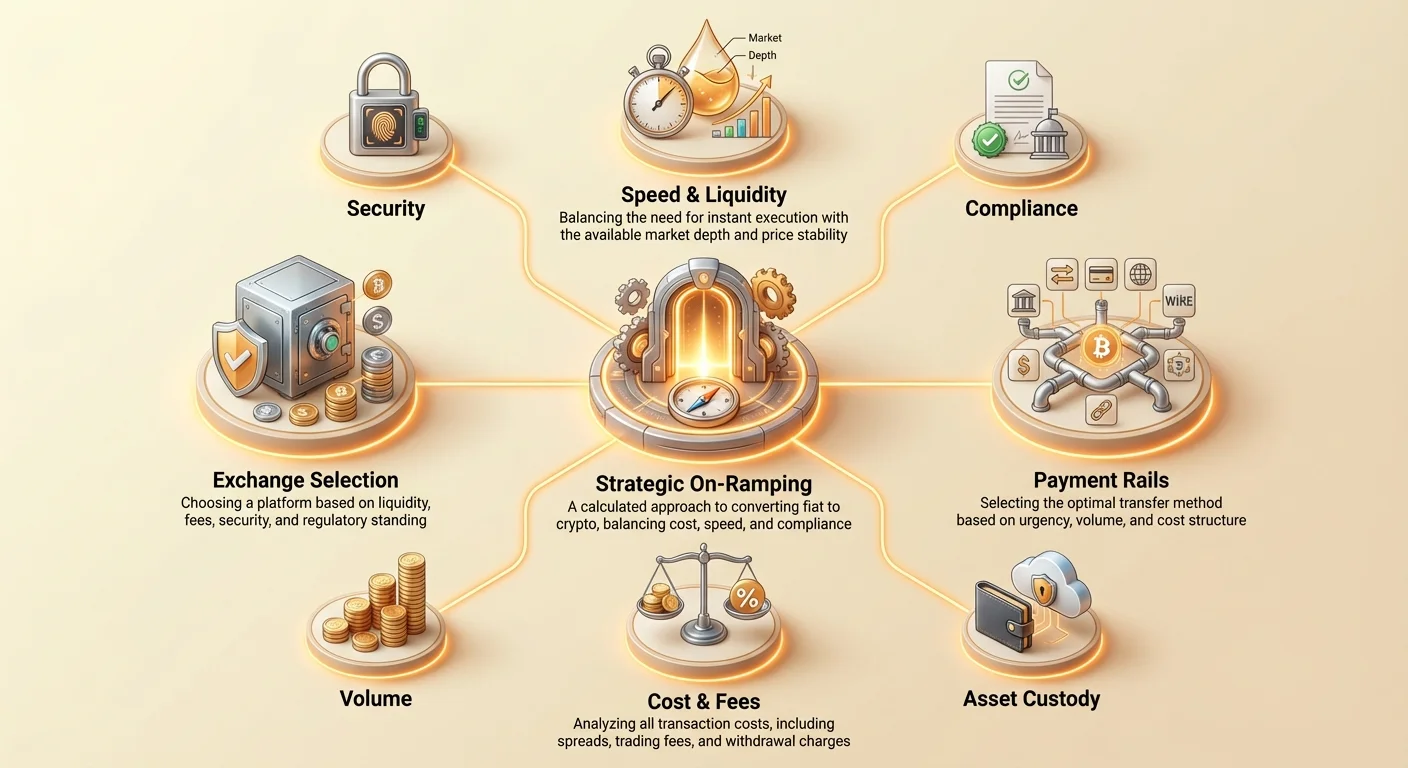
The method you choose to transfer funds from your bank to the CEX wallet—the payment rail—is the single greatest variable in determining speed and direct cost. Every rail represents a fundamental trade-off between instant access and transactional expense.
| Payment Rail | Speed | Cost Structure | Best Use Case |
|---|---|---|---|
| ACH Transfer | 3–5 Business Days | Low/Zero Fee | DCA, Regular Savings, Large Savings Purchases |
| Wire Transfer | Same Day/1 Business Day | Flat Fee (High) | High-Volume, Time-Sensitive Purchases ($50k+) |
| Debit/Credit Card | Instant | High Percentage Fee (3%–5%) | Urgent Purchases, Highly Volatile Trading |
Automated Clearing House (ACH): The Low-Cost Standard
The ACH network is the standard mechanism for routine electronic transfers within the U.S. banking system (similar low-cost systems exist globally, like SEPA in Europe).
Cost and Speed: ACH transfers are typically offered for free by CEXs, as the underlying cost is minimal for the institution. However, they are inherently slow, often taking 3 to 5 business days to fully clear.
Pre-Crediting and Risk: To maintain a good user experience, many large exchanges pre-credit your account, allowing you to buy crypto immediately after initiating the ACH transfer, even though the fiat funds haven't officially settled. This is a form of temporary lending by the exchange. If the underlying ACH transfer fails (e.g., insufficient funds), the exchange will liquidate the crypto purchased, often resulting in penalties or account freezes.
Optimization: ACH is ideal for Dollar-Cost Averaging (DCA) and routine, non-urgent asset accumulation where speed is secondary to cost minimization. Always ensure sufficient fiat balance to avoid the risk associated with pre-credited funds.
Wire Transfers: Speed and Volume Efficiency
Wire transfers are direct, real-time, irreversible transfers between financial institutions. They are necessary for professional or high-net-worth investors making substantial purchases.
Cost and Speed: Banks charge a high, flat fee for wire transfers (often $25–$50). However, because the transfer is direct and settled quickly (often same-day if initiated before the cut-off time), CEXs treat these funds as fully cleared immediately. This avoids the delay and risk associated with ACH pre-crediting.
Volume Optimization: While a $30 wire fee is expensive for a $100 purchase (30% cost), it becomes negligible for a $100,000 purchase (0.03% cost). The flat fee structure makes wires the most efficient rail for high-volume on-ramping, regardless of urgency.
Debit/Credit Card Purchases: The Price of Instantaneity
Using a card is the fastest way to acquire crypto, but it is universally the most expensive method.
Cost Structure: Card processors classify crypto purchases as high-risk, leading to processing fees ranging from 3% to 5% of the transaction value. These fees are usually passed directly to the user by the exchange. Furthermore, if you use a credit card, the issuer may classify the transaction as a "cash advance," triggering immediate, high interest rates and additional fees imposed by the card company itself.
Use Case Limitations: Card purchases are highly restricted by volume and are primarily intended for immediate, small, or urgent purchases—for example, if a sudden market dip occurs and you need to deploy funds faster than an ACH or wire allows. Strategic investors should minimize card usage due to the exorbitant cost.
3. The Total Cost of Acquisition (TCA) Model
Optimized on-ramping requires evaluating the Total Cost of Acquisition (TCA). TCA is not just the fiat deposit fee; it encompasses every cost incurred from the moment you decide to purchase to the moment the asset is secured in your self-custody wallet. Ignoring components of the TCA leads to significant capital leakage.
Trading Fees vs. Withdrawal Fees (The Hidden Costs)
Many users focus solely on the low trading fee (the Maker/Taker fee) without considering the cost of moving the asset off the exchange.
Withdrawal Fee Analysis: When you purchase crypto, the goal is often to move it off the CEX and into a self-custody wallet for security. This final step incurs a network fee, often subsidized or standardized by the exchange.
- Fixed Fees: Some exchanges charge a fixed withdrawal fee in the cryptocurrency itself (e.g., 0.0005 BTC). If you are making frequent, small purchases, these fixed fees can quickly consume a large percentage of the acquired asset.
- Dynamic Fees: High-efficiency exchanges often use dynamic fees that adjust based on current network congestion, ensuring your withdrawal executes quickly.
Optimization Strategy: If you plan to move funds into self-custody regularly, select an exchange with competitively low, or highly efficient, fixed withdrawal fees for your target asset. Alternatively, aggregate smaller purchases over several weeks or months before making a single, cost-effective withdrawal.
Spreads and Liquidity: The Invisible Tax
As mentioned, the spread is the cost you pay for immediate execution, often disguised within the "instant purchase" price.
Example Scenario:
- Exchange A (High Liquidity): BTC is trading at $60,000. The spread is $50. You buy at $60,025.
- Exchange B (Low Liquidity/Broker Model): BTC is trading at $60,000. The spread is $300. You buy at $60,150.
Even if Exchange A charges a higher transactional fee (e.g., 0.25%) than Exchange B (e.g., 0.10%), the cost incurred through the wide spread on Exchange B might make it significantly more expensive in real terms.
Actionable Tip: Always compare the purchase price offered on the simple "Buy" screen versus the price available on the advanced "Trade" screen (which shows the order book). This difference is the spread you are paying for convenience. Strategic investors avoid instant purchase buttons.
Volume Optimization: Scaling Your Purchases
The relationship between trading volume and fees is crucial for intermediate practitioners planning large investments or regular high-frequency trading.
- Tiered Fee Reduction: CEX fee schedules are generally structured around a 30-day rolling trading volume. As your volume increases, your Maker/Taker fees drop dramatically. For example, a beginner might pay 0.60% in Taker fees, while a trader doing $1 million in volume might pay 0.08%.
- Strategic Phasing: If you are planning a very large capital allocation (e.g., $250,000), consider breaking it into smaller, timed purchases over a short period. The first few purchases will incur higher fees, but they will rapidly push you into a lower fee tier for the majority of the capital deployment, leading to significant net savings.
- Flat Fees vs. Percentage Fees: Always favor flat-fee mechanisms (like wire transfers) over percentage-based mechanisms (like credit cards) when scaling up capital. A 3% card fee on a $50,000 purchase is $1,500—an unacceptable loss of capital.
4. Strategic On-Ramping for Specific Goals
The optimized payment rail choice depends entirely on your investment objective and time horizon.
Strategy 1: Small, Frequent Purchases (Dollar-Cost Averaging - DCA)
DCA involves consistently purchasing a fixed dollar amount of crypto regardless of price fluctuations. This is the most common approach for beginners and long-term accumulators.
Optimized Rail: ACH transfers are overwhelmingly the best choice. Since DCA prioritizes consistency and low maintenance over speed, the 3–5 day settlement time is irrelevant. The zero-cost deposit fee ensures the maximum amount of fiat is converted into crypto, keeping the TCA extremely low.
Best Practice: Set up recurring ACH transfers directly to your CEX account, and then use the advanced trading platform (not the instant buy feature) to execute limit orders as the funds arrive.
Strategy 2: Large, Infrequent Purchases (Capital Deployment)
This strategy applies when deploying a significant lump sum of capital, perhaps from liquidated traditional assets or savings. Speed and certainty are high priorities.
Optimized Rail: Wire transfers. The goal is to maximize the final crypto acquisition value. While the $25 flat wire fee seems high, its percentage impact on a large sum is negligible. Furthermore, wire funds settle quickly and are instantly usable, reducing market exposure risk inherent in waiting 3–5 days for an ACH transfer to clear.
Best Practice: Confirm the CEX's wire instructions (including unique reference codes) before initiating the transfer. Once the fiat lands, utilize limit orders to execute the large trade immediately, moving into the lower Maker fee tier.
Strategy 3: Urgent or Volatility-Sensitive Purchases
This involves executing a trade based on immediate market conditions, such as buying a sudden, deep dip, or reacting to breaking news. Time is the absolute priority.
Optimized Rail: Debit card or, if necessary, utilizing pre-funded fiat balances on the CEX. Since card fees are high, this option should only be used when the potential market gain from immediate execution dramatically outweighs the 3-5% transaction cost.
Best Practice: Maintain a small buffer of fiat currency already deposited and settled on your CEX (using ACH or Wire) for instantaneous deployment during unexpected events. This eliminates the high card fee while retaining the speed of instant execution.
5. Alternative On-Ramping Methods (Bypassing Traditional CEX)
While centralized exchanges offer the best liquidity and regulatory security for most users, advanced practitioners may look to alternative methods for increased privacy, faster regional access, or to circumvent local banking restrictions.
Peer-to-Peer (P2P) Markets: Privacy and Flexibility
P2P exchanges connect buyers and sellers directly. Instead of dealing with an exchange order book, you are agreeing to terms with an individual counterparty.
Mechanism and Cost: P2P platforms often facilitate the trade, holding the crypto in escrow until the fiat payment (via bank transfer, PayPal, cash, etc.) is confirmed. The cost is highly variable; the seller often charges a premium (an elevated price) above the market spot price to compensate for the counterparty risk and payment processing fees.
Strategic Advantage: P2P is superior for users in jurisdictions with restrictive banking policies or those seeking maximum privacy (often offering No-KYC options). It also allows for highly flexible payment methods not supported by CEXs.
Trade-Offs: The risks are higher. You rely on the trustworthiness and reliability of the individual seller, potentially incurring delays or disputes.
Crypto Brokerages and Aggregators
A crypto brokerage is a platform that buys and sells crypto on your behalf, often offering a highly simplified interface (like the instant buy feature on a CEX). An aggregator searches multiple CEXs and decentralized exchanges (DEXs) to find the best price.
Brokerage Model: Brokerages typically do not use Maker/Taker fees. Instead, they bundle all costs (spread, fee, processing) into the final purchase price, making their services appear "fee-free." This means the final price is often higher than if you executed a limit order yourself on a major CEX.
Aggregator Model: Aggregators are powerful tools for speed. By querying multiple venues, they ensure you are getting the cheapest current price, minimizing the spread. However, the service fee charged by the aggregator must be weighed against the savings achieved.
Optimization: Use brokerages only for ultimate convenience when costs are secondary. Use aggregators if you need speed combined with robust price comparison across multiple, high-liquidity venues.
6. Compliance and Record Keeping for Optimized Tracking
Optimization extends beyond transactional cost into managing the regulatory burden, which affects long-term cost efficiency (e.g., tax preparation time and professional fees).
Establishing a Compliance Baseline (Tax Implications)
In most major jurisdictions, every crypto-to-crypto, crypto-to-fiat, or crypto-to-good transaction triggers a taxable event. Accurate record-keeping is vital for calculating capital gains and losses correctly.
Actionable Tip: Immediately upon starting your on-ramping process, commit to a robust record-keeping or crypto tax solution. These platforms integrate directly with your CEX (via APIs or CSV exports) to automatically track transactions, apply appropriate cost basis methods (like FIFO or LIFO), and generate necessary tax forms. Trying to manually reconcile thousands of transactions later is a costly and time-consuming endeavor that negates any optimization gained on the front end.
Segregating Funds and Wallets
For security and compliance purposes, maintain clear segregation between your funds:
- CEX Wallet (Hot Wallet): Used only for immediate trading, on-ramping, and off-ramping. Keep balances low.
- Self-Custody Wallet (Cold Storage): Used for long-term savings and holdings. This is the final destination for assets you have optimized for acquisition.
By treating the CEX as a temporary transaction hub and moving optimized assets swiftly to self-custody, you reduce exposure to exchange-specific risks while maintaining clear records of capital deployed.
Conclusion
Optimized on-ramping is the gateway to responsible and strategic crypto asset management. It demands moving past the "instant buy" mentality and treating the fiat-to-crypto conversion as a multi-variable equation where speed, compliance, liquidity, and cost must be balanced.
By selecting high-liquidity centralized exchanges, leveraging limit orders to attain Maker fee status, and rigorously applying the appropriate payment rail (ACH for routine DCA, Wire for high-volume deployment) based on your specific goals, you ensure that the maximum amount of your fiat capital is converted into working digital assets. Start tracking your Total Cost of Acquisition today; minimizing frictional fees is the first, most important step toward building a resilient digital portfolio.