
Entering the world of decentralized finance requires more than just buying a digital asset. It demands a fundamental understanding of the infrastructure that powers these networks. As users move away from centralized exchanges and toward self-custody, they encounter complex mechanisms that work silently in the background. To navigate this landscape effectively, one must grasp the roles of Remote Procedure Calls (RPC), validators, and Chain IDs.
These components form the backbone of every interaction you have on the blockchain. Whether you are swapping tokens, minting an NFT, or bridging assets to a new network, these technical elements ensure your request reaches the right destination. Without them, decentralized applications would be isolated islands unable to communicate with user wallets.
Understanding these concepts is not just for developers. It is crucial for any user who wants to maintain security and efficiency. Knowing how your wallet connects to a network can prevent costly errors. Recognizing the role of validators helps explain why transaction fees fluctuate. identifying the correct Chain ID protects you from sending funds to the wrong environment.
This guide breaks down the technical architecture of decentralized networks into digestible concepts. We will explore how these distinct parts function together to create a seamless experience. By the end, you will have the knowledge to configure your wallets confidently and explore new chains with reduced risk.
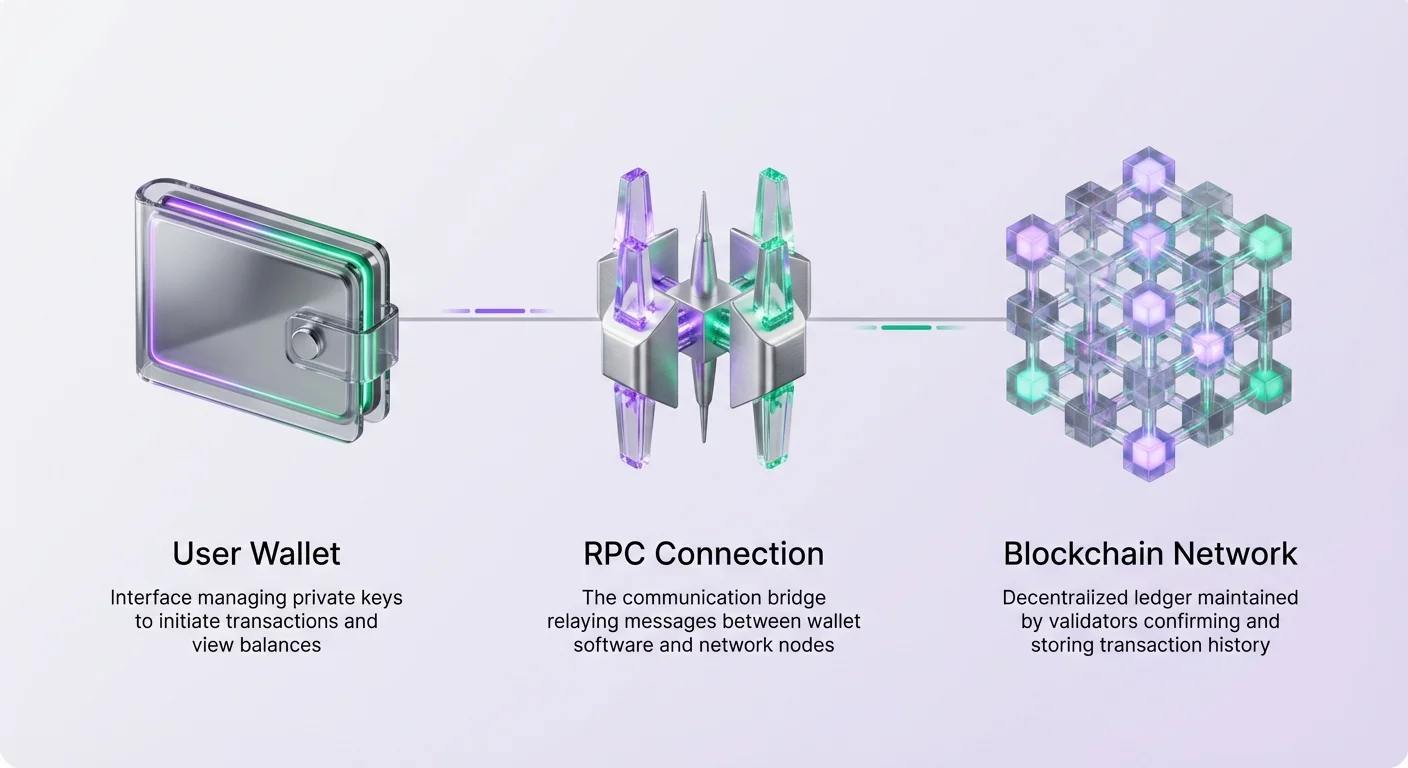
The Architecture of Decentralized Networks
Blockchains operate on a system of tradeoffs. No single network is perfect, and each one must balance speed, security, and cost. This is often referred to as the blockchain trilemma. Some networks prioritize decentralization and security, resulting in slower transaction times and higher costs. Others prioritize speed and low fees but may compromise on the number of active validators.
Source material indicates that these tradeoffs profoundly impact the user experience. For instance, Ethereum is highly developed with liquid markets but often suffers from congestion. In contrast, newer chains might process transactions significantly faster but have different security models. These architectural decisions define the environment you are entering.
When you choose to interact with a specific blockchain, you are essentially choosing a specific set of compromises. You might prefer a high-speed network for frequent, small trades. Alternatively, you might choose a highly secure, slower network for storing significant value. This choice dictates which technical parameters your wallet must use to connect.
The Role of Nodes and Communication
A blockchain is maintained by a network of computers known as nodes. These nodes store the history of the blockchain and verify new transactions. However, your personal computer or mobile phone does not typically run a full node. It does not store the entire history of the network due to storage and bandwidth constraints.
Instead, your wallet software acts as a light client. It needs a way to ask the blockchain for information, such as your account balance or the current gas price. It also needs a way to broadcast your transactions to the network. This communication gap is bridged by specific protocols that allow disparate systems to talk to each other.
If the nodes are the library of the blockchain, your wallet is a visitor who needs a librarian to find a specific book. You cannot read every book on the shelf yourself. You need an intermediary to fetch the data you requested. This request-and-response dynamic is the foundation of how users interact with decentralized applications (dApps).
Understanding Network Tradeoffs
Different networks optimize for different outcomes. A network designed for high-frequency trading will require powerful nodes and fast communication channels. This often leads to a more centralized structure where fewer, more powerful computers run the network. This benefits the user through instant finality and negligible fees.
Conversely, a network designed for maximum censorship resistance will allow almost anyone to run a node on consumer hardware. This increases the number of participants but slows down the propagation of data. Every node must agree on the state of the ledger, and more voices mean a longer deliberation time.
These architectural choices influence the "shopping mall" analogy often used in crypto. You might visit one mall (blockchain) because it has specific stores (dApps) or better sales (yields). You might visit another because the parking is cheaper (low gas fees). However, unlike physical malls, moving between them requires navigating complex digital bridges and understanding the unique identifiers of each location.
Remote Procedure Calls (RPC) Explained
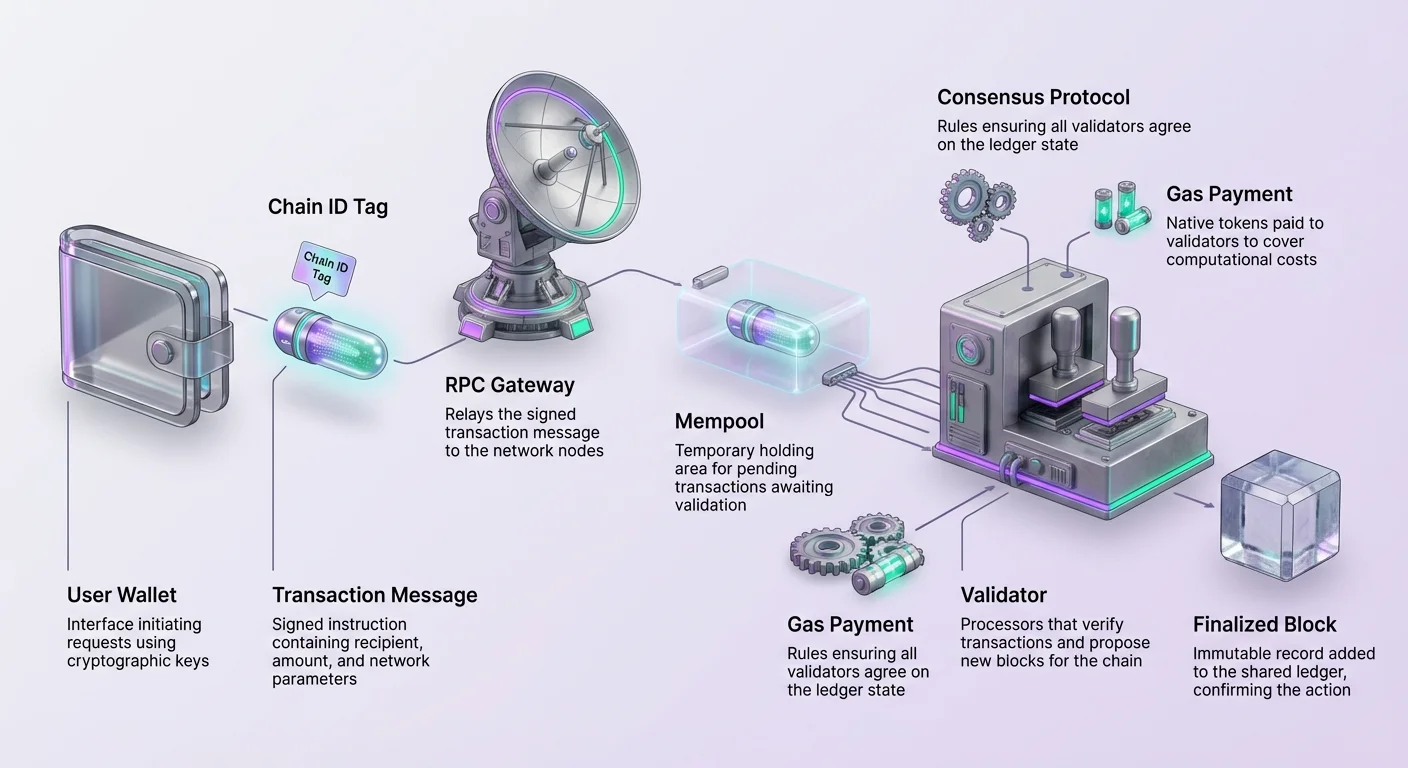
Remote Procedure Calls, or RPCs, are the critical bridge between your wallet and the blockchain. When you click "send" on a transaction, your wallet does not magically insert data into the blockchain. It constructs a message and sends it to a node via an RPC endpoint. This node then propagates the transaction to the rest of the network.
An RPC endpoint looks like a standard URL. It is the address your wallet uses to "dial in" to the blockchain. Without a functioning RPC connection, your wallet is offline. It cannot see balances, it cannot estimate fees, and it cannot execute trades. It is effectively a car with no engine.
How Wallets Talk to Chains
When you open a wallet application, it immediately sends queries through the RPC. It asks, "What is the balance of this address?" and "What is the current block number?" The RPC node receives these questions, looks up the answers in its copy of the blockchain ledger, and sends the data back to your wallet. This happens in milliseconds.
This process is invisible to the user during normal operation. However, it becomes very visible when the network is congested. If the RPC node is overloaded with requests, your wallet may fail to load balances or transactions may get stuck. In these cases, advanced users often switch their RPC endpoint to a less congested node to restore functionality.
Public vs. Private RPCs
Most blockchains provide public RPC endpoints that are free to use. These are sufficient for the average user who makes occasional transactions. However, because they are public and free, they are often rate-limited or slower during times of high network activity. This can lead to failed transactions or slow interface updates.
Private RPCs offer a dedicated lane for traffic. heavy traders or developers often pay for access to private nodes. This ensures that their transactions are broadcast immediately, even when the public network is clogged. While beginners rarely need this, understanding the distinction helps explain why performance can vary between users on the same network.
RPC Security Implications
The RPC provider can see the IP address originating the request and the content of the request (such as the transaction data). While they cannot sign transactions or steal funds without your private key, there are privacy considerations. Using a trusted RPC provider is important for maintaining metadata privacy.
Furthermore, a malicious RPC could theoretically feed your wallet false data. It could tell you a transaction succeeded when it failed, or display an incorrect balance. This is why wallets usually default to trusted, community-verified RPC endpoints. When adding a new network manually, one should always verify the RPC URL from official documentation to avoid connecting to a malicious node.
The Function of Chain IDs
With hundreds of active blockchains in existence, the software needs a foolproof way to distinguish between them. Many blockchains are "forks" of others, meaning they share the same underlying code and address formats. For example, Ethereum, Polygon, and Binance Smart Chain all use addresses starting with "0x".
This compatibility creates a risk. If you sign a transaction meant for Ethereum but broadcast it to Polygon, what happens? To prevent this confusion, networks utilize a unique identifier known as a Chain ID. This is a number that acts as the digital fingerprint of the specific blockchain network.
Preventing Replay Attacks
The primary purpose of the Chain ID is to prevent replay attacks. A replay attack occurs when a valid transaction on one chain is maliciously or accidentally broadcast to another chain where it is also valid. If you send 1 ETH to a friend on the Ethereum mainnet, you do not want that same transaction to be "replayed" on another chain, causing you to send funds twice.
By including the Chain ID in the signed transaction data, the network ensures the transaction is only valid on the intended chain. If a node on the Polygon network receives a transaction signed with the Ethereum Chain ID, it will reject it immediately. This cryptographic separation is essential for the security of a multichain ecosystem.
Navigating Testnets and Mainnets
Chain IDs are also used to distinguish between a "Mainnet" and a "Testnet." Developers use Testnets to experiment with applications without using real money. These Testnets often function identically to the Mainnet but use play-money tokens.
If a user accidentally connects their wallet to a Testnet while trying to perform a real trade, the Chain ID mismatch or the different environment protects them. The wallet knows that Chain ID 1 is Ethereum Mainnet, while Chain ID 5 (Goerli) is a test network. This distinction allows developers to build safely and users to interact without fear of mixing play funds with real assets.
Configuring Custom Networks
When you add a new network to a wallet like MetaMask, you are often asked to input the Chain ID manually. This is a critical step. If you enter the wrong ID, the wallet will fail to connect, or it will display incorrect data.
Source material suggests relying on trusted aggregators or official documentation when finding these details. Scammers may try to trick users into adding a fake network configuration. Always cross-reference the Chain ID with a reputable source like CoinGecko or the official documentation of the blockchain project you are trying to enter.
Validators: The Guardians of the Network
Validators are the entities responsible for processing transactions and securing the blockchain. In a decentralized network, there is no bank or central server. Instead, thousands of independent validators work together to agree on the state of the ledger.
When you broadcast a transaction via an RPC, it enters a holding area known as the mempool. Validators select transactions from this pool, verify that the sender has enough funds, check that the signature is valid, and then bundle them into a block. Once a block is finalized, the transaction is immutable.
Consensus Mechanisms
Validators operate under a set of rules called a consensus mechanism. This ensures that all validators agree on the truth, even if they don't trust each other. The most common mechanisms are Proof of Work (PoW) and Proof of Stake (PoS).
In Proof of Stake systems, validators must lock up, or "stake," a large amount of the network's native token as collateral. If they act maliciously or try to cheat the system, their staked tokens can be slashed (confiscated). This financial incentive keeps validators honest and aligns their interests with the health of the network.
Speed vs. Decentralization
The number of validators on a network directly impacts its performance. A network with tens of thousands of validators is extremely secure and decentralized, but it may be slower because it takes longer for everyone to agree. A network with only 20 validators can process transactions at lightning speed, but it is more centralized and potentially easier to censor.
This relates back to the tradeoffs mentioned earlier. When Source 3 discusses "entering a new chain" for speed or lower fees, it is often describing a move to a network with a different validator structure. Users benefit from the efficiency but should be aware that the security model differs from the base layer of major chains like Bitcoin or Ethereum.
Transaction Fees and Validators
Transaction fees exist to pay validators for their work. Every action on a blockchain requires computational power and storage space. When you pay "gas," you are renting a small portion of the validator's resources.
During times of high demand, users bid against each other to get their transactions included in the next block. Validators naturally prioritize transactions with higher fees. This market dynamic explains why fees spike during popular NFT mints or market volatility. Understanding this helps users time their transactions to avoid overpaying.
Wallets as the Interface
A cryptocurrency wallet is the tool that brings all these concepts together into a usable interface. As defined in the source material, a wallet is software or hardware that stores private keys and interacts with blockchain networks. It manages the complex cryptography so the user doesn't have to.
Wallets serve as the control panel for your digital assets. They handle the RPC connections, store the Chain IDs for various networks, and sign the transactions that validators eventually process. Without a wallet, a user cannot generate the cryptographic signatures required to authorize the movement of funds.
Custodial vs. Non-Custodial
The distinction between custodial and non-custodial wallets is paramount. In a custodial arrangement, a third party (like an exchange) holds the private keys. They manage the technical connections. You simply log in with a password. While convenient, this means you do not truly own the assets. If the service goes down, you lose access.
Non-custodial wallets give the user full control. The user holds the private key, usually in the form of a recovery phrase. This aligns with the ethos of decentralization but places the responsibility of security entirely on the user. If keys are lost, the funds are unrecoverable. The source material emphasizes that self-custody empowers individuals but requires diligent backup practices.
Hardware vs. Software Wallets
| Wallet Type | Security Level | Accessibility | Best For |
|---|---|---|---|
| Hardware | High (Offline) | Medium | Long-term storage, large amounts |
| Software | Medium (Online) | High | Daily use, DeFi interaction, dApps |
| Web/Exchange | Low (Custodial) | Very High | On-ramping, trading, beginners |
Hardware wallets, such as Trezor or Ledger, store private keys offline on a physical device. Even when connected to a computer, the keys never leave the device. Transactions are signed inside the hardware and then sent to the computer. This protects against malware that might be lurking on a laptop or smartphone.
Software wallets run as apps on phones or extensions in browsers. They are incredibly convenient for interacting with decentralized applications (dApps) and making frequent trades. However, because they are connected to the internet, they are theoretically more vulnerable to hacks if the host device is compromised.
Multi-Chain Support
Modern wallets are increasingly "multichain." A single app can manage assets across Bitcoin, Ethereum, Solana, and Avalanche. To do this, the wallet maintains separate databases of RPC endpoints and Chain IDs for each supported network.
When a user switches from Ethereum to Polygon in their wallet interface, the software silently swaps the RPC URL and Chain ID it is using to broadcast messages. This seamless switching allows users to manage a diverse portfolio without needing a dozen different applications. The best wallets handle this complexity automatically, only asking the user for permission when connecting to a completely new network.
The Gas Economy and Native Tokens
Every decentralized network runs on its own native currency. This token is not just a speculative asset; it is the fuel that powers the machine. As noted in Source 3, every transaction must be paid for with the chain's native asset.
On Ethereum, you pay in ETH. On Avalanche, you pay in AVAX. On Polygon, you pay in MATIC. This creates a friction point for new users. You cannot simply bridge a token like USDC to a new network and start trading. You arrive with USDC, but you have zero gas to pay for the transaction to swap it.
Why Gas Exists
Gas serves two purposes: compensating validators and preventing spam. If transactions were free, a malicious actor could clog the network with billions of useless transactions, halting legitimate activity. By attaching a cost to every operation, the network ensures that resources are allocated efficiently.
The cost of gas depends on the complexity of the transaction. Sending a simple payment requires minimal computation and is cheap. Interacting with a complex smart contract, such as a decentralized exchange or a lending protocol, requires more computational steps and costs more gas.
Managing Gas on New Chains
When entering a new chain, the first priority is acquiring the native token. Bridges often provide a "faucet" feature or a small airdrop of gas tokens to help users get started. Alternatively, users may need to use a centralized exchange to buy the specific native token and withdraw it directly to their wallet address on that specific network.
Running out of gas is a common pitfall. If you have $10,000 in stablecoins but $0 in the native gas token, your funds are effectively frozen until you can deposit more gas. Experienced users always leave a "dust" amount of the native token in their wallets to cover future transaction fees.
Bridging and Interoperability
Bridges are the infrastructure that connects isolated blockchains. Since blockchains cannot naturally read data from one another, bridges act as trusted intermediaries (or decentralized protocols) that lock assets on one chain and issue equivalent assets on another.
Source 3 highlights that moving to a new chain typically involves bridging assets. This process is distinct from a simple transaction. It involves two separate transactions on two different blockchains.
How Bridges Work
To bridge a token from Chain A to Chain B, you typically send your tokens to a smart contract on Chain A. This contract locks your tokens in a vault. The bridge protocol observes this deposit and then mints a representation of that token on Chain B and sends it to your wallet.
If you want to return, you send the representation tokens back to the bridge contract on Chain B. The protocol burns (destroys) them and unlocks your original tokens on Chain A. This "lock and mint" mechanism preserves the total supply of the asset across the ecosystem.
Risks of Bridging
Bridges are complex pieces of software and have historically been targets for hackers. If the central vault on Chain A is drained, the representation tokens on Chain B become worthless because there is no collateral backing them.
Users should prioritize bridges with high liquidity and established security audits. Moving assets between chains always carries more risk than holding them on a single, established layer-1 blockchain. However, the benefits of accessing new dApps and lower fees often outweigh these risks for active participants.
Single dApp Chains vs. Multichain Ecosystems
The decentralized landscape is evolving into two distinct categories: general-purpose blockchains and application-specific blockchains (AppChains).
General-purpose chains, like Ethereum or Solana, host thousands of different applications. They are like bustling cities where you can find everything. The infrastructure (RPCs, validators) is shared among all applications. If one popular NFT project clogs the network, everyone suffers.
The Rise of AppChains
Single dApp chains are blockchains dedicated to a specific application. As Source 3 mentions, some platforms like dYdX have migrated to their own chains. In this model, the entire blockchain is optimized for one specific use case, such as trading derivatives or gaming.
The validators on an AppChain focus solely on processing transactions for that specific application. This allows for much higher performance and customization. For the user, the onboarding experience is often more curated. The bridge is integrated directly into the application interface, making the technical "hop" between chains feel seamless.
User Experience Differences
On a general-purpose chain, you connect your wallet and can interact with any dApp immediately. On a single dApp chain, you usually have to deposit funds specifically into that ecosystem. Once inside, the experience is often superior due to the lack of congestion from other unrelated applications.
However, exiting an AppChain can be more restrictive. You typically have to withdraw back to a main hub chain before you can move your funds elsewhere. This fragmentation of liquidity is a trade-off for the increased performance.
Security and Best Practices
Entering new chains and interacting with decentralized networks requires a heightened sense of security. Because there is no customer support to reverse transactions, the user acts as their own bank security manager.
Phishing and Imposters
Source 3 warns that phishing attacks are prevalent. Scammers create websites that look identical to popular dApps or bridges. If you connect your wallet to a fake site, it may ask you to sign a malicious permission that drains your funds.
Always start from trusted sources. Use aggregators like CoinGecko or CoinMarketCap to find official website links. Bookmark the legitimate sites you use frequently. Never click on links sent via unsolicited emails or direct messages.
Verifying Contracts
When swapping tokens or interacting with a new protocol, check the contract address. Tokens can have identical names. A scammer can create a token named "USDC" and list it on a decentralized exchange. The only way to distinguish the real USDC from the fake one is by checking the contract address against an official explorer.
Wallet Hygiene
Segregate your assets. As suggested in the source material, keep your long-term holdings in a separate wallet (preferably hardware) that rarely interacts with complex smart contracts. Use a "burner" or "hot" wallet for trying out new chains or minting NFTs. If the hot wallet is compromised, your main savings remain secure.
Regularly review and revoke token approvals. When you trade on a DEX, you give the contract permission to spend your tokens. If that DEX is later exploited, your wallet could be at risk. Tools exist to view and revoke these permissions, reducing your attack surface.
Conclusion
Decentralized networks offer a level of financial freedom and control that was previously impossible. However, this freedom comes with the responsibility of understanding the machinery that powers it. The interplay between RPCs, validators, and Chain IDs creates the environment in which digital assets live and move.
RPCs provide the voice for your wallet to speak to the network. Chain IDs provide the address to ensure messages arrive at the correct destination. Validators provide the security and consensus that make the entire system trustworthy without a central authority. While modern wallets do an excellent job of hiding this complexity behind sleek interfaces, knowing what happens under the hood is the best defense against user error and malicious actors.
As you explore new chains and experiment with the growing ecosystem of dApps, remember that every transaction is a conversation between your device and a decentralized network of nodes. By treating these interactions with care—checking network settings, verifying RPCs, and understanding gas fees—you can navigate the crypto landscape safely. The technology is powerful, but your knowledge is the key to unlocking it securely.
Mastering the basics of network infrastructure turns a confusing crypto experience into a confident and secure financial journey.