
Dobrodošli u više-lančani svet Decentralizovanih finansija (DeFi). Iako obećanje kriptovaluta obećava globalni, bezgranični finansijski sistem, realnost je da je ekosistem izgrađen na desetinama jedinstvenih, odvojenih bloklanaca—svaki funkcioniše kao sopstvena izdvojena ekonomija.
Zamislimo da pokušavate da vozite od Njujorka do Londona. Ne možete samo preći Atlantik automobilom; potrebna vam je specijalizovana vrsta transporta—avion ili brod. Ista logika važi za digitalna imovina. Ako držite token na Ethereum mreži, a želite da koristite specifičnu aplikaciju (kao Decentralizovanu berzu, ili DEX) koja radi samo na Solana mreži, vaša imovina je zaglavljena.
Ova potreba za prenosom vrednosti i podataka između nekompatibilnih bloklanaca rešava se pomoću Tehnologije DEX mostova i Protokola interoperabilnosti. Ova infrastruktura je kičma moderne DeFi, omogućavajući korisnicima da izvršavaju složene zamene preko različitih lanaca bez trzanja, pretvarajući fragmentirani kripto pejzaž u ujedinjeno, fluidno tržište.
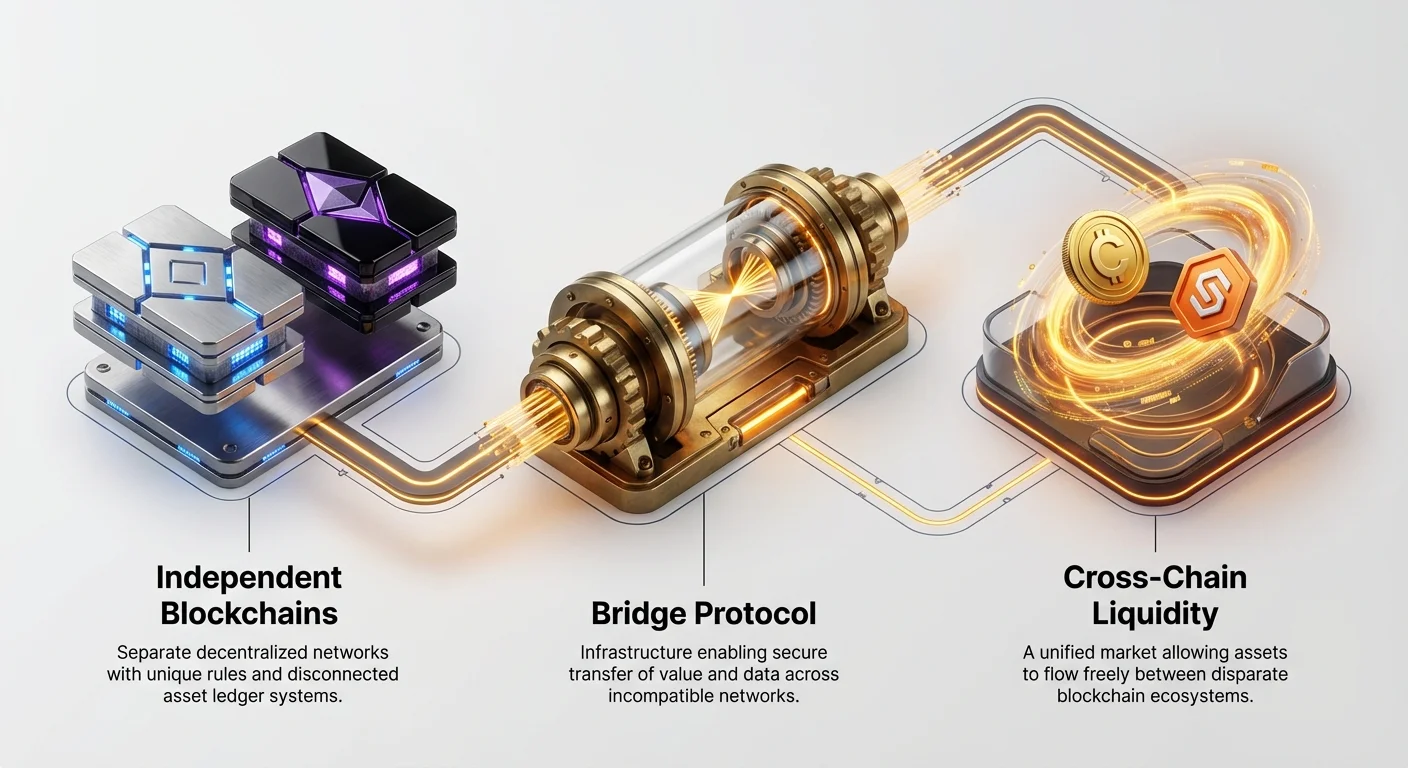
The Core Problem: Why DeFi Needs Bridges (The "Island" Analogy)
To understand why bridges are essential, we first need to recognize the fundamental architecture of the crypto landscape. Blockchains are designed to be independent and secure, which inherently makes them isolated.
The Rise of the Multichain Ecosystem
In the early days of crypto, Ethereum dominated, hosting the vast majority of DeFi applications. However, high transaction fees and slow processing speeds led to the creation of alternative, faster, and cheaper blockchains, often called "Layer 1s" (like Solana, Avalanche, and Binance Smart Chain) and "Layer 2s" (like Polygon and Arbitrum).
Each of these chains operates under its own set of rules, programming language, and security mechanisms. They are essentially digital islands:
- Island A (Ethereum): High security, but expensive transactions. Holds massive value.
- Island B (Solana): Very fast and cheap, but different technical structure.
- Island C (Polygon): A side street off Ethereum, faster and lower cost, but still requires linking back to the main chain.
If a popular new token launches on Solana, an investor whose funds are tied up on Ethereum cannot simply send ETH directly to Solana. They need a mechanism to convert that value and securely transfer it across the digital ocean.
Limitations of Single-Chain DEXs
A traditional Decentralized Exchange (DEX), such as Uniswap running on Ethereum, can only swap tokens that exist on the Ethereum network. For example, it can trade ETH for USDC (an Ethereum token), or for UNI (another Ethereum token). It cannot natively trade Ethereum’s ETH for Solana’s SOL.
This limitation means that liquidity—the pool of available assets for trading—is fragmented. Without bridges, users would be forced to use a Centralized Exchange (CEX) as an intermediary to facilitate the transfer (e.g., send ETH to Coinbase, sell for USD, withdraw USD, buy SOL, send SOL to Solana wallet). Bridges provide a purely decentralized solution, maintaining the core ethos of DeFi.
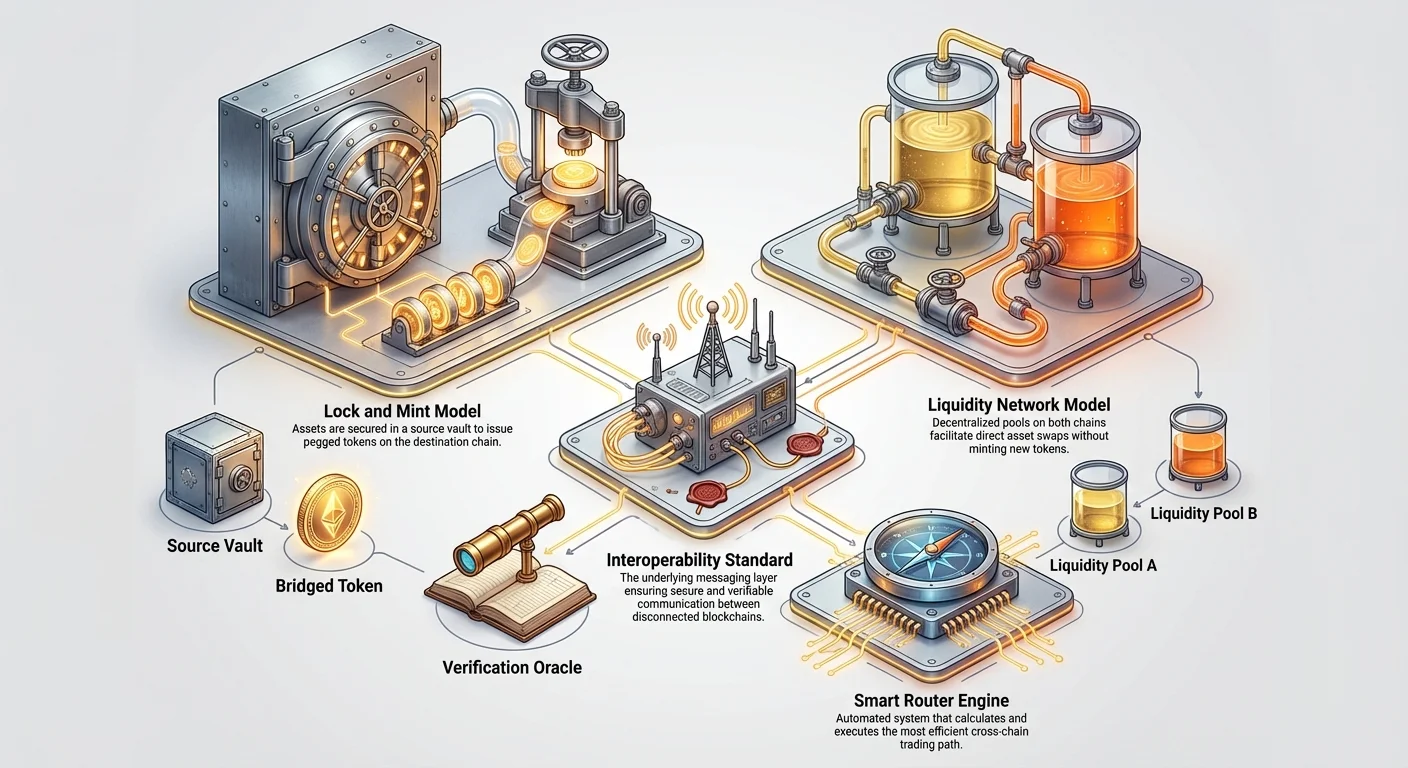
Kako funkcioniše menjanje preko lanaca: Dve glavne arhitekture mostova
Mostovi su u suštini protokoli koji omogućavaju da imovina na jednom lancu bude predstavljena i korišćena na drugom lancu. Iako korisničko iskustvo izgleda bez trzanja, osnovni mehanizmi uključuju složene kriptografske i ekonomske garancije. Dva glavna tipa mostova postižu ovu interoperabilnost na fundamentalno različite načine.
Tip 1: Mostovi zaključaj i mint (Klasični sef)
Model zaključaj i mint je najjednostavniji koncept i bio je prva prevladavajuća forma mostova.
Analogna „Sef“
Ovaj most radi kao sef visoke bezbednosti:
- Zaključavanje: Korisnik želi da premesti 1 ETH sa Ethereum-a (Lanac A) na Polygon (Lanac B). Korisnik šalje 1 ETH na pametni ugovor mosta na Lancu A. Ovaj ETH je sada zaključan, u suštini izvađen iz opticaja.
- Verifikacija: Protokol mosta verifikuje da je 1 ETH uspešno zaključan.
- Mintovanje: Na Lancu B (Polygon), most automatski mintuje novi, ekvivalentni token—često nazvan „umotani“ ili „premreženi“ asset, kao „wETH (Polygon)“—i šalje ga u korisnički novčanik.
- Otpremanje: Da bi premestio imovinu nazad, korisnik šalje umotani token na ugovor mosta na Lancu B (gde se spali), i originalni 1 ETH se otključava i vraća korisniku na Lancu A.
Ključna karakteristika: Umotani token na ciljnom lancu ima vrednost samo zato što je podržan 1:1 imovinom zaključanom u sefu na izvornom lancu.
Bezbednosna napomena: Najveći rizik ovog modela je pametni ugovor koji drži zaključane imovine („sef“). Ako je ovaj ugovor iskorišćen, kolateral se ukrade, čineći sve mintovane umotane tokene besvrijednima (jer nemaju podršku). Istorijski, neki od najvećih hakova u DeFi-u ciljali su ove centralizovane ugovore mostova zaključaj-i-mint.
Tip 2: Mostovi likvidnosne mreže (Trgovačka postaja)
Mostovi likvidnosne mreže nude decentralizovaniju i često bržu alternativu oslanjajući se na decentralizovane bazene kapitala umesto na jedan sef.
Analogna „Trgovačka postaja“
Umesto mintovanja novog tokena, ovi mostovi funkcionišu kao kiosci za razmenu valute koji rade paralelno na različitim lancima:
- Bazeni likvidnosti: Specijalizovani pružaoci likvidnosti depoziraju imovine (npr. ETH na Ethereum-u i ekvivalentnu količinu wETH na Polygon-u) u bazene na izvornom i ciljnom lancu.
- Atomska zamena: Korisnik šalje 1 ETH u bazen na Lancu A. Istovremeno, protokol mosta naređuje bazenu na Lancu B da isplati ekvivalentnu imovinu (1 wETH) korisniku.
- Rebalansiranje: Bazen na Lancu A je sada bogatiji za 1 ETH, a bazen na Lancu B siromašniji za 1 wETH. Specijalizovani agenti (često nazvani ruterima ili relejima) rebalansiraju likvidnost između bazena, osiguravajući da sistem ostane solventan.
Ključna karakteristika: Ne mintuju se novi tokeni; imovine se direktno menjaju iz postojećih zaliha. Ovaj metod je često brži i ne oslanja se na jedan masivan sef zaključanih fondova, raspoređujući rizik preko više bazena.
Upotreba u DEX-ovima: Moderni DEX agregatori preferiraju ovaj model jer se besprekorno integriše u standardnu strukturu Automatskog tvorca tržišta (AMM). Zamena mosta izgleda skoro identično redovnoj razmeni između dva tokena na istom lancu.
DEX integracija: Olakšavanje menjanja preko lanaca
Za prosečnog početnika, ideja zaključavanja imovina, mintovanja tokena i interakcije sa ugovorima mostova zvuči komplikovano. Moderni DEX-ovi i agregatori su u velikoj meri apstrahovali ovu složenost, čineći više-lančanu trgovinu kao jednostavnu, jednim klikom zamenu.
Apstrahovanje složenosti (Pametni ruter)
Tehnologija koja povezuje DEX interfejs sa različitim protokolima mostova je Pametni ruter ili Motor za rutiranje. Ovo je sloj inteligencije koji pronalazi najefikasniji, najjeftiniji i najbrži put za korisničku transakciju, čak i ako taj put uključuje više lanaca i protokola.
Proces optimizacije rute
Kada pokrenete zamenu preko lanaca (npr. zamena Tokena A na Polygon-u za Token Z na Ethereum-u), pametni ruter izvršava proračun:
- Pronalaženje puta: Proverava sve dostupne puteve. Da li da koristi Most X (Zaključaj/Mint) ili Most Y (Likvidnosna mreža)?
- Analiza troškova: Uzima u obzir gas naknade za inicijalnu transakciju, naknade mosta, gas naknade ciljnog lanca i bilo kakvo potencijalno klizanje u bazenu likvidnosti cilja.
- Izvršenje: Ruter spaja sve ove korake—inicijalnu zamenu, most, i finalnu zamenu na ciljnom lancu—u jedan konsolidovani zahtev za transakciju koji korisnik odobrava jednom.
Korisnik samo vidi: „Zameni 100 Tokena A za 15 Tokena Z“, dok ruter možda izvršava 5-korak proces preko tri odvojena protokola.
Studija slučaja: Agregatori i zamene bazirane na nameri
DEX agregatori (kao 1inch ili Paraswap) specijalizovani su za pronalaženje najbolje likvidnosti preko svih dostupnih berzi. Kada integrišu tehnologiju mostova, postaju Agregatori preko lanaca.
Umesto da kažu protokolu kako da izvrši trgovinu, moderni sistemi prelaze ka Trgovini baziranoj na nameri. Korisnik izražava svoju nameru („Želim Token Z u svom novčaniku na Lancu Y“), a infrastruktura rukuje celim izvršenjem, optimizujući svaki korak mosta, zamene i rutiranja tiho u pozadini.
Ovaj fokus na korisničku nameru je ključan za masovnu adoptiju više-lančanog DeFi-ja, jer uklanja teret upravljanja složenim tehničkim koracima kao što je ručno mostovanje sredstava pre trgovine.
Interoperability Protocols: The Backbone of the DEX Bridge
While bridges manage the transfer of value (moving the token), the most critical component underlying modern bridges is the Interoperability Protocol. These protocols ensure that the messages being sent between chains are genuine and secure.
Communicating Securely (Messaging Layers)
Blockchains cannot inherently communicate with each other. If Chain A locks 1 ETH, Chain B needs irrefutable proof that this happened before it mints the wrapped token.
Interoperability protocols act as standardized communication layers, providing secure and verifiable methods for transferring information—not just assets—between disparate blockchain environments. They solve the "trust minimization" problem.
The key function is the verifier mechanism. When a transaction happens on Chain A, the interoperability protocol uses external validators or specialized cryptography to confirm the transaction’s validity before relaying the authenticated message to Chain B.
Examples: LayerZero and Wormhole
These next-generation protocols are essential for providing the foundation upon which complex cross-chain DEXs are built:
1. LayerZero
LayerZero is an Omnichain Interoperability Protocol (OIP) designed to create trustless, secure connections between chains. It achieves security by separating the role of message relaying and message validation:
- Relayer: An entity that fetches the transaction proof from the source chain.
- Oracle (or Watcher): A third-party service (like Chainlink) that independently verifies the transaction block header on the source chain.
For a message to be executed on the destination chain, the data provided by the Relayer must match the verification provided by the Oracle. If these two independent parties do not agree, the transaction fails. This segregation of duties significantly enhances security compared to older bridge models that relied on a single group of validators.
2. Wormhole
Wormhole is a generic message passing protocol that allows decentralized applications (dApps) to build on any connected chain and communicate with each other. It is primarily secured by a decentralized network of guardians (validators) who observe activity on connected chains.
When a message is sent:
- Guardians observe the message on the source chain.
- At least two-thirds of the Guardians must sign a "Verified Action Request (VAA)"—a cryptographic proof that the message is legitimate.
- This VAA is then relayed to the destination chain, instructing the target smart contract (a DEX or application) to take action.
Protocols like Wormhole allow applications built on entirely different architectures (like connecting Ethereum and Solana, which are technically very different) to communicate securely, creating the foundation for truly multichain DEX experiences.
Navigating the Risks of Cross-Chain Swaps
While bridge technology is the engine of DeFi growth, it is also the source of some of the ecosystem's most significant risks. As a beginner, understanding these vulnerabilities is crucial for safely participating in cross-chain trading.
The Critical Security Risk: Smart Contract Exploits
The primary risk in bridging is the smart contract risk—specifically concerning the security of the bridge code itself.
Bridges are high-value targets. Lock-and-mint bridges hold millions, sometimes billions, of dollars worth of locked assets. If a vulnerability exists in the smart contract code (a bug, a flawed access control mechanism, or a private key compromise), hackers can drain the entire vault.
Why Bridges are Hacked:
- Complexity: Cross-chain code is inherently more complex than single-chain code, making it harder to audit and easier for subtle bugs to slip through.
- Centralized Verification: Older bridge models relied on a small, centralized group of signers or a single multisignature wallet to approve transfers. If these signers were compromised, the entire system failed.
Newer messaging protocols, like LayerZero and Wormhole, address this by decentralizing the verification process, spreading trust across multiple independent parties (oracles, relayers, guardians) to minimize any single point of failure.
Liquidity Risk and Slippage
When performing a swap on a DEX, slippage occurs when the price of the asset changes between the moment you submit the transaction and the moment it executes.
In cross-chain swaps using Liquidity Network Bridges, liquidity risk is compounded:
- Source Chain Slippage: The price movement on the initial DEX swap.
- Bridge Execution Slippage: If the liquidity pools within the bridge itself are temporarily depleted or heavily utilized, the swap might execute at a worse rate than quoted.
- Destination Chain Slippage: The price movement on the final DEX swap on the destination chain.
If a bridge liquidity pool is severely unbalanced (e.g., if everyone is moving assets from Chain A to Chain B, but no one is moving assets back), the cost to bridge becomes prohibitively expensive, leading to high slippage for the user attempting the transfer.
Best Practices for Bridge Users
To safely navigate the cross-chain environment, follow these best practices:
| Practice | Description |
|---|---|
| Verify Bridge Audits | Only use bridges that have undergone rigorous, public security audits by reputable firms. Look for protocols that clearly display their security model (e.g., using LayerZero’s segmented security). |
| Start Small | When using a new bridge or interacting with a new chain, transfer only a small, test amount first. Never move your entire portfolio in one go. |
| Check the Liquidity | Before initiating a large swap, check the total value locked (TVL) and liquidity of the bridge pools for your chosen assets. Low liquidity means higher risk of failure or excessive slippage. |
| Use Aggregators | Opt for DEX aggregators that automatically incorporate bridging. These smart routers are designed to find the safest, most cost-effective path, removing the need for manual contract interaction. |
| Understand the Asset | If you are receiving a wrapped asset (like wETH), ensure you understand which bridge created it. The security of your wrapped asset is directly tied to the security of the vault where the original asset is locked. |
Zaključak: Budućnost besprekornog menjanja
Tehnologija DEX mostova i protokoli interoperabilnosti su definisanje infrastrukture modernog DeFi pejzaža. Oni su transformisali kripto svet iz kolekcije izolovanih ostrva u masivan, povezan kontinent.
Za početnika, budućnost menjanja preko lanaca biće karakterisana sve većim nivoima apstrakcije. Zahvaljujući naprednim protokolima kao LayerZero i poboljšanim DEX rutiranjem, korisnici više neće morati da brinu o tehničkim detaljima mostovanja. Umesto toga, samo će izraziti svoju finalnu nameru—koji token žele i na kom lancu—a sofisticirana infrastruktura će rukovati bezbednim, optimizovanim izvršenjem.
Kako ovi osnovni protokoli poruka sazrevaju, bezbednost se poboljšava, a trošak inter-lančane komunikacije pada, razlika između „Lanca A“ i „Lanca B“ će se sve više zamaglivati, stvarajući zaista ujedinjeni, decentralizovani finansijski sistem koji kripto obećava.