
Svet kriptovaluta, posebno Bitcoin, često deluje obavijen zastrašujućim žargonom, složenim kodom i visokim finansijskim barijerama. Čujete termine poput „blockchain“, „decentralizacije“ i „rudarenja“, što može učiniti da početak vašeg edukativnog puta izgleda preteće.
Ovaj vodič probija složenost. Cilj nam je da pružimo jednostavnu, netehničku definiciju Bitcoina, fokusirajući se na njegovu upotrebu i ključne komponente. Ključno je da ćemo se pozabaviti najvećim zabunom koja sprečava većinu novopridošlih da naprave prvi korak: percepcijom visoke cene. Uvođenjem skale Satoshi (ili „sat“) odmah ćemo predefinisati pristupačnost Bitcoina i pokazati vam kako da počnete graditi svoj udeo danas, bez obzira koliko imate za ulaganje.
Zamislite ovu stranicu kao vaš prijateljski ulaz u digitalnu ekonomiju. Razbijamo osnove onoga što je Bitcoin, kako se meri i kako mu pristupiti, postavljajući scenu za ličnu suverenost.
What Exactly *Is* Bitcoin? The Simple Definition
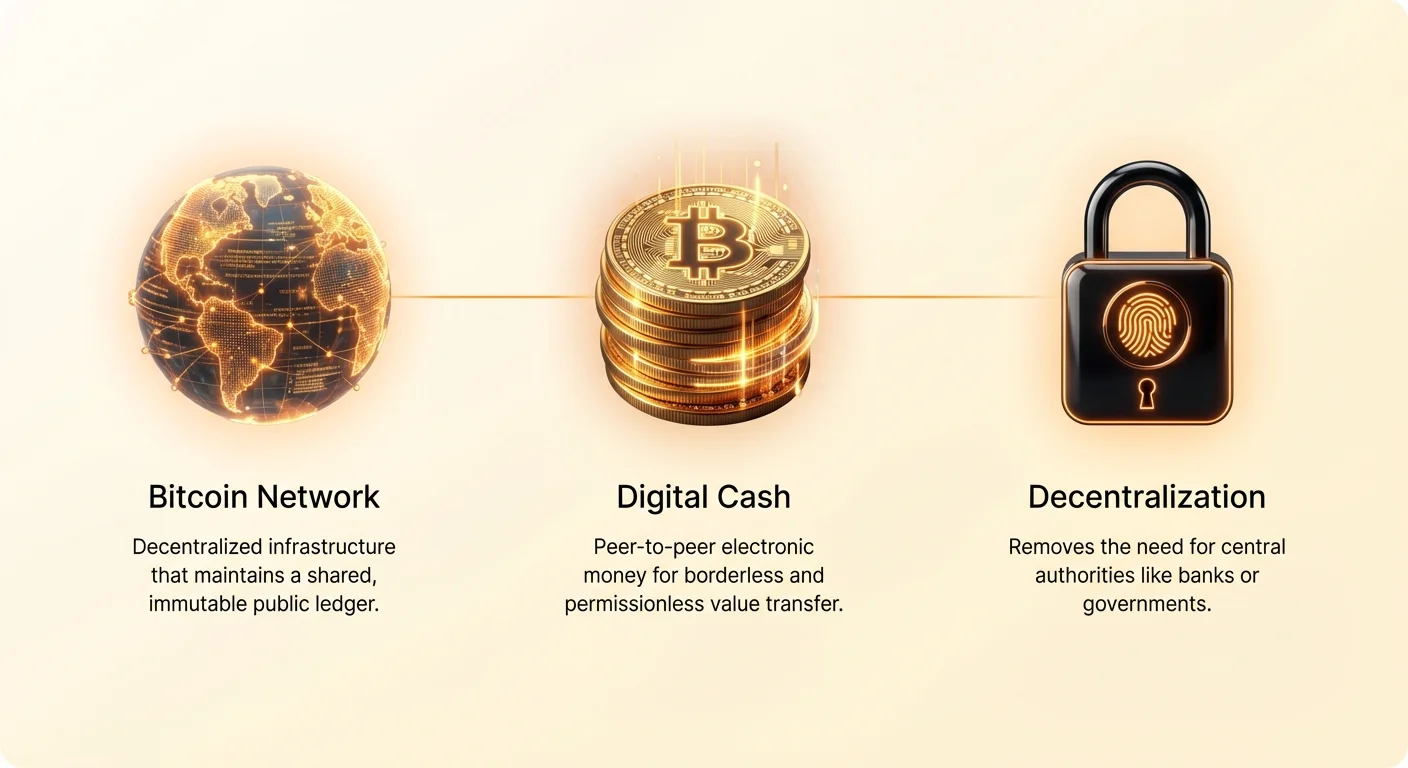
At its core, Bitcoin is simply a form of digital money designed to work without central control, like a bank or government. It is a peer-to-peer electronic cash system. To understand its revolutionary nature, you must understand that "Bitcoin" is actually two things: the currency (the BTC token) and the network (the technological infrastructure).
Bitcoin as Digital Cash (The Use Case)
Imagine cash in your pocket. It’s physical, fungible (meaning one dollar is the same as any other dollar), and you can exchange it directly with another person without needing a third party like a bank to approve the transaction.
Bitcoin is designed to replicate these qualities digitally, but with a few crucial upgrades:
- It’s Borderless: You can send value across the world just as easily as sending an email.
- It’s Permissionless: No bank can block you from sending or receiving funds.
- It’s Scarce: Unlike traditional currencies, which governments can print infinitely, the total supply of Bitcoin is capped at 21 million units.
Bitcoin as a Decentralized Ledger (The Technology)
If Bitcoin is digital cash, how do we know who owns what without a central bank tracking balances? This is where the network aspect—the underlying technology known as the blockchain—comes in.
Think of the Bitcoin network as a giant, public, shared Excel spreadsheet that millions of computers around the world constantly maintain and verify. This ledger contains a record of every transaction ever made.
- Decentralized: No single person or entity controls this spreadsheet. If one computer goes down, millions of others still hold the record.
- Immutable (Permanent): Once a transaction is added to the ledger (the "block"), it cannot be changed or deleted. This permanence is what creates trust in the system.
How Bitcoin Solves the "Double-Spend" Problem (Trustlessness)
Historically, digital money had one major flaw: the "double-spend problem." If I have a digital file (money), what stops me from sending a copy of that file to two different people simultaneously?
Traditional banking solved this by having a central authority (the bank) track balances and reject the second transaction. Bitcoin solved it using cryptography and the decentralized network. The global network constantly verifies that when you send BTC, the original amount is simultaneously removed from your available balance, making it mathematically impossible to spend the same unit twice. This system allows for trustless exchange—you don’t need to trust the other party or a bank; you only need to trust the mathematics and the open-source code.
The Biggest Misconception: Bitcoin is Too Expensive
When newcomers first look at Bitcoin, they often see a price tag in the tens of thousands of dollars. This immediately leads to the conclusion: "I can't afford Bitcoin." This is perhaps the most significant barrier to entry, but it is based on a fundamental misunderstanding of the unit of account.
Why the Price Tag is Deceptive
If you want to buy gold, you don't have to buy an entire 400-ounce bar. You can buy one ounce, a gram, or even a tiny fraction of a gram. Bitcoin works the exact same way.
The price you see quoted on exchanges—say, $70,000—is the price for one whole Bitcoin (1 BTC). However, Bitcoin is highly divisible, far more divisible than any traditional currency. Because the market always quotes the price of a whole BTC, beginners are tricked into thinking they need to purchase the entire unit. You absolutely do not.
The Solution: Meet the Satoshi (The Smallest Unit)
The key to understanding Bitcoin affordability is recognizing its smallest denomination: the Satoshi, or simply "sat."
The Satoshi is named after the pseudonymous creator of Bitcoin, Satoshi Nakamoto. It serves the same function for Bitcoin that a penny serves for the U.S. Dollar, but on a vastly larger scale.
1 Whole Bitcoin (1 BTC) is divisible into 100,000,000 Satoshis.
This means that you can buy and own a tiny fraction of a Bitcoin, down to one hundred-millionth of a single coin. When you buy $50 worth of Bitcoin, you are purchasing thousands, or even hundreds of thousands, of Satoshis, depending on the current price.
The Sat Scale: Thinking in Smaller Units
Adopting the "sat scale" is more than just a mathematical exercise; it’s a necessary mental shift for successful, stress-free investing in Bitcoin. It transforms Bitcoin from an abstract, high-priced asset into an accessible savings technology.
Breaking Down the Math: 1 BTC = 100,000,000 Sats
Understanding the relationship between the whole unit (BTC) and the micro-unit (sats) is critical for tracking your investments. Bitcoin transactions are actually calculated in Satoshis on the network.
Here is the simple breakdown:
| Unit | Decimal Equivalent (of 1 BTC) | Number of Satoshis |
|---|---|---|
| 1 BTC | 1.0 | 100,000,000 |
| 0.1 BTC | 0.1 | 10,000,000 |
| 0.01 BTC | 0.01 | 1,000,000 |
| 0.001 BTC | 0.001 | 100,000 |
| 0.00001 BTC | 0.00001 | 1,000 |
| 0.00000001 BTC | 0.00000001 | 1 Sat |
When you decide to purchase $25 of Bitcoin, you are not chasing the price of the whole coin; you are acquiring a specific quantity of Satoshis.
Practical Mental Modeling (The "Penny" Analogy)
To make sats tangible, adopt this analogy:
- The Dollar Analogy: If the U.S. Dollar were divisible by 100 million, the highest bill would be a $100 Million Bill (1 BTC), and the smallest unit you could transact with would be a "millipenny" (1 Sat).
- The Investment Mindset: Instead of focusing on owning "one Bitcoin" (which feels unattainable), focus on accumulating a target number of Satoshis (e.g., "I want to save 5 million sats this year").
This reframing is essential for using the DCA (Dollar-Cost Averaging) investment strategy, where you regularly buy small amounts of sats over time, minimizing the stress of short-term price fluctuations. When you think in sats, volatility becomes less intimidating; you simply know you acquired a certain number of digital savings units that day.
Why Buying Sats Makes Sense for Beginners
- Affordability: You can start with $1 or $10. There is no minimum investment beyond what the exchange requires.
- Goal Setting: Setting goals in sats (e.g., reaching 1 million sats) is far more motivating and measurable than trying to achieve 1.0 BTC.
- Future-Proofing: Many experts believe that as the price of Bitcoin continues to appreciate over decades, the primary unit of account used in daily transactions may eventually shift from BTC to sats. Thinking in sats now prepares you for that future.
Actionable Tip: When you buy Bitcoin on an exchange, switch the display setting (if available) from BTC to Sats. This reinforces the mental model that you are accumulating thousands of units, not just tiny fractions of a whole coin.
Pristup vašem Bitcoinu: Kratak pogled na novčanike
Kada shvatite šta je Bitcoin i kako se meri u Satoshijima, sledeće prirodno pitanje je: Kako da držim i pristupim svom novcu? Odgovor je preko Bitcoin novčanika.
Bitcoin novčanik nije fizičko mesto gde se vaš BTC čuva. Zapamtite, Bitcoin živi trajno na globalnoj, decentralizovanoj knjizi (blockchain-u). Vaš novčanik je jednostavno alat koji drži neophodne kriptografske ključeve koji vam omogućavaju da dokažete vlasništvo i ovlaštite transakcije.
Šta je adresa novčanika? (Javni ključ)
Kada podesite Bitcoin novčanik, prvo što generišete je vaš javni ključ, ili adresa novčanika.
- Analoga: Ovo je vaš javni broj bankovnog računa ili e-mail adresa.
- Funkcija: Ovo je adresa koju date nekome kada želite primiti Bitcoin (sats). Javna je i bezbedno je deliti. Omogućava drugima da vide vaše stanje na javnoj knjizi, ali ne mogu trošiti vaš novac.
Ključ za vaše bogatstvo: Privatni ključevi (Tajna)
Najkritičnija komponenta vašeg novčanika je privatni ključ.
- Analoga: Ovo je vaš PIN, lozinka za banku i potpis ovlašćenja u jednom.
- Funkcija: Privatni ključ je visoko osetljivi podatak (obično predstavljen 12- ili 24-rečnom „seed frazom“) koji matematički dokazuje da posedujete Satoshije povezane sa vašom javnom adresom. Ako neko dobije pristup vašem privatnom ključu, može ukrasti sva vaša sredstva. Ako izgubite privatni ključ, vaša sredstva su trajno zaključana.
U Bitcoinu, vi ste svoja banka, što znači vi ste isključivo odgovorni za zaštitu svog privatnog ključa.
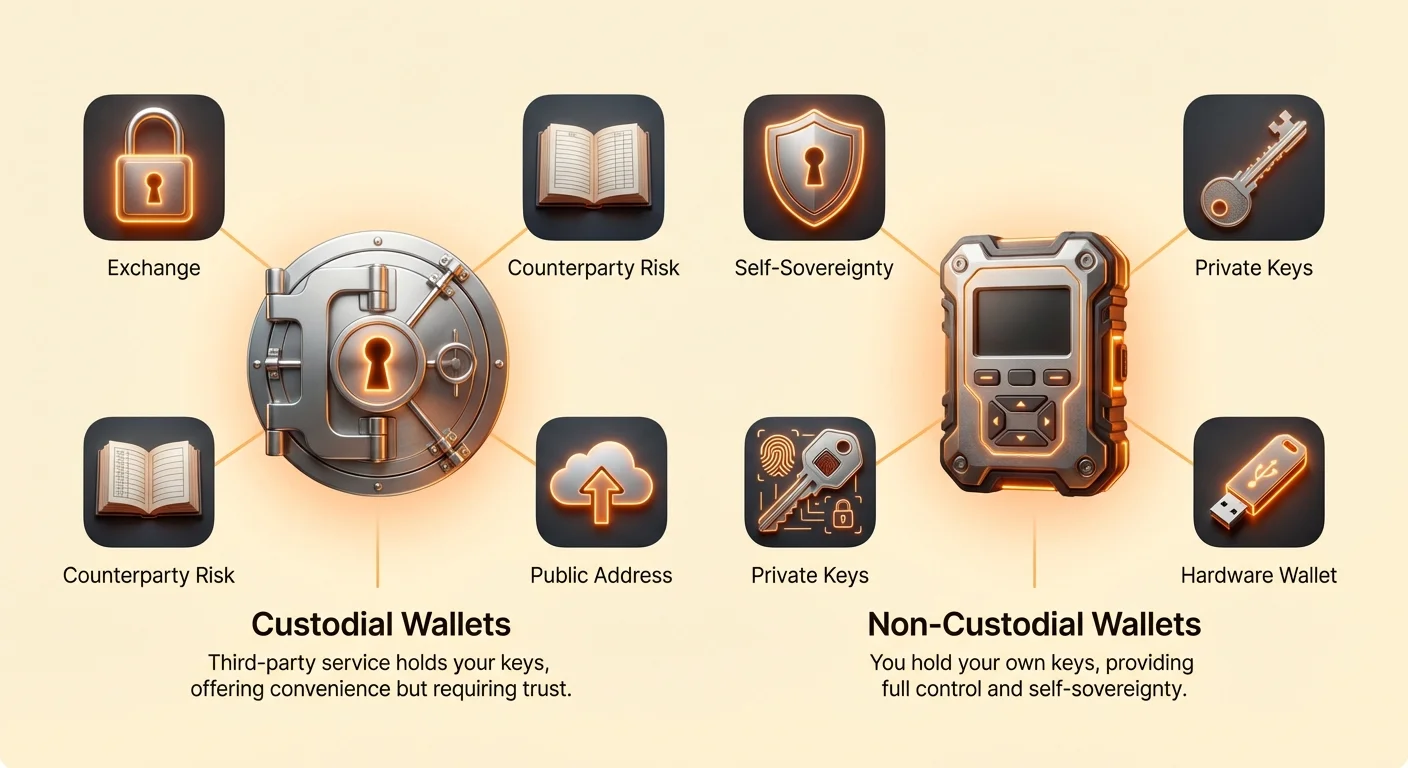
Custodial vs. Non-Custodial novčanici
Odabir novčanika je jedna od prvih velikih odluka koju novopridošli donese, i sve se svodi na to gde se čuva privatni ključ.
| Tip novčanika | Ko drži privatni ključ? | Najbolje za | Rizik/Pogodnost |
|---|---|---|---|
| Custodial | Treća strana (npr. velika berza). | Apsolutni početnici; male testne količine. | Pogodnost: Ako zaboravite lozinku, berza može vratiti pristup. Rizik: Morate verovati trećoj strani da ne bude hakovana ili da ne zamrzne vaša sredstva. (Nije lična suverenost.) |
| Non-Custodial | Samo vi držite ključ (na ličnom uređaju ili hardveru). | Svako ko traži pravu finansijsku slobodu i kontrolu. | Pogodnost: Imate 100% kontrolu i vlasništvo; nijedna treća strana ne može zamrznuti vaša sredstva. Rizik: Ako izgubite ključeve, sredstva su zauvek nestala. (Zahteva disciplinu bezbednosti.) |
Izbor između ova dva tipa direktno utiče na vaš nivo lične suverenosti. Dok custodial novčanici nude udobnost, prelazak na non-custodial novčanik je neophodan korak za pravo prihvatanje etosa Bitcoina. (Detaljno istražujemo ovu odluku u sledećem vodiču.)
Zaključak: Početak vašeg puta u Sats
Bitcoin je revolucionarna finansijska tehnologija — decentralizovana, transparentna i retka digitalna valuta potkrepljena trajnom knjigom.
Najvažnija poruka za svakog početnika treba da bude ovo: Bitcoin nije preskup. Prepoznatljivši Sat skalu, shvatate da možete učestvovati u ovom novom finansijskom sistemu odmah, pretvarajući male, redovne uštede u dugoročnu ličnu suverenost.
Vaši sledeći koraci uključuju prelazak iz teorije u praksu: podešavanje prvog novčanika (non-custodial novčanici su visoko preporučeni za bezbednost i kontrolu) i učenje kako efikasno kupiti i steći prve serije Satoshija. Put do razumevanja Bitcoina počinje sada, jedan sat po sat.