
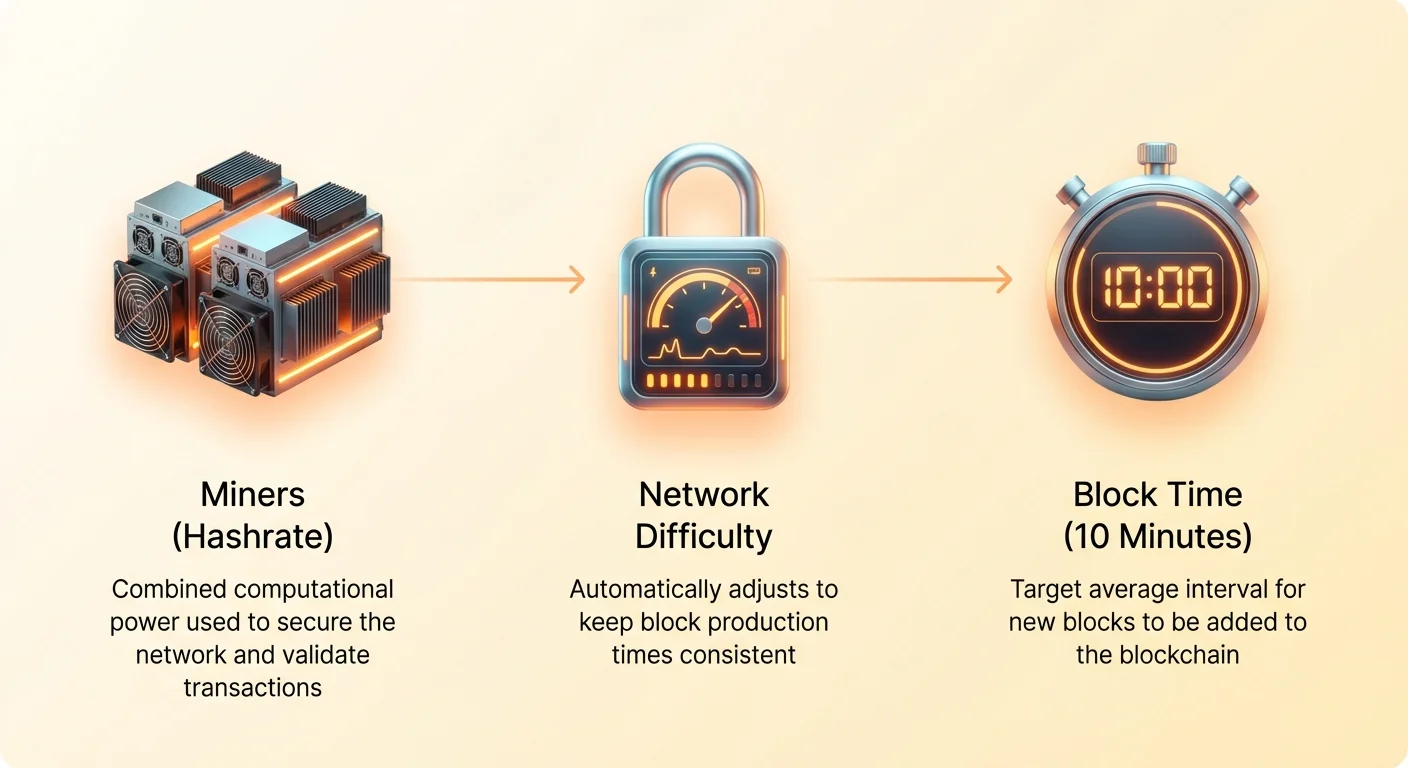
Bitcoin operates as a decentralized digital currency without a central bank or administrator. Instead of relying on human intervention to manage inflation or secure the network, it utilizes a set of pre-programmed rules. These rules create a self-regulating economic system. At the core of this system lies the interplay between hashrate and difficulty adjustment. These two mechanisms work in tandem to ensure the network remains secure and the issuance of new currency remains predictable.
The relationship between mining power and network difficulty forms a continuous feedback loop. This loop responds to market conditions, technological advancements, and changes in participation. It allows Bitcoin to adapt to the physical world while maintaining its digital scarcity. Understanding this dynamic is essential for grasping how Bitcoin survives and functions autonomously. It is the engine that keeps the heartbeat of the network steady at ten-minute intervals.
The Mechanics of Proof of Work
Proof of Work (PoW) is the consensus mechanism that underpins the Bitcoin network. It serves as the bridge between the digital ledger and physical reality. In this system, network participants known as miners compete to solve complex mathematical puzzles. These puzzles require significant computational effort and energy expenditure. The process is not arbitrary; it creates a cost of production for every bitcoin minted.
The Computational Lottery
The mining process is often compared to a global lottery. Miners use specialized hardware to generate trillions of guesses per second. They are looking for a specific number, known as a nonce, that results in a block hash below a certain target value. This process uses the Secure Hash Algorithm 2 (SHA-256). It is impossible to predict which nonce will produce a valid hash. The only way to find it is through brute force trial and error.
When a miner finds a valid solution, they broadcast the new block to the network. Other nodes verify the solution instantly. If the work is valid, the block is added to the blockchain, and the miner is rewarded. This reward consists of newly minted bitcoin and transaction fees. This incentivizes honest participation. Attempting to cheat the system would require wasting energy on invalid blocks that the network would reject.
Validating the Ledger
Proof of Work does more than just issue new coins. It provides the mechanism for distributed consensus. In a decentralized network, there is no single source of truth. All participants must agree on the order of transactions to prevent double-spending. The "longest chain" rule dictates that the valid blockchain is the one with the most accumulated proof of work.
Miners effectively vote on the valid history of transactions with their computing power. By building new blocks on top of previous ones, they confirm the history of the ledger. The more energy expended on the chain, the more secure it becomes. This makes the history immutable. Changing a past transaction would require re-doing the work for that block and all subsequent blocks, which becomes exponentially difficult as time passes.
Understanding Network Hashrate
Hashrate is the metric used to quantify the total computational power dedicated to the Bitcoin network. It represents the combined processing speed of every miner globally. A higher hashrate indicates that more machines are actively guessing solutions to the hashing algorithm. This metric is a direct reflection of the network's security budget. It shows how much energy is being deployed to protect the ledger.
The unit of measurement for hashrate is hashes per second (H/s). Because modern mining hardware is incredibly powerful, the network hashrate is typically expressed in massive denominations. We often see terms like Exahashes per second (EH/s). One Exahash represents one quintillion hashes calculated every second.
| Unit | Value | Scale |
|---|---|---|
| Megahash (MH/s) | 1,000,000 | One Million |
| Terahash (TH/s) | 1,000,000,000,000 | One Trillion |
| Exahash (EH/s) | 1,000,000,000,000,000,000 | One Quintillion |
This immense number demonstrates the scale of the physical infrastructure supporting Bitcoin. As hashrate grows, the probability of a single miner finding the next block decreases. This forces miners to upgrade their hardware to stay competitive. It also makes the network more resistant to attacks. An attacker would need to acquire more computing power than the entire existing network combined to disrupt it.
The Difficulty Adjustment Mechanism
If hashrate grew unchecked, blocks would be found faster and faster. This would accelerate the issuance of bitcoin and disrupt the predictable supply schedule. To prevent this, the protocol includes a difficulty adjustment algorithm. This is a self-correcting mechanism that ensures blocks are mined approximately every ten minutes, regardless of how much mining power is active.
How the Adjustment Works
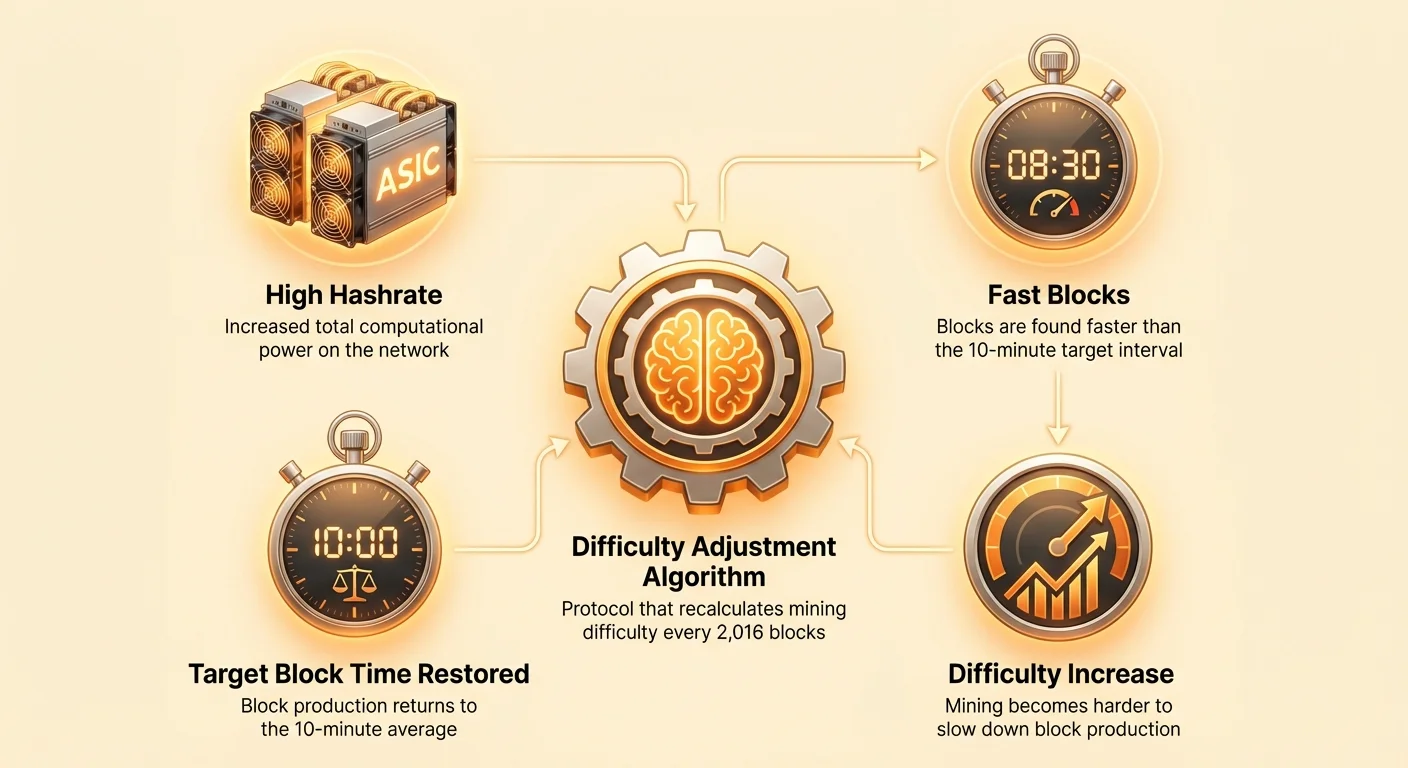
The difficulty target is not static. The protocol reviews the time it took to mine the previous 2,016 blocks. This period is roughly two weeks. Ideally, it should take exactly 20,160 minutes to mine these blocks. If the network was faster than this target, it means hashrate has increased. The protocol then increases the difficulty of the puzzle for the next period.
Conversely, if miners turn off their machines and hashrate drops, blocks will be found more slowly. If it takes longer than two weeks to mine 2,016 blocks, the protocol lowers the difficulty. This makes the puzzles easier to solve. This bi-directional adjustment ensures that the network can survive even if a massive portion of miners goes offline instantly.
Why Ten Minutes Matters
The ten-minute block interval is a specific design choice. It balances the need for fast confirmations with the physical limitations of the internet. When a block is found, it must propagate to nodes around the world. If blocks were produced too quickly, say every few seconds, many miners would be working on outdated versions of the blockchain.
This would lead to a high rate of "orphan blocks." These are valid blocks that get discarded because another miner found a block at the same time. A ten-minute interval provides ample time for a new block to spread across the global network. It ensures that all miners are working on the most current tip of the blockchain. This synchronicity is vital for maintaining a decentralized consensus without a central clock.
The Economic Feedback Loop
The interaction between hashrate and difficulty creates a profound economic cycle. This cycle is driven by the price of bitcoin and the cost of energy. Bitcoin mining is a competitive market where profit margins determine participation. When the price of bitcoin rises, the fiat value of the block reward increases. This makes mining more profitable.
When Price Rises
Higher profitability attracts new entrants to the mining industry. Existing miners may also plug in older, less efficient hardware that was previously unprofitable. This influx of hardware causes the total network hashrate to spike. Blocks are mined faster than the ten-minute target.
Eventually, the 2,016-block epoch ends. The difficulty adjustment kicks in. Because blocks were too fast, the difficulty increases. This makes it harder to find blocks, raising the cost of production for every miner. The profit margins tighten. This checks the expansion of the network and brings the block production rate back to equilibrium.
When Price Falls
If the price of bitcoin drops significantly, the revenue for miners decreases. Miners with high electricity costs or inefficient hardware may start losing money. Rational actors will shut down their machines to prevent losses. This causes the network hashrate to decline.
With less computing power, block production slows down. It might take 11 or 12 minutes to find a block. The network effectively moves in slow motion. However, once the epoch concludes, the difficulty adjusts downward. Mining becomes easier and cheaper. This restores profitability for the remaining miners. This resilience ensures the network continues to function even during severe bear markets.
Hardware Evolution and Efficiency
The race for hashrate has driven rapid technological innovation. In the early days, mining was performed on standard Central Processing Units (CPUs) found in home computers. As competition increased, miners moved to Graphics Processing Units (GPUs), which were more efficient at parallel processing.
Today, mining is dominated by Application-Specific Integrated Circuits (ASICs). These are chips designed for one singular purpose: to run the SHA-256 hashing algorithm. They cannot browse the web or render video games. They only mine bitcoin. ASICs are thousands of times more efficient than general-purpose hardware.
This evolution impacts the feedback loop. As new, more efficient machines are released, the hashrate rises even if the number of miners stays the same. This pushes the difficulty up. Miners relying on older generation ASICs eventually get pushed out of the market. This constant pressure forces the industry toward seeking the cheapest sources of energy and the most efficient hardware. It transforms mining from a hobbyist activity into a professional industrial operation.
Security and the 51% Threshold
The primary function of high hashrate is security. The decentralized nature of Bitcoin relies on the assumption that no single entity controls more than 50% of the mining power. If an attacker gained 51% of the hashrate, they could theoretically censor transactions or perform a double-spend attack.
The Cost of Corruption
A double-spend involves spending coins, then rewriting the blockchain to erase that transaction and spend the coins again. To do this, an attacker must build a secret chain of blocks that is longer than the honest chain. This requires generating hashes faster than the rest of the world combined.
As the hashrate grows, the cost of such an attack becomes astronomical. It would require billions of dollars in hardware and massive amounts of electricity. Furthermore, the logistics of acquiring that much hardware without alerting the market are nearly impossible. This concept is known as "unforgeable costliness." The sheer expense protects the network.
Immutable History
The deeper a transaction is buried in the blockchain, the more secure it becomes. Each new block adds another layer of proof of work on top of the previous ones. To reverse a transaction that happened six blocks ago, an attacker would have to redo the work for all six blocks plus the current one.
This cumulative security means that the history of the ledger becomes effectively unchangeable over time. The difficulty adjustment ensures that this security wall remains high. Even if technology improves, the difficulty rises to match it. This guarantees that the effort required to attack the network always scales with the technology used to defend it.
The Impact of Halving Events
Every 210,000 blocks, or roughly every four years, the Bitcoin network undergoes a "halving." This event cuts the block subsidy in half. For example, the reward drops from 6.25 BTC to 3.125 BTC per block. This is a supply shock that fundamentally alters the mining economics.
The halving effectively doubles the cost of production for miners overnight. If the price of bitcoin does not double to match the cut, miner revenue is slashed. This places immense pressure on the ecosystem. Inefficient miners are often forced to capitulate immediately. This can lead to a temporary drop in hashrate.
However, the difficulty adjustment mechanism handles this shock gracefully. If miners drop out, the difficulty eventually lowers. The network finds a new equilibrium. Historically, halvings have also been associated with bullish market cycles. The reduced supply issuance, coupled with steady demand, can lead to price increases. Higher prices then attract hashrate back to the network, restarting the growth cycle.
Transaction Fees as Future Security
Currently, miners are compensated primarily through the block subsidy (newly minted coins). However, they also earn transaction fees paid by users. Users attach fees to their transactions to incentivize miners to include them in the next block. The Bitcoin protocol caps the block size, creating a limited supply of space for transactions.
The Fee Market
When the network is busy, the "mempool" (the waiting area for unconfirmed transactions) fills up. Users compete for block space by bidding higher fees. This creates a fee market. During periods of high congestion, fees can become a significant portion of miner revenue.
This mechanism is critical for the long-term sustainability of Bitcoin. The block subsidy is programmed to decrease every four years until it reaches zero around the year 2140. At that point, there will be no new bitcoin created. The network security will rely entirely on transaction fees.
Long-term Security Budget
The transition from a subsidy-based model to a fee-based model is gradual. The difficulty adjustment ensures that mining remains viable during this transition. If fees are low and subsidy is low, difficulty will drop to match the available revenue. If demand for block space is high, fees will rise, supporting a higher difficulty and higher security.
This ensures that Bitcoin does not need eternal inflation to pay for its security. The users of the network pay for the security directly through fees. The hashrate will ultimately settle at a level that the market is willing to pay for. This self-sustaining economic model distinguishes Bitcoin from traditional fiat currencies and many other digital assets.
The Role of Nodes in Consensus
While miners produce blocks, they do not rule the network. "Full nodes" are the validators of the ecosystem. A full node is a computer that runs the Bitcoin software and maintains a complete copy of the blockchain. These nodes enforce the rules of the protocol.
If a miner produces a block that violates the rules (such as creating more bitcoin than allowed or double-spending), the full nodes will reject it. It does not matter how much hashrate the miner used. An invalid block is simply discarded by the network.
This creates a system of checks and balances. Miners provide security against rewriting history, but nodes define the valid rules of the game. The difficulty adjustment is one of these rules enforced by nodes. If a miner tries to cheat the difficulty target, their block is rejected. This separation of powers prevents miners from changing the protocol for their own benefit.
Environmental Dynamics
The energy consumption of the Bitcoin network is a topic of frequent debate. The high hashrate requires significant electricity. However, this energy expenditure is the firewall that protects the network. It is the physical cost that prevents digital forgery.
Mining economics drive the industry toward renewable and stranded energy sources. Miners are location-agnostic. They can set up operations in remote areas where energy is abundant but demand is low, such as near hydroelectric dams or flared gas sites. Because electricity is the primary cost, miners are incentivized to find the cheapest power available.
This search for efficiency often leads miners to use energy that would otherwise be wasted. In this context, the difficulty adjustment acts as an efficiency filter. It mercilessly weeds out miners using expensive, inefficient energy sources. Only the most energy-efficient operations can survive the relentless upward pressure of difficulty and hashrate competition.
Conclusion
The interaction between hashrate and difficulty adjustment is the masterpiece of Bitcoin’s engineering. It creates a closed-loop system that requires no external management. The network observes its own speed and adjusts its own parameters to maintain stability. This feedback loop aligns the incentives of miners, users, and investors.
By regulating the pace of block production, Bitcoin ensures its monetary policy remains credible and immutable. It protects the network from attacks by making them prohibitively expensive. As the world changes, the protocol adapts automatically. This resilience allows Bitcoin to function as a secure, decentralized store of value that operates solely on the laws of mathematics and thermodynamics.
Bitcoin’s difficulty adjustment ensures that no matter how much power is added to or removed from the network, the heartbeat of the blockchain remains constant and secure.