
In the rapidly expanding universe of digital assets, terminology often creates the first barrier to entry for new participants. While the words "crypto," "coin," and "token" are frequently used interchangeably in casual conversation, they represent distinct technical concepts with vastly different roles. Understanding the difference between a coin and a token is not merely a matter of semantics. It is a fundamental distinction between the infrastructure layer of the blockchain economy and the application layer built on top of it.
This distinction influences everything from how an asset is created and secured to how it derives value and fits into a portfolio. Coins act as the native currency of a sovereign digital nation, while tokens function more like the diverse businesses, contracts, and assets operating within that nation's borders. As the market matures and technology advances into 2025, the lines have blurred slightly through Layer 2 networks and cross-chain protocols. However, the core architectural differences remain the bedrock of how decentralized systems operate.
For investors and developers alike, grasping this split is essential for evaluating risk and utility. A coin relies on the adoption and security of its underlying network. A token relies on the utility of the specific project it represents and the stability of the host blockchain. By dissecting these two categories, we can better navigate the complex hierarchy of the cryptocurrency market.
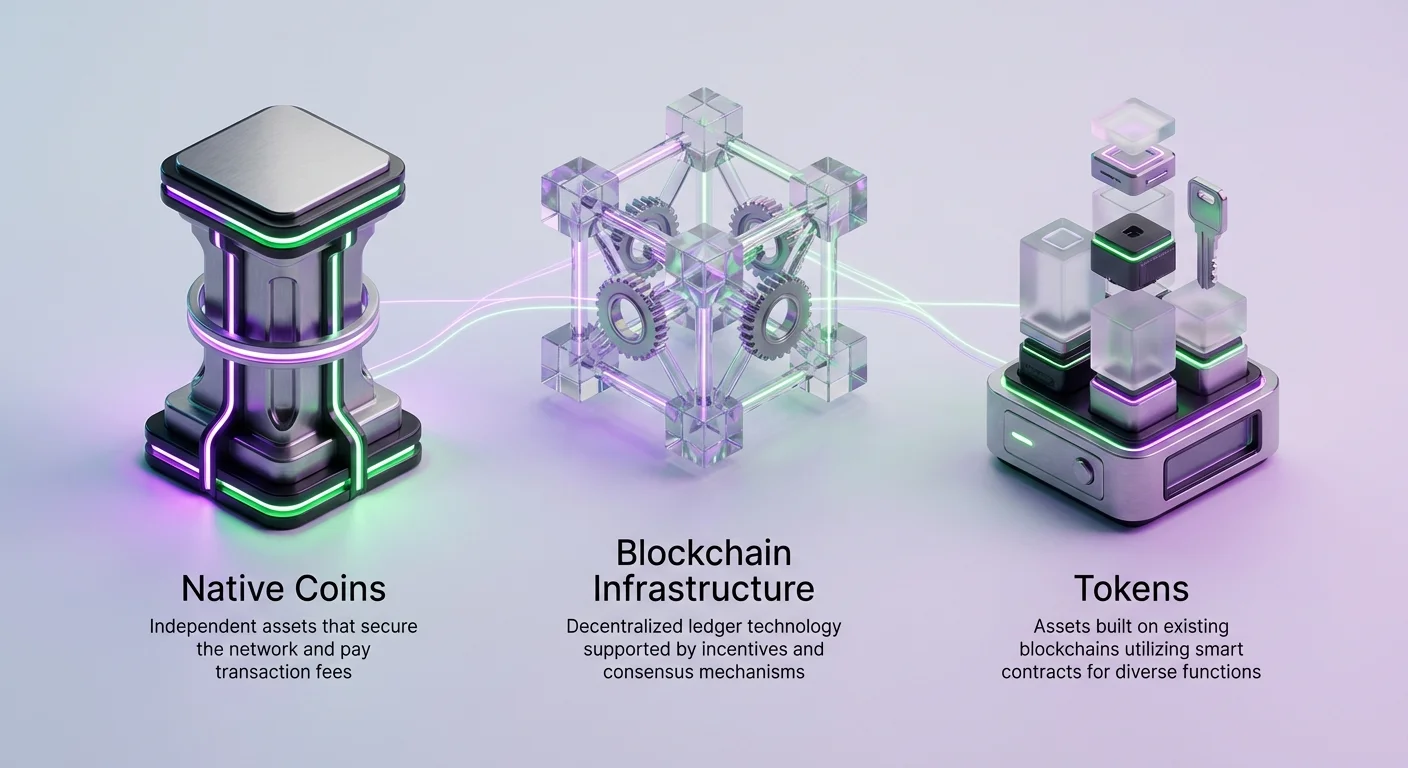
The Coin: Sovereign of the Blockchain
A coin is defined by its independence. It is the native asset of its own blockchain. Bitcoin (BTC) is the original and most prominent example, operating on the Bitcoin blockchain. Similarly, Ether (ETH) is the native coin of the Ethereum network, and SOL is the native coin of the Solana blockchain. These assets exist at the protocol level and are essential for the network's survival and operation.
The Role in Network Security
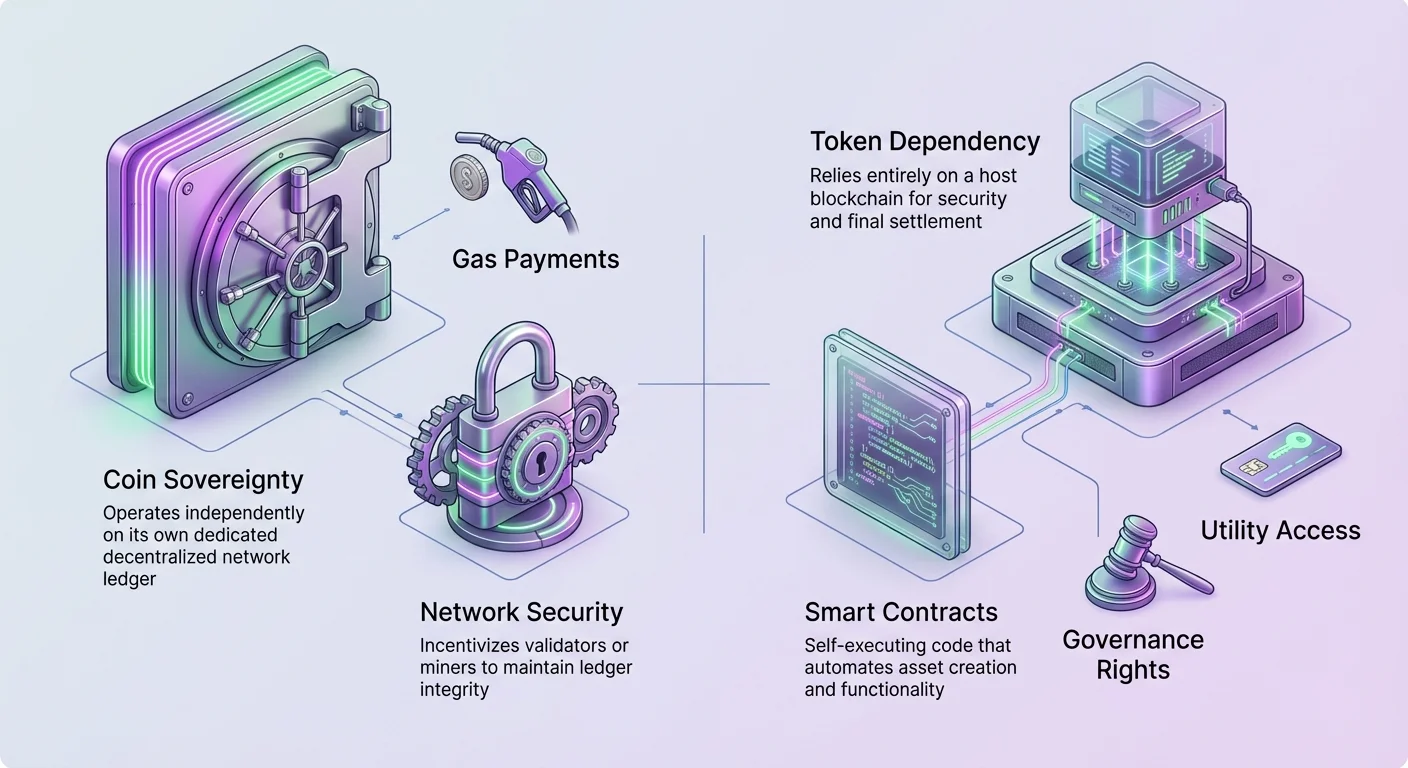
The primary function of a native coin is to incentivize the maintenance of the ledger. Blockchains rely on decentralized networks of computers to validate transactions and secure the system against attacks. In a Proof-of-Work system like Bitcoin, miners spend energy to solve complex puzzles and are rewarded with newly minted coins. In Proof-of-Stake systems, validators lock up (stake) their coins to vouch for the network's integrity.
Without the native coin, there would be no economic reason for participants to expend resources securing the network. The coin is the mechanism that aligns the incentives of thousands of disparate actors. If the value of the coin drops to zero, the security budget of the network effectively vanishes. This tight coupling between the asset and the infrastructure is unique to coins.
Payment for Block Space
Coins also serve as the medium of exchange for purchasing resources on the network. Every time a user sends a transaction or interacts with a smart contract, they consume network resources such as storage and computational power. This is often referred to as "gas." This fee must be paid in the native coin of that specific blockchain.
For example, you cannot pay for an Ethereum transaction using Bitcoin, nor can you pay for a Solana transaction using Ether. The native coin is the only acceptable currency for settlement within its own ecosystem. This creates a baseline demand for the coin; as long as people want to use the network, they must acquire the coin to pay the toll.
Independence and Sovereignty
Because coins run on their own infrastructure, they are sovereign. They do not rely on another blockchain to exist. If the Ethereum network were to halt, the Bitcoin network would continue to operate unaffected. This independence grants coins a level of resilience that tokens do not possess. However, it also means that creating a new coin is resource-intensive.
Launching a coin requires building a blockchain from scratch or forking an existing one. It involves recruiting a network of miners or validators and establishing a consensus mechanism. This high barrier to entry is why there are far fewer coins than tokens in the market. Coins represent the foundation upon which the rest of the crypto economy is built.
The Token: Building on Existing Foundations
Tokens are digital assets created on top of existing blockchains. They do not have their own independent ledger. Instead, they rely on the host blockchain to record their transactions and secure their balances. If the host blockchain is the operating system, tokens are the software applications running on it.
The Power of Smart Contracts
Tokens are generated through smart contracts, which are self-executing codes deployed on a blockchain. Ethereum popularized this concept with the ERC-20 standard, which made it incredibly easy for developers to issue new assets. By using a standard template, a developer can create a new token in minutes without worrying about cryptographic security or validator incentives.
This ease of creation sparked the explosion of the crypto ecosystem. Projects could focus on building their application or community without needing to engineer a new consensus protocol. The host blockchain, such as Ethereum or Solana, handles the heavy lifting of processing transactions and preventing double-spending.
Inherited Security and Dependency
The major trade-off for tokens is dependency. A token completely inherits the security profile of its host chain. If a token is built on a secure network like Ethereum, it benefits from the massive hash rate or stake securing that chain. However, if the host blockchain suffers a catastrophic failure or a 51% attack, the token is directly affected.
If the host network becomes congested, token transactions become expensive and slow, regardless of the token project's own efficiency. The token team has no control over the underlying infrastructure. They are tenants in a building owned by the coin holders and validators. This relationship dictates that a token's technical risk is always tied to the health of the layer beneath it.
Diverse Utility and Functionality
Because they are programmable software, tokens can represent almost anything. While coins function primarily as money or fuel, tokens can represent governance rights, fractional ownership of real-world assets, stable currency pegs, or membership access.
For instance, a token might function as a key to access a specific decentralized finance service. Another might represent a vote in a decentralized autonomous organization (DAO). This flexibility allows tokens to fill niches that native coins cannot. They bring the application layer to life, enabling complex economic interactions beyond simple value transfer.
Comparing the Architecture
The distinction between coins and tokens can be visualized by comparing their technical attributes. While they may look the same in a user's wallet, their backend mechanics differ significantly.
| Feature | Native Coin | Token |
|---|---|---|
| Infrastructure | Runs its own blockchain | Runs on a host blockchain |
| Creation | Protocol-level consensus | Smart contract deployment |
| Transaction Fees | Used to pay fees (Gas) | Fees paid in host Coin |
| Security | Secured by own validators/miners | Inherits host chain security |
| Primary Role | Network security & payment | Utility, access, or governance |
This architectural split dictates how users interact with these assets. When you transfer a token, you must also hold a small amount of the native coin to pay for the transaction fee. You cannot send a standard Ethereum-based token without holding ETH in your wallet to cover the gas cost. This dependency reinforces the hierarchy: the coin facilitates the movement of the token.
The Evolution of Digital Assets
The boundary between coins and tokens is not always rigid. As the crypto industry has evolved, we have seen assets migrate between categories and new hybrid forms emerge. Understanding these shifts provides context for the current state of the market in 2025.
From Token to Coin
Some successful projects start as tokens to bootstrap their ecosystem and later launch their own blockchain. The most famous example is Binance Coin (BNB). It launched in 2017 as an ERC-20 token on the Ethereum network. This allowed the project to raise funds and distribute assets quickly.
In 2019, the project launched its own mainnet, the Binance Chain. Holders swapped their ERC-20 tokens for the new native coin. This transition allowed the asset to become the base currency for its own ecosystem, used for paying gas fees and securing the new network. This migration path is a common strategy for ambitious projects that eventually outgrow the limitations of their host chain.
The Rise of Layer 2 Networks
Layer 2 solutions have introduced nuance to the definitions. Networks like Arbitrum or Optimism operate on top of Ethereum to provide faster and cheaper transactions. They have their own tokens, which are used for governance and sometimes for internal fees.
Layer 2 solutions have introduced nuance to the definitions. Networks like Arbitrum or Optimism operate on top of Ethereum to provide faster and cheaper transactions. They have their own tokens, which are used for governance and sometimes for internal fees. Technically, these assets function largely like tokens because they rely on Ethereum for final settlement and security. However, within their own specific "rollup" environments, they increasingly take on coin-like properties. They sit in a gray area where they manage a secondary layer of infrastructure while still being anchored to a Layer 1 blockchain.
Wrapped Assets and Interoperability
Interoperability protocols have created "wrapped" versions of coins that function as tokens. Wrapped Bitcoin (wBTC) is a prime example. It is a token on the Ethereum network that tracks the price of Bitcoin.
Technically, wBTC is a token. It follows the ERC-20 standard and relies on Ethereum miners for security. However, its value is derived entirely from the coin (BTC) held in reserve. This allows Bitcoin holders to participate in Ethereum's decentralized finance ecosystem. This cross-pollination means an asset can effectively be a coin on one chain and a token on another simultaneously.
Categorizing Token Utilities
While coins generally serve similar roles across different blockchains (security and gas), tokens are incredibly diverse. They are designed to solve specific problems or facilitate specific actions within an application. We can categorize tokens based on their primary utility.
Governance and DAOs
Governance tokens represent a shift in how organizations are managed. Holders of these tokens are granted voting power in a decentralized autonomous organization (DAO). They can propose changes to the protocol, vote on fee structures, or decide how treasury funds are allocated.
The Uniswap (UNI) token is a classic example. It does not represent equity in a company but rather influence over the decentralized exchange protocol. The value of the token is theoretically tied to the desire to participate in the governance of the platform. This model attempts to democratize the management of digital infrastructure.
Utility and Access
Utility tokens are designed to provide access to a service or product. They function somewhat like digital arcade tokens or paid API keys. To use a decentralized cloud storage network, for example, a user might need to pay in the platform's specific utility token.
These tokens drive the internal economy of a specific application. Demand for the token is driven by demand for the service. If the service provides genuine value, users will buy the token to access it. This creates a closed-loop economy where the token serves as the medium of exchange for that specific micro-market.
Stablecoins and Payments
Stablecoins are a unique subset of tokens designed to solve the problem of volatility. By pegging their value to a fiat currency like the US Dollar, they serve as a reliable medium of exchange and store of value for short-term needs.
USDC and USDT are the most prominent examples. While they operate on blockchains like Ethereum and Solana, they do not fluctuate wildly like BTC or ETH. They are crucial for the infrastructure of decentralized finance, allowing traders to move in and out of volatile positions without leaving the crypto ecosystem. They bridge the gap between traditional finance and the blockchain world.
Investment Analysis: Evaluating Coins vs. Tokens
For investors, the distinction between coin and token dictates the evaluation framework. The metrics used to assess the potential of a Layer 1 coin are different from those used for a governance token or a utility token.
Assessing Network Value
When evaluating a coin, you are essentially valuing a digital economy. You look at the number of active wallets, the total value of assets secured by the network, and the volume of transaction fees generated. You are betting on the adoption of the infrastructure itself.
The risk profile involves competition from other blockchains and potential technical flaws in the consensus mechanism. If a blockchain fails to attract developers and users, the native coin loses its utility as gas. The "store of value" narrative also plays a significant role for major coins like Bitcoin, where scarcity and censorship resistance are key value drivers.
Analyzing Product Utility
Evaluating a token requires analyzing the specific business model or protocol it supports. You must ask what the token is actually used for. Does it capture revenue from the protocol? Does it offer governance rights that people actually want? Or is it merely a speculative instrument with no clear connection to the product's success?
Many tokens suffer from "velocity" problems, where users buy them only to use a service and then immediately sell them. This can prevent value accrual even if the platform is popular. Investors must scrutinize the "tokenomics"—the economic design of the token supply and demand mechanics—much more closely than with coins.
Risk Factors
The risk spectrum differs significantly. Coins face "51% attacks" where an attacker gains control of the majority of the network's computing power. Tokens face "smart contract risk," where a bug in the code allows a hacker to drain the specific pool of funds associated with that smart contract risk.
Furthermore, tokens face regulatory scrutiny regarding whether they constitute unregistered securities. Because many tokens look and act like shares in a company, they often attract more attention from regulators than decentralized native coins. Understanding these specific risks is vital for constructing a balanced portfolio.
Conclusion
The split between coins and tokens represents the fundamental architecture of the crypto ecosystem. Coins provide the necessary infrastructure, security, and economic incentives that keep the blockchain networks running. They are the foundation—the roads and utilities of the digital city. Tokens represent the businesses, contracts, and applications built upon that infrastructure, offering a limitless range of use cases from finance to governance to digital art.
As the industry moves toward 2025, the complexity of these assets continues to deepen. Layer 2 solutions and cross-chain bridges are weaving these distinct categories closer together, creating a more interconnected web of value. However, the basic premise remains: you cannot have the application without the infrastructure. Understanding whether an asset is a sovereign coin or a dependent token is the first step in accurately assessing its role, its value, and its risk.
The most important distinction to remember is that coins secure the network, while tokens use the network.