
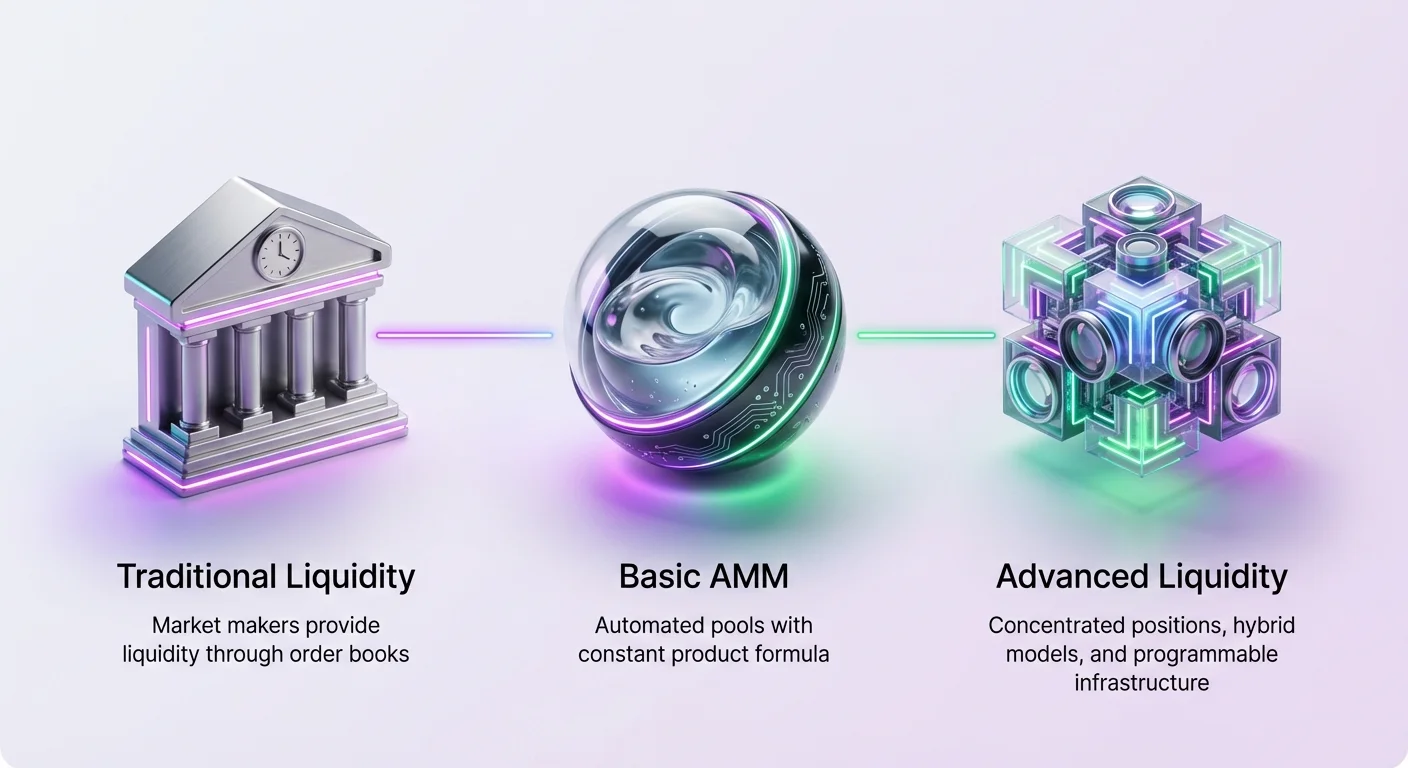
Decentralized finance has fundamentally altered how assets are traded, valued, and exchanged. At the heart of this transformation lies the concept of liquidity. In traditional finance, liquidity is often provided by centralized market makers and large institutions that facilitate trades by maintaining order books. The emergence of blockchain technology introduced a radical alternative known as the Automated Market Maker. This innovation replaced human intermediaries with smart contracts, allowing users to trade directly against a pool of assets rather than a specific counterparty.
The journey began with simple, constant formulas that democratized access to market making. However, the early models were capital inefficient. Liquidity was spread thinly across every possible price, meaning much of the capital sat idle. As the sector matured, developers sought to solve these inefficiencies through complex mathematical innovations.
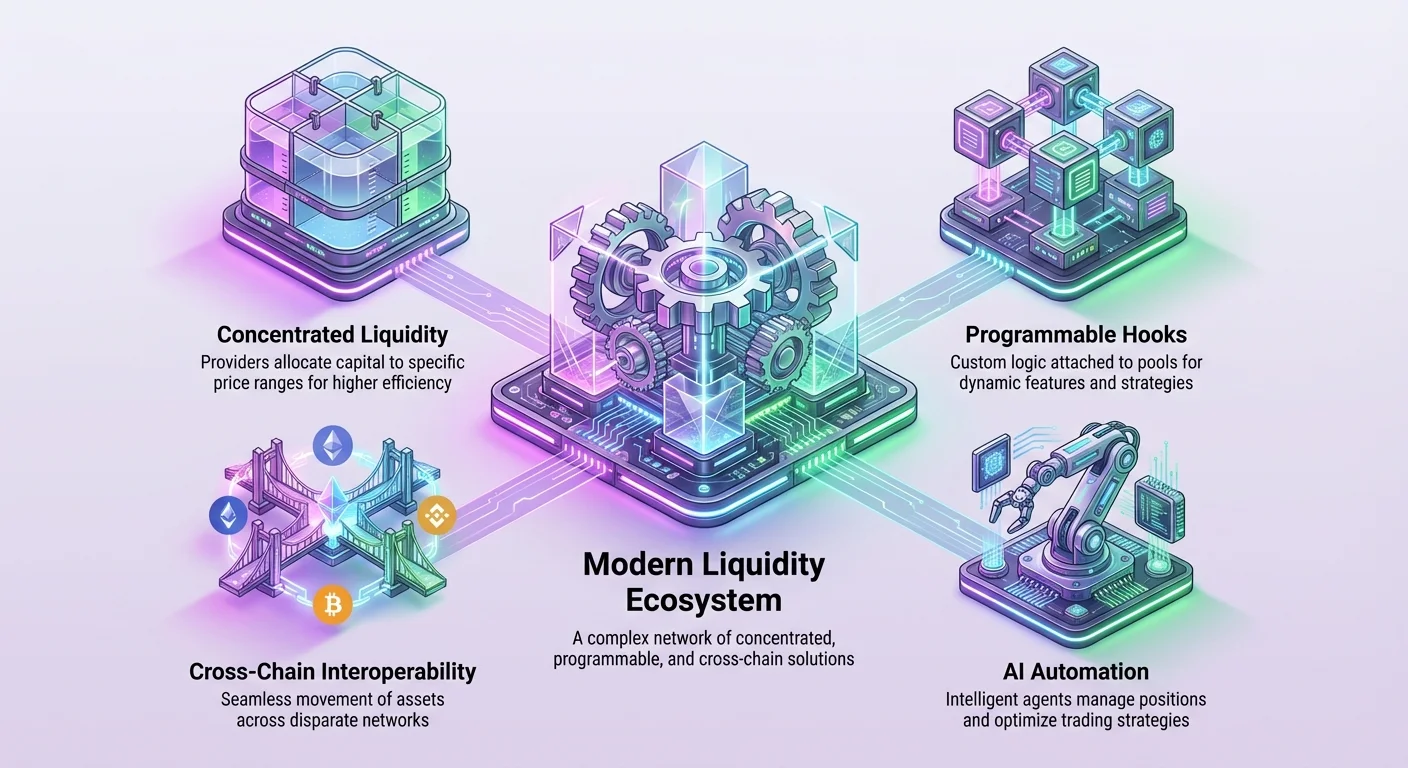
Today, we are witnessing a new era of liquidity management. This phase is characterized by concentrated positions, hybrid trading models, and cross-chain interoperability. Protocols are no longer just facilitating swaps. They are building programmable infrastructure that allows for customized trading strategies, dynamic fee structures, and seamless movement of value across disparate networks. Understanding this evolution requires looking at the mechanics of how these systems operate and where they are heading next.
The Foundation of Automated Market Makers
The initial breakthrough in decentralized exchange came with the introduction of the Automated Market Maker model. Unlike centralized exchanges that rely on an order book to match buy and sell orders, AMMs utilize liquidity pools as the core engine. Users, known as liquidity providers, deposit pairs of tokens into these smart contracts. This creates a reserve of assets that traders can access at any time without needing a matching counterparty on the other side of the trade.
The mechanism that governs these trades is a mathematical formula. The most common variation is the constant product formula. This ensures that the balance of assets in the pool remains relative to trade volume. When a trader buys one asset from the pool, they add the other asset, changing the ratio. The algorithm automatically adjusts the price based on this shifting supply and demand. This system provided a way to bootstrap liquidity for new assets without relying on professional market makers.
The Constant Product Formula Explained
The core mechanism powering early decentralized exchanges is surprisingly simple. It is often expressed as x * y = k. In this equation, x represents the quantity of one token in the liquidity pool, and y represents the quantity of the other. The variable k remains a constant value. This formula dictates that the product of the reserves must always equal the same number after a trade is executed (ignoring fees).
If a user wants to buy Token A from the pool, they must deposit Token B. This increases the supply of Token B in the pool and decreases the supply of Token A. To maintain the constant k, the price of Token A increases exponentially as it becomes scarcer in the pool. This automatic price adjustment is what removes the need for an order book. It ensures there is always liquidity available, regardless of the trade size, although larger trades will suffer from higher price slippage.
Challenges with Capital Efficiency
While revolutionary, the first generation of AMMs faced significant limitations regarding capital efficiency. In the standard model, liquidity is distributed evenly along a price curve that ranges from zero to infinity. This means that a liquidity provider's capital is spread across every possible price point for the assets. For stablecoin pairs or assets that trade within a narrow range, this is extremely wasteful.
For example, in a pool pairing two stablecoins, the price rarely deviates far from a 1:1 ratio. However, in a standard AMM, the vast majority of the capital is reserved for price points that will likely never be reached, such as one stablecoin being worth near zero or infinity. This results in high slippage for traders and lower fee generation for liquidity providers relative to the capital deployed. Solving this inefficiency became the primary driver for the next stage of AMM evolution.
The Shift to Concentrated Liquidity
The introduction of concentrated liquidity marked a pivotal moment in decentralized exchange architecture. This model allows liquidity providers to define specific price ranges in which their capital is active. Instead of spreading assets across an infinite curve, a provider can choose to allocate their funds only within a range where they believe the market will trade. This mimics the depth of an order book while retaining the automated nature of an AMM.
By concentrating capital, providers can earn significantly more trading fees with less upfront investment. A smaller amount of capital focused on a tight range can facilitate the same volume of trading as a much larger amount spread across an infinite range. This increases the depth of the market around the current price, resulting in better execution prices for traders and higher potential yields for providers. However, this innovation introduced new layers of complexity and risk.
Understanding Price Ticks and Ranges
To implement concentrated liquidity, the price spectrum is divided into discrete intervals known as ticks. Liquidity providers create positions by selecting a lower tick and an upper tick. Their capital is then distributed smoothly across this specific range. If the market price stays within these boundaries, the provider earns fees from every trade that occurs.
This granular control transforms liquidity provision from a passive activity into an active strategy. A provider effectively makes a prediction on market volatility. If they choose a very narrow range, they capture a larger share of fees when the price is within that zone. However, if the price moves outside their selected ticks, their position becomes inactive. They stop earning fees and their assets are converted entirely into the less valuable token of the pair until the price returns to the range.
The Risk of Impermanent Loss
Concentrated liquidity amplifies the concept of impermanent loss. In a standard pool, impermanent loss occurs when the price of deposited assets diverges from the price at deposit. In a concentrated position, this effect is accelerated. Because the capital is deployed more aggressively within a narrow band, the rate at which the asset mix changes is much faster.
If the market price exits the provider's range, they are left holding 100% of the depreciating asset. For instance, if the price of Ethereum drops below the selected range in an ETH/USDC pool, the provider will end up holding only Ethereum. Conversely, if the price rises above the range, they will have sold all their Ethereum for USDC early. This requires providers to actively monitor markets and adjust their ranges, creating a demand for automated management tools and professional strategies. It is vital to learn advanced strategies to mitigate this risk.
Hybrid Models and Programmable Liquidity
As the industry moves beyond static liquidity models, the focus has shifted toward customization and modularity. Newer protocols are introducing architecture that allows developers to build custom logic directly on top of the liquidity layer. This creates a hybrid environment where the benefits of AMMs blend with features typically found in centralized finance, such as limit orders and dynamic fee adjustments.
This wave of innovation is best exemplified by the concept of "hooks." These are external smart contracts that can be attached to a liquidity pool. They run specific code at key points in the lifecycle of a trade, such as before a swap is executed or after liquidity is modified. This opens the door for limitless functionality without requiring changes to the core protocol.
Customizing Pools with Hooks
Hooks allow for a level of flexibility that was previously impossible in rigid AMM designs. Developers can create pools that support on-chain limit orders, where a swap is only executed if the price hits a certain target. Other applications include time-weighted average market makers (TWAMM), which help execute large orders over time to minimize price impact.
The utility of hooks extends to governance and compliance as well. A pool could be designed to require specific verification checks or to distribute fees in unique ways. For example, fees could dynamically increase during periods of high volatility to compensate liquidity providers for the increased risk. This modular approach transforms the DEX from a simple application into a platform for financial engineering.
The Singleton Architecture Efficiency
Modern decentralized exchanges are also optimizing their underlying contract structure to reduce costs. Traditional AMMs often deploy a separate smart contract for every single token pair. This fragmentation increases gas costs for users, especially when performing multi-hop trades that route through several pools.
The solution is a singleton architecture. This design consolidates all liquidity pools into a single smart contract. By holding all balances in one place, the protocol effectively eliminates the need to transfer tokens between different contracts during a complex swap. This significantly reduces gas consumption. It also simplifies the process of managing liquidity across multiple pairs, making the entire ecosystem more efficient for both traders and developers building on top of the protocol.
The Role of Aggregators and Automation
The complexity of concentrated liquidity and hybrid models has created a barrier to entry for casual users. Managing price ranges, rebalancing portfolios, and optimizing for yield requires technical knowledge and constant attention. This friction has led to the rise of yield aggregators and automated liquidity managers. These platforms act as a layer above the exchange, simplifying the user experience while maximizing returns.
Aggregators function by pooling user funds and deploying them via automated strategies. For example, a user might deposit stablecoins into a vault. The protocol then automatically searches for the best yield opportunities across the DeFi landscape. It handles the difficult tasks of selecting price ranges, reinvesting fees, and shifting capital between different pools or lending platforms to chase the highest returns.
| Feature | Standalone AMM | Aggregator / Vault |
|---|---|---|
| User Effort | High (Manual range setting) | Low (Deposit and forget) |
| Strategy | Static or manual rebalancing | Automated active management |
| Fee Compounding | Often manual | Automated / Auto-compounding |
Automating Yield Generation
Protocols like Yearn Finance pioneered the concept of automated yield farming. These systems use complex strategies that involve lending, borrowing, and providing liquidity across multiple protocols simultaneously. For the end user, the process is streamlined into a simple deposit action. The protocol takes care of the heavy lifting, including the "zapping" of assets, which bundles multiple transaction steps into one.
In the context of concentrated liquidity, automation is even more critical. Automated managers monitor the price of the assets relative to the provider's selected range. If the price moves close to the edge of the range, the smart contract can automatically rebalance the position. This involves withdrawing the liquidity and re-deploying it around the new price, ensuring the user continues to earn fees without needing to be online 24/7.
Simplifying DeFi Interaction
Beyond yield, aggregators solve the problem of fragmentation. With liquidity split across dozens of different exchanges and chains, finding the best price for a trade can be difficult. DEX aggregators scan all available liquidity sources to route trades efficiently. They might split a single large trade across three different pools to minimize slippage. For users seeking streamlined returns, automated platforms provide a crucial service by optimizing positions across multiple protocols.
This layer of abstraction is essential for mass adoption. It allows users to interact with DeFi without needing to understand the underlying mechanics of ticks, curves, or smart contract interactions. By decoupling the complexity of the protocol from the user interface, aggregators serve as the bridge between advanced financial infrastructure and everyday investors.
Scaling Liquidity with Layer 2 Solutions
High transaction costs on mainnet blockchains like Ethereum have historically limited the potential of decentralized exchanges. High fees make it unprofitable for smaller liquidity providers to participate, as the cost of rebalancing a position can outweigh the fees earned. This has driven the migration of liquidity toward Layer 2 scaling solutions and sidechains.
Platforms like Polygon have evolved from simple sidechains into comprehensive ecosystems of scaling infrastructure. By processing transactions off the main Ethereum chain and settling them in batches, these networks reduce costs by orders of magnitude. This reduction in friction is vital for the health of AMMs. It allows for more frequent rebalancing, smaller trade sizes, and higher frequency trading strategies that would be impossible on a high-fee network.
Zero-Knowledge Technology
The forefront of scaling technology is the Zero-Knowledge (ZK) Rollup. Solutions like Polygon zkEVM allow developers to deploy Ethereum-compatible smart contracts in a highly scalable environment. ZK-rollups use cryptographic proofs to verify the validity of transactions without revealing the underlying data, offering both privacy and massive throughput.
For decentralized exchanges, ZK technology offers a path to near-instant finality and low costs without sacrificing security. It enables a "value layer" where assets can flow freely. The integration of these technologies facilitates shared liquidity across different chains. Instead of fragmenting liquidity into isolated silos on different Layer 2s, new architectures allow for unified liquidity layers where a single pool of assets can service trades across the entire ecosystem.
The Future of Cross-Chain Trading
The ultimate goal of scaling is to create a seamless multi-chain experience. Concepts like Unichain and Polygon's 2.0 vision aim to connect disparate networks. The idea is to allow a user on one chain to trade against liquidity on another chain transparently. This reduces the friction of bridging assets manually, which is often slow and risky.
Innovations in this space focus on creating specific application-specific chains (app-chains) tailored for DeFi. These chains can optimize their block times and fee markets specifically for trading. By dedicating block space to exchange transactions, they prevent congestion from other activities, like NFT minting, from spiking trading fees. This specialization leads to a more reliable and professional trading environment.
The Oracle Connection and Data Integrity
As decentralized exchanges become more sophisticated, their reliance on accurate external data grows. This is where blockchain oracles like Chainlink play an indispensable role. An oracle serves as a bridge between the blockchain (on-chain) and the real world (off-chain). Smart contracts cannot inherently access data outside their network, such as the price of Apple stock or the current weather.
For hybrid exchanges and advanced financial products, reliable price feeds are non-negotiable. While simple AMMs determine price based solely on internal supply and demand, derivatives platforms and lending protocols require external reference prices to function safely. Oracles aggregate data from multiple sources to provide a tamper-proof price feed that triggers liquidations or settles futures contracts.
Mitigating Market Manipulation
One of the critical functions of oracles in the liquidity ecosystem is preventing manipulation. In a purely internal AMM pricing model, a malicious actor with large capital could temporarily distort the price in a pool to exploit a dependent protocol. This is often referred to as a flash loan attack. By referencing a decentralized oracle network, protocols can verify that the price in a specific pool reflects the true global market price.
If the internal price deviates significantly from the oracle price, the system can pause trading or cap the execution price. This hybrid approach—using internal AMM dynamics for execution but external oracles for verification—creates a much more robust security model. It allows for the creation of markets for synthetic assets and tokenized real-world assets, expanding the scope of what can be traded on-chain.
Governance and Community Control
The evolution of liquidity is not just technical; it is also political. Decentralized exchanges are governed by their communities through tokens. Assets like UNI, YFI, and POL represent voting power. This shifts control from a corporate boardroom to a distributed network of stakeholders. Token holders vote on critical parameters, such as fee tiers, treasury allocations, and deployment to new blockchains.
Governance models are becoming more complex. Newer projects like World Liberty Financial are experimenting with governance-only tokens that focus strictly on decision-making power without direct revenue sharing transfers. This distinction is often driven by regulatory considerations. The goal is to maintain compliance while ensuring that the protocol remains decentralized and responsive to its user base.
The Role of Strategic Treasuries
Governance also involves the management of massive protocol treasuries. Projects are increasingly using their accumulated fees to diversify their holdings. A protocol might hold a mix of stablecoins, Bitcoin, and Ethereum to ensure long-term sustainability. This strategic reserve management is similar to corporate balance sheet management but executed via transparent smart contracts.
Community votes determine how these funds are deployed. They can be used to fund development grants, incentivize liquidity in specific pools, or even invest in other DeFi protocols to build strategic partnerships. This economic coordination allows decentralized exchanges to operate as autonomous entities that grow and adapt based on the collective intelligence of their stakeholders.
The Intersection of AI and Liquidity
The future of decentralized exchange intersects heavily with artificial intelligence. As trading strategies become more complex, human manual input becomes less efficient. We are entering a phase where AI agents will manage liquidity positions, execute arbitrage trades, and optimize routing paths. Projects like NodeAI are building the infrastructure to power these computations.
AI requires massive computing power, particularly GPUs. Decentralized infrastructure networks are emerging to provide this hardware. By connecting idle GPU power with AI developers, these networks enable the training of models that can analyze market sentiment and on-chain data in real time.
Autonomous Trading Agents
In the near future, liquidity provision may be dominated by AI agents. These autonomous software programs can monitor hundreds of liquidity pools simultaneously. They can instantly calculate the optimal price range for a V3 position based on historical volatility and current volume. When the market shifts, the AI agent can withdraw and re-deploy liquidity faster and more accurately than any human.
This automation benefits the ecosystem by ensuring markets are always efficient. It reduces the spreads between buy and sell prices and ensures that liquidity is present exactly where it is needed. For the token holder, this means depositing funds into a smart contract managed by an AI, engaging in a passive investment strategy that leverages cutting-edge technology to maximize yield while managing risk.
Conclusion
The landscape of decentralized exchange has transformed from simple experimental code into a sophisticated financial infrastructure. What started with basic token swaps has evolved into a multi-layered ecosystem of concentrated liquidity, programmable hooks, and cross-chain networks. The shift from the constant product formula to active position management has unlocked capital efficiency, allowing DeFi to compete more aggressively with traditional finance.
Scaling solutions and aggregators have further democratized access, lowering the barriers to entry for users and developers alike. The integration of decentralized oracles ensures these systems remain secure and tethered to global market realities, while governance tokens ensure the systems remain owned by their communities. As AI agents begin to take on the role of active managers, the line between automated code and intelligent trading blurs even further.
The trajectory points toward a unified, highly efficient value layer for the internet. In this future, liquidity is not static; it is intelligent, programmable, and fluid. It moves instantly to where it is needed, governed by transparent protocols and secured by advanced cryptography. This evolution is building the foundation for a financial system that is open, accessible, and resilient.
The future of finance is not just decentralized; it is intelligent, modular, and infinitely programmable.