
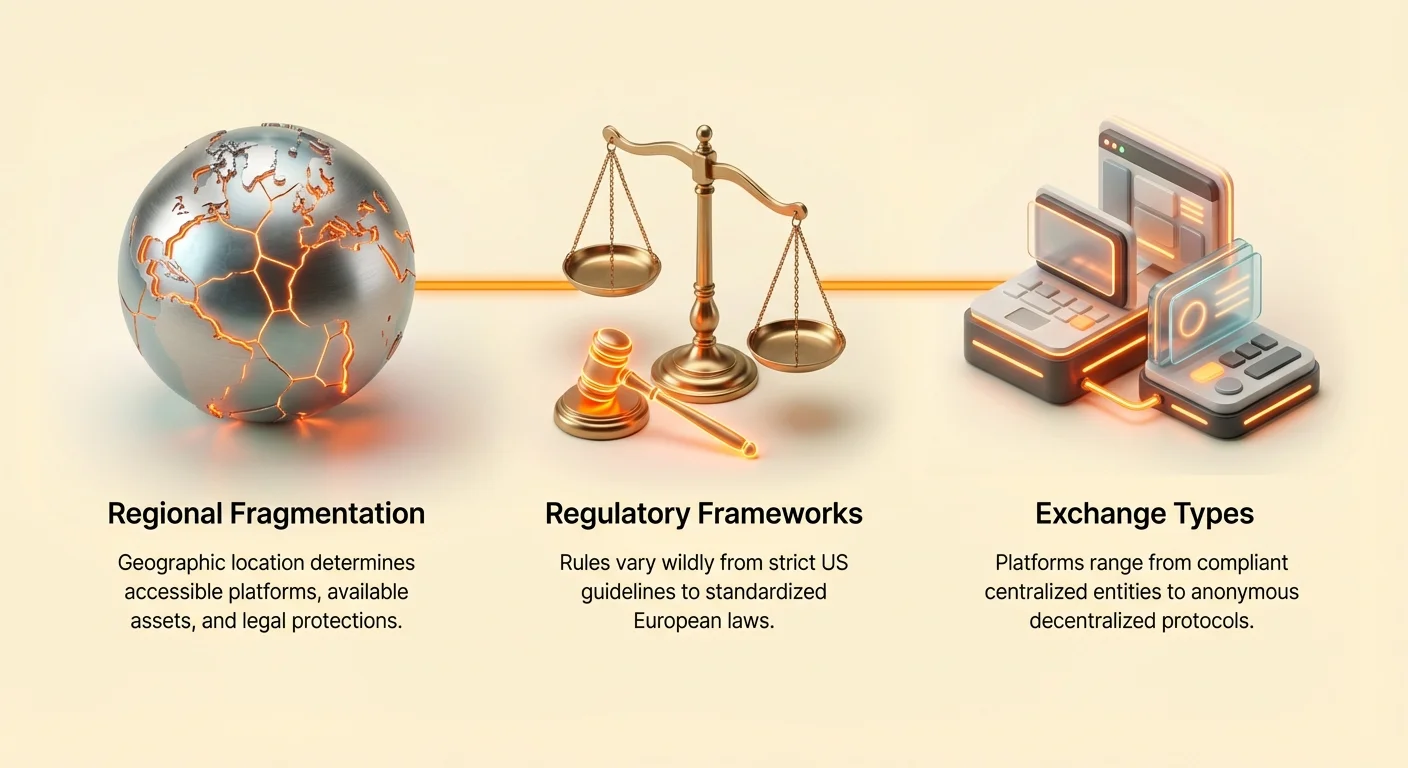
Cryptocurrency trading is no longer a borderless free-for-all. Where you live determines which platforms you can access, what assets you can buy, and the level of protection your funds receive. National borders act as digital fences in the blockchain world.
Regulatory frameworks vary wildly from one jurisdiction to another. A trader in the United States faces a completely different set of rules compared to a trader in Switzerland or Singapore. These rules dictate leverage limits, available trading pairs, and identity verification requirements.
Navigating this fragmented environment requires understanding how different regions approach digital asset oversight. Some nations prioritize strict consumer protection and anti-money laundering (AML) compliance. Others focus on fostering innovation by offering looser restrictions on trading products.
Choosing the right platform involves balancing your location with your trading goals. A user seeking high-leverage futures might find their options limited in strict jurisdictions. Conversely, an investor prioritizing institutional-grade security will gravitate toward heavily regulated domestic exchanges.
The global crypto map is divided into compliant zones, gray markets, and offshore havens. Understanding where a specific exchange fits into this map is the first step in securing your digital wealth.
The Impact of Location on Crypto Access
Geography is the primary filter for cryptocurrency availability. Top-tier exchanges often maintain separate platforms for different regions to comply with local laws. A global exchange might offer hundreds of altcoins to international users but only a dozen to US residents.
This segregation protects the exchange from regulatory legal action. It also means traders must verify that a platform is legally authorized to operate in their country. Using a platform that is technically banned in your region can lead to frozen accounts or loss of funds.
Centralized vs. Decentralized Regional Availability
Centralized exchanges (CEX) are businesses with headquarters and legal entities. They must adhere to the laws of the countries they serve. This makes them the most convenient entry point for fiat currency but also the most restricted geographically.
Decentralized exchanges (DEX) operate on code rather than corporate policy. They are harder to restrict based on geography. However, they often lack direct fiat support and require a higher level of technical knowledge to use safely.
The North American Landscape: Compliance and Security
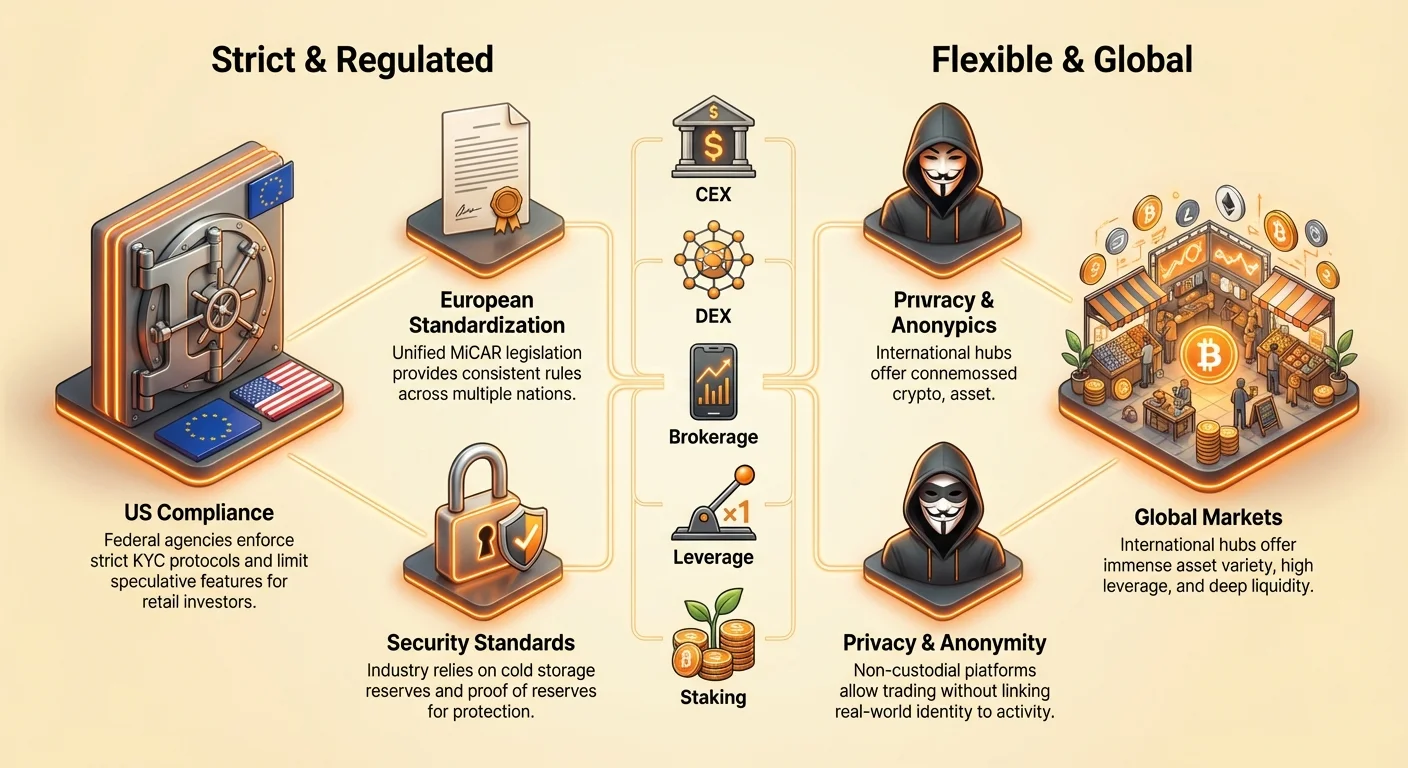
The United States represents one of the most rigorous regulatory environments for cryptocurrency. Federal agencies like the SEC and CFTC enforce strict guidelines on how digital assets are sold and traded.
Platforms operating here must adhere to "Know Your Customer" (KYC) protocols. This eliminates anonymity but significantly increases security and recourse for users. Exchanges serving this market focus heavily on trust and transparency.
Leading US-Based Platforms
Coinbase stands as a pillar of the US market. Since its launch in 2012, it has positioned itself as the default entry point for American investors. It is a publicly traded company, which forces a level of financial transparency rare in the crypto sector.
Coinbase focuses on simplicity and regulatory adherence. It offers a seamless onboarding process that connects directly to US bank accounts. The trade-off for this compliance is often higher fees and a more limited selection of speculative altcoins.
Gemini is another heavyweight in this region. Founded with a "security-first" philosophy, it operates as a New York trust company. This status subjects it to capital reserve requirements and cybersecurity standards similar to traditional banks.
Gemini is particularly notable for its SOC 1 Type 2 and SOC 2 Type 2 certifications. These are independent audits that verify the security and availability of user data and funds. For institutional investors or safety-conscious individuals, these certifications provide significant peace of mind.
The Role of Brokerages in the US
Brokerages offer a simplified alternative to traditional exchanges. Uphold is a prominent example that bridges the gap between crypto and traditional finance. It allows users to trade a variety of asset classes from a single interface.
Uphold’s distinctive feature is its "Trade Anything to Anything" model. A user can swap Bitcoin directly for a traditional currency or another asset class without an intermediate step. This reduces friction and simplifies portfolio management.
Brokerages often charge a spread rather than a transparent trading fee. This means the cost is built into the price of the asset. While this simplifies the user experience, it can sometimes result in higher overall costs for high-volume traders.
Regulatory Constraints on Features
US regulations strictly limit certain types of trading products. High-leverage futures and margin trading are largely restricted for retail investors on major platforms. This is done to protect consumers from rapid liquidation. Users seeking advanced strategies should understand leverage trading mechanics.
Consequently, platforms like Kraken offer different feature sets depending on the user's location. A US user on Kraken has access to spot trading and staking but may face restrictions on margin products that are available to European or Asian clients.
European Markets: Standardization and Innovation
Europe has moved toward a unified regulatory framework known as Markets in Crypto-Assets (MiCAR). This legislation aims to create a consistent set of rules across the European Union. It provides clarity that allows platforms to operate with confidence across multiple countries.
This stability attracts exchanges that want to offer advanced features without operating in a legal gray area. European traders often have access to a wider range of financial products than their American counterparts.
Platforms Tailored for Europe
Bitpanda is a prime example of a platform designed for the European market. It was the first European platform to receive a MiCAR license, signaling its commitment to the new regulatory era.
Bitpanda allows users to trade cryptocurrencies alongside stocks and precious metals. This multi-asset approach is popular in Europe, where investors often look for comprehensive wealth management solutions. The platform supports a wide range of Euro trading pairs, minimizing currency conversion fees for locals.
Security and Consumer Protection in the EU
European regulations place a heavy emphasis on consumer protection. Platforms operating here must segregate user funds from corporate assets. This ensures that if the exchange goes bankrupt, user funds theoretically remain safe.
Exchanges in this region often partner with regulated custodians to store digital assets. This separation of duties reduces the risk of internal theft or mismanagement. It mirrors the structure of traditional financial markets, bringing institutional reliability to crypto.
Asian and Global Markets: Volume and Variety
Asia has historically been a hub for cryptocurrency trading volume. Markets in this region are diverse, ranging from Japan’s strict licensing system to more fluid environments in other nations. Global exchanges often establish their base of operations here to serve a worldwide audience.
These platforms typically offer the widest range of assets and the deepest liquidity. They cater to active traders who demand fast execution and advanced order types.
Global Trading Giants
Binance dominates the global landscape by volume. It offers an immense selection of cryptocurrencies and trading pairs. Its ecosystem includes spot trading, futures, staking, and a launchpool for new tokens.
The sheer size of Binance ensures that liquidity is rarely an issue. Large orders can be executed without significant price slippage. However, its global reach means it faces constant regulatory scrutiny in various jurisdictions, leading to different versions of the site for different countries.
Bitget is another major player focusing on the global altcoin market. It differentiates itself through social trading features. Users can copy the strategies of successful traders, making it popular among beginners who want exposure to active trading without doing the technical analysis themselves.
Bitget supports a vast array of altcoins that might not be listed on more conservative US platforms. This makes it a destination for traders looking for early access to newer projects.
Derivatives and High Leverage
Global platforms are the primary venue for derivatives trading. This includes futures, options, and perpetual contracts. These financial instruments allow traders to speculate on price movements without owning the underlying asset.
PrimeXBT is a platform that specializes in this area. It offers an "all-in-one" approach, allowing users to trade crypto futures alongside traditional commodities and forex. It provides high leverage, which amplifies both potential profits and risks.
Leverage is a double-edged sword. While it allows traders to control large positions with small capital, it also exposes them to liquidation risks. Global platforms like PrimeXBT and BTCC cater to experienced traders who understand these mechanics.
BTCC is one of the longest-running exchanges, established in 2011. It focuses heavily on Bitcoin futures and mining solutions. Its longevity in a volatile industry speaks to the reliability of its infrastructure, even as it operates in the competitive global derivatives market.
Privacy and Anonymity in Trading
Not all traders want to hand over personal documents to a centralized corporation. Privacy is a core tenet of the cryptocurrency ethos. Anonymous or "No KYC" (Know Your Customer) exchanges cater to this demographic.
These platforms prioritize data protection. They allow users to trade without linking their real-world identity to their blockchain activity. This is attractive for users in restrictive regimes or those who simply value financial privacy.
The Mechanics of Anonymous Exchanges
Anonymous exchanges often function as swap services rather than traditional order-book exchanges. ChangeNOW is a prominent example of this model. It acts as a non-custodial intermediary.
Users send crypto to the platform, and the platform sends the swapped asset back to the user’s personal wallet. The exchange does not hold the funds. This reduces the risk of hacks affecting user deposits since the assets are only on the platform for minutes.
Because there is no account creation or identity verification, these swaps are fast and private. However, they rely on external liquidity providers to execute the trades.
Risks of Non-Custodial Trading
The primary risk with anonymous exchanges is regulatory uncertainty. As governments tighten controls on money laundering, these platforms face increasing pressure. Some may block IP addresses from strict jurisdictions.
Furthermore, because these platforms do not hold custody of funds, user error is irreversible. If a user sends funds to the wrong address, there is no customer support team that can reverse the transaction. Users must be comfortable managing their own private keys and wallet security.
Fee Structures Across Different Regions
Cost is a universal concern for traders regardless of location. Fees eat into profits, especially for high-frequency traders. Understanding the different fee models is essential for selecting a cost-effective platform.
Maker vs. Taker Fees
Most centralized exchanges use a maker-taker fee model. "Makers" are traders who place limit orders that sit on the order book, adding liquidity. "Takers" are traders who place market orders that match immediately, removing liquidity.
Exchanges incentivize makers with lower fees. "Makers" are traders who place limit orders that sit on the order book, adding liquidity. "Takers" are traders who place market orders that match immediately, removing liquidity. Platforms like BTCC and PrimeXBT often have very competitive rates for makers to ensure deep liquidity for their futures contracts. Understanding these incentives can lead to maximization of rebates.
Brokerage Spreads
Brokerage platforms like Uphold or Coinbase (in its basic mode) often charge a spread. The spread is the difference between the market price and the price the user pays.
While this model is simpler for beginners, it is often more expensive than the maker-taker model. Users paying a spread might not see a separate "fee" line item, but they are receiving less crypto for their money compared to a professional trading interface.
Deposit and Withdrawal Costs
Fees are not limited to trading. Funding an account can incur costs depending on the method used. Credit card purchases are notoriously expensive, often incurring fees of 3% or more. Bank transfers are typically cheaper but slower.
Some platforms offer low-fee incentives. For example, certain exchanges allow free fiat deposits via specific banking networks (like SEPA in Europe or ACH in the US). Checking the deposit fee schedule is as important as checking trading rates.
Payment Methods and Onboarding
The bridge between fiat currency and cryptocurrency is often the biggest hurdle for new users. The ease of depositing money depends heavily on the banking partnerships an exchange has secured in a specific region.
PayPal and Digital Wallets
PayPal has become a popular entry point for crypto due to its convenience and security. However, not all exchanges support it due to the high risk of chargebacks.
Platforms that do accept PayPal often provide a streamlined experience. This integration is particularly valuable for users who do not want to link their main bank account directly to a crypto exchange. It adds a layer of separation between personal banking and speculative assets.
Direct Banking Integration
For larger amounts, direct bank transfers are the standard. US platforms like Coinbase and Gemini have deep integrations with the US banking system. This allows for relatively fast ACH transfers.
In Europe, the SEPA network allows for quick and cheap Euro transfers to platforms like Bitpanda. Global platforms may rely on third-party payment processors to handle fiat, which can sometimes result in higher fees or flagged transactions by conservative banks.
Security Standards: A Global Perspective
Security is the non-negotiable aspect of choosing a platform. Regardless of where an exchange is based, it must demonstrate the ability to protect user assets from theft and hacking.
Cold Storage and Asset Protection
The industry standard for security is cold storage. This involves keeping the majority of digital assets in offline wallets that are not connected to the internet. This makes them inaccessible to remote hackers.
Leading exchanges like Kraken and Coinbase keep over 95% of user funds in cold storage. This ensures that even if the platform's hot wallet (online wallet) is compromised, the vast majority of funds remain safe.
Insurance and Reserves
Some platforms offer insurance policies to cover potential losses from security breaches. This is different from government-backed deposit insurance (like FDIC for banks). Crypto exchange insurance is typically private and limited in scope.
Proof of Reserves (PoR) has become a critical metric for trust. Following high-profile exchange collapses, users now demand proof that the exchange actually holds the assets it claims to. Platforms like Uphold emphasize their reserve transparency, updating asset backing data in real-time.
User-Side Security Tools
Exchange security is a partnership between the platform and the user. The safest exchanges provide robust tools for users to lock down their accounts.
Two-factor authentication (2FA) is the baseline requirement. The best platforms support hardware security keys (like YubiKeys), which are immune to SIM-swapping attacks. Withdrawal whitelisting is another vital feature, allowing users to restrict outgoing funds to verified addresses only.
Navigating the Exchange Types
The crypto market offers a diverse array of exchange architectures. Understanding the difference between these types helps traders select the right tool for their specific strategy.
| Exchange Type | Primary Function | Target Audience | Example |
|---|---|---|---|
| Centralized (CEX) | Custodial trading, fiat onramps | Beginners, Institutions | Coinbase |
| Decentralized (DEX) | Peer-to-peer, non-custodial | Privacy advocates | Uniswap |
| Brokerage | Simplified buying/selling | Casual investors | Uphold |
| Derivatives | Futures, Options, Leverage | Experienced traders | PrimeXBT |
Hybrid Exchanges
Hybrid exchanges attempt to combine the liquidity of centralized platforms with the security of decentralized ones. They aim to offer the speed of a central matching engine while allowing users to retain custody of their funds.
While the concept is promising, hybrid models are still evolving. They often face challenges in achieving the same level of user experience as fully centralized competitors.
Crypto-to-Fiat Gateways
Some platforms specialize solely in the conversion process. These gateways focus on speed and simplicity rather than advanced trading tools. They are useful for users who primarily want to acquire crypto to send to a personal wallet immediately.
ChangeNOW fits this description well. By removing the need for account registration, it acts as a rapid transit point between fiat and crypto or between different blockchains.
Specialized Trading Features
Advanced traders often look beyond basic buying and selling. They seek platforms that offer tools to automate strategies or earn passive income.
Copy Trading
Copy trading allows users to automatically replicate the trades of experienced professionals. This is a key feature of Bitget. It creates a social environment where beginners can learn from experts, and experts can earn commissions on their followers' profits.
This feature requires transparency. Platforms usually display the historical performance of the traders available to copy. However, past performance is never a guarantee of future results, and users must still manage their risk.
Staking and Earn Programs
Many exchanges now function as crypto banks, offering interest on deposited assets. Staking involves locking up Proof-of-Stake coins (like Ethereum or Solana) to support the network in exchange for rewards.
Binance and Kraken offer extensive staking services. They handle the technical complexity of running validator nodes and pass the rewards on to the user (minus a fee). This is a popular way for long-term holders to generate yield.
Algorithmic Trading
For those who prefer code to human intuition, algorithmic trading support is essential. This involves using bots to execute trades based on predefined criteria. Exchanges with robust APIs (Application Programming Interfaces) allow users to connect third-party trading bots. This enables 24/7 trading without constant manual monitoring. Low-fee exchanges are particularly attractive for algorithmic traders, as high frequency makes fees a significant factor. Users can leverage APIs to build custom crypto algorithms.
Exchanges with robust APIs (Application Programming Interfaces) allow users to connect third-party trading bots. This enables 24/7 trading without constant manual monitoring. Low-fee exchanges are particularly attractive for algorithmic traders, as high frequency makes fees a significant factor.
The Role of Customer Support
When money is on the line, the quality of support matters. The unregulated nature of crypto means there is no government helpline to call if things go wrong. The exchange's support team is the only line of defense.
Support Channels
Top-tier exchanges offer 24/7 live chat support. This is crucial in a market that never sleeps. Email support is standard but can be slow. Phone support is rare but offered by some premium brokerages.
The quality of support often correlates with the exchange's regulatory status. Regulated US exchanges tend to invest more heavily in customer service infrastructure to maintain their licenses and reputation.
Educational Resources
A knowledgeable user is a safer user. Platforms like Coinbase invest significantly in educational content. They offer "Learn to Earn" programs that reward users with small amounts of crypto for completing tutorials.
These resources help beginners understand complex topics like blockchain mechanics, wallet security, and market cycles. For a new trader, an exchange that prioritizes education can be as valuable as one that prioritizes low fees.
Conclusion
The cryptocurrency landscape in 2025 is defined by regional fragmentation and specialization. There is no single "best" exchange for everyone. The right choice depends entirely on where you live, your risk tolerance, and your trading goals.
For US residents, the priority is compliance and security. Platforms like Coinbase and Gemini offer a safe harbor protected by strict regulatory oversight. They provide the most reliable onramps for fiat currency, ensuring that your entry into the market is smooth and legal.
For international traders, the horizon is broader. Global giants like Binance and Bitget offer unparalleled liquidity and asset variety. They provide the tools necessary for active trading strategies, including futures and social trading, which may be restricted in tighter jurisdictions.
Privacy-focused traders and those in restrictive regions rely on non-custodial options like ChangeNOW. These platforms preserve the original ethos of cryptocurrency, offering autonomy and anonymity at the cost of centralized protections.
Ultimately, the safety of your investments relies on due diligence. Verifying an exchange's security history, understanding its fee structure, and ensuring it is authorized to operate in your region are the foundational steps of successful crypto investing.
Your location defines your crypto experience; always match your platform choice to your local laws and personal security needs.