
Kad Bitcoin tika pirmo reizi ieviests, tas piedāvāja revolucionālu risinājumu uzticības problēmai: digitālu valūtu, ko varēja droši pārsūtīt vienādranga pret vienādrangu, nepaļaujoties uz bankām vai valdībām. Tomēr tīklam augot radās fundamentāls izaicinājums — kā apstrādāt globālo pieprasījumu, saglabājot pašas raksturīgās iezīmes, kas padarīja Bitcoin revolucionāru no sākuma?
Šo izaicinājumu dēvē par mērogošanu, un tas ir lielākā arhitektūras diskusija kriptovalūtu pasaulē. Mērogošana nav tikai par tīkla ātruma palielināšanu; tā ir par sarežģītiem filozofiskiem un inženiertehniskiem kompromisiem. Radītie arhitektūras risinājumi Bitcoin ekosistēmu sadala divās galvenajās kategorijās: 1. slānis (L1), pamats, un 2. slānis (L2), paplašinājumi, kas uzbūvēti virs tā.
Šis ceļvedis kalpo kā pamatakmens mūsdienu Bitcoin attīstības izpratnei. Mēs definēsim ierobežojumus, ar kuriem saskaras visas decentralizētās sistēmas — bēdīgi slaveno Trilēmnu —, un izanalizēsim, kā Bitcoin pamatslāņa unikālās dizaina izvēles padara nepieciešamu robustu, bet atšķirīgu ārējo slāņu izveidi. Izprotot L1 pret L2 arhitektūru, jūs varat pārsniegt vienkāršās tehniskās definīcijas un analizēt mērogošanas risinājumus, balstoties uz to fundamentāliem ideoloģiskiem kompromisiem: drošība pret ātrumu un decentralizācija pret ērtumu.
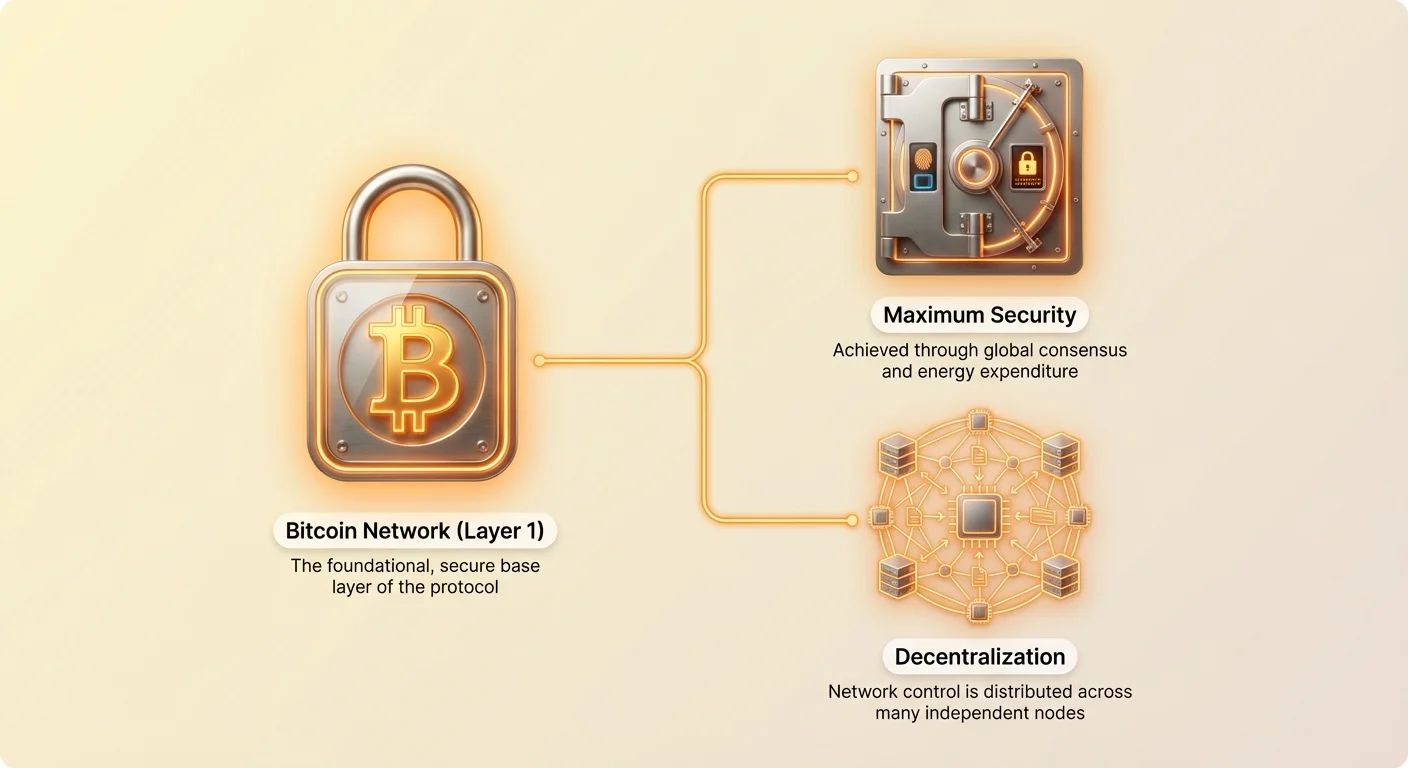
The Foundational Challenge: Understanding the Bitcoin Trilemma
The core dilemma facing any decentralized, public blockchain system is that it seems impossible to optimize three key properties simultaneously: Decentralization, Security, and Scalability. This is widely known as the Blockchain Trilemma.
In theory, you can achieve any two of these properties, but the third must always be sacrificed or compromised to some degree. Bitcoin’s early design choices prioritized security and decentralization above all else. This choice defines why the network operates the way it does and why external layers are necessary.
Decentralization: Preserving Accessibility and Resistance
Decentralization refers to how distributed the control and operation of the network are. A highly decentralized network means that thousands of independent, inexpensive nodes can participate in verifying transactions and validating the chain.
The Trade-Off: High decentralization requires low barriers to entry. If the blockchain ledger gets too large or transactions happen too quickly, users require massive amounts of storage and computing power to run a full verifying node. If only large corporations or wealthy individuals can afford to run a node, control of the network centralizes, making it vulnerable to censorship, collusion, or regulatory pressure.
Bitcoin’s Choice: Bitcoin sacrifices raw speed (scalability) to ensure that the entire history of transactions can be validated and stored by anyone with a standard computer and internet connection. This ensures resilience and censorship resistance—its key value proposition.
Security: The Cost of Irreversibility
Security, in the context of Bitcoin, is achieved through its consensus mechanism, Proof-of-Work (PoW). Security is the guarantee that once a transaction is confirmed and added to a block, it cannot be reversed, censored, or tampered with without expending an enormous, computationally prohibitive amount of energy (the 51% attack threat).
The Trade-Off: High security requires economic investment (the energy spent by miners) and strict enforcement of the protocol rules. This level of security is inherently expensive and slow to achieve. Waiting for multiple block confirmations (the standard practice) adds latency, limiting the transactional speed of the system.
Bitcoin’s Choice: Bitcoin employs the most proven and economically costly security model in existence. Every transaction that lands on Layer 1 inherits this massive security budget, ensuring the immutability of the financial record.
Scalability: The Transaction Bottleneck
Scalability is the network's ability to handle an increasing number of transactions and users without causing latency or dramatic fee increases. Measured in transactions per second (tps), this is where Bitcoin L1 notoriously lags behind traditional payment systems (like Visa) or newer, high-throughput blockchains (like Solana or alternative L1s).
The Trade-Off: To increase scalability on Layer 1, you must either increase block size (compromising decentralization) or reduce the security requirements (compromising security). Since Bitcoin opted for maximum decentralization and security, its native scalability is intentionally capped.
The Necessity of L2: Because the core layer is optimized for security and decentralization, the only viable way to achieve mass-market scalability is to move the bulk of transactional activity off the core chain while still linking the results back to the L1 security model. This is the entire premise of Layer 2 solutions.
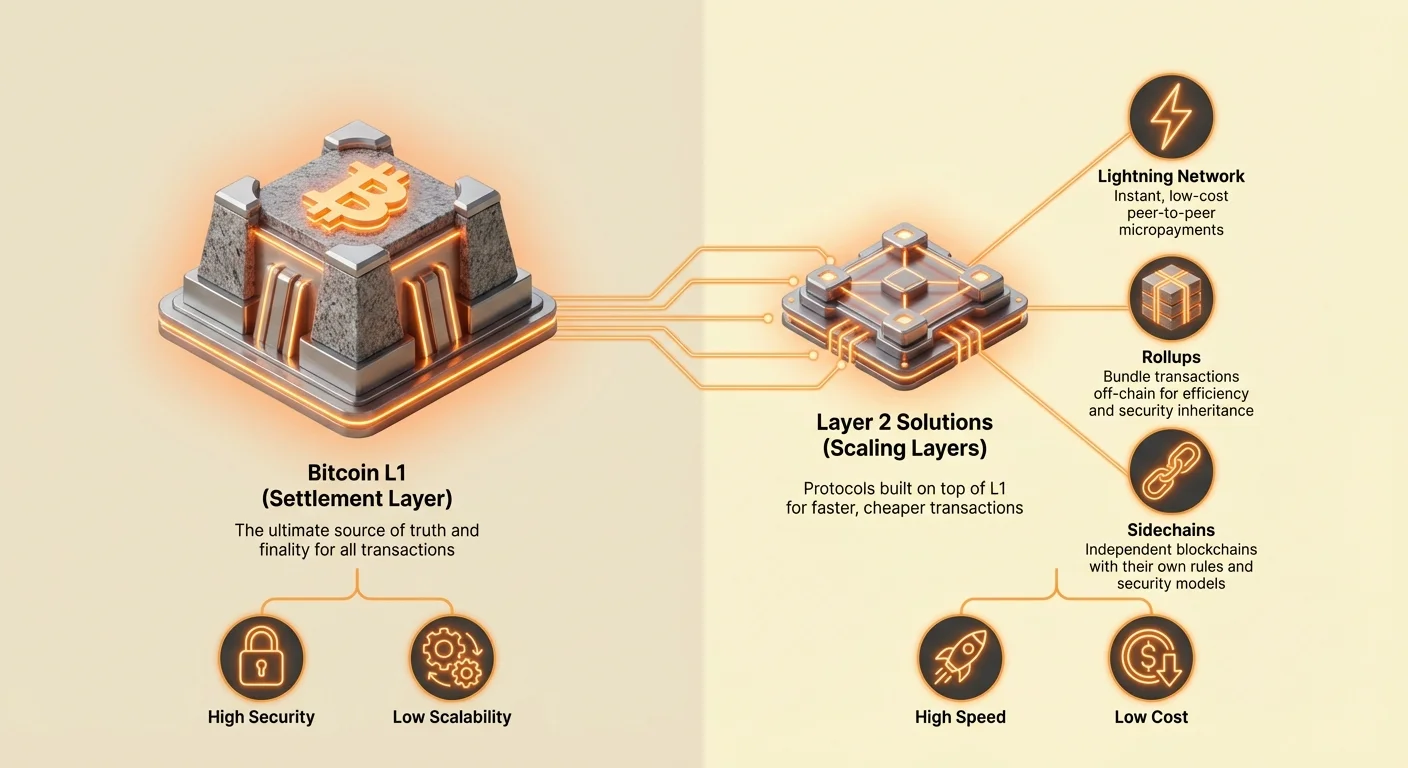
Layer 1 Scaling: The Pursuit of On-Chain Purity
Layer 1 (L1) refers to the base protocol and the core blockchain itself—the Bitcoin chain. When we talk about L1 scaling, we are discussing modifications or improvements made directly to the fundamental rules, structures, or capabilities of the Bitcoin network.
L1 is often called the Settlement Layer because it is the ultimate source of truth. It records the final, immutable state of all transactions and acts as the final judge for disputes originating in external layers.
Definition and Architectural Characteristics
An L1 transaction is an "on-chain" transaction. It is broadcast globally to all nodes, included in a block by a miner, and secured by the full economic weight of the Proof-of-Work network.
Key Characteristics of L1:
- Maximum Security: Transactions inherit the complete PoW budget.
- Global Consensus: Every node in the world validates the transaction.
- Finality: Once confirmed with sufficient blocks, the transaction is irreversible (true finality).
- High Cost, Low Throughput: Due to the global consensus requirement, transactions are expensive and slow (currently limited to around 7 transactions per second).
The Historical Scaling Debate: Block Size and SegWit
The history of Bitcoin scaling is marked by the ideological battle over block size. Early developers quickly realized the network’s capacity limits.
The Block Size Debate (The Scaling Wars): One faction argued for a simple solution: increase the size of the block limit (from the original 1MB). This would instantly increase throughput (scalability). However, this hard fork proposal was strongly opposed by those who argued that larger blocks would increase the bandwidth and storage requirements for running a full node, thus severely compromising decentralization. This philosophical impasse led to significant splits and the creation of different forks, such as Bitcoin Cash (which prioritized large blocks).
Segregated Witness (SegWit): The community eventually coalesced around a clever, non-controversial improvement called SegWit (2017). SegWit did not fundamentally increase the strict 1MB limit, but it optimized how transaction data was stored. By moving the witness (signature) data out of the main transaction body, it effectively increased the transactional capacity of blocks without requiring massive hardware upgrades for nodes.
The Trade-Off: SegWit was an example of scaling through efficiency—making the existing rules work better—rather than scaling through capacity—changing the fundamental rules. This approach preserved the network's decentralization while offering modest, manageable throughput gains.
Innovations in Efficiency: Taproot and Scripting Limitations
More recent L1 developments, such as the Taproot upgrade (2021), continue the focus on efficiency, privacy, and flexibility, paving the way for more robust L2 solutions.
Taproot combines three proposals: Schnorr signatures, Tapscript, and MAST (Merkelized Abstract Syntax Trees). Its primary goal is to make complex transactions (like those involving multiple signatures or smart contracts) look identical to simple, single-signature transactions.
How Taproot Aids Scaling:
- Reduced Data Size: By making complex scripts smaller and requiring only the executed path to be revealed on-chain, Taproot reduces the data footprint of multisignature and smart contract activity. Less data per transaction means more transactions fit into a single block.
- Increased Privacy: The standardized look of transactions reduces traceability and enhances privacy.
- Foundation for Smart Contracts: While Bitcoin’s scripting language (Script) is intentionally limited compared to languages like Ethereum's Solidity (Source Inspiration), Taproot dramatically expands the potential for more complex covenants and conditions without sacrificing L1 security. It allows for the construction of more efficient and complex L2 infrastructures. (For more details, see: Taproot and MAST: The Foundation for Modern Bitcoin Development).
Layer 2 Architectures: Scaling Off-Chain, Settling On-Chain
Layer 2 (L2) solutions are protocols built on top of the Layer 1 blockchain. They handle transactions rapidly off-chain and only use the L1 network as an anchoring and dispute resolution system.
The philosophical shift is profound: instead of demanding that the core network validate every trivial transaction (like buying a coffee), L2s allow high-frequency interactions to occur privately and quickly, using the L1 only for the ultimate settlement of net balances.
The Philosophical Shift: Moving Computation, Preserving Security
L2s are essentially specialized micro-processing layers. They take a large number of transactions, bundle them together, and then record the aggregated proof of these transactions (a single, small summary) onto the main L1 chain.
The Core Concept: Anchoring and Security Inheritance A transaction that occurs on an L2 is fast and cheap, but it does not have the immediate finality of an L1 transaction. Its security is inherited from the L1 through cryptographic mechanisms:
- Entry: Funds are "locked" into a contract on L1, moving them to the L2 system.
- Off-Chain Activity: Transactions happen instantaneously on the L2 network.
- Exit/Settlement: A summary proof of the activity is sent back to the L1, which confirms the final balances and "unlocks" the funds.
If any party tries to cheat or submit a fraudulent summary, the L1 network (the judge) is used to verify the cryptographic proof and penalize the malicious actor.
The Security Spectrum of Layer 2s
Not all Layer 2s are created equal. The most crucial difference lies in how they inherit L1 security and what mechanisms they use to prevent fraud. This is often described along a spectrum:
1. Payment Channels (e.g., Lightning Network)
- Security Model: Trust-minimized, relying on time-locked contracts and cryptographic guarantees.
- Mechanism: Users lock funds into channels and update a shared balance sheet off-chain. If one party tries to broadcast an outdated, fraudulent balance, the other party has a limited time window (the revocation period) to submit the true, most recent balance to the L1, thus penalizing the cheater.
- Key Trade-Off: Requires liquidity setup (opening channels) and continuous monitoring (or using a watchtower service).
2. Sidechains and Drivechains
- Security Model: External or federated security.
- Mechanism: Sidechains (like Liquid or RSK) have their own block producers and consensus rules. They often rely on a federation (a small, trusted group of institutions) to manage the transfer of assets between L1 and the sidechain. While they offer high programmability and speed, their security is not fully inherited from Bitcoin PoW; it depends on the integrity of the federation or the security of the sidechain’s independent mining mechanism (e.g., merged mining).
- Key Trade-Off: High centralization/trust assumption in exchange for maximum speed and functionality. (For more details, see: Bitcoin Sidechain Security Models: Merged Mining vs. Custodial Federations).
3. Rollups and Validity Proofs (Emerging on Bitcoin)
- Security Model: Cryptographically proven inheritance.
- Mechanism: Rollups (common on Ethereum, emerging on Bitcoin) take thousands of transactions, process them off-chain, and generate a single, highly compressed cryptographic proof of correctness.
- Fraud Proofs (Optimistic Rollups): Assume transactions are valid but allow a challenge period where anyone can submit proof of fraud to the L1.
- Validity Proofs (ZK-Rollups): Use complex zero-knowledge cryptography to prove mathematical correctness instantly, offering immediate finality without a challenge period.
- Key Trade-Off: Requires significant computational power to generate the proofs but offers the highest level of trustlessness and security inheritance among non-custodial L2s.
Transaction Finality and Settlement Layers
The concept of finality is essential for differentiating L1 and L2 security.
L1 Finality: Absolute. Once a transaction has sufficient confirmations (e.g., 6 blocks), it is practically immutable. The global network agrees it happened.
L2 Settlement: Conditional. L2 transactions are considered settled within the L2 environment, but they are not final until the aggregated data or proof has been written to, and confirmed by, the Layer 1 chain.
The Role of L1 as the Court of Law: Think of Layer 1 as the Supreme Court. L2s are like municipal courts. Most daily disputes (transactions) are settled quickly and cheaply at the local level (L2). However, if there is a serious dispute (fraud), the case must be escalated to the Supreme Court (L1), which verifies the cryptographic evidence, enforces penalties, and guarantees the final outcome based on the fundamental L1 rules. This mechanism ensures that even though the activity happens off-chain, L1 remains the source of financial truth and security guarantee.
Case Study Comparison: The Lightning Network vs. L1 Transactions
The Lightning Network is the most successful and widely adopted example of a Bitcoin L2 solution. Analyzing it provides a clear, practical view of the L1 vs. L2 trade-offs.
Speed, Cost, and Efficiency Gains
| Feature | Bitcoin Layer 1 (On-Chain) | Lightning Network (Layer 2) |
|---|---|---|
| Speed (Finality) | 10 minutes (minimum), often 1 hour for high confidence | Instant (milliseconds to seconds) |
| Cost | Volatile, often $1 - $100+ (depending on network congestion) | Fractions of a penny |
| Throughput (tps) | ~7 tps globally | Theoretical capacity in the millions of tps |
| Security Inheritance | 100% PoW security; absolute finality | Security guaranteed by time-locked contracts; inherited finality |
| Privacy | Transactions and amounts are permanently public on the ledger | Transactions are private (peer-to-peer); only opening/closing is public |
Practical Example: Buying a Coffee
- L1 Transaction: Sending $5 to a coffee shop. You would pay $10 in fees and wait 30 minutes for confirmation. This is economically irrational and useless for retail.
- L2 Transaction (Lightning): Sending $5. You pay $0.001 in fees, and the payment is confirmed before the barista finishes pouring your drink. This is economically viable, but the settlement layer (the funds supporting the channel) is still secured by the L1.
Addressing Security Differences: Channels and Watchtowers
The Lightning Network does not inherit security automatically; it requires active participation and cryptographic enforcement.
The Active Security Model: L1 transactions are passively secured—you only need to receive the coins and wait for confirmation. L2 channels, however, require participants to be ready to act if their counterparty attempts to cheat.
If Alice and Bob have an open channel, and Alice tries to close the channel using an old balance that benefits her, Bob must have the means to publish the true, most recent balance within a specified time window (often 24-72 hours). If he fails to do so, the fraudulent transaction is finalized on L1.
Watchtowers: This active security requirement introduces complexity. Users must either keep their nodes online or rely on Watchtowers—third-party services that monitor the blockchain on behalf of users, ready to intervene instantly if a fraudulent channel close is attempted. While this reduces the burden on the user, it requires a minor degree of trust in the watchtower service, which acts as a protective agent.
Use Case Suitability: Where L1 Excels vs. L2
The critical takeaway from the scaling trade-offs is that L1 and L2 are not competitors; they are complementary, serving different economic purposes.
| Layer | Best Used For: | Why This Layer? |
|---|---|---|
| Layer 1 (L1) | High-Value Settlement: Large transactions, storing generational wealth, interbank transfers, cold storage (HODLing). | Requires the absolute highest degree of security, finality, and immutability. Fees, though high, are acceptable relative to the transaction size. |
| Layer 2 (L2) | Daily Commerce: Micro-payments, streaming services, retail purchases, small remittances. | Requires speed, low cost, and throughput, prioritizing user experience while minimizing exposure to L1 fee volatility. |
The Trade-Off Reframed: L1 is the secure vault, perfect for long-term storage of high-value assets. L2 is the high-speed cash register and rail network, designed for immediate, everyday economic activity.
Alternatīvi mērogošanas paradigmas: Aiz tradicionālajiem slāņiem
L1 pret L2 dihotomija ir pamatīga, bet Bitkoina evolūcija ietver arī alternatīvus arhitektūras pieejas, kas paplašina programmējamības un drošības pieņēmumu robežas.
Blakusķēdes un apvienotā ieguve
Blakusķēdes ir neatkarīgas blokķēdes, kas darbojas paralēli Bitkoina galvenajai ķēdei un ļauj aktīviem (piemēram, piesaistītiem Bitkoiniem vai vietējiem žetoniem) pārvietoties uz tām. Galvenā mērogošanas priekšrocība ir tā, ka blakusķēde var ieviest savus noteikumus — ātrākus blokus, citus konsensa algoritmus vai Turing-pilnus viedos līgumus —, nekompromitējot L1.
Drošības atšķirība: Atšķirībā no Lightning Network, kas izmanto kriptogrāfiskus laika aizslēgus L1 drošībai, daudzas izcilas blakusķēdes izmanto ārējas drošības modeļus:
- Federēta uzraudzība: Centralizēta apstiprināto entītiju grupa (federācija) pārvalda Bitkoina aizslēgšanu L1 un izsniedz ekvivalentus žetonus blakusķēdē. Drošība balstās uz uzticību, ka šī grupa nekolaborēs, lai nozagt aizslēgtos līdzekļus. Tas ir apzināts decentralizācijas upuris uzlabotu funkciju labā.
- Apvienotā ieguve: Blakusķēde izmanto Bitkoina ieguvēju, lai nodrošinātu savus blokus. Ieguvēji aprēķina PoW gan Bitkoina ķēdei, gan blakusķēdei vienlaikus, izmantojot to pašu enerģijas patēriņu. Lai gan tas izmanto Bitkoina drošības budžetu, tas nedod blakusķēdei L1 galīgumu; tas tikai padara dārgu uzbrukumu blakusķēdei.
Fundamentālais kompromiss: Blakusķēdes piedāvā masveida mērogojamību un programmējamību (tuvāk tam, ko sniedz vispārējas L1 kā Ethereum vai Solana), bet tās fundamentāli maina drošības modeli, prasot lietotājiem pieņemt citu uzticības pieņēmumu kopumu nekā tas, kas valda galvenajā Bitkoina ķēdē.
Viedie līgumi un programmējamība
Viens no definējošiem Bitkoina (L1) un alternatīvo vispārēju L1 blokķēžu (piemēram, Ethereum) atšķirībām ir viņu pieeja viedajiem līgumiem.
- Ethereum dizains: Ethereum tika eksplicitēti izstrādāts kā "pasaules dators", izmantojot Turing-pilnu Solidity valodu sarežģītu, patvaļīgi definētu viedu līgumu izpildei tieši savā 1. slānī. Tas prioritizē kompozējamību un daudzpusību, bet pievieno lielu noslogojumu, sarežģītību un daudz lielāku uzbrukuma virsmu L1.
- Bitkoina dizains: Bitkoina Skriptošanas valoda ir apzināti ierobežota un ne-Turing pilna. Tā ir paredzēta vienkāršas finanšu loģikas apstrādei (sūtītājs, saņēmējs, laika aizslēgi, multisig) un novēršanai bēgļu sarežģītā koda, kas varētu apdraudēt L1 stabilitāti un drošību.
L2 kā viedu līgumu risinājums: Bitkoina gadījumā vispārēta viedu līgumu spēja jānotiek 2. slānī (piemēram, caur blakusķēdēm vai attīstītiem rollups, kas pašlaik tiek izstrādāti). Pārvietojot sarežģītību ārpus ķēdes, Bitkoins saglabā savu ideoloģisko apņemšanos: L1 ir rezervēts vienkāršai, augsti drošai naudas bāzes un galīgā norēķinu slāņa lomai, kamēr L2 apstrādā eksperimentālos, sarežģītos un potenciāli augstāka riska pielietojumus.
Navigējot kompromisos: Izvēloties pareizo slāni
Kā digitālās ekonomikas pieņemējs, izpratne par mērogošanas kompromisiem ļauj jums pieņemt apzinātas lēmumus par to, kā un kur veikt darījumus ar jūsu līdzekļiem. Lēmums starp L1 un L2 izmantošanu galvenokārt jābalsta uz jūsu riska tolerances līmeni, darījuma vērtību un tūlītējas ātruma nepieciešamību.
Riska tolerance un glabāšanas modeļi
Atšķirīgie slāņi ievieš dažādus drošības riskus, īpaši saistītus ar līdzekļu glabāšanu:
1. 1. slānis (Aukstā glabāšana):
- Riska profils: Zemākais risks. Līdzekļi ir aizsargāti ar PoW un jūsu privātajām atslēgām. Primārais risks ir atslēgu pazaudēšana vai cilvēciska kļūda.
- Glabāšana: Necustodiālā, pašsuverēnā. Vienīgā būtne, kas kontrolē līdzekļus, esat jūs.
2. 2. slānis (Lightning Network):
- Riska profils: Zems risks, bet prasa aktīvu pārvaldību. Līdzekļi tehniski ir necustodiāli (jūs turat atslēgas), bet tie ir bloķēti specifiskā līgumā. Riski ietver potenciālu darījuma puses krāpšanos (ja jūsu mezgls neuzrauga ķēdi) vai kanāla maršrutēšanas kļūmes.
- Glabāšana: Necustodiālā, atkarīga no līguma.
3. Sānu ķēdes (Federācijas modelis):
- Riska profils: Vidējs līdz augsts risks. Ja sānu ķēde izmanto federāciju, lai pārvaldītu piesaistītos aktīvus, jūs ieviešat custodiālo risku — jums jāuzticas federācijas locekļiem, ka tie neapvienosies un nenodzēs L1 bloķētos līdzekļus.
- Glabāšana: Custodiālā vai puscustodiālā, atkarībā no sānu ķēdes struktūras.
Praktisks padoms: Vienmēr pēc noklusējuma izmantojiet 1. slāni lielākajai daļai jūsu bagātības (aukstā glabāšana). Izmantojiet L2 tikai tiem līdzekļiem, kas nepieciešami tūlītējai tērēšanai (jūsu digitālais «wallet cash»). Nekad neriskējiet ar visu savu atlikumu uz augstāku slāņu eksperimentālajām sarežģītībām, ja vien pilnībā nesaprotat specifiskās uzticēšanās pieņēmumus.
Ekonomiskie implikācijas: Maksas un resursu piešķiršana
Fundamentālais kompromiss arī nosaka resursu piešķiršanu visā tīklā:
Maksas mehānisms: L1 maksas ir tieši saistītas ar bloka vietas pieprasījumu. Kad tīkls ir noslogots, maksas pieaug, jo lietotāji cīnās par ierobežotu vietu. Šī augstā cena ir nepieciešama; tā nodrošina, ka tikai ekonomiski vērtīgi darījumi (vai darījumi, kas prasa maksimālu drošību) sacenšas par ierobežoto L1 bloka vietu. Šī augstā cena aizsargā tīkla decentralizāciju, novēršot virsgrāmatas ātru izaugsmi līdz nevaldāmiem izmēriem.
L2 efektivitāte: L2 maksas ir minimālas, jo tām nepieciešama tikai maza L1 bloka vietas daļa ieejai, strīdu risināšanai un norēķiniem. Tās apvieno tūkstošiem darījumu izmaksas vienā mazā maksā. Šī milzīgā efektivitātes pieaugums ļauj Bitcoin darboties kā augsta caurlaides ekonomikai, nezaudējot bāzes slāņa drošības garantijas.
Ekonomiskais kompromiss: Augstās L1 maksas nav «bug» — tās ir apzināta funkcija, kas monetāri nodrošina Trilemma risinājumu. Tās racionē visdrošākā, visvairāk decentralizētā resursa (L1 virsgrāmatas) izmantošanu tikai visbūtiskākajām vajadzībām, spiežot visu citu darbību uz mērogojamākiem, efektīvākiem un lētākajiem L2 slāņiem.
Secinājumi
Bitkoina mērogošanas arhitektūra ir dziļa tīkla kodola vērtību atspoguļojums. Prioritizējot decentralizāciju un drošību savā bāzes slānī (L1), Bitkoins apzināti izvēlējās externalizēt mērogojamību. Tas padarīja nepieciešamu robustu 2. slāņa risinājumu izveidi — no peer-to-peer tūlītējiem maksājumiem Lightning Network līdz blakusķēžu sarežģītajai programmējamībai.
Bitkoina mērogošanas kompromisu — Trilemmas — izpratne ir atslēga mūsdienu kripto ainavas navigācijai. L1 darījumi ir dārgi, lēni un galīgi; tie ir drošības un uzticības pamats. L2 darījumi ir lēti, ātri un nosacīti droši; tie ir komercijas dzinējs.
Atzīstot, ka L1 darbojas kā galīgais norēķinu slānis un L2 kā apstrādes slāņi, lietotāji iegūst spēku izvēlēties piemērotu drošības, ātruma un izmaksu līmeni katrai mijiedarbībai, tādējādi tuvojoties patiesai pašsuverenitātei digitālajā ekonomikā. Bitkoina evolūcija nav par tā drošā pamata maiņu, bet par ātrāku, gudrāku arhitektūru būvēšanu virs tā.