
Uzzinot par kriptovalūtām, mēs bieži koncentrējamies uz decentralizācijas, ātruma un galīguma solījumiem. Bet kā mēs zinām, ka šie solījumi ir balstīti uz realitāti? Tradicionālajā finanšu sistēmā drošību garantē centrālās bankas un valdības likumi. Bitcoin pasaulē drošību garantē divi nemaināmi spēki: fizika un ekonomika.
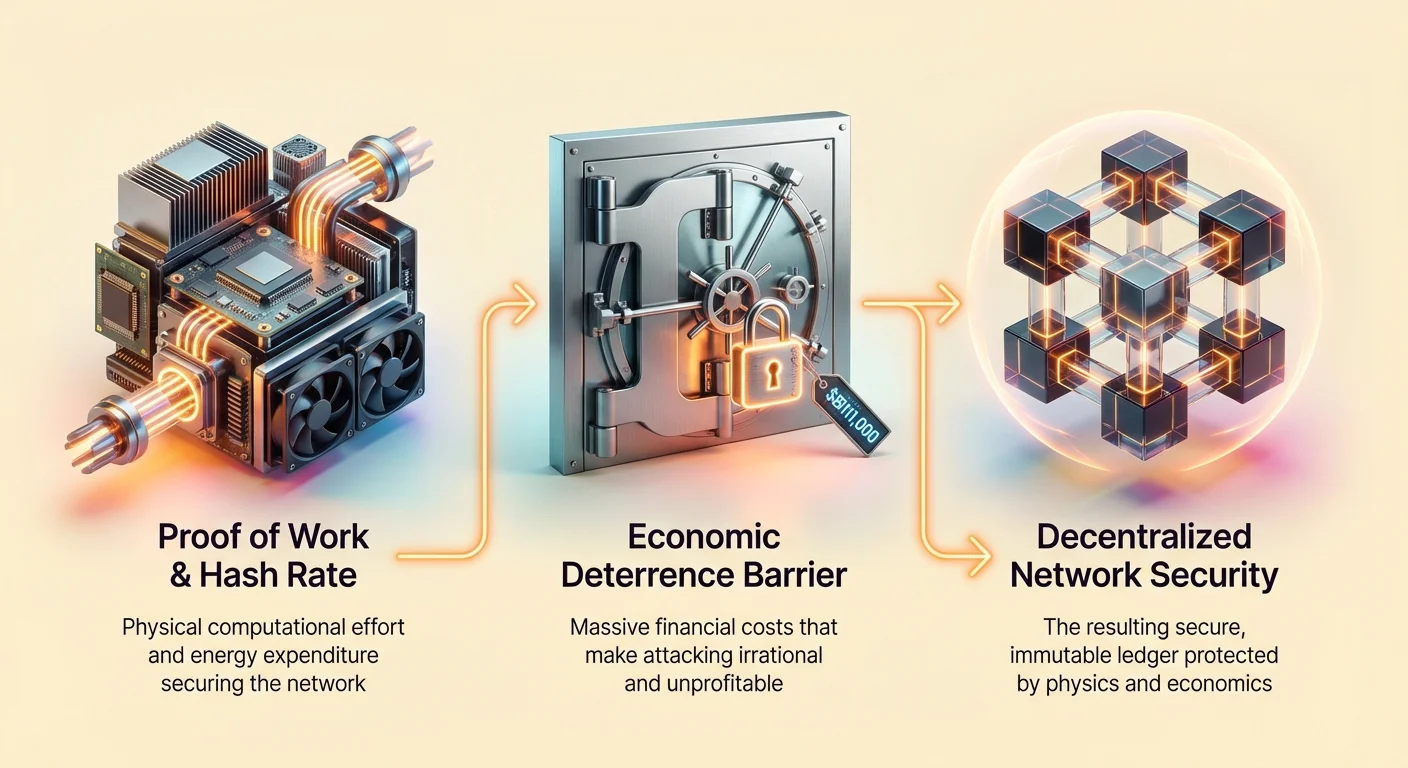
Bitcoin izturība nav uzticības jautājums; tā ir izmērāms resurss. Tīklu aizsargā globāls skaitļošanas pūliņš, ko dēvē par hāša ātrumu, ko nodrošina aparatūra un elektrība. Lai Bitcoin izgāztos, uzbrucējam jāpārvar šis fiziskais šķērslis, kas prasa milzīgu kapitālu un enerģiju — izmaksas tik šokējošas, ka uzbrukums kļūst neloģisks un nerentabls.
Šī analīze pāriet no Bitcoin komponentu apraksta uz tā aizsardzības kvantificēšanu. Mēs izpētīsim galveno neveiksmes punktu — 51 % uzbrukumu — un aprēķināsim nepieciešamos ekonomiskos resursus tā veiksmīgai izpildei. Izprotot neveiksmes izmaksas, mēs gūstam dziļāku novērtējumu tam, kāpēc Bitcoin paliek drošākais, pašsuverēnais virsgrāmata digitālajā ekonomikā.
The Economics of Decentralized Security
To analyze potential attacks, we must first recognize what an attacker must overcome. Bitcoin uses the Proof of Work (PoW) consensus mechanism, which requires miners to expend real-world energy (electricity) to secure the network. This energy expenditure translates directly into a defense mechanism.
Defining Proof of Work and Network Hash Rate
Proof of Work is Bitcoin’s answer to the "Byzantine Generals Problem"—how can a distributed group agree on a single, undeniable truth without a central authority? The solution is to make lying extremely expensive.
Miners compete to solve a complex cryptographic puzzle. The first miner to find the solution gets to bundle the latest batch of transactions into a new "block" and append it to the existing blockchain. This successful miner is rewarded with newly minted bitcoin (the block subsidy) and transaction fees.
The hash rate is the total computational power dedicated to solving these puzzles. It is measured in hashes per second (H/s) and represents the collective force protecting the network. A high hash rate means greater security because an attacker needs a proportional amount of computational power to gain control. The hash rate is the security perimeter; the economic cost is the price tag of breaching that perimeter.
The Role of Economic Incentives
The entire system relies on cryptoeconomics—the study of combining cryptography with economic incentives to secure decentralized systems. Miners are rational economic actors. They invest millions in hardware and continuously pay for electricity. They participate because the rewards (block subsidies and fees) outweigh their costs.
For the system to remain secure, the economic incentive to play honestly must always be far greater than the incentive to cheat. The 51% attack is only successful if the attacker can generate a profit after accounting for the colossal capital and operational costs required to acquire half of the network’s global hashing power.
Saprotot 51% uzbrukuma dinamiku
51% uzbrukums ir primārais, kvantificētais draudu modelis visām Darba pierādījuma blokķēdēm. Tas attiecas uz vienu subjektu, grupu vai koordinētu valsts aktoru, kas iegūst kontroli pār vairāk nekā 50% no tīkla kopējās ieguves hēša jaudas.
Izšķiroši ir tas, ka 51% hēša jaudas īpašumtiesības nedod uzbrucējam iespēju:
- Nozagt jau esošās monētas no citu cilvēku maciņiem.
- Mainīt protokola noteikumus (piemēram, palielināt 21 miljonu piedāvājuma ierobežojumu).
- Apgriezt transakcijas, kas jau ir dziļi apstiprinātas (piemēram, blokus, kas ir 100 dziļi apglabāti).
Ko uzbrucējs var darīt, ir kontrolēt jaunu transakciju secību un apstiprināšanu. Tas noved pie divām galvenajām ļaunprātīgas izmantošanas formām: dubultizdevumiem un transakciju cenzūras.
Dubultizdevumi: Primārais finanšu drauds
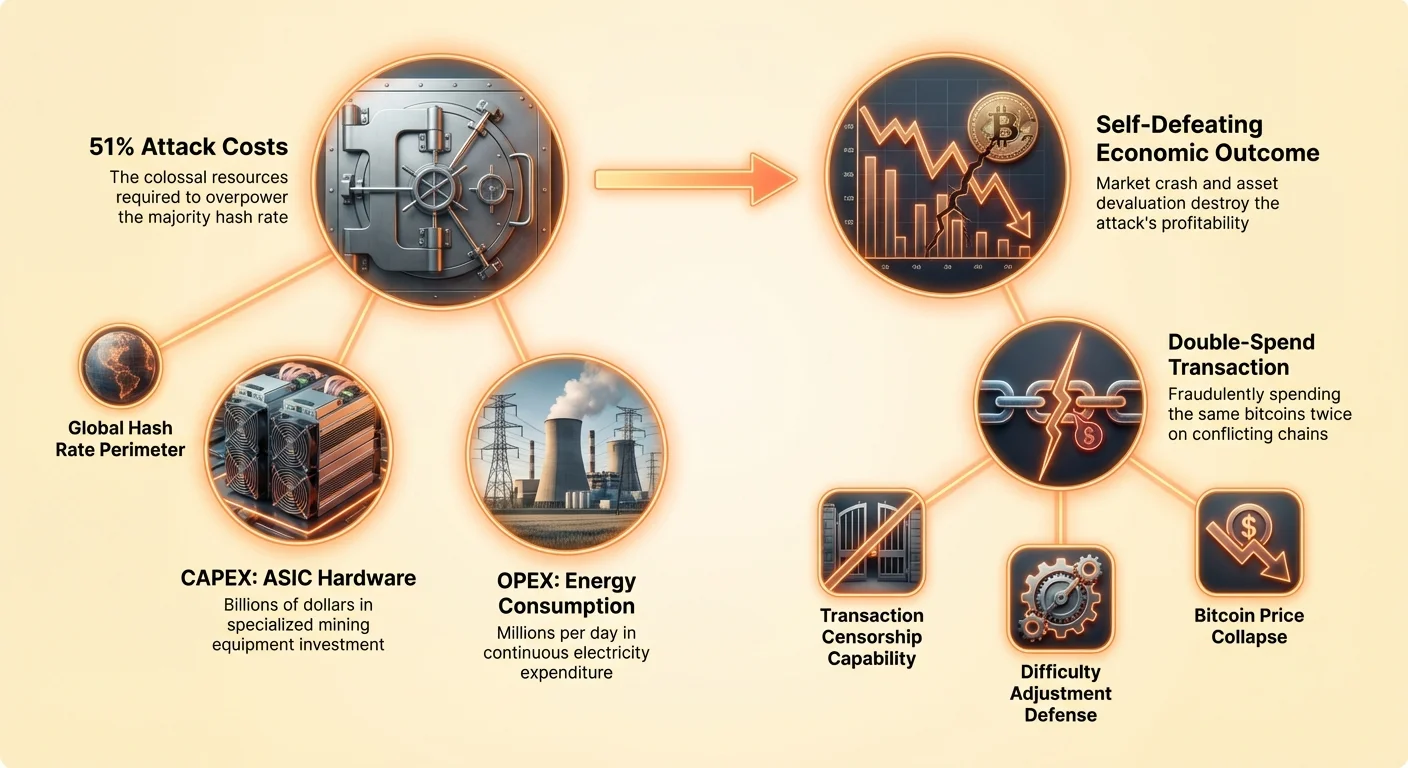
Visrentablākais un satraucošākais 51% uzbrukuma rezultāts ir dubultizdevumi. Tas ir specifisks krāpšanās veids, kas ļauj uzbrucējam iztērēt tās pašas bitkoinus divreiz.
Scenārijs:
- Uzbrucējs (A) nosūta 1000 BTC uz lielu biržu (B) apmaiņā pret fiat valūtu vai citu aktīvu. Šī transakcija (Transakcija 1) nonāk publiskajā atmiņas baseinā un galu galā tiek iekļauta blokā N godīgajā tīklā.
- Tā kā uzbrucējs kontrolē 51% hēša jaudas, viņš vienlaikus iegauda privāto ķēdi, kas sākas tieši pirms bloka N. Šajā privātajā ķēdē viņš iekļauj pretrunīgu transakciju (Transakcija 2), kas nosūta tos pašus 1000 BTC atpakaļ uz savu iekšējo maku.
- Kad uzbrucēja privātā ķēde kļūst garāka par publisko ķēdi (kas prasa 51%+ hēša jaudu), viņš to izsludina publiskajā tīklā.
- Vienmēr uzvar garākā ķēde. Kad tīkls pieņem uzbrucēja garāko ķēdi, Transakcija 1 (maksājums biržai) tiek izdzēsta, un Transakcija 2 (atgriešanās uzbrucēja macenī) tiek apstiprināta.
Rezultāts: Uzbrucējs saņem biržas aktīvus, bet saglabā 1000 BTC, efektīvi iztērējot tās pašas monētas divreiz. Lai šis uzbrukums būtu veiksmīgs un rentabls, upuris (birža vai pārdevējs) jāpieņem transakcija ar ļoti mazām apstiprinājumiem (piemēram, 1–2 blokiem), pirms uzbrucējs var pārņemt ķēdi.
Transakciju cenzūra: Sociālais drauds
Otrā galvenā 51% uzbrucēja spēja ir transakciju cenzūra. Kontrolējot lielāko daļu ieguves jaudas, uzbrucējs nosaka, kuras gaidāmās transakcijas tiek iekļautas jaunos blokos.
Ja valdība, karteļa vai spēcīga organizācija vēlas bloķēt transakcijas no noteiktas valsts, maka vai personas, viņi var izpildīt šo mīksto uzbrukuma formu. Jebkura transakcija, ko viņi vēlas cenzēt, tiks nepārtraukti noraidīta no jauniem blokiem, neļaujot tai nekad tikt apstiprinātai.
Finanšu ziņā mazāk katastrofāla nekā dubultizdevumi, cenzūra apdraud Bitkoina kodolpirmsaku kā atvērtu, bezatļauju tīklu, radot sistēmisku kļūdu, kas apdraud tā pamatvērtību.
Quantifying the Cost: The Economic Deterrence Model
The most effective barrier against a 51% attack is the immense economic cost required to succeed. This cost is so high that it serves as an effective deterrent, making the attack economically irrational.
The cost of a 51% attack can be broken down into three major components: Capital Expenditure (CAPEX), Operational Expenditure (OPEX), and Opportunity Cost.
Calculating the Capital Expenditure (CAPEX): Hardware
CAPEX involves the initial investment needed to acquire the necessary hardware. To achieve 51% of the hash rate, the attacker needs to purchase half of the total computational power currently securing the network.
1. Sourcing the Hardware: As of a given date, assume the Bitcoin network has a hash rate of 600 Exahashes per second (EH/s). An attacker needs 301 EH/s.
If the best available, modern ASIC mining machine (e.g., a high-end S21 miner) provides 200 Terahashes per second (TH/s), the calculation is:
- Required Hash Rate: 301,000,000 TH/s (301 EH/s)
- Miner Efficiency: 200 TH/s per machine
- Total Machines Needed: 1,505,000 ASIC units.
2. Acquisition Cost: If each high-end ASIC costs $5,000 (a reasonable, often conservative estimate for new hardware), the hardware cost alone is:
- 1,505,000 units * $5,000/unit = $7.525 Billion USD (approx.)
This calculation often overlooks logistical challenges. An attacker would not only need billions of dollars, but they would also need to procure roughly 1.5 million highly specialized machines, which are produced by only a handful of manufacturers globally. Attempting to purchase this quantity instantly would immediately alert the market, drive up prices significantly (making the attack even more expensive), and potentially lead to manufacturers refusing the sale for security reasons.
Calculating the Operational Expenditure (OPEX): Energy
Once the hardware is acquired, it must be powered. This is the continuous cost of the attack, usually calculated hourly or daily. This OPEX must be sustained for the entire duration of the double-spend attempt.
The energy consumption of an ASIC miner is substantial. If we assume the required fleet of 1.5 million machines draws an average of 3,500 Watts (3.5 kW) each:
- Total Power Draw: 1,505,000 machines * 3.5 kW/machine = 5,267,500 kW (or 5.27 Gigawatts).
- Comparison: This is the equivalent energy consumption of a large metropolitan city or several nuclear power plants.
- Cost: Assuming an industrial energy cost of $0.05 per kilowatt-hour (kWh), the daily electricity cost is:
- 5,267,500 kW * 24 hours * $0.05/kWh = $6.32 Million USD per day.
To execute a profitable double-spend attack (which may require several days or weeks of sustained effort to maximize profits), the attacker must be willing to burn tens or hundreds of millions of dollars in electricity alone.
The Opportunity Cost and Expected Profit
Beyond the tangible costs of CAPEX and OPEX, the attacker faces an enormous opportunity cost—the value of the rewards they forfeit by attacking the network instead of mining honestly.
When an attacker dedicates their $7.5 billion worth of hardware to a hostile chain, they forgo the regular block rewards (subsidy + fees) they would have earned by mining honestly. This honest revenue can easily reach tens of millions of dollars daily.
The Economic Deterrence Principle:
- Massive Upfront Cost: Billions in hardware required.
- Sustained Negative Cash Flow: Millions in electricity burned daily.
- Self-Defeating Outcome: The primary goal of a double-spend is to profit from a high Bitcoin price. However, the moment a 51% attack is successfully executed and confirmed by the public, confidence in Bitcoin would plummet. The price of BTC would crash, potentially erasing the entire value of the attack itself, including the coins the attacker tried to double-spend.
The attacker is forced to calculate: Is the profit gained from a temporary double-spend worth the immediate loss of billions in hardware investment and the destruction of the asset’s underlying value? For Bitcoin, the answer is demonstrably no.
Secondary Vulnerabilities: Censorship and Resource Exhaustion
While the 51% attack represents the existential, quantified threat, other attack vectors exist that do not require majority control but still compromise network function. These are often focused on manipulating the fee market or exhausting network resources.
Transaction Fee Manipulation and Spam Attacks
Bitcoin transactions include a network fee, which is paid to the miner who confirms the transaction. This fee determines the priority of the transaction. Attackers can attempt a resource exhaustion attack, often called a "spam attack," to clutter the transaction memory pool (mempool).
Mechanism:
- An attacker broadcasts millions of tiny transactions (or transactions with very low fees) to fill up the mempool.
- The backlog of unconfirmed transactions swells.
- Honest users wishing to get their transactions confirmed quickly must now bid significantly higher fees to jump ahead of the backlog.
Economic Cost to Attacker: The attacker must pay the minimum required fee for every spam transaction they broadcast. While they lose money on these low-value transactions, the goal is to drive up costs for everyone else, making the network temporarily unusable or extremely expensive for ordinary users.
However, the network effectively defends against this by making the spam attack increasingly expensive. Since miners always prioritize the transactions with the highest fees, a sustained, high-volume spam attack quickly becomes prohibitively costly for the attacker, as they are effectively outbidding themselves to maintain the congestion.
The Cost of Censorship Without 51% Control
Achieving absolute transaction censorship requires 51% control. However, a powerful mining cartel controlling, say, 30% of the hash rate could attempt targeted censorship.
Limitations of Partial Censorship: If 30% of the miners decide to ignore a specific person’s transactions, the remaining 70% of honest miners will eventually confirm those transactions. Censorship would simply mean a delay, forcing the censored transaction to wait a few extra blocks until an honest miner wins the block reward.
The economic cost of maintaining this partial censorship is primarily the opportunity cost. These cartel members would have to coordinate, potentially losing customers (pool members), and accept the public scrutiny that follows, while gaining no immediate financial benefit other than achieving a political goal (which is notoriously hard to monetize).
Regulatory and Social Attacks
The physical nature of mining creates a regulatory attack vector. Mining facilities are stationary, visible, and require licenses and energy contracts. A coordinated global regulatory effort could attempt to shut down or seize large mining operations.
Impact: A massive, coordinated shutdown would suddenly reduce the hash rate. While this doesn't constitute a 51% attack (it’s a hash rate reduction), it significantly lowers the bar for a subsequent attack by decreasing the total computational power an aggressor needs to acquire.
Bitcoin's Defense: The Difficulty Adjustment Mechanism (DAM). If the hash rate drops dramatically, the DAM automatically adjusts the difficulty downward approximately every two weeks (or every 2016 blocks). This ensures that blocks continue to be found at the targeted rate of one every ten minutes, stabilizing the network and restoring security by making the remaining hash rate more powerful relative to the adjusted difficulty.
Sistēmas aizsardzības mehānismi: Spēles teorija un stimuli
Bitcoin drošība bieži tiek salīdzināta ar digitālu vairogu, bet to precīzāk apraksta kā pašdziedinošu ekonomisku organismu, kas soda sliktos aktierus. Trīs kritiskākās aizsardzības pret ekonomiskajiem uzbrukumiem ir Grūtības korekcija, godīgo kalnraču kolektīvā pašinterese un tirgus reakcija.
Grūtības korekcijas mehānisms (DAM)
DAM ir Bitcoin automātiskais stabilizācijas faktors. Tas pārskaita PoW mīklas sarežģītību, balstoties uz laiku, kas nepieciešams iepriekšējiem 2016 blokiem atrast.
Kā tas atturēja uzbrucējus:
- Uzbrucējs velta 51% no hash rate savai privātai, krāpnieciskai ķēdei.
- Godīgais tīkls pēkšņi redz bloku ražošanas temps palēnināties (jo godīgie kalnrači ir tikai 49% jaudas).
- Ja uzbrukums turpinās vairāk nekā divas nedēļas, DAM samazinās grūtību godīgajai ķēdei, padarot vieglāku godīgajiem 49% ātri atrast blokus, palielinot viņu efektivitāti un liekot uzbrucējam veltīt vēl vairāk skaitļošanas jaudas, lai paliktu priekšā.
DAM nodrošina, ka 51% uzbrukuma uzturēšana uzbrucējam ir eskalējoša ieroču sacensība, nepārtraukti paaugstinot viņa OPEX prasības.
Ekonomiskā paškorekcija un tirgus spēles teorija
Visnozīmīgākais atturētājs ir pats tirgus. Bitcoin vērtība ir neatņemami saistīta ar tā integritāti.
Ja uzbrucējs veiksmīgi dubultspends 10,000 BTC vērtībā $500 miljonus, sākotnējā peļņa ir $500 miljoni. Tomēr brīdī, kad uzbrukums ir verificēts, ziņu aģentūras, biržas un pašuzglabāšanas piekritēji atpazītu, ka tīkls ir kompromitēts.
Veiksmīga uzbrukuma sekas:
- Cenas sabrukums: BTC cena visticamāk sabruktu par 80% vai vairāk, uzreiz iznīcinot lielāko daļu uzbrucēja peļņas un pārvēršot viņa $7.5 miljardu CAPEX ieguldījumu (aparatūru) bezvērtīgā metālā, jo aparatūra ir vērtīga tikai vērtīgas kriptovalūtas kalnrakšanai.
- Forking: Ja 51% uzbrukums būtu veiksmīgs, kopiena, izstrādātāji un godīgie kalnrači nekavējoties koordinētu soft vai hard fork, lai atceltu krāpnieciskos blokus un potenciāli mainītu pamata kalnrakšanas algoritmu, lai padarītu uzbrucēja specializēto aparatūru bezjēdzīgu (piem., pārejot no SHA-256 uz citu algoritmu).
Šajā scenārijā uzbrucējs būtu iztērējis miljardus, lai sasniegtu īstermiņa peļņu (dubultspend), vienlaikus garantējot pilnīgu ilgtermiņa aktīvu iznīcināšanu (aparatūru un jebkādas atlikušās BTC turēšanas). Riska-peļņas aprēķins padara uzbrukumu pašnāvniecisku.
Kopsavilkums: Bitcoin aizsardzība ir kvantificēta atturēšana
Bitcoin drošības modelis ir spēles teorijas šedevrs. Tas demonstrē, ka decentralizēta sistēma var sasniegt daudz lielāku drošību nekā centralizētas sistēmas, jo tā aizsardzība ir publiska, kvantificējama un balstīta uz reālas pasaules enerģijas patēriņu, nevis mainīgo regulējuma politiku.
Galvenais secinājums ir tas, ka Bitcoin uzbrukuma izmaksas — mērītas miljardos dolāru specializētā aparatūrā (CAPEX) un miljonos dolāru dienā enerģijā (OPEX) — pārsniedz potenciālo īstermiņa peļņu no dubultspend mēģinājuma. Turklāt uzbrucējam jāstājas pretī gandrīz pārliecinātībai, ka veiksmīgs uzbrukums iznīcinātu pamata aktīva vērtību, padarot viņa masīvo ieguldījumu novecojušu.
Šī analīze apstiprina, ka Bitcoin nav nodrošināts tikai ar koda rindām, bet ar rūpīgi sabalansētu ekonomisko struktūru, kur stimuls palikt godīgam ir matemātiski pārāks par stimulu apmuļķot. Uzbrukuma cena ir augsta, un potenciālā atlīdzība ir niecīga, nostiprinot Bitcoin kā digitālās pašsuverenitātes cietoksni.
Rīcībspējīgi secinājumi lietotājiem
- Prioritizēt apstiprinājuma dziļumu: Nekad neakceptējiet augstas vērtības Bitcoin maksājumus balstoties uz nulli vai vienu apstiprinājumu. Jo lielāks apstiprinājuma dziļums (6 bloki ir standarts, 60 bloki augstas vērtības darījumiem), jo eksponenciāli augstākas izmaksas uzbrucējam darījuma apgriešanai.
- Uzraudzīt Hash Rate: Izmantojiet publiskos pētniešus, lai uzraudzītu Bitcoin tīkla hash rate. Lai gan augsts hash rate apstiprina drošību, jebkura pēkšņa, masīva un ilgtspējīga kritums var signalizēt neparastu aktivitāti vai regulatorisku represiju, kas palielina ievainojamību.
- Saprast ierobežojumus: Atpazīstiet, ka Bitcoin galvenās drošības garantijas ir darījumu secība un galīgums, nevis atslēgu drošība. Jūsu lielākais drošības vājais punkts vienmēr ir jūsu privāto atslēgu drošība, nevis tīkla konsensa mehānisms.