
Welcome to the multichain world of Decentralized Finance (DeFi). While the promise of crypto is a global, borderless financial system, the reality is that the ecosystem is built upon dozens of unique, separate blockchains—each operating as its own distinct economy.
Imagine trying to drive from New York to London. You can’t just drive across the Atlantic; you need a specialized form of transport—a plane or a ship. The same logic applies to digital assets. If you hold a token on the Ethereum network, and you want to use a specific application (like a Decentralized Exchange, or DEX) that only runs on the Solana network, your assets are stuck.
This need to move value and data between incompatible blockchains is solved by DEX Bridge Technology and Interoperability Protocols. This infrastructure is the backbone of modern DeFi, allowing users to execute complex swaps across different chains seamlessly, transforming the fragmented crypto landscape into a unified, fluid market.
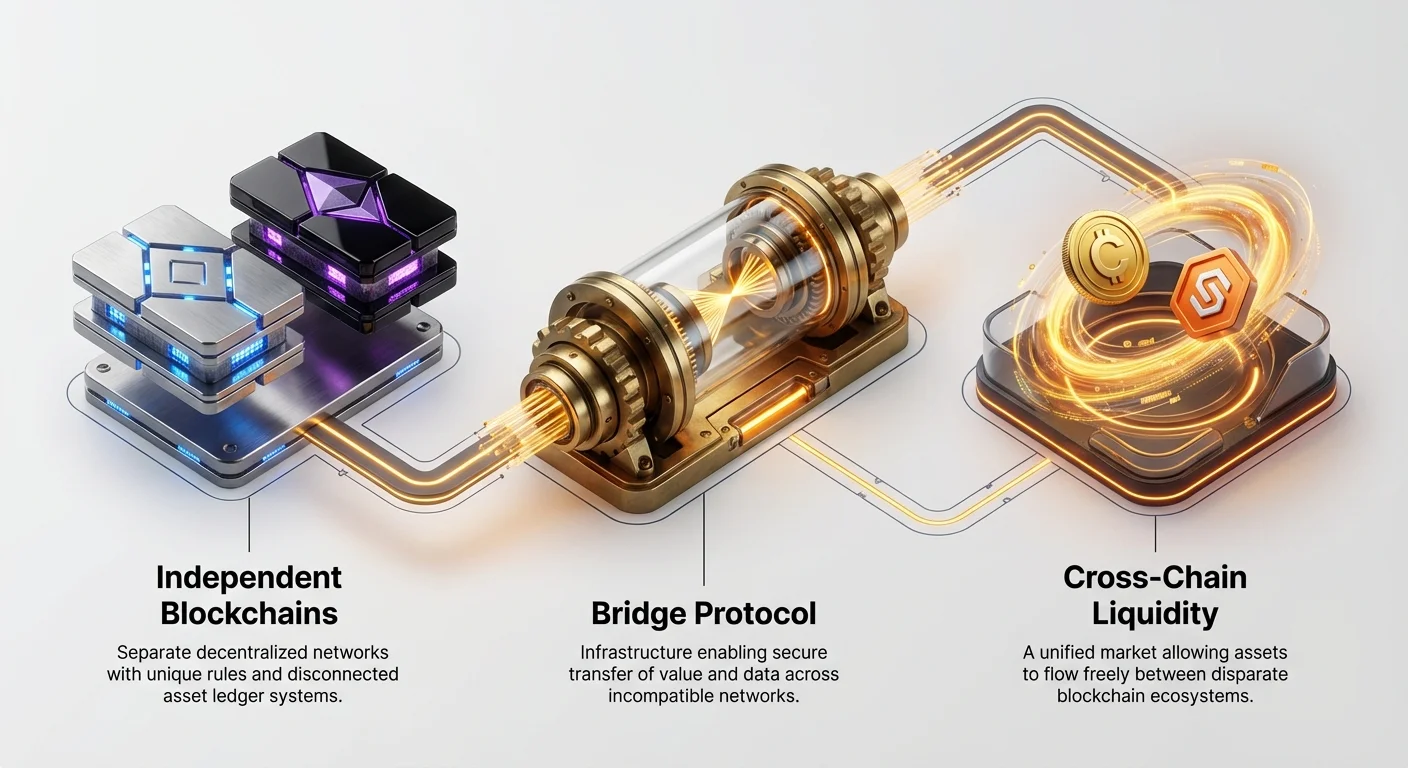
The Core Problem: Why DeFi Needs Bridges (The "Island" Analogy)
To understand why bridges are essential, we first need to recognize the fundamental architecture of the crypto landscape. Blockchains are designed to be independent and secure, which inherently makes them isolated.
The Rise of the Multichain Ecosystem
In the early days of crypto, Ethereum dominated, hosting the vast majority of DeFi applications. However, high transaction fees and slow processing speeds led to the creation of alternative, faster, and cheaper blockchains, often called "Layer 1s" (like Solana, Avalanche, and Binance Smart Chain) and "Layer 2s" (like Polygon and Arbitrum).
Each of these chains operates under its own set of rules, programming language, and security mechanisms. They are essentially digital islands:
- Island A (Ethereum): High security, but expensive transactions. Holds massive value.
- Island B (Solana): Very fast and cheap, but different technical structure.
- Island C (Polygon): A side street off Ethereum, faster and lower cost, but still requires linking back to the main chain.
If a popular new token launches on Solana, an investor whose funds are tied up on Ethereum cannot simply send ETH directly to Solana. They need a mechanism to convert that value and securely transfer it across the digital ocean.
Limitations of Single-Chain DEXs
A traditional Decentralized Exchange (DEX), such as Uniswap running on Ethereum, can only swap tokens that exist on the Ethereum network. For example, it can trade ETH for USDC (an Ethereum token), or for UNI (another Ethereum token). It cannot natively trade Ethereum’s ETH for Solana’s SOL.
This limitation means that liquidity—the pool of available assets for trading—is fragmented. Without bridges, users would be forced to use a Centralized Exchange (CEX) as an intermediary to facilitate the transfer (e.g., send ETH to Coinbase, sell for USD, withdraw USD, buy SOL, send SOL to Solana wallet). Bridges provide a purely decentralized solution, maintaining the core ethos of DeFi.
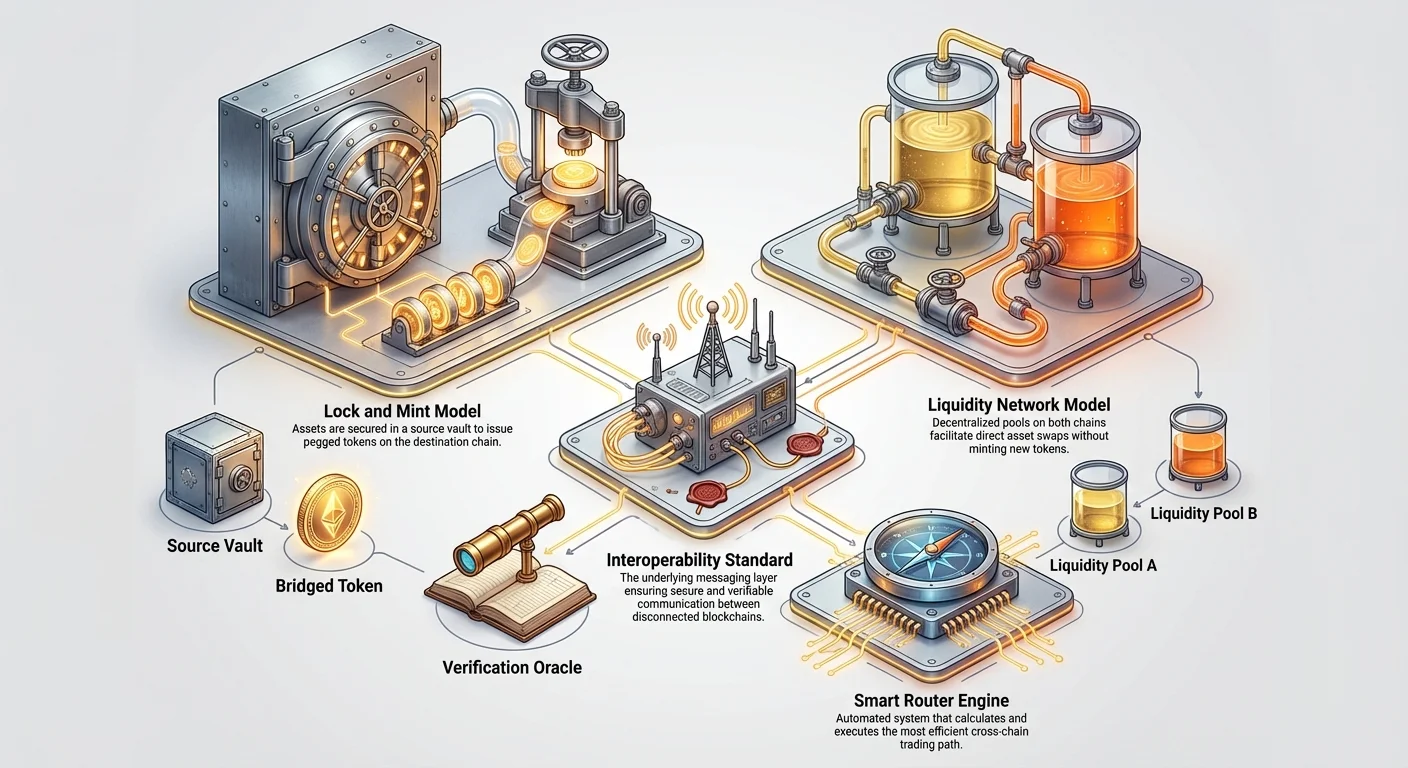
How Cross-Chain Swapping Works: Two Main Bridge Architectures
Bridges are essentially protocols that allow an asset on one chain to be represented and used on another chain. While the user experience appears seamless, the underlying mechanisms involve complex cryptographic and economic assurances. The two main types of bridges achieve this interoperability in fundamentally different ways.
Type 1: Lock and Mint Bridges (The Classic Vault)
The lock and mint model is the most straightforward concept and was the first prevalent form of bridging.
The "Vault" Analogy
This bridge works like a high-security vault:
- Locking: A user wants to move 1 ETH from Ethereum (Chain A) to Polygon (Chain B). The user sends 1 ETH to the bridge’s smart contract on Chain A. This ETH is now locked, essentially taken out of circulation.
- Verification: The bridge protocol verifies that the 1 ETH has been successfully locked.
- Minting: On Chain B (Polygon), the bridge automatically mints a new, equivalent token—often called a "wrapped" or "bridged" asset, such as "wETH (Polygon)"—and sends it to the user’s wallet.
- Redemption: To move the asset back, the user sends the wrapped token to the bridge contract on Chain B (where it is burned), and the original 1 ETH is unlocked and returned to the user on Chain A.
Key Feature: The wrapped token on the destination chain is only valuable because it is backed 1:1 by the asset locked in the vault on the source chain.
Security Consideration: The single largest risk of this model is the smart contract that holds the locked assets (the "vault"). If this contract is exploited, the collateral is stolen, rendering all minted wrapped tokens worthless (since they have no backing). Historically, some of the largest hacks in DeFi have targeted these centralized lock-and-mint bridge contracts.
Type 2: Liquidity Network Bridges (The Trading Post)
Liquidity network bridges offer a more decentralized and often faster alternative by relying on decentralized pools of capital rather than a single vault.
The "Trading Post" Analogy
Instead of minting a new token, these bridges function like currency exchange kiosks operating in parallel on different chains:
- Liquidity Pools: Specialized liquidity providers deposit assets (e.g., ETH on Ethereum and the equivalent amount of wETH on Polygon) into pools on both the source and destination chains.
- Atomic Swap: A user sends 1 ETH to the pool on Chain A. Simultaneously, the bridge protocol instructs the pool on Chain B to dispense the equivalent asset (1 wETH) to the user.
- Rebalancing: The pool on Chain A is now 1 ETH richer, and the pool on Chain B is 1 wETH poorer. Specialized agents (often called routers or relayers) rebalance the liquidity between the pools, ensuring the system remains solvent.
Key Feature: No new tokens are minted; the assets are swapped directly from existing inventories. This method is often faster and does not rely on a single, massive vault of locked funds, distributing risk across multiple pools.
Use Case in DEXs: Modern DEX aggregators prefer this model because it integrates seamlessly into the standard Automated Market Maker (AMM) structure. The bridge swap looks almost identical to a regular exchange between two tokens on the same chain.
DEX Integration: Making Cross-Chain Swaps Easy
For the average beginner, the idea of locking assets, minting tokens, and interacting with bridge contracts sounds complicated. Modern DEXs and aggregators have largely abstracted this complexity away, making multichain trading feel like a simple, single-click swap.
Abstracting the Complexity (The Smart Router)
The technology that links a DEX interface to various bridge protocols is the Smart Router or Routing Engine. This is the intelligence layer that finds the most efficient, cheapest, and fastest path for a user's transaction, even if that path involves multiple chains and multiple protocols.
The Route Optimization Process
When you initiate a cross-chain swap (e.g., swapping Token A on Polygon for Token Z on Ethereum), the smart router performs a calculation:
- Pathfinding: It checks all available paths. Should it use Bridge X (Lock/Mint) or Bridge Y (Liquidity Network)?
- Cost Analysis: It factors in the gas fees for the initial transaction, the bridge fees, the destination chain’s gas fees, and any potential slippage in the destination liquidity pool.
- Execution: The router bundles all these steps—the initial swap, the bridging, and the final swap on the destination chain—into a single, consolidated transaction request that the user approves once.
The user simply sees: "Swap 100 Token A for 15 Token Z," while the router might execute a 5-step process across three separate protocols.
Case Study: Aggregators and Intent-Based Swaps
DEX aggregators (like 1inch or Paraswap) specialize in finding the best liquidity across all available exchanges. When they integrate bridging technology, they become Cross-Chain Aggregators.
Instead of telling the protocol how to execute the trade, modern systems are moving towards Intent-Based Trading. The user declares their intent ("I want Token Z in my wallet on Chain Y"), and the infrastructure handles the entire execution, optimizing every step of the bridge, swap, and routing process silently in the background.
This focus on user intent is crucial for the mainstream adoption of multichain DeFi, as it removes the burden of managing complex technical steps like manually bridging funds before trading.
Interoperability Protocols: The Backbone of the DEX Bridge
While bridges manage the transfer of value (moving the token), the most critical component underlying modern bridges is the Interoperability Protocol. These protocols ensure that the messages being sent between chains are genuine and secure.
Communicating Securely (Messaging Layers)
Blockchains cannot inherently communicate with each other. If Chain A locks 1 ETH, Chain B needs irrefutable proof that this happened before it mints the wrapped token.
Interoperability protocols act as standardized communication layers, providing secure and verifiable methods for transferring information—not just assets—between disparate blockchain environments. They solve the "trust minimization" problem.
The key function is the verifier mechanism. When a transaction happens on Chain A, the interoperability protocol uses external validators or specialized cryptography to confirm the transaction’s validity before relaying the authenticated message to Chain B.
Examples: LayerZero and Wormhole
These next-generation protocols are essential for providing the foundation upon which complex cross-chain DEXs are built:
1. LayerZero
LayerZero is an Omnichain Interoperability Protocol (OIP) designed to create trustless, secure connections between chains. It achieves security by separating the role of message relaying and message validation:
- Relayer: An entity that fetches the transaction proof from the source chain.
- Oracle (or Watcher): A third-party service (like Chainlink) that independently verifies the transaction block header on the source chain.
For a message to be executed on the destination chain, the data provided by the Relayer must match the verification provided by the Oracle. If these two independent parties do not agree, the transaction fails. This segregation of duties significantly enhances security compared to older bridge models that relied on a single group of validators.
2. Wormhole
Wormhole is a generic message passing protocol that allows decentralized applications (dApps) to build on any connected chain and communicate with each other. It is primarily secured by a decentralized network of guardians (validators) who observe activity on connected chains.
When a message is sent:
- Guardians observe the message on the source chain.
- At least two-thirds of the Guardians must sign a "Verified Action Request (VAA)"—a cryptographic proof that the message is legitimate.
- This VAA is then relayed to the destination chain, instructing the target smart contract (a DEX or application) to take action.
Protocols like Wormhole allow applications built on entirely different architectures (like connecting Ethereum and Solana, which are technically very different) to communicate securely, creating the foundation for truly multichain DEX experiences.
Navigating the Risks of Cross-Chain Swaps
While bridge technology is the engine of DeFi growth, it is also the source of some of the ecosystem's most significant risks. As a beginner, understanding these vulnerabilities is crucial for safely participating in cross-chain trading.
The Critical Security Risk: Smart Contract Exploits
The primary risk in bridging is the smart contract risk—specifically concerning the security of the bridge code itself.
Bridges are high-value targets. Lock-and-mint bridges hold millions, sometimes billions, of dollars worth of locked assets. If a vulnerability exists in the smart contract code (a bug, a flawed access control mechanism, or a private key compromise), hackers can drain the entire vault.
Why Bridges are Hacked:
- Complexity: Cross-chain code is inherently more complex than single-chain code, making it harder to audit and easier for subtle bugs to slip through.
- Centralized Verification: Older bridge models relied on a small, centralized group of signers or a single multisignature wallet to approve transfers. If these signers were compromised, the entire system failed.
Newer messaging protocols, like LayerZero and Wormhole, address this by decentralizing the verification process, spreading trust across multiple independent parties (oracles, relayers, guardians) to minimize any single point of failure.
Liquidity Risk and Slippage
When performing a swap on a DEX, slippage occurs when the price of the asset changes between the moment you submit the transaction and the moment it executes.
In cross-chain swaps using Liquidity Network Bridges, liquidity risk is compounded:
- Source Chain Slippage: The price movement on the initial DEX swap.
- Bridge Execution Slippage: If the liquidity pools within the bridge itself are temporarily depleted or heavily utilized, the swap might execute at a worse rate than quoted.
- Destination Chain Slippage: The price movement on the final DEX swap on the destination chain.
If a bridge liquidity pool is severely unbalanced (e.g., if everyone is moving assets from Chain A to Chain B, but no one is moving assets back), the cost to bridge becomes prohibitively expensive, leading to high slippage for the user attempting the transfer.
Best Practices for Bridge Users
To safely navigate the cross-chain environment, follow these best practices:
| Practice | Description |
|---|---|
| Verify Bridge Audits | Only use bridges that have undergone rigorous, public security audits by reputable firms. Look for protocols that clearly display their security model (e.g., using LayerZero’s segmented security). |
| Start Small | When using a new bridge or interacting with a new chain, transfer only a small, test amount first. Never move your entire portfolio in one go. |
| Check the Liquidity | Before initiating a large swap, check the total value locked (TVL) and liquidity of the bridge pools for your chosen assets. Low liquidity means higher risk of failure or excessive slippage. |
| Use Aggregators | Opt for DEX aggregators that automatically incorporate bridging. These smart routers are designed to find the safest, most cost-effective path, removing the need for manual contract interaction. |
| Understand the Asset | If you are receiving a wrapped asset (like wETH), ensure you understand which bridge created it. The security of your wrapped asset is directly tied to the security of the vault where the original asset is locked. |
Conclusion: The Future of Seamless Swapping
DEX Bridge Technology and interoperability protocols are the defining infrastructure of the modern DeFi landscape. They have transformed the crypto world from a collection of isolated islands into a massive, interconnected continent.
For the beginner, the future of cross-chain swaps will be characterized by increasing levels of abstraction. Thanks to advanced protocols like LayerZero and improved DEX routing, users will no longer need to worry about the technical details of bridging. Instead, they will simply declare their final intent—what token they want, and on what chain—and the sophisticated infrastructure will handle the secure, optimized execution.
As these underlying messaging protocols mature, security improves, and the cost of inter-chain communication drops, the distinction between "Chain A" and "Chain B" will increasingly blur, creating the truly unified, decentralized financial system that crypto promises.