
Traveling the world has traditionally relied on banks, credit cards, and cash exchanges, often burdened by foreign transaction fees and volatile exchange rates. The rise of digital assets has introduced a new paradigm, allowing users to leverage their crypto holdings for streamlined, often rewarding, international travel.
Crypto travel hacking is more than just paying for a flight with Bitcoin; it is a comprehensive strategy for maximizing the utility, rewards, and security of your digital assets throughout the entire travel lifecycle—from booking accommodations to managing taxes and identity abroad.
This guide provides a step-by-step framework for beginners looking to integrate crypto into their travel plans. We will cover the essential tools, the best platforms for booking, strategies for accessing local currency, and—crucially—how to remain tax compliant while spending your assets overseas. By adopting these strategies, you can minimize fees, unlock unique perks, and enjoy a more financially independent journey.
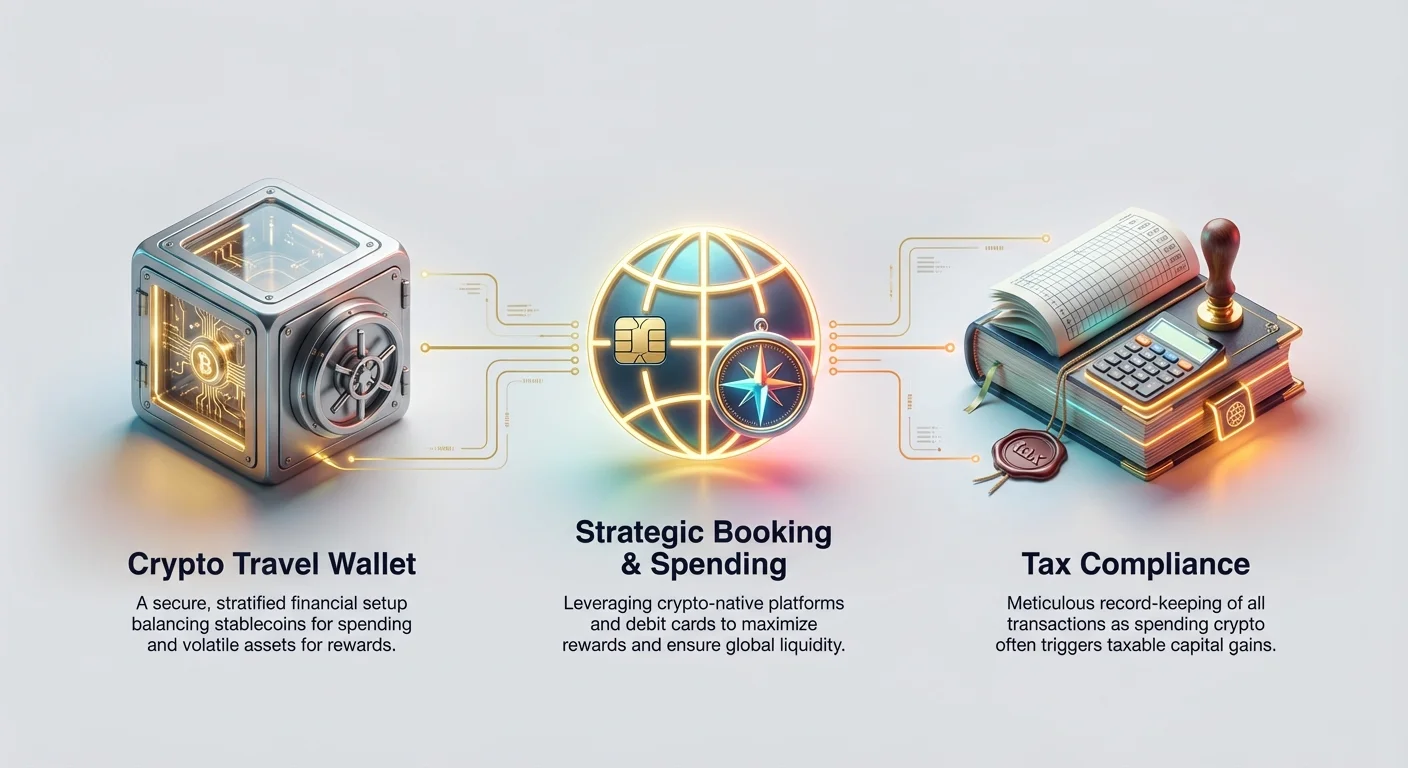
Phase 1: Planning and Preparation: The Crypto Travel Wallet
Before you book your first hotel with crypto, you need a robust, secure, and strategically balanced financial setup. Traveling requires liquidity and stability, making careful asset selection critical.
Choosing the Right Assets (Stablecoins vs. Volatile Assets)
The greatest enemy of a travel budget is volatility. Imagine budgeting $1,000 worth of Bitcoin for a flight only to watch Bitcoin’s value drop 20% right before you pay.
- Stablecoins for Budgeting and Spending: For immediate spending (flights, hotels, daily expenses), Stablecoins are the preferred choice. Stablecoins (like USDC or USDT) are pegged to a stable asset, typically the US Dollar, minimizing price fluctuation. Using stablecoins ensures that the money you allocate for your trip today is the same amount available tomorrow.
- Volatile Assets for Earning Rewards: While you should avoid spending highly volatile assets (like Bitcoin or Ethereum) directly on necessities, you may use them through specialized crypto cards that offer higher cashback rewards. The strategy here is to immediately convert the volatility into a stable asset or fiat upon spending, capturing the reward, but accepting the tax complexity involved (see Phase 4).
Practical Tip: Create a specific, dedicated "Travel Fund" wallet holding 80% stablecoins and 20% highly liquid, low-fee assets (like Solana or Litecoin) for quick transfers if needed.
The Crypto Spending Stack: Cards vs. Direct Wallets
How you spend your crypto determines your fees, speed, and overall convenience. There are two primary methods for utilizing crypto while traveling:
1. Crypto Debit/Prepaid Cards (The Beginner’s Choice)
Crypto cards are the most accessible tool for travelers. They act exactly like traditional Visa or Mastercard debit cards, but they draw funds from your crypto wallet instead of a bank account.
- How they work: When you swipe the card, the card issuer instantly converts the required amount of cryptocurrency (e.g., Stablecoin or BTC) into the local fiat currency (e.g., Euros, Yen) at the point of sale.
- Benefits: Wide acceptance globally, seamless integration with existing payment infrastructure (ATMs, POS machines), and often offer significant crypto rewards (e.g., 2% to 5% back on spending).
- Drawbacks: They require KYC (Know Your Customer) verification, and the card issuer may charge conversion or foreign transaction fees.
2. Direct Wallet Payments (The Advanced Choice)
Direct payments involve scanning a QR code or entering a wallet address to send crypto directly to a merchant.
- How they work: Used mainly with specialized travel providers (like those listed in Phase 2) or in crypto-friendly cities where businesses have adopted self-custodial wallets.
- Benefits: Lower fees (transaction fees are typically cheaper than card processing fees), greater privacy (in some cases), and no reliance on third-party banking infrastructure.
- Drawbacks: Extremely low adoption rate globally. You cannot use direct wallet payments at most major hotels or chain stores.
Security Fundamentals for Traveling with Digital Assets
Traveling increases the risk of loss, theft, or digital attack. Robust security is non-negotiable when taking digital assets across borders.
- Never Travel with Your Primary Holdings: Your long-term investments should remain secured offline in a cold storage solution (like a hardware wallet) left safely at home. Only transfer the funds required for the trip to your "hot wallet" or crypto card linked account.
- Use a Dedicated Travel Wallet: Set up a separate mobile hot wallet (e.g., a software wallet on your phone) specifically for travel spending. This wallet should only hold your spending budget.
- Protect Your Seed Phrase: Your seed phrase is the master key to your funds. Under no circumstances should you ever write it down digitally (on your phone, cloud, or email). If you must travel with a recovery phrase for emergency access, secure it physically (e.g., etched onto metal or stored in a high-security container) and keep it separate from your devices.
- Use Two-Factor Authentication (2FA): Enable 2FA on all exchange accounts and crypto card apps. If possible, use hardware 2FA keys (like YubiKey) instead of SMS or app-based authentication, which can be vulnerable while roaming.
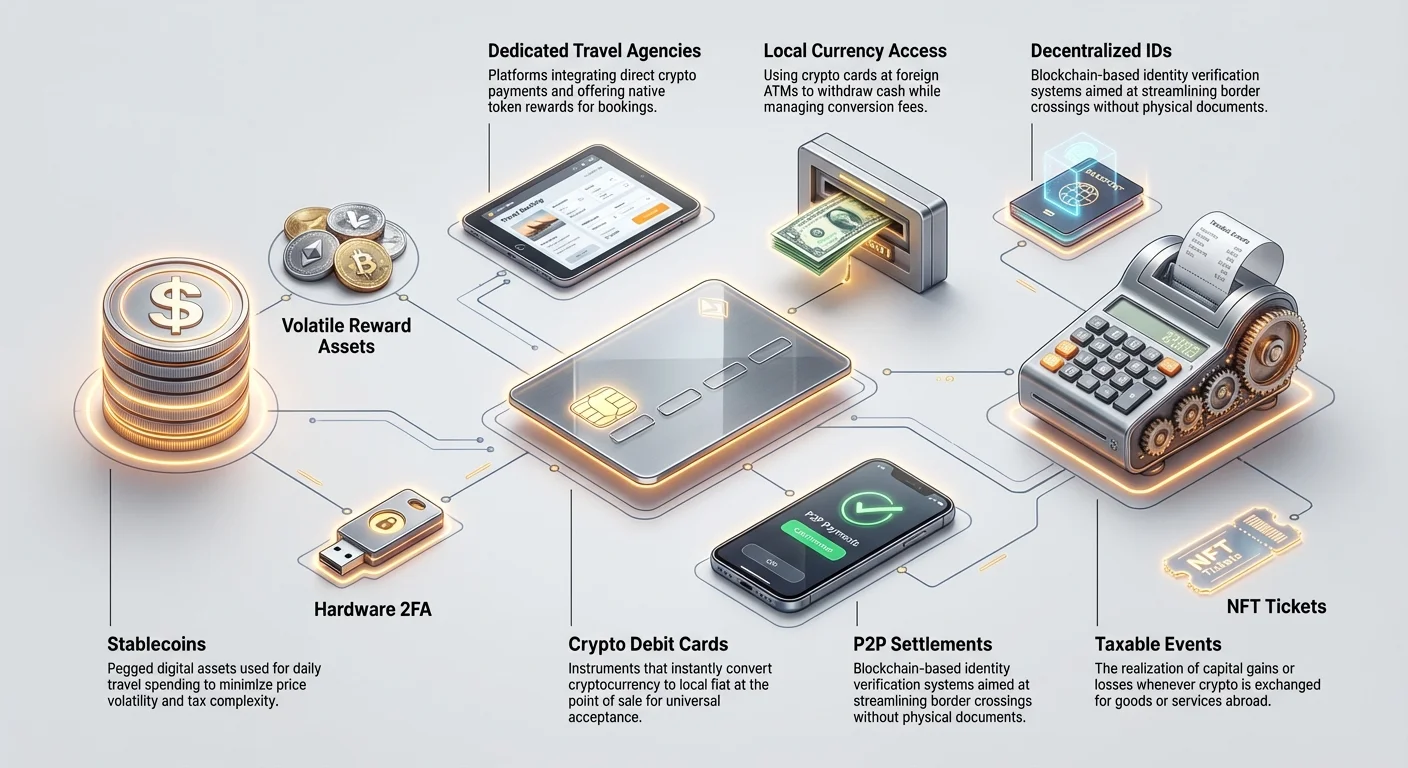
Phase 2: Booking Logistics: Platforms and Perks
Once your crypto travel wallet is secured and funded, the next step is leveraging dedicated platforms to book flights and accommodation. This is where crypto-specific rewards can often surpass traditional credit card programs.
Dedicated Crypto Travel Agencies
A handful of online travel agencies (OTAs) have fully integrated crypto payments, allowing travelers to book directly using Bitcoin, Ethereum, Stablecoins, and various altcoins.
Case Study: Platforms Like Travala
Travala is one of the most prominent examples, listing millions of flights and accommodations globally.
- Direct Crypto Payment: Travala accepts dozens of different cryptocurrencies directly from your wallet, removing the need for a crypto card intermediary for the booking phase.
- Loyalty Tokens and Rewards: Many crypto travel sites offer native loyalty tokens (e.g., AVA). By holding or staking these tokens, users can receive guaranteed discounts, loyalty rewards, and enhanced incentives that are far more generous than typical hotel points programs. For example, some platforms offer tiered membership levels providing up to 10% cash back in the form of their native token.
- Tokenized Ownership: These tokens sometimes grant rights to governance or access to exclusive deals, turning travel spending into an investment in the ecosystem itself.
Strategic Booking Tip: Compare the cost of booking directly with crypto platforms versus using your crypto debit card on traditional OTAs (like Expedia). Sometimes, the direct reward structure outweighs the convenience of card payment, but always check final pricing and associated fees.
Using Crypto Debit Cards for Traditional Booking Sites (The Bridging Strategy)
Most major airlines (like United or British Airways) and large hotel chains (like Marriott or Hilton) do not accept crypto directly. The "bridging strategy" uses your crypto card to pay these traditional merchants.
- Mechanism: You treat the crypto card exactly like a traditional payment method during checkout. The card processor handles the instant conversion and settlement, paying the airline in the required local currency (fiat).
- Benefits: This grants you near-universal acceptance while still drawing funds from your digital assets. You retain the ability to earn the rewards offered by the crypto card provider.
- Maximizing Rewards: When choosing a crypto card, focus on the reward tier that offers the highest percentage back on travel or general spending categories. Sometimes, a high-tier crypto card can offer 3-4% back, often paid in a valuable native token, beating standard 1-2% fiat cashback cards.
Maximizing Travel Rewards and Loyalty Programs
Traditional travel hacking relies on collecting points and miles. Crypto travel hacking introduces a layered system of rewards:
- Base Layer Reward (Crypto Card): Earn 1-5% back on every transaction just by using the crypto card.
- Platform Layer Reward (OTA): Earn additional rewards (e.g., loyalty tokens or discounts) by booking through a crypto-native platform.
- Network Layer Reward (Staking): If your crypto card or platform requires staking a native token to unlock higher tiers, you may also earn staking rewards just for holding the required minimum.
By strategically combining these layers, a crypto traveler can achieve a total reward rate that far exceeds what is possible through traditional banking relationships.
Phase 3: On-the-Ground Payments: Foreign Exchange Strategies
Once you land in a foreign country, your focus shifts from large pre-payments (flights) to managing daily liquidity: paying for taxis, meals, and emergencies. This requires optimizing for local currency access and minimizing foreign transaction fees.
Instant Conversion Services and Local ATM Access
The most common use case for crypto while abroad is withdrawing local fiat currency from an ATM using your crypto debit card.
- The Process: You insert your crypto card into a standard ATM. You select the amount of local currency you need. The card processor calculates the required amount of crypto (e.g., $100 equivalent in USDC) and instantly sells that crypto to fund the fiat withdrawal.
- Navigating Fees: Be aware of three potential fee layers:
- Card Issuer Fee: The fee charged by your crypto card provider for using an ATM (often waived up to a monthly limit for higher-tier cards).
- ATM Operator Fee: The fee charged by the local bank that owns the ATM.
- Currency Conversion Spread: The small difference between the spot exchange rate and the rate provided by your card issuer. Always check your card provider's fee schedule before traveling.
Actionable Tip: If possible, utilize cards that offer fee-free ATM withdrawals up to a generous monthly limit. Instead of withdrawing small amounts repeatedly, plan a single, larger withdrawal to minimize transaction costs.
P2P and Merchant Acceptance in Tourist Hubs
While crypto adoption remains limited globally, certain tourist hubs and digital nomad centers (e.g., Lisbon, El Salvador, parts of Southeast Asia) have higher rates of merchant acceptance.
- Merchant Acceptance: Look for stickers or signs indicating acceptance of Bitcoin, Ethereum, or Stablecoins. These businesses often prefer direct wallet payments (using Lightning Network for Bitcoin or similar low-fee layers).
- Peer-to-Peer (P2P) Settlements: Crypto shines in settling expenses with travel companions. Instead of complex Venmo conversions or cash splitting, travelers can settle debts instantly and fee-free using Stablecoins, particularly useful if you are traveling with others who also hold crypto.
Navigating Dynamic Currency Conversion (DCC) Fees with Crypto Cards
Dynamic Currency Conversion (DCC) is a common scam tactic abroad. When you pay for a meal or withdraw cash, the merchant or ATM operator may offer to process the transaction in your home currency (e.g., USD) rather than the local currency (e.g., Thai Baht).
- The Trap: While it sounds helpful to see the cost in USD, the exchange rate used by the local machine is usually atrocious—often 5% to 15% worse than the rate your crypto card issuer would provide.
- How to Avoid DCC: Always choose to be charged in the local currency. If you are in Mexico, choose MXN. If you are in Japan, choose JPY. This forces your crypto card processor to execute the conversion at a transparent, often competitive, market rate. Your crypto card will then accurately debit your funds.
Phase 4: Navigating the Legal Landscape: Taxes and Compliance
The most critical and often overlooked aspect of crypto travel hacking is tax compliance. In many jurisdictions, including the US, UK, and Canada, spending crypto is legally considered a taxable event, similar to selling an asset. Ignoring this can lead to severe penalties.
Understanding Taxable Events (The Conversion/Spend Rule)
For most tax authorities, when you use a cryptocurrency (like Bitcoin or Ethereum) to pay for a service (like a flight), you are effectively performing two simultaneous actions:
- Selling the Asset: You are selling your BTC at its current Fair Market Value (FMV) to acquire the fiat currency needed for the payment.
- Acquiring the Service: You are using the newly acquired fiat to purchase the flight.
The tax implication arises from the first step: the Capital Gain or Loss generated from the sale.
Example Scenario:
- Acquisition (Cost Basis): You bought 0.1 BTC two years ago when the price was $10,000 per BTC. Your cost basis is $1,000.
- Spending Event: Today, you use that 0.1 BTC to pay for a flight costing $4,000. The price of BTC is currently $40,000.
- Calculation: You sold 0.1 BTC for $4,000. Your cost basis was $1,000.
- Taxable Gain: $4,000 (Proceeds) - $1,000 (Cost Basis) = $3,000 Capital Gain.
Even though the money went toward travel, you have realized a $3,000 gain that must be reported to your home country's tax authority.
Why Stablecoins Simplify Taxes: If you spend $1,000 worth of USDC (a stablecoin pegged to $1.00), the capital gain is usually negligible (perhaps $0.05). This is why stablecoins are overwhelmingly recommended for daily travel spending—they minimize taxable events and record-keeping complexity.
Record Keeping and Tracking Tools for International Transactions
Compliance relies entirely on meticulous record-keeping. You must be able to prove the cost basis (original purchase price) and the fair market value (FMV) at the time of every spend.
Essential Data to Track:
| Data Point | Purpose |
|---|---|
| Date and Time of Transaction | Establishes the exact moment of the taxable event. |
| Asset Used (e.g., 0.05 BTC) | Identifies the specific asset spent. |
| Cost Basis of the Asset | The original fiat price you paid for that specific crypto unit. |
| Fair Market Value (FMV) at Spend | The fiat value of the crypto at the time of the transaction (i.e., the cost of the flight). |
| Counterparty/Purpose | Description of the expense (e.g., "Air France Flight to Paris"). |
Utilizing Crypto Tax Software
Attempting to track hundreds of small crypto card transactions manually across a multi-week trip is nearly impossible. Crypto tax tracking software (e.g., Koinly, CoinTracker) is essential. These platforms connect to your exchange accounts and crypto card history, automatically calculating gains and losses, and generating the necessary tax forms based on your home country's rules.
Cross-Border Reporting Thresholds (FATCA, CRS, FBAR)
Spending crypto abroad also intersects with international financial reporting laws designed to prevent money laundering and offshore tax evasion.
- FBAR (Foreign Bank Account Report): If you are a US person, the FBAR requires you to report holdings in foreign bank and financial accounts. While the IRS has not universally declared all self-custodial crypto wallets as "reportable accounts," accounts held on foreign crypto exchanges or wallets linked to non-US crypto cards may fall under this requirement if the aggregate value exceeds $10,000 at any point during the year.
- FATCA (Foreign Account Tax Compliance Act): This US law requires foreign financial institutions to report information about US account holders. As crypto exchanges become regulated, many are now compliant with FATCA/CRS (Common Reporting Standard) and share data on high-value users with international tax authorities.
- The Travel Cash Rule: Be aware of physical currency limits. Many countries require you to declare amounts of physical currency (cash) exceeding $10,000 (or equivalent) when entering or leaving. Importantly, digital assets are generally NOT considered physical currency for customs declaration purposes, which is a key advantage for large-scale transfers, though local laws vary wildly.
Disclaimer: Tax laws related to digital assets are rapidly changing and differ significantly by country. This guide provides foundational information; always consult with a qualified tax professional specializing in crypto before making major international purchases or planning large transfers.
Phase 5: Advanced Travel Utility: Visas and Identity Management
Beyond simple payments, the future of crypto utility in travel involves leveraging blockchain technology for identity, security, and access.
Digital Identity and Decentralized IDs (DIDs) for Travel Verification
Traditional travel relies on physical documentation (passports, driver’s licenses). Decentralized IDs (DIDs) aim to change this by creating verifiable, self-sovereign digital identities secured on a blockchain.
- How DIDs Work: A DID allows a traveler to selectively share verified data (e.g., "I am over 21," "I hold a valid pilot’s license," or "My COVID test was negative") without revealing the underlying sensitive document (passport number or medical records).
- Travel Applications: Imagine speeding through airport security by proving your identity and right to travel using a quick, cryptographically verified scan, bypassing the need for human inspection of physical documents and reducing the risk of identity theft. While this technology is still maturing, several global initiatives are working to pilot DID solutions for seamless border crossing.
The Role of Non-Fungible Tokens (NFTs) in Travel Tickets and Access
NFTs are digital assets that represent unique ownership. They are moving beyond digital art to become functional tools in travel and logistics.
- Tokenized Tickets: Airlines and event venues are exploring issuing tickets as NFTs. This prevents fraudulent resales, simplifies transferability (if allowed), and grants the user self-custody of their access rights.
- Loyalty and Membership: Premium travel clubs or airline loyalty programs could issue status membership as an NFT. Holding this token automatically grants access to lounges, priority boarding, and other perks, verifiable instantly via a blockchain scan.
- Visa/Entry Rights: In highly advanced scenarios, certain entry permits or short-term visas could be issued as NFTs linked to a traveler’s verified DID, streamlining bureaucratic processes.
Utilizing Stablecoins for Cross-Border Visa Payments (Where Accepted)
While direct visa payments using crypto are still rare for government services, the trend is growing, particularly for jurisdictions seeking to attract digital nomads or demonstrate technological progress.
- Payment Speed: Traditional international wire transfers for visa applications can be slow and expensive. Stablecoins offer near-instant settlement, which is particularly useful when deadlines are tight.
- Cost Control: Governments or payment processors that accept stablecoins can offer lower overall fees compared to credit card processing or international bank fees, benefiting the traveler.
While few national governments currently accept direct crypto payments for residency or tourist visas, the utility is clear: where accepted, paying with a stable asset guarantees the exact cost basis and speeds up the entire financial validation process.
Conclusion
Crypto travel hacking transforms the financial foundation of international travel. It moves spending away from slow, fee-laden banking infrastructure toward a system that prioritizes instant liquidity, competitive rewards, and enhanced digital security.
For the beginner traveler, the key takeaway is to build a conservative, secure strategy:
- Fund your trip primarily with Stablecoins to mitigate volatility and simplify tax reporting.
- Rely on a high-reward Crypto Debit Card for universal acceptance and ATM access.
- Use dedicated crypto travel platforms (like Travala) for strategic bookings that offer token-based loyalty rewards.
- Prioritize tax compliance by tracking every international spend and understanding that spending an appreciated asset is a taxable event.
By mastering these steps, you are not just spending crypto; you are optimizing your travel experience, ensuring that your digital assets work harder for you, no matter where in the world you choose to explore.