
10年以上にわたり、Bitcoinはデジタル希少性と自己主権の基盤として機能し、主に価値移転のための堅牢で不変の台帳として働いてきました。しかし、サトシ・ナカモトが設計したアーキテクチャは—革新的ではあるものの—スクリプトの柔軟性、プライバシー、トランザクション効率に関する固有の制限を伴っていました。
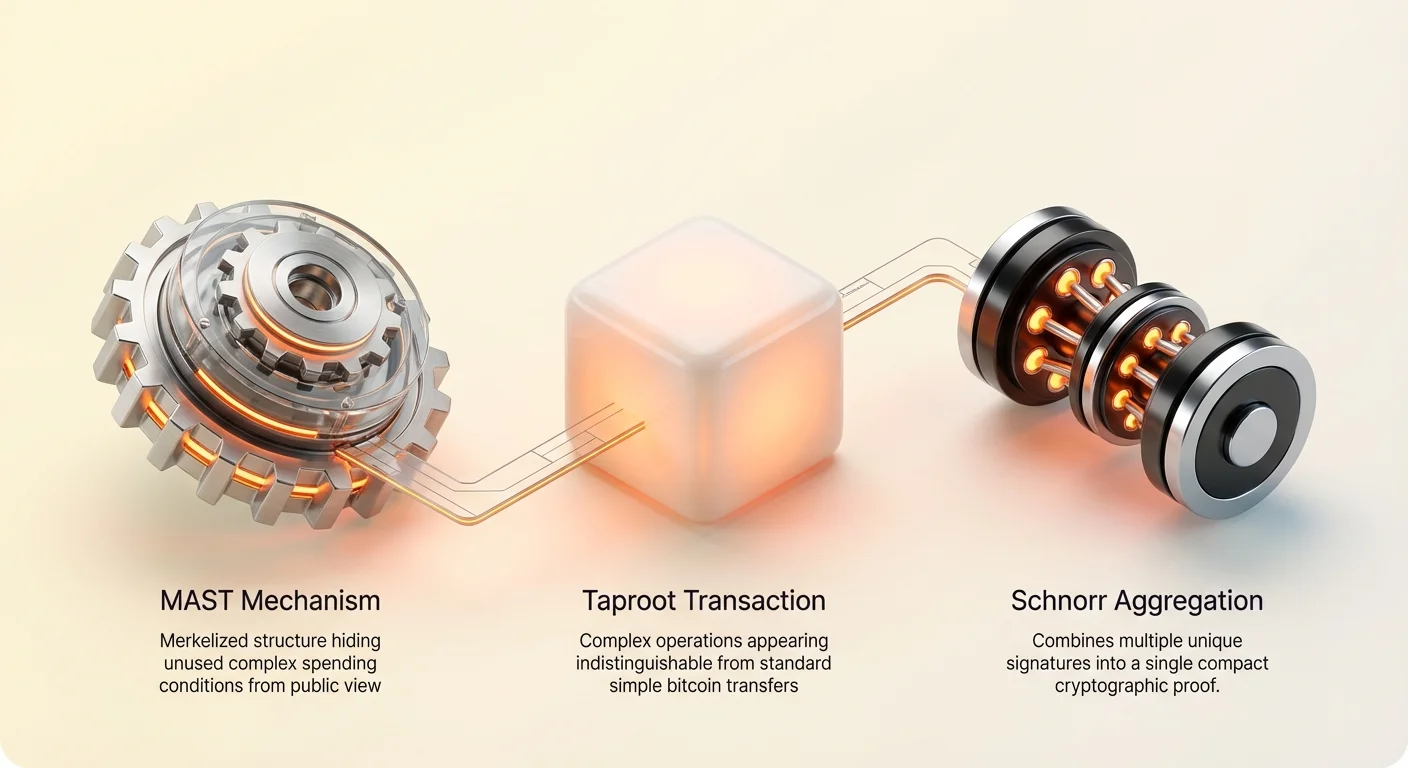
2021年末に有効化されたTaprootアップグレードは、2017年のSegWit以来、Bitcoinのベースレイヤー(Layer 1)に対する最も重要な改善です。Taprootは単一の機能ではなく、3つの相互に関連する技術の洗練されたバンドルです:MAST(メルケライズド抽象構文木)、Schnorr署名、およびPay-to-Taproot(P2TR)アドレス。
このアップグレードは、ネットワーク上で複雑なトランザクションが実行される方法を根本的に変えます。従来のトランザクションはすべての潜在的な支出条件を世界中に放送し、貴重なブロックスペースを消費し、機密データを公開していましたが、Taprootは複雑なスクリプトをシンプルな単一署名支払いと区別がつかないようにします。このアーキテクチャのシフトは、プライバシーを劇的に向上させ、コストを削減し、決定的にBitcoinが先進的なスマートコントラクトとLightning NetworkのようなスケーラブルなLayer 2(L2)ソリューションをサポートするための堅牢なインフラ基盤を築きます。ここでの焦点は、Taprootが何かを説明するだけでなく、それが開発者が世界で最もセキュアなブロックチェーン上で次世代の分散型金融とセルフカストディツールを構築できるようにどのようにエンパワーするかにあります。
Taproot が解決する問題:Bitcoin の従来のスクリプト制限
Taproot の天才性を理解するには、まず Bitcoin の元のスクリプト言語の制約を認識する必要があります。Bitcoin は、資金の支出ルールを定義するために、シンプルなスタックベースの言語(しばしば Script と呼ばれる)を使用します。
シンプルな Bitcoin トランザクションの構造
Taproot 以前のほとんどの Bitcoin トランザクションは、公開鍵ハッシュ払い (P2PKH)(標準的な単一署名支払い)または、より複雑なルール(マルチ署名要件やタイムロックなど)を可能にする スクリプトハッシュ払い (P2SH) を使用していました。
P2SH を使用して資金を支出する場合、ネットワークはあなたが設定した条件(スクリプト)が満たされていることを検証する必要があります。重要なのは、トランザクションが支出されると、スクリプト全体 がブロックチェーン上に公開され、それに満足する証明(署名)も一緒に公開されることです。
例えば、3 つの鍵のうち 2 つが必要なマルチ署名(2-of-3 multisig)を設定した場合、公開記録には 3 つの潜在的な鍵すべて、要件(2-of-3)、および必要な 2 つの署名が表示され、実際の実行がどれほどシンプルであっても関係ありません。
複雑なトランザクションのコスト
潜在的に複雑な支出スクリプト全体を公開する必要があるというこの要件には、重大な欠点がありました:
- プライバシーの低下(情報漏洩): スクリプト全体を公開すると、資金が可能だったすべての支出方法が暴露され、最終的に選択されたパスが 1 つだけだったとしてもです。2-of-3 の例では、3 つの鍵保有者の身元すべてが暴露され、休眠中だったとしてもです。
- トランザクションサイズと手数料の増加: 多くの参加者や条件付きタイムロックを含む複雑なスクリプトは、ブロックスペースを大幅に消費します。手数料は主にトランザクションサイズによって決まるため、企業財務のマルチシグや複雑な相続計画などの高度なカストディソリューションが非常に高価で非効率になりました。
- 代替可能性の欠如: 代替可能性とは、通貨の 1 単位が他のどの単位とも交換可能であることを意味します。ブロックチェーン上で複雑なスクリプトが明確に可視化されると、その特定のトランザクション出力が標準的なシンプルな出力と異なって見えます。この視覚的な区別により、外部者が特定の種類の資金を追跡しやすくなり、Bitcoin の全体的な代替可能性を損ないます。
MAST: Making Complex Scripts Look Simple
Merkelized Abstract Syntax Trees (MAST) is the core cryptographic concept that allows Taproot to solve the transparency and efficiency problems inherent in P2SH.
Understanding Merkel Trees
To grasp MAST, we must first understand the Merkle Tree (also known as a Hash Tree). This data structure is foundational to Bitcoin itself, as every block uses a Merkle Tree to efficiently summarize all transactions within that block.
A Merkle Tree works like a digital filing system:
- Each piece of data (in the case of MAST, this is a potential spending condition, or "script path") is individually hashed.
- These individual hashes are paired and hashed together, moving up the tree structure.
- This process continues until all the data is condensed into a single, summary hash called the Merkle Root.
The powerful advantage of the Merkle Root is that it allows anyone to verify that a specific piece of data is included in the set, simply by providing a small number of intermediate hashes (the Merkle Path) rather than having to show all the data.
How MAST Hides Unexecuted Conditions
MAST applies this Merkle Tree concept to the spending conditions of a transaction.
Imagine a complex smart contract that has four possible paths for spending funds:
- Path A: Alice and Bob both sign (standard spending).
- Path B: After 90 days, only Alice can sign (time-lock recovery).
- Path C: After 180 days, only a backup key signs (inheritance/safety).
- Path D: Requires input from an oracle (e.g., weather data trigger).
Using the old P2SH model, all four paths (A, B, C, and D) would be exposed on the blockchain when the funds are spent.
Using MAST:
- Each path (A, B, C, D) is the "leaf" of a Merkle Tree.
- All four paths are summarized into a single MAST Root.
- When Alice and Bob execute Path A, they only publish the script for Path A and the small cryptographic proof (the Merkle Path) necessary to prove that Path A is included in the MAST Root.
The critical benefit: The existence of Paths B, C, and D is revealed by the Merkle Root, but their actual scripting content remains completely private and unpublished on the chain. Only the executed path is revealed, leading to massive space savings and increased confidentiality.
Practical Example: The Multi-Sig Scenario
Consider a corporate treasury that requires a 3-of-5 multi-signature agreement for routine expenses, but also requires a simplified 1-of-5 signature path (after 6 months) for emergency liquidation if the company dissolves.
- Pre-MAST: The standard 3-of-5 script and the emergency 1-of-5 script must both be broadcast to the chain, increasing transaction size and revealing the emergency spending rules to everyone.
- With MAST: If the 3-of-5 path is used, only the 3-of-5 script is broadcast, along with the small proof that it belongs to the contract. The 1-of-5 emergency liquidation path remains hidden within the MAST Root, only revealed if it is actually executed later.
MAST fundamentally transforms complex conditions into efficient, compact, and private proofs.
シュノール署名:効率性とプライバシーの鍵
MASTがスクリプトの複雑さを解決する一方、Taprootの2番目の主要コンポーネントであるシュノール署名は、署名の効率性、セキュリティ、および匿名性を扱います。Bitcoinは当初、楕円曲線デジタル署名アルゴリズム (ECDSA) を使用していました。シュノールは数学的に優れた代替案で、2つの巨大な利点をもたらします:署名集約と強化されたセキュリティ証明です。
シュノール対ECDSAの技術的優位性
ECDSA署名は安全ですが、かさばり、個別の検証を必要とします。トランザクションが3つの署名を必要とする場合、ブロックチェーンは3つの別々の署名データブロックを必要とし、ネットワークノードはそれらの3つの異なるブロックを順次検証しなければなりません。
より単純な数学とセキュリティ前提に基づくシュノール署名は、重要な利点を提供します:線形性。これにより、複数の公開鍵を1つの有効な集約公開鍵に組み合わせることができ、複数の署名を1つの有効な集約署名に組み合わせることができます。
署名集約:バッチ検証と効率性
署名集約は、Taprootがスケーリングにもたらす最も目に見える改善点かもしれません:
- マルチパーティ効率:シュノールを使用した5-of-5マルチシグネチャトランザクションでは、5つの必要な公開鍵を暗号学的に1つの新しい公開鍵にマージでき、対応する5つの署名を1つの集約署名にマージできます。
- ブロックチェーン解釈:Bitcoinネットワークの残りの部分から見ると、この集約トランザクションは標準的な単一署名支払い (P2PKH) と全く同じに見えます。
- 検証速度:ノードはこの単一の集約署名を、5つの個別ECDSA署名を検証するよりも速く検証します。この改善により、ネットワーク参加者全員の計算リソースを節約し、複雑なトランザクションのデータサイズを大幅に削減します。
この機能は、企業カストディ、共同所有ウォレット、そして最も重要なLayer 2スケーリングソリューションなどのマルチパーティアプリケーションにとって革新的です。
プライバシーの配当(鍵集約とP2TR形式)
鍵と署名を集約する能力は、プライバシーと交換可能性に決定的なブーストを提供します。
マルチシグトランザクションが標準的な単一署名トランザクションと同一に見える場合、外部の観察者はトランザクションが複雑(複数の当事者、タイムロック、または特殊なコントラクトを必要とする)か単純(単に1人がお金を送るだけ)かを判断できません。
これによりネットワークに真の出力一様性が導入され、洗練されたスマートコントラクト出力が単純なP2P支払いと機能的に区別がつかなくなります。これによりBitcoinの交換可能性が大幅に強化され、すべてのサトシが観察者によって平等に扱われます。
Taproot Explained: The Seamless Integration of MAST and Schnorr
Taproot is the overarching implementation that ties MAST for conditional execution and Schnorr for signature efficiency together under a new, unified address type.
Pay-to-Taproot (P2TR) Addresses
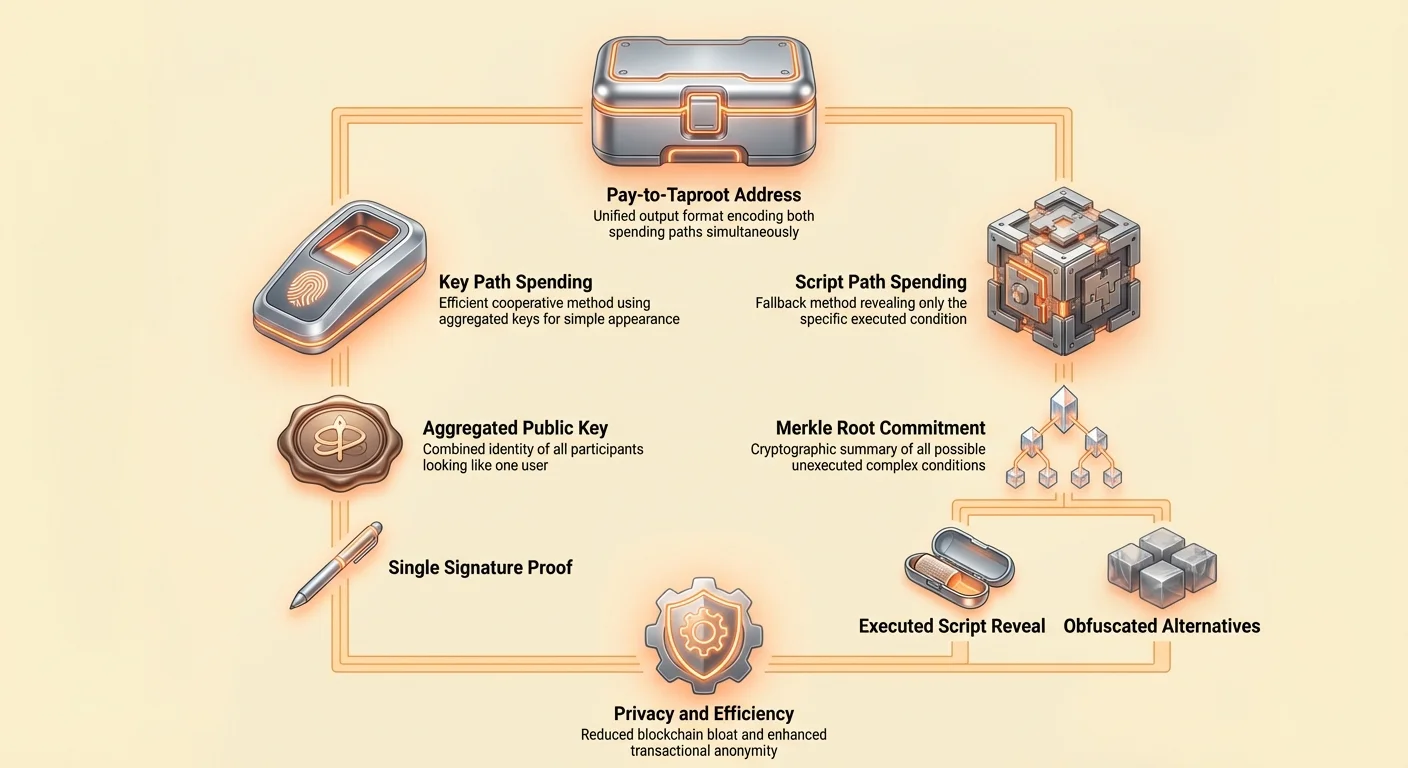
Taproot introduces a new standard output type called Pay-to-Taproot (P2TR). P2TR outputs encode not just a single public key, but a combination of a public key (for the Schnorr key aggregation path) and the Merkle Root of all potential spending scripts (for the MAST script path).
When funds are sent to a P2TR address, the transaction effectively locks the funds using two distinct methods simultaneously: the Key Path and the Script Path.
The Key Path vs. The Script Path (The Choice Mechanism)
Taproot is designed around a simple, efficient trade-off: if all parties cooperate, use the simple, cheap path; if they disagree or require complex conditions, use the slightly more expensive but robust path.
1. The Key Path (The Ideal Scenario)
The Key Path is the preferred and most efficient way to spend funds locked in a P2TR output. This path is activated when all original participants agree on the spending conditions and cooperate.
- How it works: All participants aggregate their public keys into a single Taproot key, and then aggregate their signatures into a single Schnorr signature.
- Result: The on-chain transaction looks exactly like a standard, single-signer P2PKH transfer. The entire MAST structure remains hidden, saving space and preserving privacy. This path is maximally cheap and efficient.
2. The Script Path (The Conditional Scenario)
The Script Path is activated if the participants cannot cooperate, or if the transaction requires a predetermined script condition (like a time-lock or the input of an oracle).
- How it works: The spending transaction reveals the specific script condition that was met (e.g., "Time-lock of 90 days has passed") and the small Merkle Proof required to validate that this script was indeed part of the original MAST Root.
- Result: This transaction is slightly larger than the Key Path, but still significantly smaller and more private than the old P2SH model, because it only reveals the one executed script, keeping all other potential spending conditions private.
Achieving Script Obfuscation
The combination of the Key Path and the Script Path achieves a powerful property called script obfuscation.
From the perspective of an outside observer analyzing the blockchain:
- If the Key Path is used (which is anticipated to be the most common usage for cooperative parties, especially in L2 solutions), the transaction is completely opaque and private. It looks like simple spending.
- Even if the Script Path is used, the observer only learns about the specific condition that was met, not the details of all the alternative conditions that were also possible.
This seamless integration ensures that simple, cooperative uses are highly efficient, while complex, conditional uses remain highly private—a massive leap forward for Layer 1 flexibility.
Taproot’s Impact on Modern Bitcoin Development
Taproot is not just a cosmetic upgrade; it is the most critical infrastructure update enabling Bitcoin to move beyond basic value transfer and into a realm of sophisticated decentralized applications.
Scaling Layer 2 Solutions (Lightning Network Efficiency)
The Lightning Network, Bitcoin’s primary L2 scaling solution, relies heavily on multi-signature channels and time-locks for security. Taproot directly addresses the pain points of opening and closing these channels.
Before Taproot, opening and closing a Lightning channel required visible multi-signature transactions (typically 2-of-2), which were bulky, expensive, and easily identifiable as L2 activity.
With Taproot and Schnorr Signatures:
- Channel Opening: Opening a Lightning channel can utilize the Key Path. The funding transaction now looks like a simple 1-of-1 transaction on the chain, drastically reducing block footprint and increasing privacy.
- Cooperative Closing: If the channel is closed cooperatively (the most common scenario), the Key Path is used again, minimizing fees and remaining indistinguishable from standard payments.
- Non-Cooperative Closing: If a non-cooperative closure is necessary, the Script Path (which includes the time-lock conditions) is used, but thanks to MAST, only the necessary, relevant conditions are published, still saving space compared to the old model.
This efficiency gain significantly lowers the cost of participation in the Lightning Network, encouraging wider adoption and improving the speed and reliability of instant Bitcoin payments.
Enabling Complex Smart Contracts
While Ethereum was purpose-built for Turing-complete smart contracts, Bitcoin’s design prioritizes security and immutability, making its scripting language intentionally restrictive. Taproot doesn't change this fundamental focus, but it makes the execution of sophisticated Bitcoin smart contracts far more practical and affordable.
Key areas benefiting from Taproot:
- Discreet Log Contracts (DLCs): DLCs allow parties to execute contracts based on the input of an external data source (an oracle), such as sports scores or stock prices, without revealing the contract details to the network. Taproot’s MAST capability is perfect for this, hiding the numerous potential outcomes and only revealing the single result chosen by the oracle.
- Covenants: Covenants (the ability to restrict how a UTXO can be spent in the future) are powerful tools for creating complex, self-enforcing financial products. Taproot provides the necessary flexibility within the L1 scripting environment to make covenants (often combined with other proposed opcodes) viable and efficient.
- Advanced Treasury Management: Corporations can now design highly complex, nested multi-sig scenarios with specialized recovery keys, time-locks, and emergency liquidation paths, without incurring massive fees or revealing their proprietary key management scheme to the public.
Reducing On-Chain Footprint and Transaction Fees
The net result of Schnorr aggregation and MAST efficiency is a reduction in the overall data required to execute complex transactions.
By shrinking the average transaction size for multi-sig and L2 applications, Taproot reduces overall network congestion. This translates directly into:
- Lower Fees: Less data means less cost for the user.
- Faster Confirmations: Less data processing helps miners and nodes operate more quickly and efficiently.
- Increased Capacity: While Taproot is not a pure block size increase, its optimization of transaction data functionally increases the number of complex transactions that can fit into a single block.
哲学的およびアーキテクチャ的示唆
Taprootは単なる技術的アップデートではなく、Bitcoinの進化を肯定しつつその核心的なセキュリティ原則を維持するという哲学的主張でした。その活性化には、ほぼ満場一致のコミュニティ支持(「Speedy Trial」ソフトフォークメカニズム)が必要で、エコシステムが規律正しく後方互換性を保った成長へのコミットメントを示しています。
トレードオフ:分散化 vs. スクリプト機能性
暗号通貨の歴史的な議論では、しばしばBitcoin(セキュリティと分散化を優先)とEthereumのようなプラットフォーム(スクリプトの柔軟性と機能の豊富さを優先)が対立します。Taprootはこのトレードオフを慎重にナビゲートします。
フルノードの運用性を損なう可能性のあるアップグレードや、高度に複雑なコンセンサスルールを導入するものとは異なり、Taprootは非論争的な最適化です。既存で実証済みの暗号学的原則(Merkle木、楕円曲線)を用いて、ハードウェアの強化を必要とせずセキュリティモデルを変更することなく効率向上を実現します。
Script Path経由で柔軟性(スマートコントラクト、複雑なロジック)を導入しつつ、Key Path経由でシンプルな支払いの効率とプライバシーを維持する能力により、Bitcoinは最強の分散型台帳としての地位を損なうことなく先進的な開発をサポートできます。
Bitcoin DeFiの実現を可能にするTaproot
「DeFi」(分散型金融)という用語はしばしば高速アルトコインネットワークと関連付けられますが、堅牢で安全なBitcoinベースのDeFiが台頭しています。その中心にTaprootがあります。
Bitcoin DeFiの現在の課題は、Layer 1トランザクションが遅く高額になることです。Taprootは、L2/L3アプリケーションに必要なL1基盤を大幅に低コストで構築可能にし、BitcoinのセキュリティとDeFiの機能要件のギャップを埋めます。
例えば、強力なスクリプトオペコードOP_CAT(データ連結と動的スクリプト構築を可能にするもの)の有効化のような将来の潜在的アップグレードは、TaprootがMAST経由でコンパクトでプライベートなスクリプト実行の基盤をすでに敷いているため、真に実行可能で効率的です。Taprootが暗号学的プライバシーと効率を扱うことで、将来のコンセンサス変更は論理的機能の拡張に純粋に集中できます。
本質的に、Taprootは開発者がBitcoin上で複雑でありながら手頃なアプリケーションを構築するための必要な基盤を提供し、Bitcoinを単なるデジタルゴールドからグローバル分散型金融のインフラ層へパラダイムシフトさせます。
結論
Taprootアップグレードは、MASTとSchnorr署名をP2TR形式に統合することで、ビットコインの建築的可能性における画期的な転換を示しています。これは、ビットコインの基本的なセキュリティを維持しつつ、その有用性を大幅に拡大することを目指した、数年にわたる共同研究の集大成です。
初心者にとっても開発者にとっても、結論は明らかです:Taprootはビットコイン上でのあらゆる複雑な相互作用の効率を根本的に最適化します。マルチシグネチャ取引、タイムロック、条件付きスクリプトをシンプルなシングルキー支払いのように見せることで、Taprootはユーザーのプライバシーを強化し、手数料を削減し、ネットワーク全体での高いファンジビリティを確保します。
重要なことに、Taprootはビットコインのスケーリングの未来の基盤となります。ライトニングネットワークのようなLayer 2ソリューションをより安価でプライベートに使用可能にし、DLCのような先進的なスマートコントラクトの効率的な実行を可能にすることで、Taprootはビットコインを、次世代の自己主権型金融ツールに必要な複雑さを扱えるように装備しました。それは、世界で最も安全な通貨ネットワークが、分散型イノベーションのための柔軟なプラットフォームとなる準備も整っていることを保証します。