
Ethereum se uspostavio kao kičma decentraliziranog weba, pokrećući ogroman ekosustav aplikacija decentraliziranih financija, nezamjenjivih tokena i pametnih ugovora. Međutim, ovo masovno usvajanje otkrilo je kritičnu slabost u originalnom dizajnu mreže: njezin ograničen kapacitet za obradu transakcija. Kako se sve više korisnika okuplja na platformi, mreža postaje začepljena, što dovodi do sporijih vremena obrade i nestabilnih naknada za transakcije koje mogu isključiti svakodnevne korisnike.
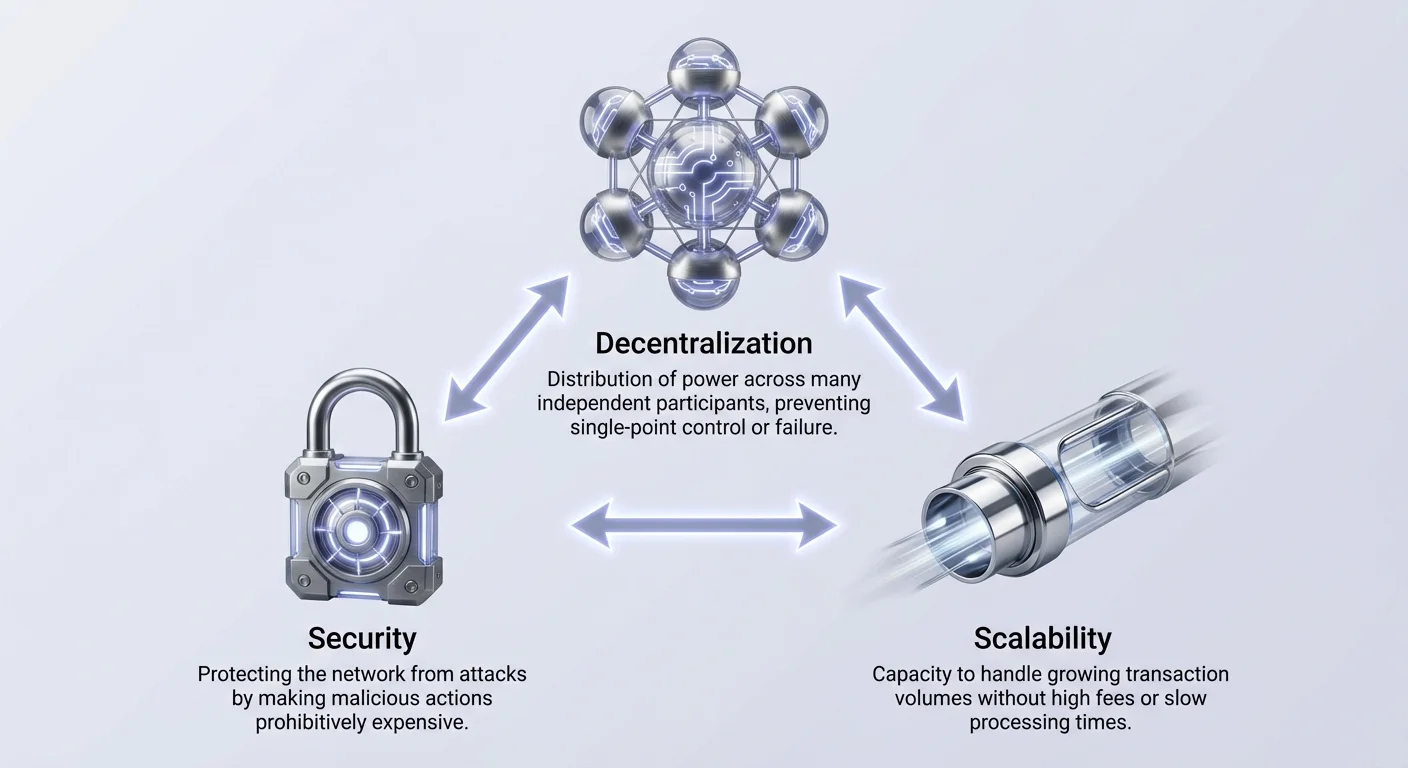
Ovaj fenomen nije samo tehnički kvar, već fundamentalni strukturni izazov poznat kao „trilema blockchaina“. Taj koncept sugerira da decentralizirana mreža obično može optimizirati samo dva od tri ključna atributa u bilo kojem trenutku: decentralizaciju, sigurnost i skalabilnost. U svom originalnom obliku Proof-of-Work, Ethereum je dao prioritet decentralizaciji i sigurnosti, neizbježno žrtvujući skalabilnost. Da bi zadržao svoju poziciju vodeće svjetske platforme za pametne ugovore, Ethereum je morao proći kroz radikalnu evoluciju koja uključuje složene nadogradnje mehanizma konsenzusa i razvoj višeslojnih rješenja za skaliranje.
Understanding the Blockchain Trilemma
The blockchain trilemma helps explain why scaling a global, decentralized network is significantly harder than scaling a centralized database. In a centralized system, a single entity controls the servers, allowing them to upgrade hardware and process thousands of transactions per second with ease. However, this comes at the cost of trust and censorship resistance. Ethereum aims to avoid this compromise, but the trade-offs remain difficult to navigate.
The Three Pillars of Network Architecture
Decentralization refers to the distribution of power across a wide network of participants. In Ethereum, this means ensuring that no single entity controls the ledger. A highly decentralized network relies on thousands of independent nodes running the software from different locations. This redundancy makes the network resistant to censorship and government interference. If one node goes down or is compromised, the rest of the network continues to operate without interruption.
Security involves the network's ability to defend against attacks, particularly 51% attacks where a malicious actor gains control of the majority of the network's resources. In a decentralized system, security is achieved by making it prohibitively expensive for any single actor to attack the chain. This requires a massive amount of resources, whether in the form of computational power or financial capital locked in the system.
Scalability is the capacity of the system to handle a growing number of transactions without suffering from congestion or exorbitant fees. This is where the bottleneck occurs. To maintain decentralization, every node in the network must verify every transaction. This requirement inherently limits the speed of the network to the processing power of its individual nodes. If the requirements to run a node become too high in pursuit of speed, fewer people can participate, leading to centralization.
The Necessity of Evolution
Ethereum initially operated on a Proof-of-Work consensus mechanism, similar to Bitcoin. While this provided immense security and a fair distribution model, it was energy-intensive and limited the network to roughly 15 transactions per second. As demand for block space exceeded this limited supply, a bidding war for transaction inclusion ensued. This resulted in high gas fees, effectively making the network unusable for smaller transactions and limiting the potential for global adoption.
To solve this, the community recognized that the protocol could not remain static. Unlike Bitcoin, which often favors a conservative approach to preserve its function as a store of value, Ethereum adopted a progressive philosophy. The goal was to evolve the underlying technology to bypass the trilemma's limitations, aiming to increase throughput without sacrificing the core values of censorship resistance and security.

The Transition to Proof of Stake
A central pillar of Ethereum’s strategy to solve the trilemma was the transition from Proof-of-Work (PoW) to Proof-of-Stake (PoS). This massive upgrade, often referred to as "The Merge," fundamentally changed how the network achieves consensus. In the old PoW model, miners used vast amounts of electricity and hardware to solve complex puzzles. This energy expenditure secured the network but drew criticism for its environmental impact.
Mechanics of the New Consensus
In the Proof-of-Stake model, energy-intensive miners are replaced by validators. To become a validator, a participant must "stake" or lock up a specific amount of cryptocurrency—specifically 32 ETH—into a smart contract. This capital acts as a security deposit or a financial guarantee of good behavior. Instead of competing with hardware, validators are selected at random to propose new blocks and verify the work of others.
This system utilizes a "carrot and stick" approach to ensure honesty. Validators who perform their duties correctly, such as ordering transactions and proposing valid blocks, are rewarded with newly minted ETH and transaction fees. Conversely, validators who act maliciously or fail to stay online can face severe penalties known as "slashing." Slashing involves the forfeiture of a portion or even the entirety of their staked assets, making an attack on the network financially devastating for the attacker.
Security and Centralization Debates
The move to PoS offers significant advantages regarding the trilemma. First, it reduced Ethereum's energy consumption by more than 99%, making the network environmentally sustainable. Second, it changed the economics of attacking the network. In PoW, an attacker needs hardware; in PoS, they need to acquire a majority of the staked supply, which drives up the price of the asset they are trying to devalue.
However, this transition has not been without criticism. Opponents argue that PoS can lead to a "rich get richer" scenario. Since rewards are proportional to the amount staked, those with large capital reserves earn more, potentially concentrating influence over time. In contrast, Bitcoin mining is highly competitive with thin margins, forcing miners to sell coins to cover costs, which distributes supply. Despite these concerns, the Ethereum community largely views PoS as a necessary step to enable future scaling technologies like sharding.
Layer 2 Solutions: The Umbrella of Scalability
While upgrades to the mainnet (Layer 1) are critical, the immediate solution to Ethereum's congestion has come from "Layer 2" solutions. Layer 2 is an umbrella term for technologies that build on top of the Ethereum mainnet to increase transaction capacity. These protocols process transactions off-chain, handling the heavy computation away from the main network, and then settle the final results back on Ethereum. This allows users to benefit from Ethereum's security while enjoying faster speeds and lower costs.
Channels and Sidechains
One of the earliest forms of scaling was the concept of Channels, similar to Bitcoin's Lightning Network. Channels allow two parties to transact an unlimited number of times between themselves while only submitting the first and last transaction to the blockchain. This is incredibly fast and cheap but requires users to lock up funds and have a direct connection to the counterparty. It is limited in scope and does not support general-purpose smart contract computation.
Independent sidechains offer another approach. These are separate blockchains that run in parallel to Ethereum and connect via a two-way bridge. Examples include the early architecture of Polygon or the Ronin chain used by Axie Infinity. Sidechains have their own consensus mechanisms and validators. This makes them very fast and cheap, but they are generally less secure than Ethereum. If the sidechain's limited number of validators collude, they could theoretically steal funds, meaning users are trusting the sidechain's security rather than Ethereum's.
The Rollup Revolution
The most promising Layer 2 technology currently is the "Rollup." Rollups execute transactions outside the main Ethereum chain but post transaction data back to Layer 1. By "rolling up" or batching hundreds of transactions into a single piece of data, they drastically reduce the space required on the main blockchain. This inherits the security of Ethereum, as the data is available for verification, but offers the speed of a sidechain.
There are two primary types of rollups: Optimistic Rollups and Zero-Knowledge (ZK) Rollups. Optimistic Rollups assume that transactions are valid by default to speed up processing. They rely on a "fraud proof" system where network participants can challenge a transaction if they believe it is invalid. This necessitates a waiting period, often seven days, for withdrawals to ensure no fraud occurred.
ZK Rollups, on the other hand, use complex cryptography to generate a validity proof for every batch of transactions. This proof is submitted to Ethereum, mathematically guaranteeing that the transactions are correct without needing a waiting period for challenges. While ZK Rollups are technically more complex and computationally heavy to generate, they offer instant finality once the proof is accepted on Layer 1.
| Feature | Optimistic Rollups | Zero-Knowledge (ZK) Rollups |
|---|---|---|
| Validation Logic | Assumes validity unless challenged | Cryptographic proof of validity |
| Withdrawal Time | Slow (~7 days for fraud window) | Fast (dependent on proof generation) |
| Complexity | Lower, easier to implement | High, requires heavy computation |
Shardiranje: Podjela mreže
Kako Ethereum nastavlja svoj roadmap, „shardiranje“ predstavlja sljedeću veliku fazu skaliranja baznog sloja. Shardiranje je koncept posuđen iz tradicionalne arhitekture baza podataka dizajniran za povećanje propusnosti podjelom radnog opterećenja. Trenutno, svaki čvor u Ethereumu pohranjuje cijelu povijest mreže. Iako to osigurava sigurnost, stvara masivno usko grlo za performanse.
Shardiranje uključuje particioniranje cijelog stanja mreže u manje, upravljive komade nazvane „shardovi“. Svaki shard radi poput vlastitog blockchaina, sposoban obrađivati transakcije i pametne ugovore neovisno. Umjesto da svaki čvor validira svaku transakciju, validatori se nasumično dodjeljuju specifičnim shardovima. Oni samo moraju upravljati podacima za svoj dodijeljeni shard, značajno smanjujući hardverske zahtjeve za sudjelovanje.
Interakcija između shardova koordinirana je glavnim lancem, često nazvanim Beacon Chain. To osigurava da podaci ostanu konzistentni preko cijele mreže. Početna implementacija shardiranja fokusira se na dostupnost podataka – pružajući više kapaciteta za rollupe sloja 2 da pohrane svoje podatke – umjesto izravnog izvršavanja pametnih ugovora na shardovima. Taj sinergijski pristup znači da će shardiranje učiniti rollupe sloja 2 još jeftinijima i bržima, stvarajući složeni učinak na skalabilnost.
Governance: The Human Element of Evolution
Solving the trilemma is not just a technical challenge; it is a governance challenge. Ethereum is a decentralized protocol, meaning there is no CEO or board of directors to unilaterally dictate changes. Upgrades must be proposed, debated, and voluntarily adopted by the community of stakeholders. This includes core developers, node operators, miners (historically), validators, and application users.
The Improvement Proposal Process
The formal method for introducing changes is the Ethereum Improvement Proposal (EIP). Anyone can draft an EIP, but getting it implemented requires navigating a rigorous process of peer review and community consensus. Proposals are debated on forums and developer calls. Once a "rough consensus" is reached, the code is written, audited, and tested on testnets. Finally, node operators must choose to update their software to include the new rules.
This process is inherently political and relies on "credible neutrality." Credible neutrality is a guiding principle suggested by Vitalik Buterin, emphasizing that the mechanism for governance should not discriminate for or against any specific people. The protocol must treat everyone fairly. This is difficult to maintain as the network grows and different stakeholders develop competing interests. For example, increasing the block size might help users by lowering fees, but it hurts node operators by increasing storage costs, which creates a centralization risk.
Progressivism versus Conservatism
The governance culture of Ethereum differs significantly from Bitcoin. Bitcoin’s community generally adheres to a philosophy of conservatism: the protocol is viewed as sound money that should rarely change to avoid introducing bugs or undermining trust. This stability is a feature, not a bug, for a store of value. Ethereum, aiming to be a global computing platform, adopts a philosophy of progressivism.
Because the demand for smart contract execution is so high and the technology is still maturing, the Ethereum community accepts the risks associated with frequent hard forks and upgrades. This was most evident in the 2016 DAO hack, where the community chose to fork the chain to reverse a theft, leading to the split between Ethereum and Ethereum Classic. While this decision was controversial and criticized for violating the "code is law" ethos, it demonstrated the community's willingness to intervene and evolve the protocol to ensure its long-term survival and utility.
Implikacije za budućnost
Kontinuirana evolucija Ethereuma ističe da trilema blockchaina nije zid, već prepreka koju se može preskočiti inovacijama. Kombinacija Proof-of-Stakea, rollupa sloja 2 i shardiranja sugerira budućnost u kojoj Ethereum može obrađivati tisuće transakcija po sekundi uz očuvanje decentralizacije. Međutim, ta složenost uvodi nove rizike. Rješenja sloja 2 fragmentiraju likvidnost, a oslanjanje na složenu kriptografiju u ZK rollupima dodaje potencijalne vektore za bagove.
Štoviše, oslanjanje na centralizirane pružatelje infrastrukture predstavlja tihu prijetnju decentralizaciji. Servisi poput Infure pružaju lak pristup podacima blockchaina, što znači da mnogi developeri ne pokreću vlastite čvorove. Ako ključni pružatelj padne, kao što se događalo u prošlosti, značajni dijelovi ekosustava mogu biti poremećeni. Održavanje niskog praga ulaska za neovisne validatore ostaje najkritičnija obrana protiv te centralizacije.
Zaključak
Put Ethereuma je studija slučaja u balansiranju konkurentnih tehnoloških prioriteta. Mreža se premjestila s jednostavnog sustava Proof-of-Work u modularni, višeslojni ekosustav dizajniran za rukovanje zahtjevima globalne financijske infrastrukture. Prijelazom na Proof-of-Stake i usvajanjem roadmapa centriranog na rollupe, Ethereum pokušava riješiti trilemu blockchaina optimizirajući različite slojeve steka za različite funkcije – sigurnost na mainnetu i brzinu na sloju 2.
Ovo stalno stanje evolucije neophodno je Ethereumu da ispuni svoju viziju. Kako mreža raste, tako raste i složenost njezina upravljanja i tehnički izazovi kojima se suočava. Uspjeh ovih nadogradnji odrediti će može li decentralizirani blockchain zaista skalirati da opслужuje milijarde korisnika bez kompromitiranja ključnih vrijednosti sigurnosti i otpornosti na cenzuru koje su ga učinile vrijednima na prvom mjestu.
Skalabilnost nije odredište, već kontinuirani proces tehničkih inovacija i koordinacije zajednice.