
Ethereum is far more than just a digital currency or a store of value. It serves as a global, open-source platform for decentralized applications. Launched in 2015, it introduced the concept of programmable money to the world. While Bitcoin demonstrated the power of a decentralized ledger for tracking ownership, Ethereum expanded this capability significantly. It allows developers to write code that controls digital value based on specific conditions.
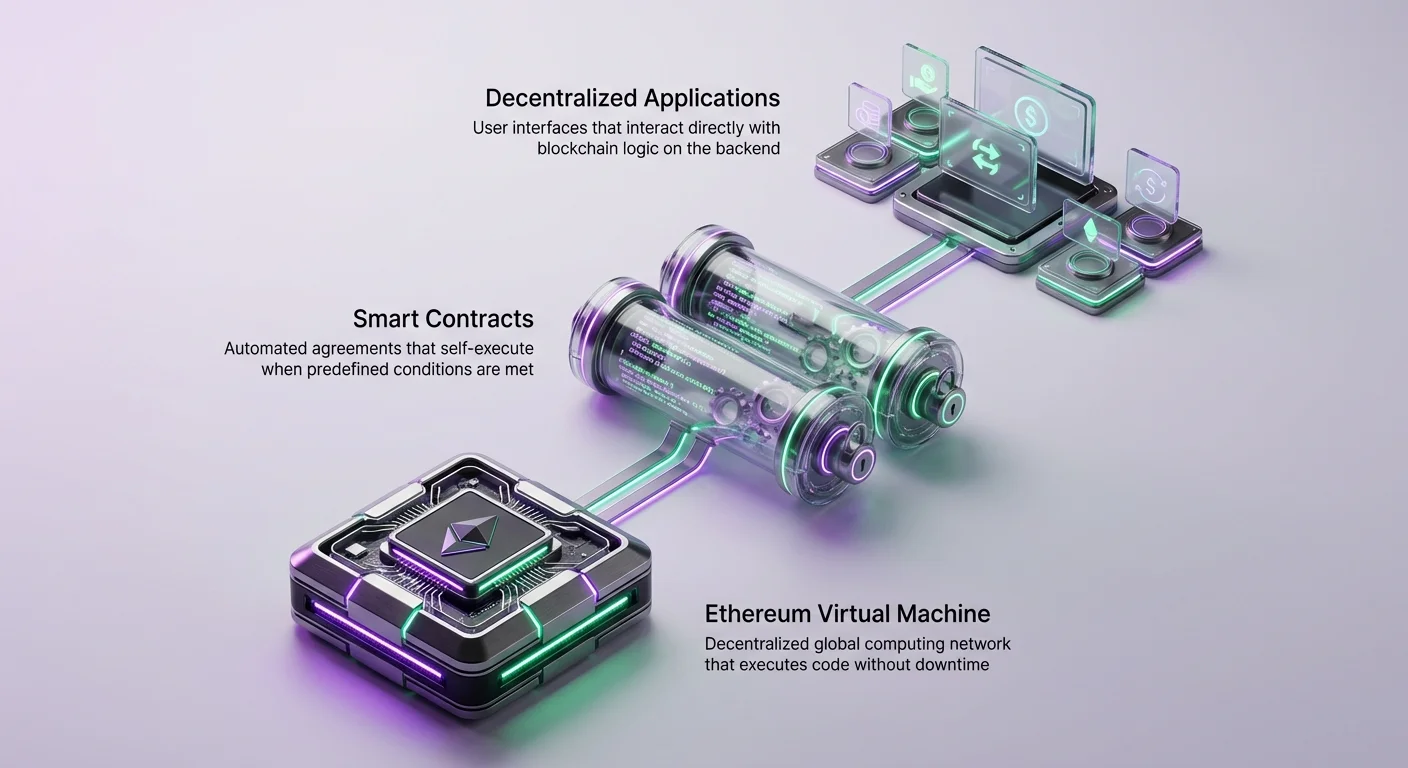
These programs run on a decentralized network of computers known as the Ethereum Virtual Machine (EVM). The EVM ensures that code executes exactly as written without downtime, censorship, or third-party interference. This infrastructure acts as the foundation for a new financial system that operates without traditional banks or intermediaries. Users can lend, borrow, trade, and earn interest on their assets directly on the blockchain.
The native cryptocurrency of the network is Ether (ETH). It is used to pay for transaction fees and computational services, a concept known as "gas." Every action on the network requires a small amount of ETH to process. This mechanism prevents spam and allocates network resources efficiently. Over time, the network has evolved from a simple payment layer into a complex ecosystem supporting billions of dollars in value.
The Mechanics of Decentralized Finance
Decentralized Finance, or DeFi, represents a shift from centralized financial institutions to peer-to-peer code. At the core of this ecosystem are smart contracts. These are self-executing contracts with the terms of the agreement directly written into code. They automatically enforce rules and execute transactions when specific criteria are met.
Smart Contracts and dApps
Smart contracts eliminate the need for trusted intermediaries. In a traditional setting, a lawyer or bank would verify a transaction. On Ethereum, the code performs this verification instantly and transparently. These contracts are the building blocks for decentralized applications, commonly referred to as dApps. DApps look like regular websites or mobile apps on the front end but interact with the blockchain on the back end.
When a user interacts with a dApp, they are essentially sending instructions to a smart contract. This could involve swapping one token for another or depositing assets into a savings protocol. Because the logic is open-source, anyone can audit the code to ensure it is secure and fair. This transparency is a fundamental characteristic of the Ethereum ecosystem. It builds trust through verification rather than reputation.
The Role of Token Standards
For DeFi to function smoothly, different applications need a way to speak the same language. Ethereum solved this through the introduction of token standards, most notably ERC-20. This standard defines a common list of rules for Ethereum tokens to follow. It allows developers to predict how new tokens will function within the larger ecosystem.
Because of ERC-20, a token created on one dApp can be easily exchanged or used in another dApp without custom coding. This interoperability is crucial for liquidity. It allows assets to flow freely between lending platforms, exchanges, and yield farming protocols. Stablecoins, governance tokens, and utility tokens all utilize this standard to ensure compatibility across the network.
Staking and Network Security
Ethereum originally utilized a Proof of Work consensus mechanism similar to Bitcoin. However, the network transitioned to Proof of Stake (PoS) to improve efficiency and scalability. This shift fundamentally changed how the network is secured and how new ETH is issued. Instead of using energy-intensive hardware to solve puzzles, the network relies on validators.
Validating Transactions
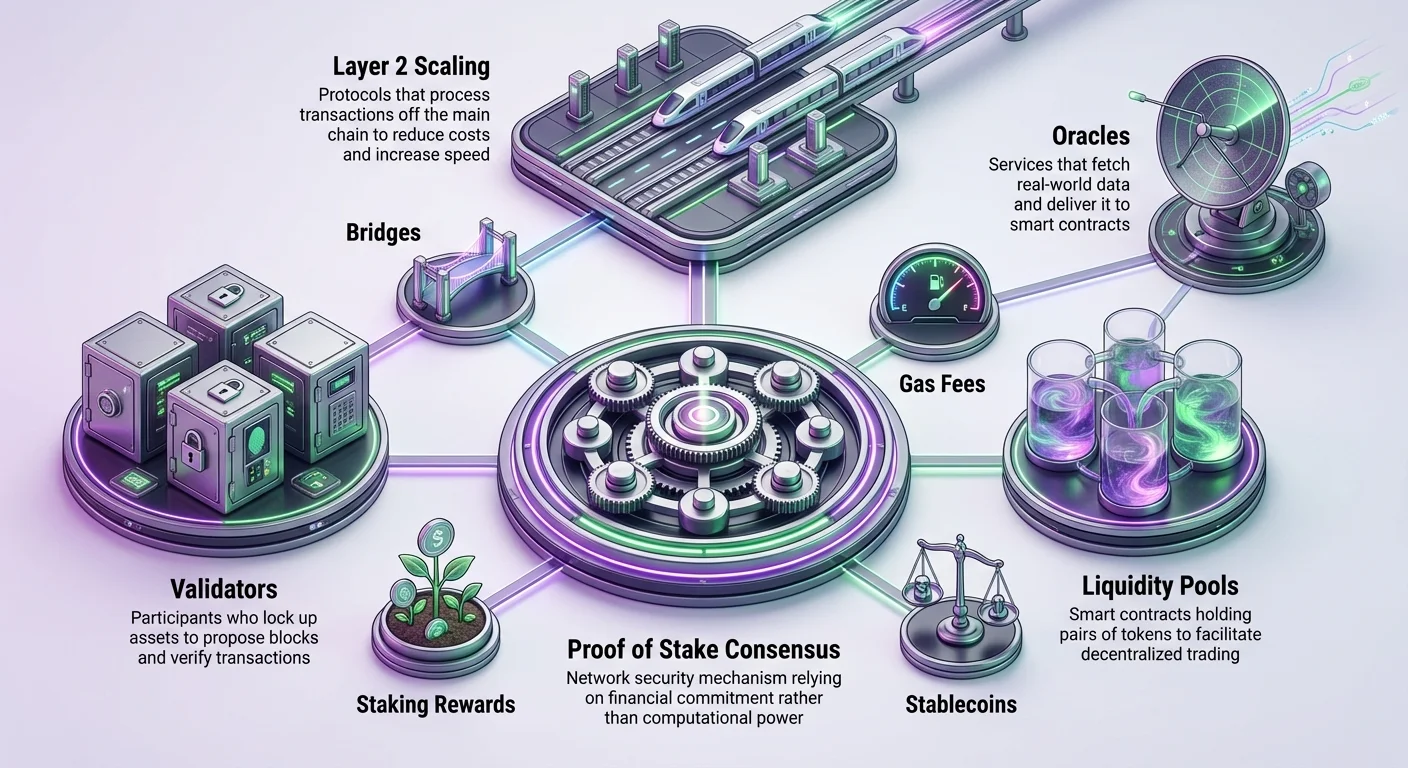
Validators are participants who lock up, or "stake," a specific amount of ETH into a smart contract. By doing so, they earn the right to propose new blocks of transactions and verify the work of others. This economic commitment acts as collateral to ensure honest behavior. If a validator attempts to attack the network or validates fraudulent transactions, they face financial penalties.
This process is known as "slashing." A portion of the validator's staked ETH is destroyed if they act maliciously or fail to maintain uptime. This creates a strong financial incentive to follow the rules. For users who do not have the required 32 ETH to become a full validator, staking pools offer an alternative. These services aggregate smaller amounts of ETH from multiple users to run a validator node.
Rewards and Economic Security
Staking provides a yield to participants in exchange for securing the network. This yield comes from two sources: issuance of new ETH and transaction priority fees. The annual percentage yield (APY) fluctuates based on network activity and the total amount of ETH staked. This system democratizes network security, allowing anyone with ETH to contribute and earn rewards.
The transition to PoS reduced Ethereum's energy consumption by over 99 percent. It also laid the groundwork for future scalability upgrades. By removing the reliance on physical mining hardware, the network became more sustainable and accessible. This evolution cemented staking as a core component of the DeFi economy, offering a "risk-free" rate of return within the crypto ecosystem.
Scaling with Layer 2 Solutions
As the popularity of DeFi grew, the Ethereum mainnet faced congestion issues. High demand for block space led to increasing gas fees, making small transactions economically unviable. To solve this, the ecosystem developed Layer 2 (L2) scaling solutions. These protocols operate on top of the main Ethereum blockchain (Layer 1) to handle transactions more efficiently.
Rollups and Transaction Bundling
Rollups are the most prominent form of Layer 2 technology. They work by executing transactions off the main chain and then bundling, or "rolling up," the data into a single batch. This batch is then posted to the Ethereum mainnet. By compressing multiple transactions into one, the cost is split among many users, drastically reducing fees.
There are two primary types of rollups: Optimistic and Zero-Knowledge (ZK). Optimistic rollups assume transactions are valid by default but allow a window for dispute. ZK-rollups use complex cryptography to prove the validity of transactions mathematically. Both methods inherit the robust security of the Ethereum mainnet while offering faster and cheaper processing.
Sidechains and Bridges
Sidechains offer another approach to scalability. These are distinct blockchains that run parallel to Ethereum. They have their own consensus mechanisms and security parameters. While they are compatible with the Ethereum Virtual Machine, they do not rely on the mainnet for security in the same way rollups do. This allows for even lower fees but comes with different trust assumptions.
To move assets between the mainnet, rollups, and sidechains, users utilize "bridges." Bridges are protocols that lock assets on one chain and mint a representation of them on another. This interconnectivity creates a multi-chain environment where users can choose the network that best fits their speed and cost requirements.
| Feature | Layer 1 (Mainnet) | Layer 2 (Rollups) | Sidechains |
|---|---|---|---|
| Security | Highest (Global) | Derived from L1 | Independent |
| Cost | High | Low | Very Low |
| Speed | Slow | Fast | Very Fast |
The Role of Decentralized Exchanges
Decentralized Exchanges (DEXs) are critical infrastructure in the DeFi landscape. unlike centralized counterparts, DEXs allow users to trade digital assets directly from their self-custodial wallets. There is no need to deposit funds into an exchange account or trust a third party with custody. The trading occurs entirely through smart contracts.
Most DEXs utilize a model called the Automated Market Maker (AMM). Instead of matching buyers and sellers using an order book, AMMs rely on liquidity pools. A liquidity pool is a smart contract that holds pairs of tokens. Users, called liquidity providers (LPs), deposit equal values of two tokens into these pools.
When a trader wants to swap ETH for a stablecoin, they trade against the liquidity in the pool rather than a specific counterparty. The price is determined algorithmically based on the ratio of assets in the pool. In return for supplying capital, liquidity providers earn a portion of the trading fees. This system ensures that liquidity is available 24/7 without reliance on professional market makers.
However, providing liquidity comes with risks, such as impermanent loss. This occurs when the price of the deposited assets changes significantly compared to when they were deposited. Despite this, AMMs have revolutionized trading by making market-making accessible to anyone.
Stablecoins and Financial Stability
The volatility of cryptocurrencies like ETH can be a barrier for everyday financial activities. Stablecoins address this issue by pegging their value to a stable asset, typically the US Dollar. In the Ethereum DeFi ecosystem, stablecoins serve as a safe harbor for traders and a reliable medium of exchange.
There are different types of stablecoins used on the network. Fiat-collateralized stablecoins, like USDC and USDT, are backed by reserves of traditional currency held by a central issuer. Crypto-collateralized stablecoins, such as DAI, are generated by locking up cryptocurrency assets in a smart contract. These are over-collateralized to account for price fluctuations in the backing asset.
Stablecoins are essential for lending and borrowing markets. Users can deposit volatile assets like ETH as collateral to borrow stablecoins. This allows them to access liquidity without selling their long-term holdings. Conversely, lenders can deposit stablecoins to earn interest, often at rates higher than traditional savings accounts. This interplay between volatile assets and stable currency powers much of the DeFi economy.
Oracles and Real-World Data
Blockchains are isolated environments. They cannot inherently access data from the outside world, such as stock prices, weather data, or sports results. This limitation is solved by "oracles." Oracles are services that fetch off-chain data and deliver it to smart contracts on the blockchain.
For example, a lending protocol needs to know the current market price of ETH to determine if a borrower's loan is under-collateralized. An oracle network, like Chainlink, aggregates price data from multiple sources and feeds it into the smart contract. This ensures that the data is accurate and resistant to manipulation.
Without oracles, many DeFi applications would not be possible. They serve as the bridge between the deterministic world of the blockchain and the dynamic real world. As DeFi expands into more complex financial products like derivatives and insurance, the reliance on secure and decentralized oracles becomes even more critical.
Restaking and Yield Farming
As the ecosystem matures, new mechanisms for earning yield have emerged. "Yield farming" involves moving assets between different protocols to maximize returns. Sophisticated users constantly seek the highest interest rates and token incentives across lending platforms and liquidity pools.
A more recent innovation is "restaking." This concept allows staked ETH, which is already securing the Ethereum network, to be used simultaneously to secure other protocols. By "restaking" their assets, validators can provide security to oracle networks, bridges, or sidechains. In return, they earn additional rewards on top of their base ETH staking yield.
This increases capital efficiency significantly. The same asset serves multiple security purposes. However, it also introduces new risks. If a validator behaves maliciously in the secondary protocol, their staked ETH could be slashed. Users must carefully weigh the potential for higher rewards against the increased complexity and risk of compounding leverage.
Governance and the Roadmap
Ethereum is not a static system; it is constantly upgrading. Changes to the network are proposed through Ethereum Improvement Proposals (EIPs). Governance happens off-chain through social consensus among developers, researchers, and the community, and on-chain through validator adoption.
Significant upgrades, such as EIP-1559, have altered the network's monetary policy by burning a portion of transaction fees. This mechanism links network usage directly to the scarcity of ETH. When activity is high, more ETH is burned, potentially making the asset deflationary.
Looking forward, the roadmap focuses on further scaling. Concepts like "sharding" aim to split the network into smaller pieces, or "shards," to process transactions in parallel. While Layer 2 solutions handle immediate scaling needs, sharding remains a long-term goal to increase the capacity of the base layer.
The network also prioritizes decentralization and censorship resistance. Developers are working on making it easier to run node software on consumer hardware. This ensures that the power to verify the ledger remains distributed across thousands of independent users rather than concentrated in large data centers.
Conclusion
Ethereum has established itself as the backbone of the decentralized finance economy. By providing a trustless, programmable infrastructure, it has enabled the creation of financial services that are open to anyone with an internet connection. From simple token swaps on DEXs to complex lending markets and restaking protocols, the utility of the network continues to expand.
The transition to Proof of Stake and the adoption of Layer 2 solutions address critical challenges regarding energy efficiency and scalability. As the roadmap progresses, the integration of stablecoins, oracles, and advanced governance mechanisms will likely drive further adoption. The ecosystem remains a work in progress, constantly evolving to meet the demands of global finance.
Ethereum transforms static digital assets into a dynamic, programmable economy accessible to everyone worldwide.