
The digital asset landscape is dominated by two giants that are frequently grouped together yet possess radically different DNA. Bitcoin and Ethereum represent the two primary poles of the cryptocurrency ecosystem. While casual observers often view them as competitors vying for the same market share, a deeper analysis reveals that they are designed to solve entirely different problems. They operate on distinct technological foundations and adhere to diverging economic philosophies.
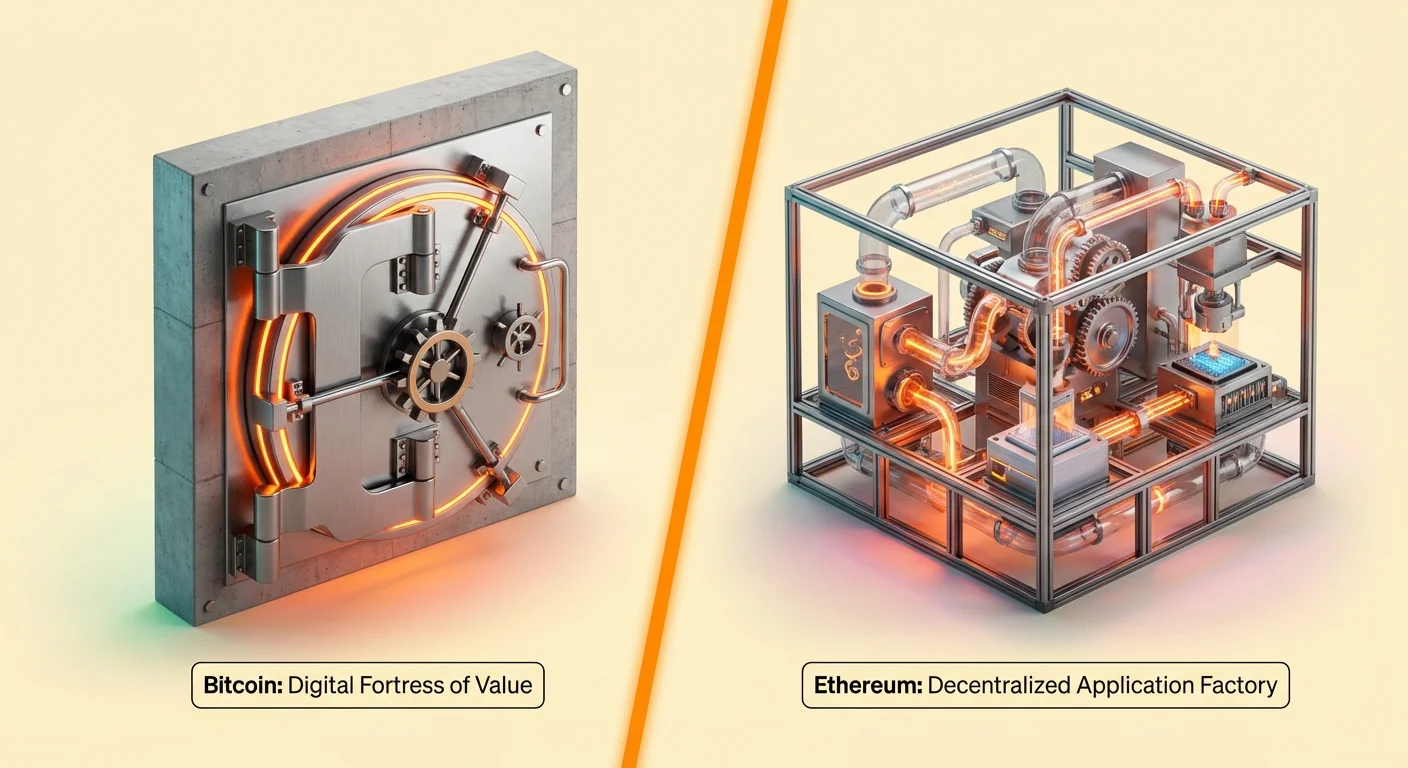
Understanding the relationship between these two networks requires moving beyond price comparisons. It involves examining the architectural decisions made by their creators. Bitcoin was built to be a fortress of value, prioritizing security and immutability above all else. Ethereum was built to be a factory for applications, prioritizing flexibility and innovation.
These fundamental differences influence everything from their monetary policies to their governance structures. Investors and users must recognize that holding Bitcoin and holding Ethereum are bets on different futures. One is a bet on a new form of money. The other is a bet on a new infrastructure for the internet itself.
The Genesis of Divergent Philosophies
The origin stories of Bitcoin and Ethereum provide the necessary context for understanding their current trajectories. They were born in different eras of the crypto timeline and were responses to different limitations in the digital world.
Bitcoin: A Response to Financial Crisis
Bitcoin emerged from the wreckage of the 2008 global financial crisis. Its creator, the pseudonymous Satoshi Nakamoto, designed the protocol as a direct counter-measure to the failures of centralized banking. The whitepaper titled "A Peer-to-Peer Electronic Cash System" outlined a specific vision: a decentralized currency that did not require trusted third parties.
The philosophy behind Bitcoin is singular and focused. It aims to be the hardest form of money ever invented. Every design choice in Bitcoin’s code prioritizes the preservation of the ledger’s integrity. It is not trying to be a social network, a gaming platform, or a legal system. It is trying to be money that cannot be debased, censored, or confiscated.
This singular focus is why Bitcoin development moves slowly. In the philosophy of Bitcoin, change is a risk. Stability is the ultimate feature. The goal is to create a monetary standard that remains predictable over decades or even centuries. This conservatism is not a bug; it is the primary value proposition for those seeking a digital store of value comparable to gold.
Ethereum: The Quest for Programmability
Ethereum was proposed in late 2013 by Vitalik Buterin, a programmer who had previously worked in the Bitcoin ecosystem. Buterin recognized the power of the blockchain technology underlying Bitcoin but felt its functionality was too limited. Bitcoin was designed to act like a calculator—perfect for one specific task. Buterin wanted to build a smartphone—a platform that could run any application developers could imagine.
The philosophy of Ethereum is one of expansive utility. It envisions a "World Computer," a globally distributed machine that anyone can use to run code. This code takes the form of smart contracts, which are self-executing agreements written directly into the blockchain.
Because Ethereum aims to support a vast ecosystem of decentralized applications (DApps), non-fungible tokens (NFTs), and decentralized finance (DeFi) protocols, it must be more flexible than Bitcoin. This requirement for flexibility has led to a culture of rapid innovation and frequent upgrades. While Bitcoin strives for ossification and stability, Ethereum strives for continuous evolution to meet the changing needs of its user base.
Comparing Consensus Mechanisms
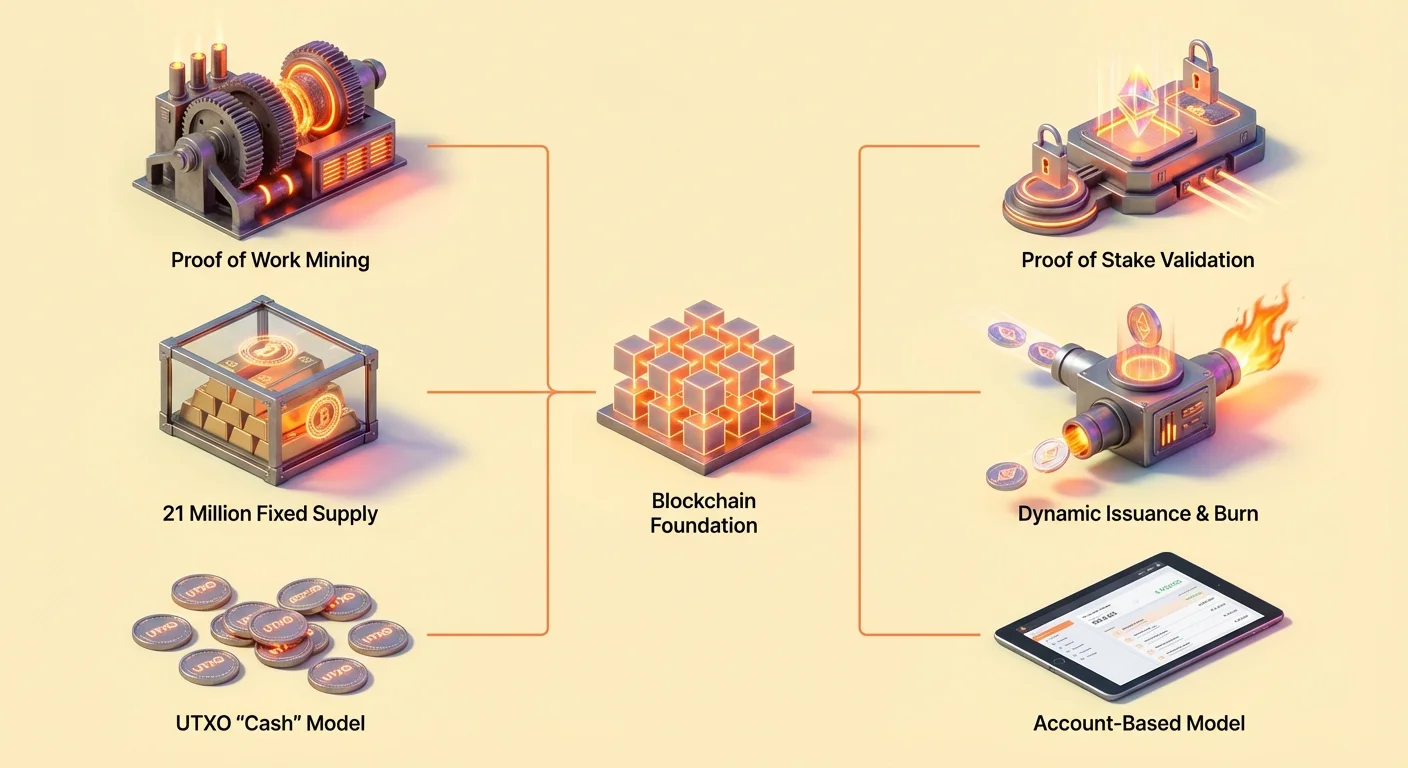
The engine that secures a blockchain is known as its consensus mechanism. This is the set of rules that allows thousands of independent computers, or nodes, to agree on the state of the ledger without a central authority. Bitcoin and Ethereum now utilize entirely different engines to achieve this goal.
Bitcoin's Proof of Work: Energy as Security
Bitcoin operates on a consensus mechanism known as Proof of Work (PoW). In this system, participants called miners compete to solve complex mathematical puzzles. The solution to these puzzles requires a significant expenditure of computational power and electricity.
The consumption of energy is a feature, not a flaw, of the Bitcoin security model. By tethering the digital ledger to physical resources (hardware and electricity), Bitcoin creates an unforgeable cost of production. To attack the network or rewrite history, an attacker would need to command more computing power than all other miners combined. This is an incredibly expensive and logistical challenge that protects the network from state-level actors.
Proof of Work creates an objective reality. The chain with the most accumulated work is the valid chain. This mechanism is simple, battle-tested, and extremely robust. It aligns the incentives of miners with the health of the network, as they must sell the bitcoin they earn to pay their electricity bills.
Ethereum's Proof of Stake: Economic Security
Ethereum originally launched with Proof of Work but transitioned to Proof of Stake (PoS) in a monumental upgrade known as "The Merge." In a Proof of Stake system, the network is secured not by energy expenditure, but by capital commitment.
Validators in Ethereum replace miners. Instead of burning energy, they "stake" or lock up their own ETH tokens as a security bond. If a validator acts maliciously or fails to validate transactions correctly, a portion of their staked ETH is destroyed or "slashed." This creates a direct economic penalty for bad behavior.
The shift to Proof of Stake reduced Ethereum’s energy consumption by over 99%. It also changed the economic structure of the asset. In PoS, the security of the network is derived from the value of the asset itself. The more valuable ETH is, the more expensive it becomes to attack the network, as an attacker would need to acquire a majority of the staked tokens.
Monetary Policy and Economic Design
The economic profiles of Bitcoin and Ethereum differ as much as their technical architectures. Investors often look at these "tokenomics" to determine the long-term value potential of the assets.
The 21 Million Hard Cap
Bitcoin’s monetary policy is etched in stone. There will only ever be 21 million bitcoins. This fixed supply is the cornerstone of its value proposition as a hedge against inflation. Unlike fiat currencies, which central banks can print in unlimited quantities, Bitcoin has a mathematically enforced scarcity.
New bitcoins are issued to miners as a reward for securing the network. However, this issuance rate is cut in half approximately every four years in an event known as the "halving". This programmatic reduction in supply issuance ensures that Bitcoin becomes scarcer over time until the final bitcoin is mined around the year 2140.
This predictability allows market participants to model the supply of Bitcoin with absolute certainty. There are no governance votes or committees that can decide to increase the supply cap. This rigid monetary policy is why Bitcoin is frequently compared to gold and treated as a premier store of value.
Dynamic Issuance and the Burn Mechanism
Ethereum does not have a hard cap on its total supply. Theoretically, the supply of ETH could grow indefinitely. However, its monetary policy is dynamic and has evolved to become what proponents call "ultra-sound money."
Ethereum’s supply is determined by two opposing forces: issuance and burning. New ETH is issued to pay validators for securing the network. Simultaneously, a portion of the transaction fees paid by users is permanently destroyed, or "burned."
When the Ethereum network is busy and transaction fees are high, the amount of ETH being burned can exceed the amount being created. This turns ETH into a deflationary asset during periods of high demand. Unlike Bitcoin’s fixed schedule, Ethereum’s supply fluctuates based on the economic activity of the network. This links the scarcity of the asset directly to the utility and adoption of the platform.
The Technical Architecture: UTXO vs Accounts
At the database level, Bitcoin and Ethereum record ownership in fundamentally different ways. These technical models define how transactions are constructed and how privacy is handled.
Bitcoin's Digital Cash Model (UTXO)
Bitcoin uses the Unspent Transaction Output (UTXO) model. This functions similarly to physical cash. If you have a $20 bill and buy a $5 item, you don't simply subtract 5 from 20 in a database. You hand over the $20 bill and receive the item plus $15 in change.
In Bitcoin, users do not have "accounts" with balances. Instead, they hold various chunks of bitcoin (UTXOs) that are locked to their address. When a user sends a transaction, they are gathering these chunks, melting them down, sending the specific amount to the recipient, and sending the remainder back to themselves as change.
This model is exceptional for privacy and scalability verification. Because each transaction output is a discrete object, it is easier to track the history of every specific coin. It also allows for parallel processing of transactions, as different UTXOs can be spent simultaneously without conflict.
Ethereum's Global State Model (Accounts)
Ethereum utilizes an account-based model, which is more similar to how a traditional bank operates. The global state of Ethereum tracks a list of accounts and their current balances. When a transaction occurs, the network simply debits the sender's account and credits the receiver's account.
This model was chosen because it is far more efficient for complex applications. Smart contracts often need to interact with the state of the network, check balances, and transfer data between multiple parties. The UTXO model makes this type of programmable logic cumbersome and difficult to implement.
However, the account model presents challenges for privacy. Since users typically reuse a single account for all their interactions, it is easier for observers to link a comprehensive history of activity to a single identity. It also requires transactions to be processed sequentially, which creates bottlenecks for scalability.
Programmability and the Scope of Innovation
The primary divergence in utility stems from the programming languages and execution environments built into these blockchains. This is where the "Money vs. Platform" distinction becomes most visible.
Bitcoin's Intentional Limitations
Bitcoin uses a scripting language that is intentionally limited. It is not "Turing complete," meaning it cannot perform complex loops or intricate logic. This was a deliberate security choice by Satoshi Nakamoto.
By restricting what programmers can do on the base layer of Bitcoin, the attack surface is minimized. There is less room for bugs, infinite loops, or smart contract exploits that could drain funds. Bitcoin prioritizes safety over functionality. The script is designed primarily to handle the locking and unlocking of value (signatures) and basic conditions like time-locks or multi-signature requirements.
This simplicity makes Bitcoin incredibly robust. It rarely breaks because there are fewer moving parts that can break. The focus remains entirely on the secure transmission of value.
Ethereum's Turing Completeness
Ethereum features the Ethereum Virtual Machine (EVM), which creates a Turing-complete environment. This means developers can write code that performs any computational task, provided there are enough resources (gas) to run it.
The primary language for Ethereum, Solidity, allows for the creation of decentralized applications that mimic and expand upon traditional software. Developers can build decentralized exchanges (DEXs), lending protocols, stablecoins, and gaming economies.
This expressiveness comes with trade-offs. The complexity of smart contracts introduces the risk of coding errors. History has seen numerous hacks and exploits within the Ethereum ecosystem where flaws in smart contract logic allowed attackers to steal funds. However, this risk is accepted as the price of enabling a permissionless innovation sandbox.
| Feature | Bitcoin (BTC) | Ethereum (ETH) |
|---|---|---|
| Primary Purpose | Decentralized Money / Store of Value | Platform for Decentralized Apps |
| Consensus | Proof of Work (PoW) | Proof of Stake (PoS) |
| Supply Policy | Hard Cap (21 Million) | Dynamic (Issuance vs Burn) |
| Transaction Model | UTXO (Cash-like) | Account-based (Bank-like) |
| Scripting | Limited (Security focus) | Turing Complete (Flexibility focus) |
Scalability and Future Roadmaps
Both networks face the "trilemma" of blockchain: the challenge of achieving decentralization, security, and scalability simultaneously. As adoption has grown, both Bitcoin and Ethereum have become congested, leading to high fees. Their approaches to solving this problem highlight their philosophical differences.
Layer 2 Solutions and Lightning
Bitcoin addresses scalability through a layered approach. The base layer (Layer 1) is kept small and secure, with limited block space. High-frequency transactions are pushed to Layer 2 networks, most notably the Lightning Network.
The Lightning Network allows users to open payment channels between each other. They can transact back and forth thousands of times instantly and with near-zero fees. Only the final result of these transactions is settled on the main Bitcoin blockchain.
This approach preserves the decentralization of the main chain. It ensures that ordinary users can still run a node and verify the ledger without needing a supercomputer. Bitcoin proponents argue that scaling on the base layer would bloat the blockchain, making it too difficult for individuals to audit, thus leading to centralization.
Sharding and Optimistic Rollups
Ethereum is also embracing Layer 2 solutions but is taking a more aggressive approach to scaling its base layer data capacity. Ethereum’s roadmap includes complex upgrades like "sharding," which involves splitting the database into smaller pieces to allow for parallel processing.
Currently, the Ethereum ecosystem relies heavily on "Rollups" (like Optimism and Arbitrum). These are separate blockchains that execute transactions off-chain, bundle them together into a single piece of data, and then post that data to the main Ethereum chain.
While Bitcoin’s scaling is focused on payments, Ethereum’s scaling solutions must accommodate complex smart contract data. This makes the engineering challenge significantly harder. Ethereum’s roadmap involves changing the core protocol frequently to make these Layer 2 solutions cheaper and more efficient.
Cultural Values and Governance
Beyond the code, Bitcoin and Ethereum are sustained by communities with distinct values. These "social layers" determine how decisions are made and how the protocols evolve.
Immutability and Ossification
The Bitcoin culture values immutability above all else. The community is extremely resistant to hard forks or changes to the consensus rules. The governance process is informal and relies on a slow-moving consensus among developers, miners, and node operators.
The ideal state for Bitcoin, according to many proponents, is "ossification." This means the protocol becomes so stable that it essentially stops changing, much like the protocols that run the internet (TCP/IP). This reliability allows companies and nations to build on top of Bitcoin with the assurance that the foundation will not shift beneath them.
Agility and Upgradability
The Ethereum community values progress and agility. They view the blockchain as software that should be improved. The governance process is more structured, with core developers and researchers playing a significant role in setting the roadmap.
Ethereum users generally accept that the network is a work in progress. They are willing to undergo hard forks (mandatory software upgrades) to implement new features or improve efficiency. This culture attracts developers who want to experiment with the cutting edge of cryptographic technology.
However, this agility creates complexity. Keeping up with Ethereum’s changes requires constant attention from developers and infrastructure providers. It effectively trades some long-term stability for short-term innovation capability.
The Role of the Asset
Ultimately, the differences in philosophy lead to different classifications for the assets themselves.
Bitcoin is viewed primarily as a capital asset. It is "digital gold"—a bearer asset that is held for the long term. Its value is derived from its scarcity and its ability to be transferred without permission. It competes with fiat currencies, gold, and treasury bonds.
Ether serves a dual role. It is a store of value, but it is also a commodity. ETH is the "fuel" or "gas" required to run the Ethereum World Computer. Every time a user interacts with a DApp or moves a token, they must pay a fee in ETH. This gives Ether fundamental utility demand. As the ecosystem of applications grows, the demand for the ETH required to use them grows with it.
Conclusion
Bitcoin and Ethereum are not merely two different cryptocurrencies; they are the physical manifestations of two different digital theories. Bitcoin is a completed thesis on the nature of money. It asserts that for a digital currency to have value, it must be scarce, immutable, and resistant to change. It sacrifices speed and flexibility to ensure it remains the most secure network in the world.
Ethereum is an unfolding experiment on the nature of the internet. It asserts that blockchain technology should be a canvas for creation. It sacrifices simplicity and pure stability to provide a platform where finance, art, and governance can be rewritten in code. It accepts the risks of complexity to achieve the rewards of utility.
Both assets have carved out critical roles in the digital economy. Bitcoin provides the foundation of safety and savings, while Ethereum provides the infrastructure for commerce and interaction. Recognizing the fundamental differences in their purpose allows for a more sophisticated view of the crypto market, where these two giants coexist not as enemies, but as specialized tools for a decentralized future.
Bitcoin is the digital fortress for your wealth; Ethereum is the digital factory for your applications.