
Svijet kriptovaluta, posebice Bitcoin, često se čini zastrt zastrašujućim žargonom, složenim kodom i visokim financijskim preprekama. Čujete pojmove poput „blockchain“, „decentralization“ i „mining“, što može učiniti da početak vašeg edukativnog putovanja bude zastrašujući.
Ovaj vodič probija kroz složenost. Cilj nam je pružiti jednostavnu, netehničku definiciju Bitcoina, usredotočenu na njegovu korisnost i ključne komponente. Ključno je da ćemo riješiti najveću zabludu koja sprječava većinu novopridošlih da naprave prvi korak: percepciju visoke cijene. Uvođenjem skale Satoshi (ili „sat“) odmah, preoblikovat ćemo pristupačnost Bitcoina i pokazati vam kako danas početi graditi svoj udjel, bez obzira na iznos koji imate za ulaganje.
Zamislite ovu stranicu kao vaš prijateljski ulazak u digitalnu ekonomiju. Razbijamo osnove onoga što je Bitcoin, kako se mjeri i kako mu pristupiti, postavljajući pozornicu za samouverenost.
Što je točno *Bitcoin*? Jednostavna definicija
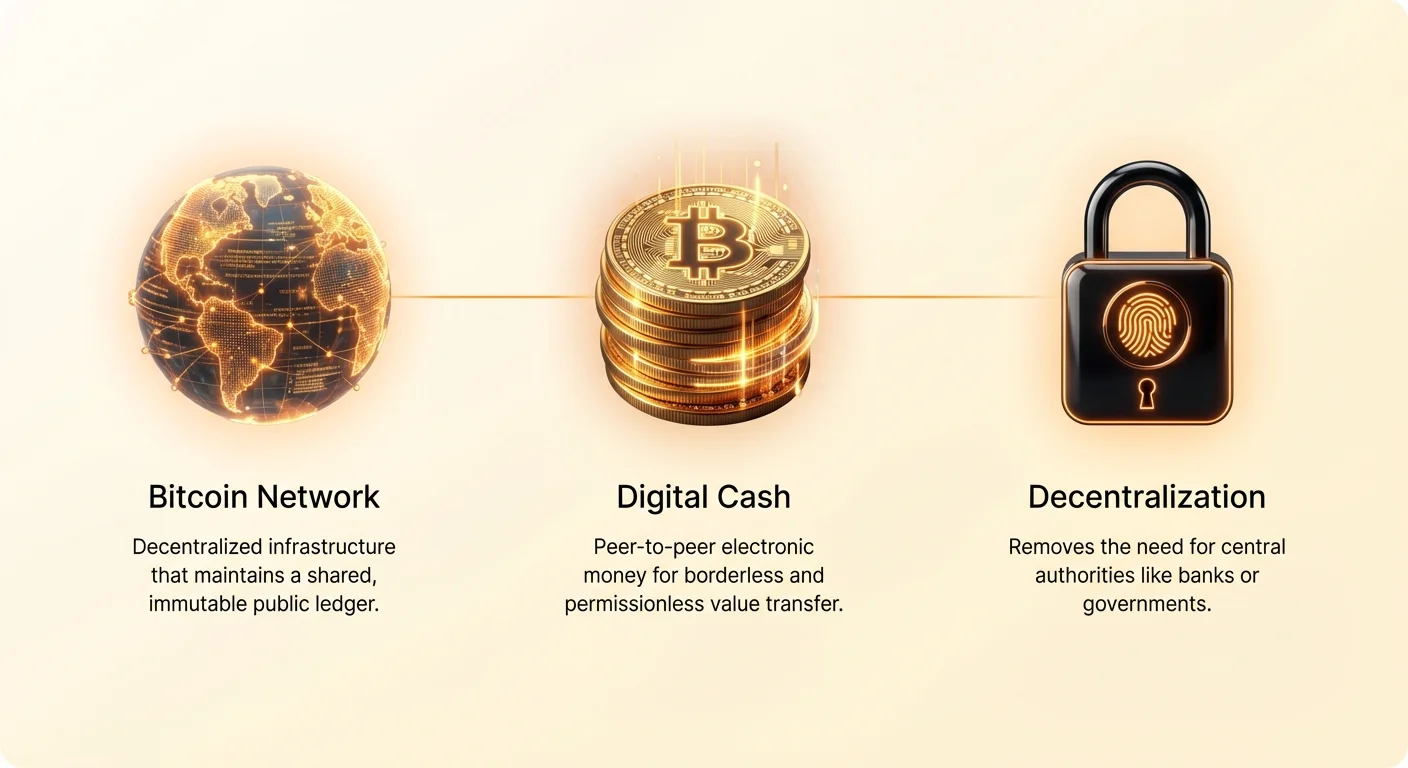
U svom jezgru, Bitcoin je jednostavno oblik digitalnog novca osmišljen da radi bez centralne kontrole, poput banke ili vlade. To je peer-to-peer sustav elektroničke gotovine. Da biste razumjeli njegovu revolucionarnu prirodu, morate shvatiti da je „Bitcoin“ zapravo dvije stvari: valuta (BTC token) i mreža (tehnološka infrastruktura).
Bitcoin kao digitalna gotovina (Slučaj upotrebe)
Zamislimo gotovinu u vašem džepu. Ona je fizička, fungibilna (što znači da je jedan dolar jednak svakom drugom dolaru), i možete je izravno razmijeniti s drugom osobom bez potrebe za trećom stranom poput banke koja odobrava transakciju.
Bitcoin je osmišljen da digitalno replicira te osobine, ali s nekoliko ključnih poboljšanja:
- Bez granica: Vrijednost možete poslati diljem svijeta jednako lako kao što šaljete e-poštu.
- Bez dopuštenja: Nijedna banka vas ne može spriječiti u slanju ili primanju sredstava.
- Rijedak: Za razliku od tradicionalnih valuta koje vlade mogu beskonačno tiskati, ukupna ponuda Bitcoina ograničena je na 21 milijun jedinica.
Bitcoin kao decentralizirana knjiga računa (Tehnologija)
Ako je Bitcoin digitalna gotovina, kako znati tko što posjeduje bez centralne banke koja prati stanja? Tu dolazi mrežni aspekt — osnovna tehnologija poznata kao blockchain.
Zamislimo Bitcoin mrežu kao ogromnu, javnu, dijeljenu Excel tablicu koju milijuni računala diljem svijeta neprestano održavaju i provjeravaju. Ova knjiga računa sadrži zapis svake transakcije koja je ikada izvršena.
- Decentralizirano: Nijedna osoba ili entitet ne kontrolira ovu tablicu. Ako jedno računalo padne, milijuni drugih još uvijek drže zapis.
- Nepromjenjivo (trajno): Čim se transakcija doda u knjigu računa („blok“), ne može se promijeniti ili izbrisati. Ova trajnost stvara povjerenje u sustav.
Kako Bitcoin rješava problem „double-spend“ (bez povjerenja)
Povijesno, digitalni novac imao je jedan veliki nedostatak: problem „double-spend“. Ako imam digitalnu datoteku (novac), što me sprječava da istovremeno pošaljem kopiju te datoteke dvjema različitim osobama?
Tradicionalno bankarstvo riješilo je to centralnim autoritetom (bankom) koji prati stanja i odbija drugu transakciju. Bitcoin ga je riješio pomoću kriptografije i decentralizirane mreže. Globalna mreža neprestano provjerava da se kada šaljete BTC, izvorni iznos istovremeno uklanja s vašeg raspoloživog stanja, čineći matematički nemogućim potrošiti istu jedinicu dva puta. Taj sustav omogućuje trustless razmjenu — ne morate vjerovati drugoj strani ili banci; trebate vjerovati samo matematici i kôdu otvorenog izvora.
The Biggest Misconception: Bitcoin is Too Expensive
When newcomers first look at Bitcoin, they often see a price tag in the tens of thousands of dollars. This immediately leads to the conclusion: "I can't afford Bitcoin." This is perhaps the most significant barrier to entry, but it is based on a fundamental misunderstanding of the unit of account.
Why the Price Tag is Deceptive
If you want to buy gold, you don't have to buy an entire 400-ounce bar. You can buy one ounce, a gram, or even a tiny fraction of a gram. Bitcoin works the exact same way.
The price you see quoted on exchanges—say, $70,000—is the price for one whole Bitcoin (1 BTC). However, Bitcoin is highly divisible, far more divisible than any traditional currency. Because the market always quotes the price of a whole BTC, beginners are tricked into thinking they need to purchase the entire unit. You absolutely do not.
The Solution: Meet the Satoshi (The Smallest Unit)
The key to understanding Bitcoin affordability is recognizing its smallest denomination: the Satoshi, or simply "sat."
The Satoshi is named after the pseudonymous creator of Bitcoin, Satoshi Nakamoto. It serves the same function for Bitcoin that a penny serves for the U.S. Dollar, but on a vastly larger scale.
1 Whole Bitcoin (1 BTC) is divisible into 100,000,000 Satoshis.
This means that you can buy and own a tiny fraction of a Bitcoin, down to one hundred-millionth of a single coin. When you buy $50 worth of Bitcoin, you are purchasing thousands, or even hundreds of thousands, of Satoshis, depending on the current price.
The Sat Scale: Thinking in Smaller Units
Adopting the "sat scale" is more than just a mathematical exercise; it’s a necessary mental shift for successful, stress-free investing in Bitcoin. It transforms Bitcoin from an abstract, high-priced asset into an accessible savings technology.
Breaking Down the Math: 1 BTC = 100,000,000 Sats
Understanding the relationship between the whole unit (BTC) and the micro-unit (sats) is critical for tracking your investments. Bitcoin transactions are actually calculated in Satoshis on the network.
Here is the simple breakdown:
| Unit | Decimal Equivalent (of 1 BTC) | Number of Satoshis |
|---|---|---|
| 1 BTC | 1.0 | 100,000,000 |
| 0.1 BTC | 0.1 | 10,000,000 |
| 0.01 BTC | 0.01 | 1,000,000 |
| 0.001 BTC | 0.001 | 100,000 |
| 0.00001 BTC | 0.00001 | 1,000 |
| 0.00000001 BTC | 0.00000001 | 1 Sat |
When you decide to purchase $25 of Bitcoin, you are not chasing the price of the whole coin; you are acquiring a specific quantity of Satoshis.
Practical Mental Modeling (The "Penny" Analogy)
To make sats tangible, adopt this analogy:
- The Dollar Analogy: If the U.S. Dollar were divisible by 100 million, the highest bill would be a $100 Million Bill (1 BTC), and the smallest unit you could transact with would be a "millipenny" (1 Sat).
- The Investment Mindset: Instead of focusing on owning "one Bitcoin" (which feels unattainable), focus on accumulating a target number of Satoshis (e.g., "I want to save 5 million sats this year").
This reframing is essential for using the DCA (Dollar-Cost Averaging) investment strategy, where you regularly buy small amounts of sats over time, minimizing the stress of short-term price fluctuations. When you think in sats, volatility becomes less intimidating; you simply know you acquired a certain number of digital savings units that day.
Why Buying Sats Makes Sense for Beginners
- Affordability: You can start with $1 or $10. There is no minimum investment beyond what the exchange requires.
- Goal Setting: Setting goals in sats (e.g., reaching 1 million sats) is far more motivating and measurable than trying to achieve 1.0 BTC.
- Future-Proofing: Many experts believe that as the price of Bitcoin continues to appreciate over decades, the primary unit of account used in daily transactions may eventually shift from BTC to sats. Thinking in sats now prepares you for that future.
Actionable Tip: When you buy Bitcoin on an exchange, switch the display setting (if available) from BTC to Sats. This reinforces the mental model that you are accumulating thousands of units, not just tiny fractions of a whole coin.
Accessing Your Bitcoin: A Brief Look at Wallets
Once you understand what Bitcoin is and how it’s measured in Satoshis, the next natural question is: How do I hold and access my money? The answer is through a Bitcoin Wallet.
A Bitcoin wallet is not a physical place where your BTC is stored. Remember, Bitcoin lives permanently on the global, decentralized ledger (the blockchain). Your wallet is simply the tool that holds the necessary cryptographic keys allowing you to prove ownership and authorize transactions.
What is a Wallet Address? (The Public Key)
When you set up a Bitcoin wallet, the first thing you generate is your public key, or wallet address.
- Analogy: This is your public bank account number or email address.
- Function: This is the address you give to someone when you want to receive Bitcoin (sats). It is public and safe to share. It allows others to see your balance on the public ledger, but they cannot spend your money.
The Key to Your Wealth: Private Keys (The Secret)
The most critical component of your wallet is the private key.
- Analogy: This is your PIN, bank login password, and authorization signature all rolled into one.
- Function: The private key is a highly sensitive piece of data (usually represented by a 12- or 24-word "seed phrase") that mathematically proves you own the Satoshis associated with your public address. If someone gains access to your private key, they can steal all your funds. If you lose your private key, your funds are permanently locked away.
In Bitcoin, you are your own bank, which means you are solely responsible for protecting your private key.
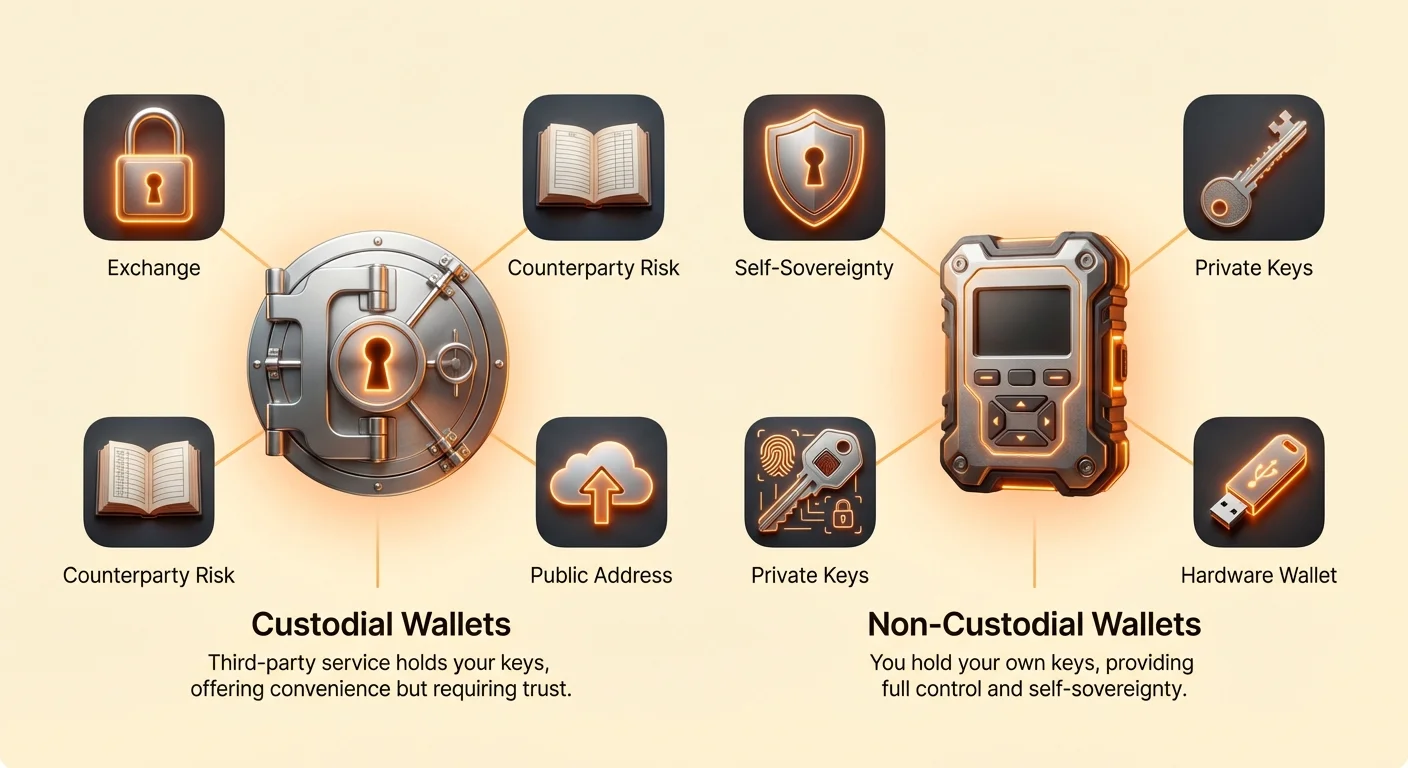
Custodial vs. Non-Custodial Wallets
Choosing a wallet is one of the first major decisions a newcomer makes, and it boils down to where the private key is stored.
| Wallet Type | Who Holds the Private Key? | Best For | Risk/Benefit |
|---|---|---|---|
| Custodial | A third-party service (e.g., a major exchange). | Absolute beginners; small testing amounts. | Benefit: If you forget your password, the exchange can recover access. Risk: You must trust the third party not to be hacked or freeze your assets. (Not self-sovereign.) |
| Non-Custodial | Only you hold the key (on a personal device or hardware). | Anyone seeking true financial freedom and control. | Benefit: You have 100% control and ownership; no third party can freeze your funds. Risk: If you lose the keys, your funds are gone forever. (Requires security discipline.) |
The choice between these two types directly impacts your level of self-sovereignty. While custodial wallets offer convenience, moving toward a non-custodial wallet is the necessary step for truly embracing the ethos of Bitcoin. (We explore this decision in detail in the next guide.)
Zaključak: Započnite svoje putovanje u satsima
Bitcoin je revolucionarna financijska tehnologija – decentralizirana, transparentna i oskudna digitalna valuta potkrijepljena trajnim knjigovodstvom.
Najveći zaključak za svakog početnika trebao bi biti ovaj: Bitcoin nije preskup. Prepoznajući Satoshijevu skalu, shvaćate da možete odmah sudjelovati u ovom novom financijskom sustavu, pretvarajući male, redovite uštede u dugoročnu samovladavinu.
Vaši sljedeći koraci uključuju prijelaz s teorije na praksu: postavljanje prvog novčanika (nekustodialni novčanici visoko su preporučeni za sigurnost i kontrolu) i učenje kako učinkovito kupiti i steći prve serije Satoshija. Putovanje ka razumijevanju Bitcoina počinje sada, jedan sat po sat.