
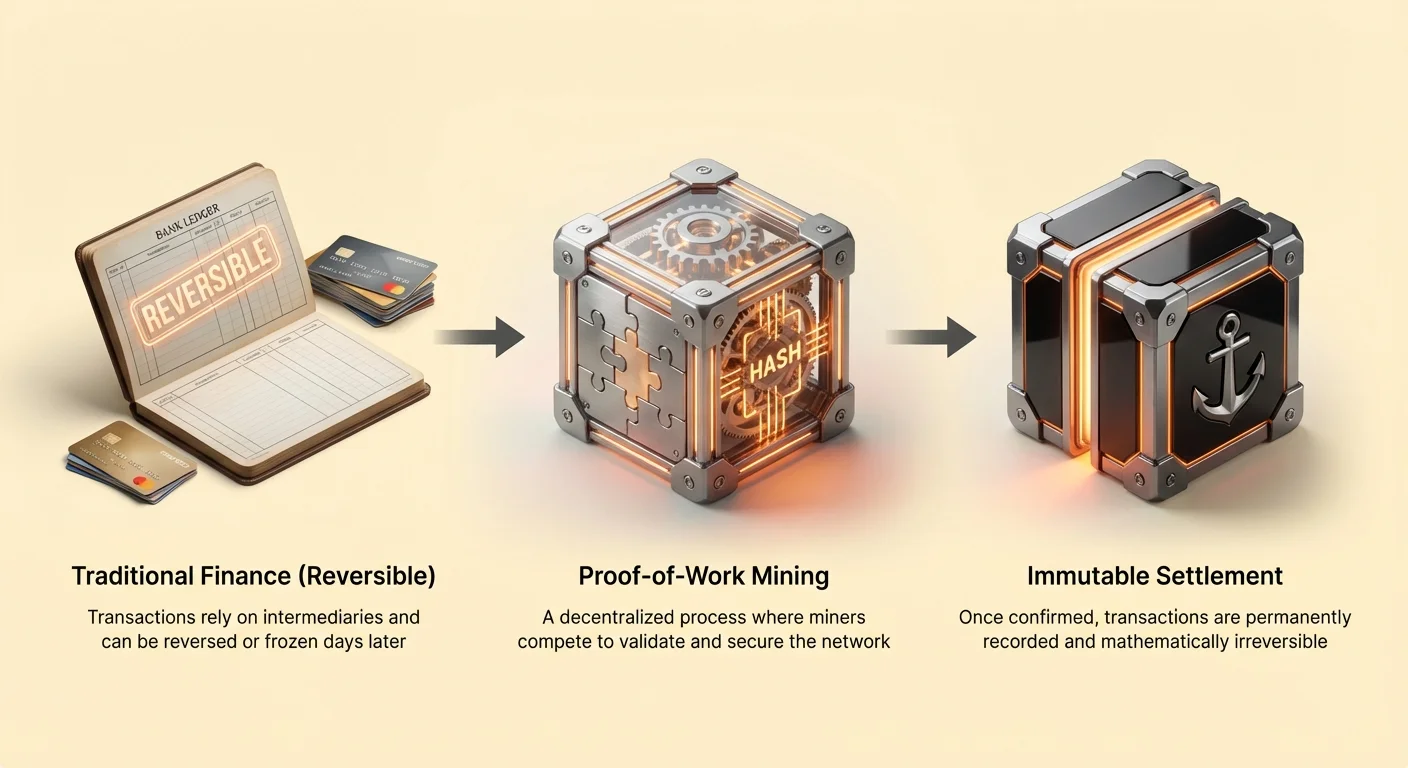
Kada šaljete novac bankovnim transferom ili povlačite kreditnom karticom, u potpunosti se oslanjate na centralizirane institucije — banke i procesore plaćanja — da verificiraju transakciju i ažuriraju knjigu. Ključno je da su ove transakcije često privremene; mogu ih osporiti, opozvati ili zamrznuti posrednik satima ili čak danima kasnije. Ovaj sustav pruža sigurnosne mreže, ali također uvodi trenje, troškove i potencijal za cenzuru.
Bitcoin, prvi uspješan sustav digitalnog gotovina na svijetu, funkcionira na fundamentalno drugačijem principu. Eliminira potrebu za pouzdanim trećim stranama postizanjem nečega što se zove konačnošću transakcije. Konačnost znači da je, nakon što je transakcija obrađena i zabilježena na javnu knjigu mreže, taj zapis trajni, nepromjenjivi i nepovratni. Ona je zauvijek završena.
Za novake je ovaj koncept često težak za shvaćanje jer smo uvrijeđeni da mislimo na digitalna plaćanja kao na preokretna. Razumijevanje kako Bitcoin postiže ovu čeličnu konačnost — i zašto često traje 10 minuta ili više — ključno je za prepoznavanje jedinstvene vrijednosne ponude sustava: stvaranje samovladajućeg, nezauzimivog i otpornog na cenzuru novca. Ovaj vodič zaronjuje u mehanizme, vrijeme i duboke implikacije nepromjenjivosti transakcija.
The Fundamental Problem Bitcoin Solved: Trust in Digital Payments
Before Bitcoin, digital money was plagued by the fundamental flaw of the "double-spend problem." Because digital information is inherently easy to copy, how could one ensure that a digital token was only used once without relying on a central authority to act as a watchdog?
The Double-Spend Conundrum
The double-spend problem is the technical hurdle that prevented successful digital currencies for decades. If you had a digital file representing $100, what would stop you from copying that file and simultaneously sending it to two different people, effectively spending the same $100 twice?
In traditional finance, the central bank or payment processor maintains a master ledger and checks every transaction against your balance. If you try to spend money you don't have, the central authority rejects the attempt. Satoshi Nakamoto’s breakthrough in creating Bitcoin was solving the double-spend problem without needing that central authority, replacing centralized trust with verifiable, decentralized cryptography.
Reversibility in Traditional Finance
To appreciate Bitcoin's finality, consider the typical reversibility built into existing systems:
- Credit Cards: Credit card transactions are notoriously non-final. A customer can initiate a chargeback weeks or months after a purchase. The merchant loses the revenue and may incur penalty fees. This forces businesses to integrate high-cost risk management systems.
- Bank Transfers (ACH): While faster than chargebacks, even bank transfers can sometimes be clawed back due to fraud or error, meaning the receiving party cannot treat the funds as 100% secure until a lengthy clearance period has passed.
- Central Authority Freezing: In any centralized system, an external entity (the government, the bank, or a court) can unilaterally freeze, seize, or reverse transactions and accounts if deemed necessary, violating the premise of finality.
Bitcoin was designed to eliminate the operational risk and third-party intervention inherent in these reversible systems.
What Exactly Is Transaction Finality?
Transaction finality refers to the point at which a transfer of value is considered complete and irreversible. In the context of Bitcoin, this means the funds have definitively moved from one address to another, and no entity, not even the sender, can reclaim them.
Irreversible Settlement
Bitcoin achieves irreversible settlement through a decentralized process known as mining (Proof-of-Work). Unlike a credit card transaction that is only "authorized" at the time of purchase and settled much later (with the risk of reversal), a Bitcoin transaction is permanently recorded onto the public ledger (the blockchain).
Once a transaction is validated and included in a confirmed block, the network has universally agreed that the state of the money has changed. This is the cryptographic equivalent of signing an unalterable, global contract, instantly removing the need for dispute resolution mechanisms like chargebacks.
Immutability Defined
Immutability, in simple terms, means the inability to be changed. The Bitcoin blockchain is immutable because of its structure: blocks of transactions are cryptographically linked together in a chronological chain.
- Each new block contains a cryptographic hash (a unique digital fingerprint) of the previous block.
- If anyone tried to tamper with a transaction deep within the chain (e.g., changing a $10 transfer to a $1,000 transfer), the hash of that block would change.
- Because the following blocks rely on the original hash, the entire chain built thereafter would instantly become invalid.
- To successfully alter one transaction, the malicious actor would have to re-mine every subsequent block faster than the rest of the global network—a computationally impossible task due to the sheer power protecting the network.
This immutability ensures that once you see your transaction confirmed on the blockchain, you can trust that it will remain there forever.
The Mechanics of Finality: Confirmation and the Blockchain
Finality is not achieved instantly the moment you press "send." It is a gradual, verifiable process dependent on the decentralized creation of new blocks.
From Unconfirmed to Pending
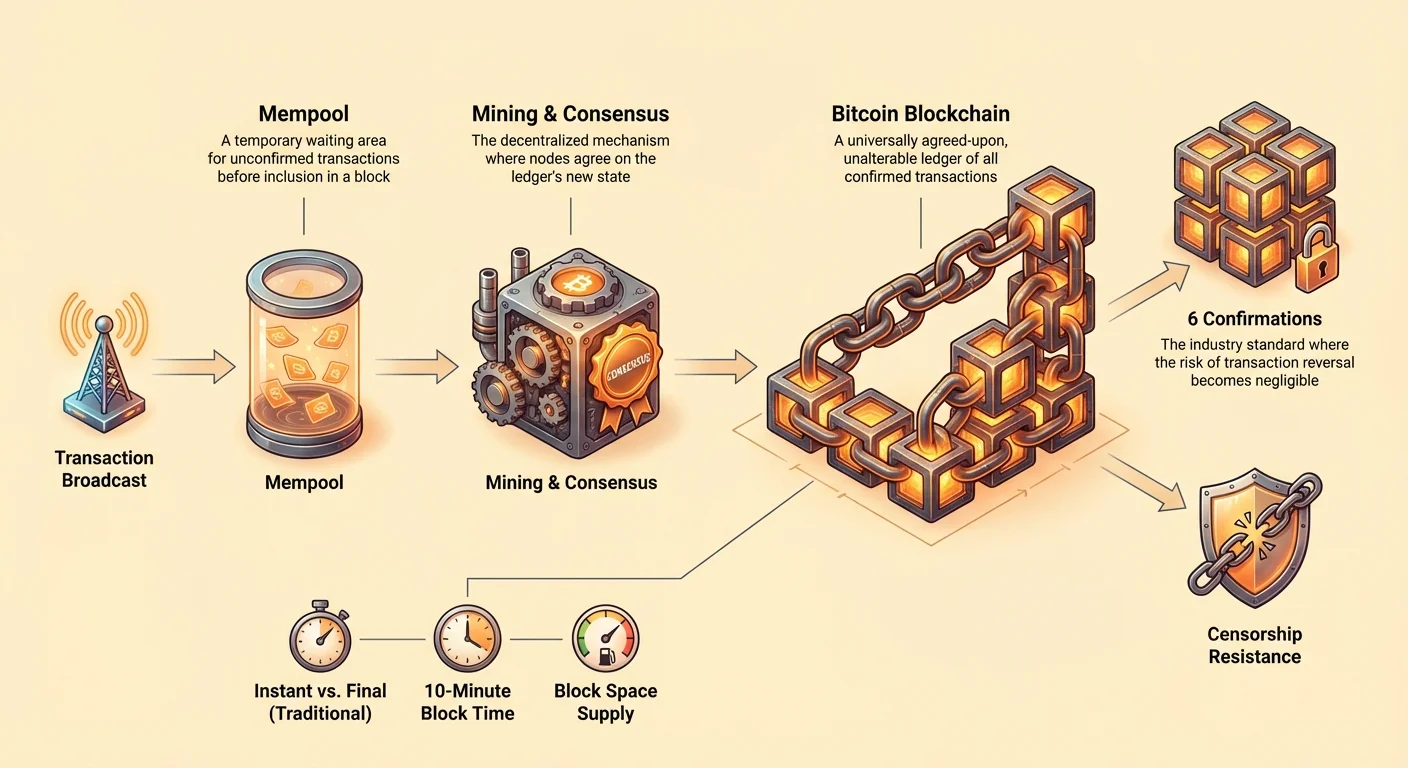
When you initiate a Bitcoin transaction, it is first broadcast to the global network of nodes (computers running the Bitcoin software).
- Broadcasting: Your transaction enters the mempool (memory pool), which is essentially a waiting room for all pending, unconfirmed transactions.
- Validation: Nodes check your transaction to ensure you have the funds and the signature is valid.
- Selection: Miners select transactions from the mempool to include in the next block they are attempting to solve. They prioritize transactions that include higher transaction fees because this acts as a payment for their work.
At this stage, the transaction is unconfirmed. While it is visible to the world, it is still vulnerable to being replaced or ignored if another valid transaction attempts to spend the same funds (though the network rules highly disincentivize this).
The Role of Mining and Proof-of-Work
The transition from pending to final occurs when a miner successfully solves the cryptographic puzzle and adds a new block to the chain. This is the heart of the Proof-of-Work (PoW) consensus mechanism.
The new block containing your transaction is broadcast to the network. Once nodes verify the block's validity, they accept it and begin working on the next block, linking it mathematically to the one that contains your transaction.
The first confirmation is powerful, as it proves your transaction is now officially part of the most recent, valid chain. However, true finality builds over time.
Confirmation Count: When is a Transaction "Final"?
While one confirmation means your transaction is highly likely to be permanent, the security risk (the chance of a reorganization where a competing chain invalidates the current block) decreases exponentially with each subsequent block confirmation.
The common industry standard for declaring a Bitcoin transaction truly immutable and fully settled is six confirmations.
- 1 Confirmation: The transaction is included in a block. For small payments (e.g., buying a coffee), many businesses might accept this risk, as the cost of a sophisticated attack is too high to warrant double-spending a small amount.
- 6 Confirmations: By the time six new blocks have been successfully mined and linked atop the block containing your transaction, the risk of that transaction being reversed or ignored falls to near zero. The computational power required to undo six blocks is practically unattainable for any single entity. This timeframe is typically around one hour (6 blocks x 10 minutes/block).
For large transfers, 6 confirmations provides the absolute assurance of finality that traditional banking systems cannot match.
Brzina potvrde i varijable mreže
Uobičajena točka zabune za novake je razlika između zagarantirane konačnosti Bitcoina i trenutne brzine usluga poput PayPala ili Visa. Bitcoin žrtvuje trenutnu brzinu za verificiranu, bezpovjerenjenu sigurnost.
Ciljano vrijeme bloka od 10 minuta
Bitcoin protokol je hardkodiran da cilja prosječno vrijeme kreacije bloka od približno 10 minuta. Ovaj interval od 10 minuta je namjerna dizajnerska odluka koja balansira brzinu i sigurnost.
Ako bi se blokovi rudarili prebrzo, rizik od sukobljenih lanaca (ili „forkova“) bi porastao, potencijalno oslabljujući mehanizam konsenzusa i obećanje nepromjenjivosti. Održavajući ritam od 10 minuta, mreža omogućuje vrijeme za globalno širenje novonadjenog bloka, osiguravajući da svi čvorovi rade na istoj, dogovorenoj verziji knjige.
Naknade za transakcije i prostor bloka
„Koliko su brze Bitcoin transakcije?“ Odgovor u velikoj mjeri ovisi o naknadi koju priložite transakciji.
Brzina kojom vaša nepotvrđena transakcija prelazi iz mempoola u potvrđeni blok određena je tržišnom dinamikom: ponudi i potražnji za prostorom bloka.
- Ponuda prostora bloka: Bitcoin blok ima ograničenu veličinu (trenutno oko 1 MB podataka o transakcijama).
- Potražnja za transakcijama: U bilo kojem trenutku, stotine ili tisuće transakcija mogu čekati u mempoolu.
- Podsticaj rudara: Rudari su ekonomski potaknuti da uključe transakcije koje plaćaju najviše naknada, maksimizirajući svoj prihod.
Ako je mreža zauzeta i pošaljete transakciju s niskom naknadom, ona može ostati u mempoolu satima ili čak danima dok potražnja ne popusti ili do sljedećeg „tržišnog smiraja naknada“. Nasuprot tome, transakcija s visokom naknadom može biti odabrana gotovo odmah i potvrđena u sljedećem bloku od 10 minuta.
Razlikovanje brzine od konačnosti
Ključno je razlikovati brzinu od konačnosti:
| Metrika | Tradicionalne financije (npr. žični transfer) | Bitcoin mreža |
|---|---|---|
| Brzina (početni transfer) | Trenutno/Sekunde | Sekunde (za ulazak u mempool) |
| Konačnost (završavanje) | Dani (rizik povlačenja ostaje) | ~60 minuta (nakon 6 potvrda) |
| Preokretnost | Da, od centralnog tijela | Ne, matematički nemoguće |
Dok tradicionalni žični transfer izgleda trenutan, osnovna sredstva često nisu završena i zagarantirana danima. Bitcoin može trajati 10–60 minuta za finalizaciju, ali kada je finaliziran, zagarantiran je matematikom.
Why Immutability Is the Cornerstone of Self-Sovereignty
The technical reality of finality translates directly into profound philosophical and practical benefits for the user, particularly regarding autonomy and security.
Censorship Resistance
Because Bitcoin transactions are immutable and cannot be reversed by any single party—not a government, a bank, or a company—the system is inherently censorship-resistant.
If you send a valid transaction (signed with your private key and paying the necessary fee), the network's function is simply to process and record it. There is no authority to deem the transaction "illegal," "unauthorized," or "inappropriate."
This is crucial for individuals living under oppressive regimes, journalists, or anyone needing to move funds without fear of institutional interception or blocking.
Unseizability
Immutability ensures that once you secure your funds under your own cryptographic control (self-custody), they are unseizable.
If your funds are held by a bank, a court order can seize them, forcing the bank to alter their internal ledger. If your funds are held in a self-custody Bitcoin wallet, the private key is the only thing that dictates ownership. Since the transaction history recorded on the blockchain is immutable, the network will only recognize a valid transaction initiated by that private key. No external entity can unilaterally issue a command to change the ledger and transfer your money.
Global Access Without Intermediaries
The finality of Bitcoin allows two people, anywhere in the world, to settle a value transfer with the same level of trust as if they were exchanging physical cash—but across vast distances. This eliminates reliance on expensive and often geographically restricted banking intermediaries.
This capability is particularly transformative for cross-border commerce and remittances, where traditional systems impose high fees and lengthy delays precisely because they must involve multiple reversible clearinghouses and correspondent banks.
Praktične implikacije za korisnike i poduzeća
Razumijevanje konačnosti transakcije diktira kako korisnici komuniciraju s mrežom, posebno u pogledu sigurnosti i upravljanja rizicima.
Upravljanje rizikom za trgovce
Za poduzeća, posebno ona koja provode međunarodnu trgovinu ili prodaju visokovrijedne digitalne robe, Bitcoina konačnost eliminira najdestruktivniji rizik u e-trgovini: povrate naknada.
Kada trgovac vidi šest potvrda, sredstva su nepovratno njegova. Ovo se često navodi kao jedan od najubjeđivijih razloga za usvajanje Bitcoina od strane poduzeća s visokim rizikom ili međunarodnih prodavača. Oni zamjenjuju rizik potencijalnog napada dvostrukog trošenja (koji je zanemariv nakon šest potvrda) sigurnošću zagarantiranog prihoda, zaobilazeći naknade od 2-8% i pravne obveze povezane s obradom kreditnih kartica.
Najbolje prakse za slanje i primanje
Za korisnike, konačnost transakcije zahtijeva disciplinu u praćenju broja potvrda i odabiru naknada.
1. Odabir odgovarajućih naknada
Ako vam treba brzo potvrđena transakcija (npr. u sljedećih 10-20 minuta), morate provjeriti trenutne uvjete tržišta naknada da osigurate da je vaša naknada dovoljno konkurentna da je rudar odabere. Ako brzina nije važna, možete postaviti nižu naknadu i čekati duže. Pogrešno procjenjivanje naknade znači da vaša transakcija može ostati zaglavljena u mempoolu dok se promet mreže ne razriješi.
2. Praćenje broja potvrda
Kao primatelj, uvijek verificirajte broj potvrda na temelju vrijednosti koja se prima:
- Mala vrijednost (npr. ispod 100 USD): 1-3 potvrde su općenito prihvatljive.
- Srednja vrijednost (npr. 100 do 10.000 USD): Pričekajte 6 potvrda za potpunu sigurnost konačnosti.
- Visoka vrijednost (npr. iznad 100.000 USD): Neke institucije mogu preporučiti 10, 20 ili čak više potvrda kao ultrakonzervativnu mjeru, iako 6 ostaje globalni standard za teoretsku nemogućnost opoziva.
3. Rukovanje transakcijama bez potvrde
Transakcija bez potvrde (emitirana, ali još ne u bloku) nije konačna. Iako je prihvatljiva za mikropayments gdje je rizik trivijalan, trgovci nikad ne bi trebali isporučiti visokovrijednu robu ili isplatiti velike količine digitalne vrijednosti samo na temelju transakcije bez potvrde, jer pošiljatelj tehnički još uvijek ima priliku za dvostruko trošenje prije nego što rudar uključi u blok.
Zaključak
Konačnost transakcije je više od tehničke značajke; to je jezgra kriptografske garancije koja podupire Bitcoininu vrijednosnu ponudu. To je osiguranje da kada se novac pomakne, on ostane pomaknut, trajno zabilježen na nepromjenjivoj knjizi dostupnoj cijelom svijetu za verifikaciju.
Prihvaćajući nešto sporije vrijeme završavanja (prosječno 10 minuta po bloku) u zamjenu za decentraliziranu, matematičku verifikaciju, Bitcoin rješava vjekoviti problem povjerenja u digitalne transakcije. Ova nepromjenjivost je motor koji pokreće otpornost na cenzuru i pruža jedinstvenu sposobnost pojedincima da postignu pravo samovladanje nad svojim bogatstvom, garantujući da je, kada se transakcija potvrdi, zauvijek završena.