
Temeljna obećanja decentraliziranih mreža – pružanje globalnog, bez dopuštenja i otpornog na cenzuru novca i računanja – inherentno su izazvana stvarnošću brzine i upravljanja podacima. Ovaj izazov poznat je kao skaliranje.
Skaliranje nije samo tehnička utrka za postizanje najbrže brzine transakcija; to je duboka ideološka rasprava o prirodi i svrsi decentralizirane mreže. Trebala bi li primarna blockchain prioritetizirati apsolutnu, nepokolebljivu sigurnost na uštrb brzine, ili prioritetizirati svestranost i visok propusni kapacitet transakcija?
Bitcoin i Ethereum, dvije najveće i najutjecajije kripto mreže, krenule su fundamentalno različitim putovima da odgovore na ovo pitanje. Bitcoin je usvojio izrazito konzervativan, minimalistički pristup, externalizirajući gotovo savu računsku složenost sekundarnim slojevima. Ethereum je, suprotno, u početku prihvatio „monolitni“ dizajn, pokušavajući rukovati svim operacijama interno, prije nego što se okrenuo „modularnom“ pristupu omogućenom Layer-2 rješenjima.
Razumijevanje ovih divergentnih filozofija skaliranja – Bitcoinov oprezni konzervatizam naspram Ethereumove ambiciozne prilagodljivosti – ključno je za shvaćanje arhitektonske budućnosti digitalne ekonomije. To otkriva kompromise u pogledu sigurnosnih budžeta, decentralizacije mreže i definicije „full nodea“.
Defining the Blockchain Layers: The Foundation of Scaling
To understand how Bitcoin and Ethereum scale, we must first define the concept of layers (L1 and L2), which represent different levels of trust, security, and execution within the crypto ecosystem.
The Core Functions of Layer 1
Layer 1 (L1), or the base layer, is the main blockchain. It is the fundamental trust anchor of the entire system.
The primary functions of any L1 are limited but essential:
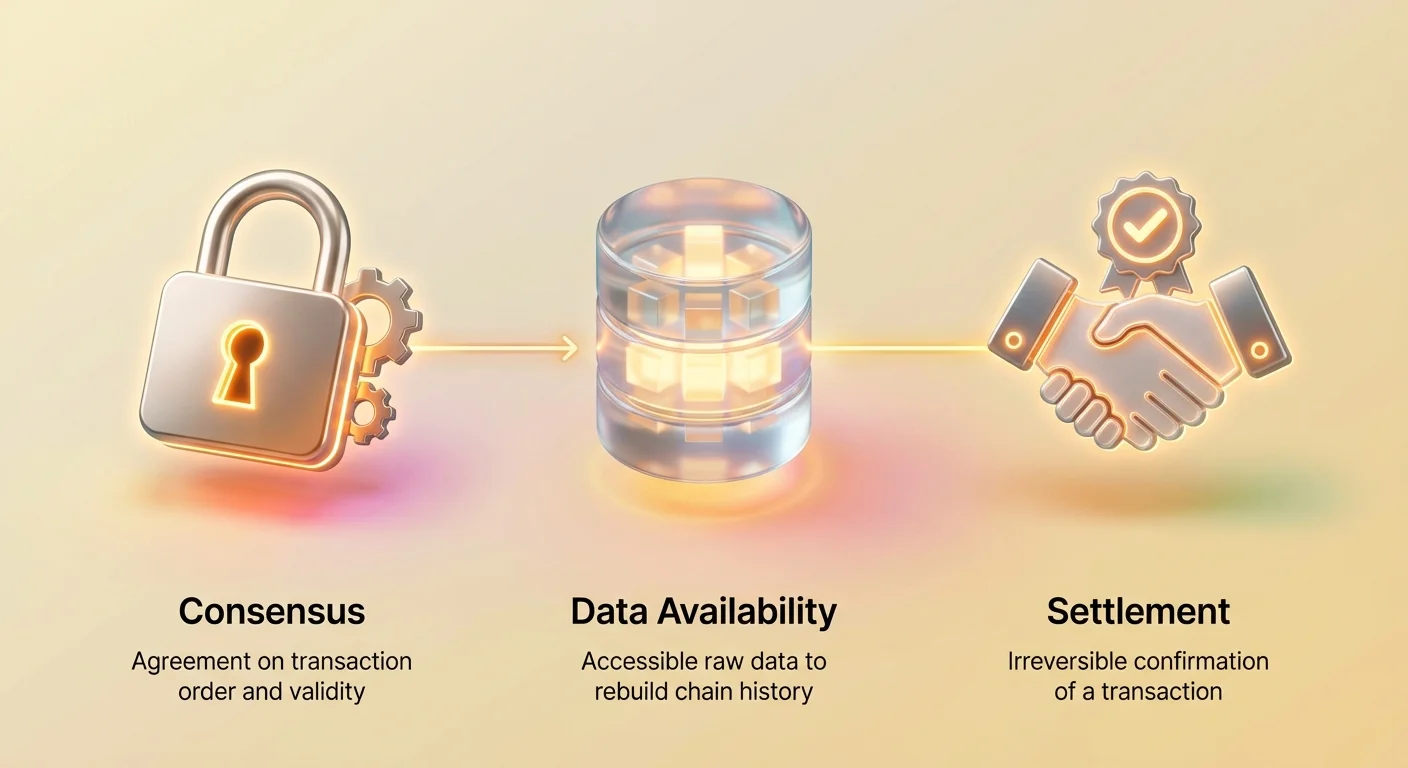
- Consensus: Establishing agreement among all network participants on the order and validity of transactions (e.g., Proof-of-Work in Bitcoin, or Proof-of-Stake in Ethereum).
- Data Availability: Ensuring that the raw transaction data required to rebuild the blockchain history is accessible to anyone.
- Settlement and Finality: Providing the ultimate, irreversible confirmation that a transaction has occurred.
Both Bitcoin and Ethereum strive for maximum security and decentralization on L1. However, they define what constitutes "security" and "decentralization" differently, leading to conflicting scaling models.
Why Layer 2 Solutions Exist
The core problem with L1 scaling is the Blockchain Trilemma: a decentralized network can only maximize two of these three traits: Decentralization, Security, or Scalability (Speed/Throughput). Maximizing L1 security requires limiting block size and transaction throughput.
Layer 2 (L2) solutions are protocols built on top of the L1 chain. They are designed to offload the burden of transaction processing and state management from the L1.
L2s achieve massive scalability by processing thousands of transactions quickly and cheaply, bundling the proof of those transactions into a single, highly compressed cryptographic receipt, and then submitting that receipt back to the L1 for final settlement. They inherit the security of the L1 without requiring every node on the L1 to process every individual transaction.
Bitcoinova filozofija skaliranja: Minimalistički pristup
Bitcoinova ideologija skaliranja definirana je ekstremnim konzervatizmom. Njezin primarni cilj nije biti brzim globalnim procesorom plaćanja, već najsigurnijim, neocenzuriranim digitalnim monetarnim baznim slojem – digitalnim zlatom.
Fokus na trgovinu vrijednošću i sigurnosni budžet
Bitcoinova arhitektura odražava njezinu primarnu funkciju: sigurnost i pouzdanost iznad svega. Njezin mehanizam konsenzusa, Proof-of-Work (PoW), zahtijeva ogromnu potrošnju energije („sigurnosni budžet“) kako bi spriječio zlonamjerne aktere od prepisivanja povijesti.
Ovaj fokus diktira da Bitcoin L1 mora biti jednostavan, robusni i maksimalno decentraliziran. Složenost, posebno izvršavanje pametnih ugovora koje bi moglo uvesti nepredviđene greške ili povećati zahtjeve za obradu mreže, strogo se izbjegava. Svaki čvor mora moći jeftino i brzo verificirati svaku transakciju.
Ključni princip: Bitcoin L1 treba rukovati samo jednostavnim monetarnim transferima (UTXO-ima) i minimalnim skriptingom potrebnim za podršku višim slojevima. Svi pokušaji kompleksne funkcionalnosti (poput naprednih financijskih aplikacija) moraju se prepustiti L2-ovima.
Externalizacija složenosti: Layer 2 rješenja
Bitcoinova strategija skaliranja inherentno je modularna. Odbija značajno povećavati veličinu L1 bloka kako bi održao decentralizaciju (dopuštajući svakome da pokrene full node). Umjesto toga, externalizira volumen i složenost specijaliziranim L2 mrežama.
- Lightning Network: Najpoznatiji L2, dizajniran za trenutne, jeftine, visokovolumenske mikroplaćanja. Lightning koristi off-chain kanale plaćanja koji dodiruju L1 samo pri otvaranju ili zatvaranju kanala. To rukuje propusnim kapacitetom bez opterećivanja glavnog lanca.
- Sidechains i drugi L2-ovi: Novija rješenja, ponekad koristeći poboljšanja jezika skriptinga Bitcoina (poput Taproota i Ordinalsa), omogućuju kompleksnije aplikacije i pametne ugovore izvršene izvan jezgre L1, uz periodično vezivanje natrag na glavni lanac za garancije sigurnosti.
Ovaj externalizirani pristup osigurava da jezgrene garancije sigurnosti Bitcoin L1 nikada ne budu ugrožene eksperimentalnom, visokopropusnom prirodom L2 aplikacija.
Koncept „monetarnih primarnika“
Bitcoin se često opisuje kao mreža monetarnih primarnika – osnovnih, nepromjenjivih građevnih blokova potrebnih za robusni novac. Ovi primarnici uključuju:
- Provjeru kriptografskih potpisa.
- Verifikaciju vlasništva (UTXO-ovi).
- Primjerene ograničenja ponude.
Bilo kakva funkcionalnost izvan ovih osnovnih primarnika smatra se „feature creepom“ koji uvodi potencijalne sigurnosne ranjivosti i smanjuje decentralizaciju mreže povećavajući trošak resursa za pokretanje full nodea. Ova ideološka predanost jednostavnosti temelj je njegovog modularnog modela skaliranja.
Ethereum's Scaling Philosophy: The Initial Monolith
In contrast to Bitcoin, Ethereum was designed from day one to be a "World Computer." Its purpose was not merely to be digital money, but to be a platform for complex, programmable smart contracts, decentralized finance (DeFi), and decentralized applications (DApps).
The Goal of a "World Computer" (Smart Contracts)
Ethereum’s original design was highly ambitious. It sought to embed computation and general-purpose scripting directly into the Layer 1. Smart contracts—self-executing agreements whose terms are written directly into code—were hosted and executed by every single node on the Ethereum mainnet.
This fundamental design choice meant that Ethereum required a much more complex L1 than Bitcoin. Where Bitcoin only manages simple balances and transaction history, Ethereum manages a constantly changing state based on the actions of thousands of interacting smart contracts.
The Monolithic Trade-Off: Speed, Cost, and State Bloat
Ethereum's early scaling model was monolithic: the L1 was responsible for all three core functions (execution, data availability, and settlement).
This monolithic design led to severe scaling limitations as the network grew popular:
- High Transaction Costs (Gas): When the network was busy, users had to pay extremely high fees (gas) to outbid others for limited block space.
- Low Throughput: The complexity of processing every contract state change meant L1 throughput was slow (around 15-30 transactions per second).
- State Bloat: The collective memory of all deployed smart contracts and their current variables rapidly increased the burden on full nodes, threatening decentralization.
This crisis of scalability forced Ethereum to fundamentally shift its ideological and architectural roadmap.
Shifting Consensus: Proof-of-Stake and Security
Ethereum’s move from Proof-of-Work (PoW) to Proof-of-Stake (PoS) during "The Merge" was partially driven by the need to support its new scaling strategy. PoS is often argued to be less resource-intensive and more adaptable to advanced scaling techniques like sharding (though sharding has largely been replaced by focusing on L2s).
However, the change in consensus also represented a trade-off in security ideology. While PoS offers economic finality and can technically support higher transaction rates, some argue it introduces new centralization vectors, such as the capital requirements to become a validator, compared to the open resource requirements of PoW mining. This highlights Ethereum’s willingness to embrace complex engineering solutions on L1 to maximize utility, even if it introduces new trade-offs concerning decentralization.
The Architectural Crossroads: Monolithic vs. Modular Design
The ideological conflict between Bitcoin and Ethereum scaling centers on the concept of architectural design: whether a blockchain should be a single, complex engine or a system of specialized, interacting components.
What is a Monolithic Blockchain?
In a monolithic architecture, a single Layer 1 blockchain is tasked with fulfilling all critical roles simultaneously: executing transactions, storing data, achieving consensus, and providing final settlement.
Characteristics of Monolithic Design (e.g., Early Ethereum, Solana, and other high-throughput chains):
- Single Point of Failure (Scaling): If the L1 is congested, the entire ecosystem slows down and fees skyrocket.
- High Barrier to Entry for Nodes: To handle the massive computational load of execution and state storage, full nodes often require powerful, expensive hardware (high CPU, vast SSD storage, high bandwidth).
- Tightly Coupled: Execution logic is inseparable from the consensus mechanism.
While monolithic chains can offer excellent speed until they hit peak demand, the heavy computational requirements often mean only institutions or specialized service providers can afford to run full nodes, leading to reduced verifier decentralization.
What is a Modular Blockchain?
A modular blockchain architecture breaks down the four core functions (Execution, Data Availability, Consensus, Settlement) into specialized layers or components.
Bitcoin's Modular Model (L1 + L2): Bitcoin has always been implicitly modular, even before the term was popularized.
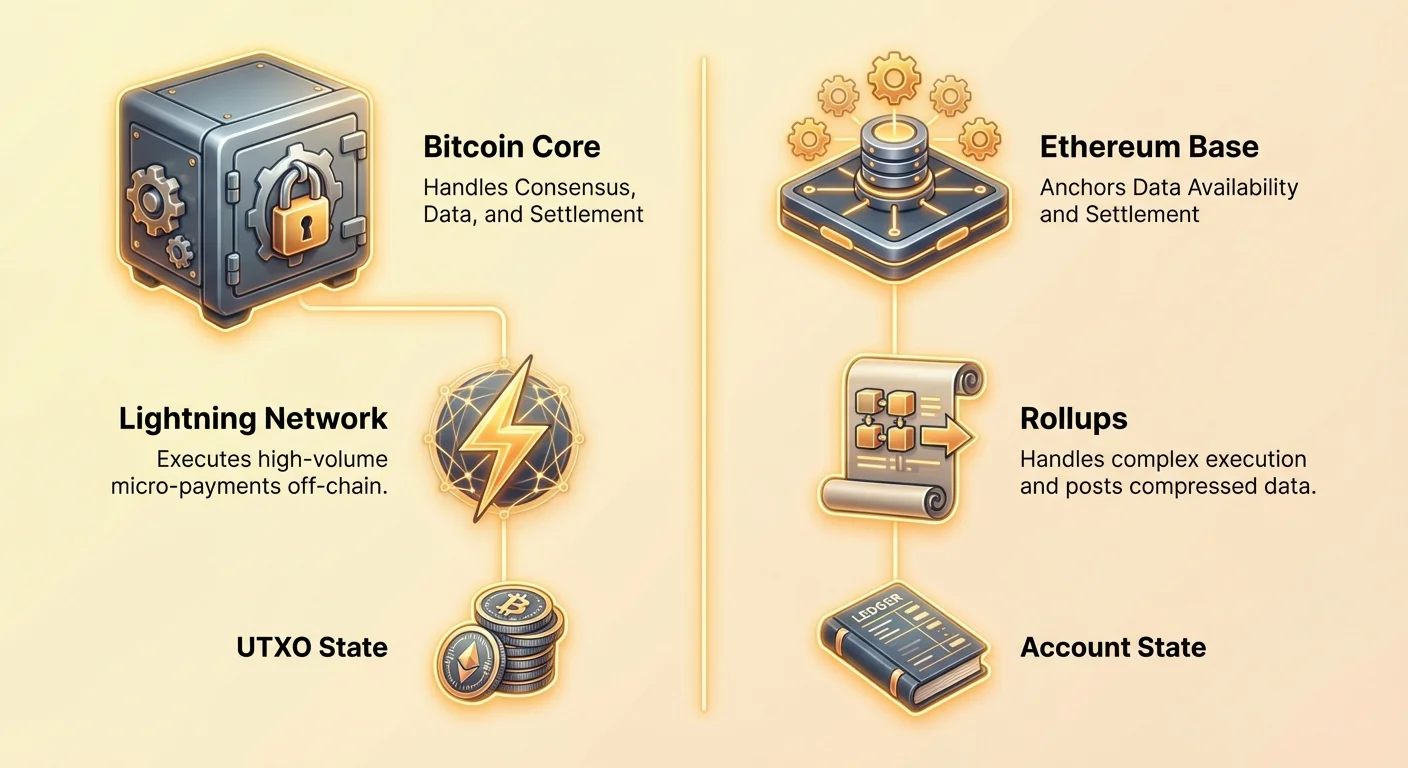
- L1 (Bitcoin Core): Handles Consensus, Data Availability, and Settlement (simple monetary transfers).
- L2 (Lightning Network, etc.): Handles Complex Execution (transaction routing, smart contract logic).
Ethereum's Modular Evolution (L1 + Rollups): Modern Ethereum is explicitly transitioning to a modular framework via "Rollups."
- L1 (Ethereum Base): Primarily focuses on Data Availability (storing L2 transaction data) and Settlement.
- L2 (Optimism, Arbitrum, etc.): Handles Execution (running smart contracts) and posting compressed data back to L1.
By delegating execution away from the L1, modularity dramatically improves throughput. The L1 doesn't have to re-execute every transaction; it only needs to verify the proof that the L2 execution was correct, or simply store the compressed data.
Security Delegation and Trust Assumptions in L2s
A crucial difference in scaling ideology lies in how trust is delegated to L2s:
Bitcoin's L2 Trust: Bitcoin’s most widely adopted L2, Lightning, uses cryptographic channels secured by HTLCs (Hash Time-Locked Contracts). If a dispute arises, the funds are always secured by the L1 rules, allowing users to "force close" their channel and settle on the main chain. The L1 always remains the final authority and security guarantor.
Ethereum's L2 Trust (Rollups): Ethereum Rollups rely on two main types of proof to maintain L1 security:
- Optimistic Rollups: Assume transactions are valid by default ("optimistic") but require a challenge period during which anyone can submit a "fraud proof" to the L1 if they detect a malicious state transition.
- Zero-Knowledge (ZK) Rollups: Use advanced cryptography to generate a succinct proof of validity that the L1 can verify almost instantly, without needing to re-execute the transactions.
While both approaches allow L2s to inherit L1 security, the complex trust architecture of Rollups is a necessary trade-off for Ethereum to achieve high utility, whereas Bitcoin's model ensures L1 simplicity by requiring L2s to fit within its highly restrictive monetary scripting language.
The State Bloat Dilemma and Decentralization
One of the most pressing concerns guiding scaling decisions is "State Bloat"—the perpetual growth of the data required to understand the current, verifiable condition (the "state") of the blockchain. This directly impacts decentralization.
Why State Bloat Harms Decentralization
For a blockchain to be truly decentralized, it must be easy for ordinary users to run a "full node." A full node downloads and verifies every transaction and maintains the current state of the chain.
If the resources required to run a full node become too high (e.g., massive disk space, intense processing power, high bandwidth), only professional entities (data centers, exchanges, etc.) can afford to participate in verification. When fewer people can verify the chain independently, decentralization is compromised, and the network becomes more susceptible to regulatory capture or censorship.
State bloat increases the synchronization time and hardware costs for new participants, raising this barrier to entry.
Bitcoin's UTXO Model and State Management
Bitcoin utilizes the Unspent Transaction Output (UTXO) model. Instead of tracking user accounts, it tracks specific units of Bitcoin that haven't yet been spent.
Advantages of UTXO:
- Simple State: The "live state" of Bitcoin only includes the current set of unspent UTXOs, which is relatively small and manageable.
- Clean Verification: Transactions can be validated quickly because a node only needs to verify that the specified UTXO was truly unspent.
- Inherently Pruned: As Bitcoins are spent, the data related to the previous transaction becomes historically irrelevant for the current state, helping to manage bloat.
Bitcoin’s strict limitation on L1 smart contracts and complex computations is fundamentally tied to keeping the UTXO state simple and small, ensuring the L1 remains highly accessible to hobbyists and individual users worldwide.
Ethereum's Account Model and State Growth
Ethereum utilizes the Account Model. The state consists of all user accounts and the code/storage associated with every deployed smart contract.
Challenges of the Account Model:
- Complex State: The live state includes all variable data within every smart contract (e.g., token balances, DAO votes, DeFi collateral levels). Every contract interaction potentially changes this state.
- Permanent Bloat: Unlike UTXOs which are spent and removed from the active state, smart contract storage persists. If a contract stores a large amount of data (e.g., NFTs or complex registry information), that data must be tracked forever by all full nodes.
- Execution Burden: Nodes must process complex virtual machine instructions (EVM) to calculate the new state after a transaction, which is far more CPU intensive than validating a simple UTXO transaction.
Ethereum's modular scaling shift (L2 rollups) is an existential necessity to manage this state bloat. By moving execution off-chain, Ethereum L1 can reduce the computational burden on its nodes, allowing them to focus primarily on checking the cryptographic proofs and storing L2 transaction data, rather than processing every smart contract action themselves.
Praktične implikacije za korisnike i developere
Razlika u ideologiji skaliranja diktira kako korisnici komuniciraju s mrežom i kako developeri biraju gdje graditi svoje aplikacije.
Biranje pravog sloja za zadatak
Filozofska podjela manifestira se u tome kako korisnici prioritetiziraju kompromise:
| Funkcija | Bitcoin L1 | Ethereum L1 | Ethereum L2 (Rollups) |
|---|---|---|---|
| Primarna upotreba | Visoko sigurno, konačno završavanje. Trgovina vrijednošću. | Konačno završavanje, sidro dostupnosti podataka. | Izvršavanje, DeFi, DApps, visokovolumenski NFT-ovi. |
| Brzina transakcije | Spora (10 minuta) | Srednja/spora (12 sekundi) | Brza (Trenutna do nekoliko sekundi) |
| Trošak transakcije | Nizak/promjenjiv (Srednji ako hitno) | Visok (Često zabranjeno skupo) | Nizak (Dio troška L1) |
| Dopuštena složenost | Minimalni skripting (Monetarni primarnici) | Puni pametni ugovori (EVM) | Puni pametni ugovori (EVM) |
| Decentralizacija | Najviša (Najlakše pokrenuti full node) | Smanjena (Visoki zahtjevi hardvera) | Nasljeđuje L1 decentralizaciju |
Za korisnike: Ako trebate ultimativnu sigurnost za držanje velikog kapitala desetljećima, jednostavnost i duboki sigurnosni budžet Bitcoin L1 (ili L1 završavanje putem Lightninga) prioritetizirani su. Ako trebate jeftinu, brzu interakciju s kompleksnim DeFi aplikacijama, Ethereum L2-ovi jedino su održivo rješenje.
Za developere: Bitcoinov restriktivni L1 prisiljava developere na ekstremnu kreativnost s L2 strukturama (sidechains, mreže kanala). Ethereumovi L2-ovi nude developerima poznato kodersko okruženje (EVM kompatibilnost) s minimalnim restrikcijama na funkcionalnost, maksimizirajući brzinu inovacija.
Razlike u sigurnosti i finalnosti
Ideologija skaliranja također utječe na koncept finalnosti transakcije:
Bitcoinova finalnost: Transakcije postižu sve veću finalnost kako se više blokova rudari na vrhu njih (obično se smatra potpuno finalnom nakon 6 potvrda, ili oko jednog sata). Sigurnost je probabilistička, temeljena na trošku prepisivanja lanca (PoW).
Ethereumova finalnost: Od prelaska na PoS, Ethereum je uveo „ekonomsku finalnost“. Kada dvije trećine validatora potvrdi blok, taj blok je finaliziran. To je mnogo brže od PoW potvrde, ali se oslanja na ekonomsku pretpostavku da validatori neće riskirati gubitak svog uloženog kapitala.
L2 finalnost: L2 transakcije smatraju se trenutno izvršenima na L2. Međutim, postizanje L1 finalnosti zahtijeva kašnjenje. Za optimistic rollups, to je razdoblje izazova (često sedam dana) potrebno za jamstvo da nije došlo do prijevare. ZK rollups postižu mnogo bržu L1 finalnost jer je kriptografski dokaz trenutno verificiriv, pružajući snažan poticaj za Ethereumov ekosustav da se pomakne prema ZK tehnologiji.
Zaključak: Dva puta prema samovladanju
Bitcoin i Ethereum predstavljaju dvije različite vizije za digitalnu ekonomiju, najjasnije odražene u njihovim ideologijama skaliranja.
Bitcoin, kroz svoju predanost modularnom i minimalističkom L1, nastoji izgraditi najsigurniji, nepromjenjivi monetarni bazni sloj mogući. Žrtvuje trenutnu L1 korisnost za maksimalnu decentralizaciju i ideološku čistoću, oslanjajući se na specijalizirane vanjske slojeve (poput Lightninga) za rukovanje složenošću svakodnevnih transakcija. Njegov fokus je dugoročna zaštita sigurnosnog budžeta i jednostavnost njegovog „stanja“.
Ethereum, koji je u početku pokušao monolitni „world computer“, prihvatio je nužan preokret prema L2-centričnom modularnom strukturiranju. Ovaj pomak omogućuje mu da održi svrhu kao platformu za bogato računanje i pametne ugovore dok minimizira onesposobljavajuću nadutost stanja na L1. Ethereum žrtvuje L1 jednostavnost i sigurnosnu sigurnost PoW-a za poboljšanu programabilnost i brzu skalabilnost potrebnu za hostanje globalnog ekosustava aplikacija.
Konačno, izbor između ovih filozofija skaliranja izbor je između maksimiziranja sigurnosti (Bitcoin) ili maksimiziranja korisnosti (Ethereum). Oba sustava neprestano inoviraju na svojim sekundarnim slojevima, dokazujući da budućnost decentraliziranih mreža nije u jednom monolitnom lancu koji radi sve, već u specijaliziranim, međusobno djelujućim slojevima ukotvljenim nepokolebljivim baznim slojem povjerenja.