
Ekosustav decentraliziranih financija (DeFi) razvio se daleko izvan jednostavnih zamjena tokena i statičkog stakinga. Dok je početno farmanje prinosa nudilo visoke, ali nestabilne prinose, profesionalni korisnici i alokatori kapitala brzo su shvatili da su osnovne strategije inherentno spekulativne zbog volatilnosti cijena.
Prava samodostatnost u financijama zahtijeva ne samo pristup alatima, već i sofisticirano razumijevanje potrebno za upravljanje rizicima. Za one koji se fokusiraju na očuvanje kapitala i maksimiziranje prinosa prilagođenih riziku, cilj se pomiče s postizanja najvišeg mogućeg godišnjeg postotka prinosa (APY) na postizanje najvišeg održivog prinosa uz minimalnu izloženost tržištu.
Ovaj vodič prelazi osnove pružanja likvidnosti i stakinga. Ući ćemo u napredne strategije posebno dizajnirane za neutralizaciju rizika volatilnosti cijena – primarno privremenog gubitka (IL) – primjenjujući tehnike iz tradicionalnih financija, poput hedginga derivatima. Fokus je na pretvaranju nestabilnih DeFi prinosa u predvidive, stabilne tokove prihoda.
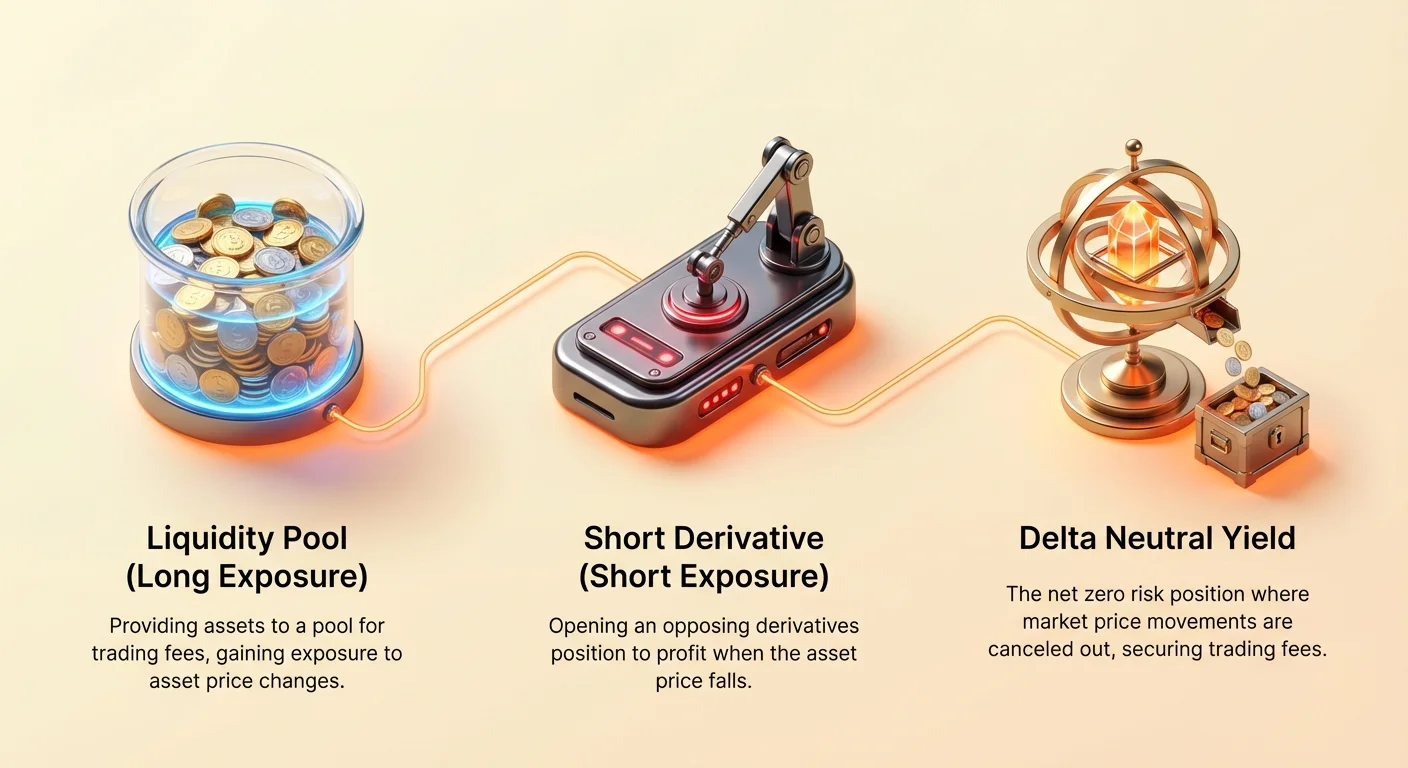
The Primary Barrier: Understanding and Mitigating Impermanent Loss (IL)
Impermanent Loss (IL) is the single greatest risk to liquidity providers (LPs) who are not actively managing their positions. Before implementing any advanced yield strategy, it is crucial to fully grasp how IL erodes capital and how initial defenses can be established.
The Mechanics of Impermanent Loss
Impermanent Loss occurs when the price ratio of assets held within a liquidity pool (LP) deviates from the ratio at the time of deposit. Since automated market makers (AMMs) maintain a constant product (X * Y = K), the pool automatically sells the asset that is increasing in price and buys the asset that is decreasing in price to maintain balance.
In simple terms: If you deposit 1 ETH and 2,000 USDC into a pool, and the price of ETH doubles, the AMM protocol ensures that your position still holds $4,000 worth of assets. However, because the pool forced you to sell some ETH as the price rose, you now hold less ETH and more USDC than if you had simply held the initial 1 ETH and 2,000 USDC in your own wallet. The difference in value between simply holding the assets versus providing liquidity is the Impermanent Loss.
Mitigation through Stable Pools and Flexible Ratios
The simplest way to reduce IL exposure is to choose pools where asset divergence is minimal or mathematically limited:
- Stablecoin Pools (Near-Zero IL): Pools consisting entirely of pegged assets (e.g., USDC/DAI/USDT) eliminate market divergence risk, as the assets are designed to remain close to $1. While minor de-pegging events can cause small, temporary losses, the risk of significant IL is negligible. These pools are the safest base for advanced strategies.
- Weighted Pools (Risk Reduction): Some AMM protocols allow for asymmetric pool ratios, such as 80/20 or 95/5. If you deposit 95% stablecoin and 5% volatile asset, the pool’s sensitivity to the volatile asset’s price change is greatly diminished compared to a standard 50/50 pool. This offers a way to capture a small amount of volatile asset upside while significantly reducing IL risk.
The Problem with Simple Yield: Why Hedging is Necessary
Even with the highest trading fees, IL often cancels out or overwhelms the yield generated by LP positions during periods of high volatility. For institutional capital or users prioritizing capital preservation, relying on trading fees alone is insufficient. The only way to guarantee the fee-based yield (the true engine of the farm) is to completely strip away the risk associated with asset price fluctuation—a process known as Delta Neutrality.
Uvod u delta neutralno farmanje
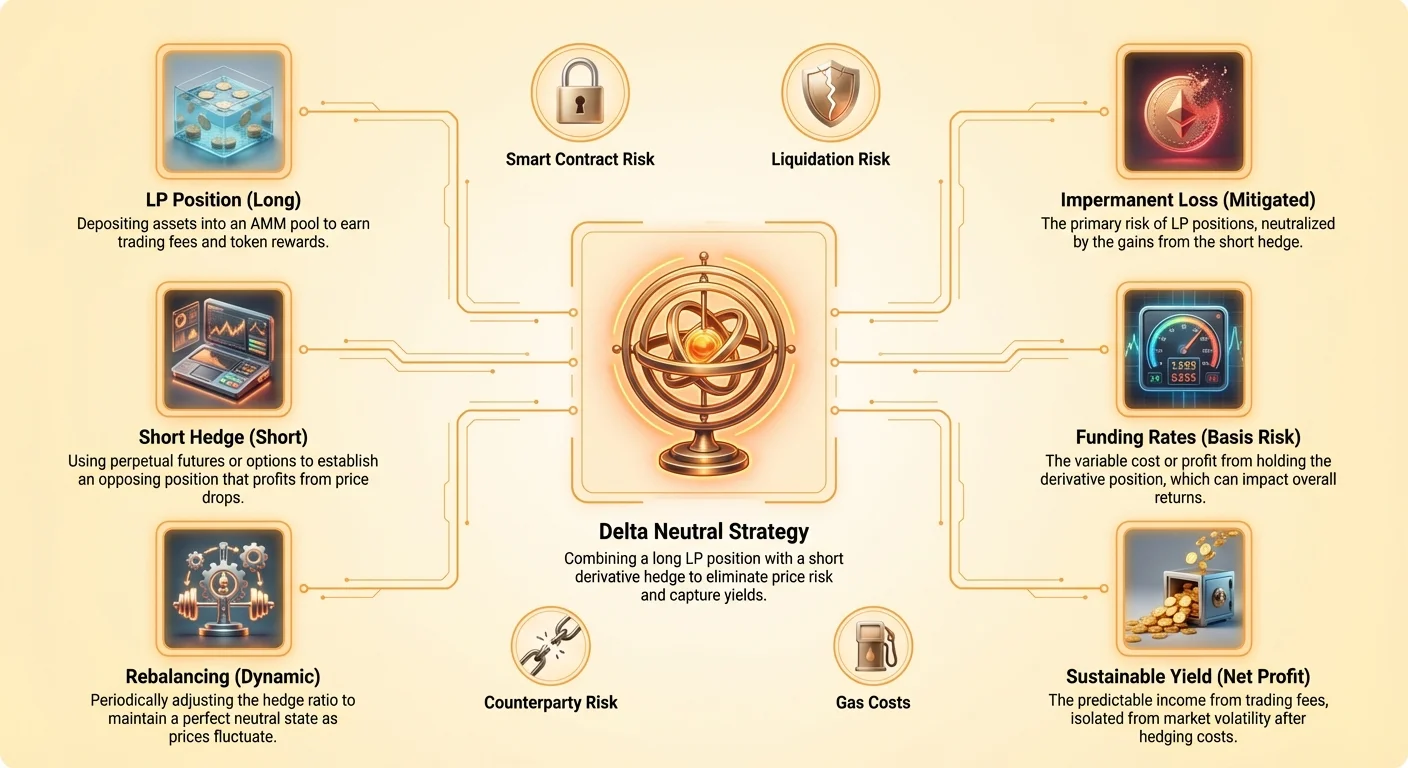
Delta neutralno farmanje napredna je DeFi strategija koja uključuje istovremeno držanje LP pozicije uz uspostavu savršeno uravnotežene suprotne pozicije na tržištu derivata (obično perpetual futures).
Definiranje „neutralnosti na deltu“
U financijama, delta mjeri osjetljivost cijene imovine na promjenu cijene osnovne imovine na tržištu.
- Ako kupite 1 ETH, vaša delta je +1 (zaradite 1 USD za svaki 1 USD kojim ETH raste). To je long delta pozicija.
- Ako prodate 1 ETH kratko, vaša delta je -1 (zaradite 1 USD za svaki 1 USD kojim ETH pada). To je short delta pozicija.
Kada uplatite u bazen likvidnosti ETH/USDC 50/50, efektivno uzimate long poziciju na ETH (vaša delta je pozitivna, iako manja od +1).
Neutralna delta pozicija cilja na neto deltu nule. Kombiniranjem long izloženosti iz LP pozicije s jednakom i suprotnom short izloženošću, cijela pozicija postaje imuna na smjerni pokret cijene. Jedini preostali izvor profita jesu trgovačke naknade generirane LP bazenom.
Osnovni mehanizam: LP pozicija + short hedge
Izvršavanje delta neutralne strategije zahtijeva pristup decentraliziranoj ili centraliziranoj burzi derivata uz odabrani bazen likvidnosti.
Korak 1: Uspostavite long poziciju (LP)
Pretpostavimo da je trenutna cijena ETH-a 2.000 USD.
- Alocirate ukupno 4.000 USD kapitala.
- Uplatite 1 ETH i 2.000 USDC u AMM bazen 50/50.
- Rezultat: Sada imate pozitivnu delta izloženost (koristite ako ETH raste, ali rizikujete IL).
Korak 2: Uspostavite short poziciju (hedge)
- Istovremeno, otvorite short poziciju za 1 ETH na perpetual futures platformi.
- Perpetual futures prate cijenu osnovne imovine, ali omogućuju short bez datuma isteka.
- Budući da je LP pozicija ekvivalentna long poziciji od 1 ETH, shortate 1 ETH kako biste poništili izloženost.
- Rezultat: Vaša neto delta sada je nula (1 ETH long - 1 ETH short = 0).
Analiza ishoda strategije
Ako cijena ETH-a poraste na 3.000 USD:
- LP gubitak (IL): LP pozicija pati IL jer je bazen prodao dio vašeg ETH-a.
- Hedge dobitak: Vaša short futures pozicija gubi 1.000 USD u vrijednosti, ali dobivate kapital na LP strani. Ključno, ako je hedge savršeno uravnotežen, gubitak na short poziciji jednaka je IL-u pretrpljenom od strane LP-a.
- Neto profit: Nula (isključujući trgovačke naknade).
Ako cijena ETH-a padne na 1.000 USD:
- LP dobitak (naspram držanja): Vrijednost LP pozicije niža je.
- Hedge dobitak: Vaša short futures pozicija dobiva 1.000 USD.
- Neto profit: Nula (isključujući trgovačke naknade).
U oba scenarija, trgovačke naknade generirane LP bazenom postaju garantirani profit, izolirani od volatilnosti tržišta.
Practical Execution: Building and Maintaining the Hedge
While the theory of delta neutrality is straightforward, its execution involves navigating complex variables, primarily funding rates and the need for constant rebalancing. This is where the difference between a high-level speculator and a professional capital manager becomes apparent.
Managing Funding Rates (Basis Risk)
Perpetual futures contracts are designed to closely track the price of the underlying asset. They achieve this through a mechanism called the Funding Rate.
- If the futures contract price is trading higher than the spot price (i.e., people are highly optimistic and bidding up the future), long position holders pay a fee (the funding rate) to short position holders.
- If the futures contract price is trading lower than the spot price, short position holders pay long position holders.
In a delta neutral strategy, you are paying or receiving this funding rate on your short hedge.
The Crucial Insight: If you can execute a delta neutral strategy where you receive the funding rate (i.e., short holders are being paid by long holders), you are effectively earning three layers of yield:
- LP Trading Fees
- LP Token Emission Rewards (if applicable)
- Funding Rate Payments (The short hedge becomes a positive income stream)
This funding rate variability is known as Basis Risk. A professional farmer must constantly calculate whether the expected trading fees outweigh the cost of the funding rate paid on the short hedge.
Calculating and Adjusting the Hedge Ratio
In traditional 50/50 pools (like Uniswap V2), the exposure ratio is effectively 1:1, meaning 100% of the volatile asset needs to be hedged. However, in concentrated liquidity pools (like Uniswap V3), the calculation becomes more complex.
Concentrated Liquidity pools: These pools only provide liquidity within a specific price range. If the price moves outside your range, all your assets convert to the less valuable asset, and your position is no longer active in fee generation. This makes the delta calculation dynamic.
Actionable Tip: Advanced strategies often require dynamic hedging tools or vaults that automatically adjust the short position leverage based on the current price relative to the LP range. If the price is near the edge of the range, the delta exposure may be close to 1:1. If the price is exactly in the middle of the range, the delta exposure might be closer to 0.5:1.
Auto-Balancing and Slippage Costs
A delta neutral position is not "set and forget." As the price of the volatile asset changes, the weights in the LP position shift.
- If ETH rises, the LP position sells ETH, meaning your effective long exposure shrinks.
- To maintain neutrality, you must also reduce your short position.
These adjustments mean periodically buying back some of the short position (or selling more short) and paying transactional gas fees and slippage. These costs are the Operational Cost of maintaining the hedge.
Best Practice: The total yield derived from LP fees and funding rates must exceed the combined cost of the funding rate payment (if paying) and the gas/slippage costs of rebalancing, otherwise the strategy is unprofitable. For capital managers, automating this rebalancing via smart contract vaults is often the most cost-effective solution.
Tehnike maksimizacije prinosa: Poluga stablecoina
Kada je primarni rizik volatilnosti (IL) neutraliziran derivatima, sljedeći korak je maksimizacija generiranja prinosa kroz opreznu primjenu poluge, posebice unutar niskorizičnih stablecoin okruženja.
Strategija: Posuđivanje za pojačavanje prinosa stablecoina
Farmanje stablecoina (npr. zarađivanje 4-6 % APY na USDC/DAI bazenu) niskorizično je, ali nudi skromne prinose. Kako biste povećali učinkovitost kapitala, korisnici koriste protokole posuđivanja (poput Aave ili Compound) za loopiranje stablecoin pozicija.
Mehanizam loopa:
- Uplatite 10.000 USD USDC kao jamstvo u protokol posuđivanja.
- Posudite 7.000 USD DAI protiv USDC jamstva (održavajući siguran omjer posuđeno-vrijednost, ili LTV).
- Koristite 7.000 USD DAI za pružanje likvidnosti u visokoprinosnom DAI/USDC bazenu, zarađujući trgovačke naknade i staking nagrade.
- Opcionalno, prinos zaraden u koraku 3 može se pretvoriti natrag u USDC i uplatiti kao dodatno jamstvo, povećavajući bazu posuđivanja za sljedeći loop.
Ova strategija koristi polugu za pojačavanje baznog prinosa niskorizične imovine. Ako je bazni prinos 5 % i održavate 50 % LTV, efektivno možete značajno povećati svoj godišnji prinos, minus trošak posuđivanja.
Upravljanje rizikom likvidacije u stablecoin loopovima
Dok je razlika između USDC-a i DAI-ja obično zanemariva, ova strategija uvodi novu vrstu rizika: rizik likvidacije de-pegginga.
Glavni rizični događaj jest ako stablecoin jamstva (npr. USDC) naglo izgubi vezu u odnosu na posuđenu imovinu (npr. DAI). Ako USDC padne na 0,90 USD dok DAI drži 1,00 USD, vrijednost vašeg jamstva pala je za 10 %, potencijalno gurajući vaš LTV iznad praga likvidacije.
Ublažavanje:
- Nizak LTV: Uvijek održavajte konzervativan omjer LTV (npr. 60-70 %) znatno ispod platforminog praga likvidacije (često 85 %).
- Kvaliteta imovine: Koristite samo visokokvalitetne, isprobane stablecoine (USDC, DAI, USDT).
- Praćenje: Implementirajte alate za praćenje koji vas odmah upozoravaju ako se vaš LTV približava opasnoj zoni.
Napredne opcijske strategije za sekundarni prinos
Za visoko iskusne korisnike, delta neutralna LP pozicija pruža savršenu osnovu za strukturirane proizvode, dodajući sekundarni sloj premijskog prinosa.
Osnovna ideja jest koristiti savršeno hedged imovinu kao jamstvo za prodaju opcija, generirajući prihod od tržišnih sudionika spremnih platiti premiju za osiguranje ili polugu.
Primjer: Prodaja pokrivenih callova
- Imate 1 ETH potpuno hedged u delta neutralnoj poziciji.
- Prodajete Covered Call opciju, dajući kupcu pravo (ali ne obvezu) kupiti vaš 1 ETH po cijeni izvršenja višoj od trenutne tržišne cijene.
- Primajte premiju (cijenu opcije) odmah.
- Ako cijena ostane ispod cijene izvršenja, opcija ističe besvrijedno, a vi zadržavate premiju i svoje delta neutralne naknade.
- Ako cijena poraste iznad cijene izvršenja, opcija se izvršava. Vaš 1 ETH se prodaje, ali vaš derivat hedge istovremeno hvata pomak cijene, neutralizirajući gubitak imovine.
To pruža dodatni, predvidivi premijski sloj na vrh vaše postojeće delta neutralne prinose, iako dodaje značajnu složenost i rizik kontranike ovisno o platformi opcija korištenoj.
Assessing True Risk: Deconstructing the "Degen Score"
In the DeFi space, high APYs are often misleading. A professional approach requires a rigorous deconstruction of the advertised yield to determine the true, risk-adjusted return, often informally referred to as calculating the "Degen Score." A low Degen Score indicates a safe, sustainable yield.
Deconstructing the Annual Percentage Yield (APY)
APYs are often inflated by two factors:
- Sustainable Yield (Trading Fees): This is the predictable income generated by users swapping assets within your LP. This yield is generally sustainable and directly correlated to network activity.
- Inflationary Yield (Token Emissions): This is the high-percentage reward paid out in the farm’s native governance token (e.g., FARM, GOV). This token often experiences severe price depreciation as the high emission rate floods the market.
Professional Filtration: A savvy investor discounts or entirely ignores the token emission yield when calculating the viability of a long-term position. The focus must be on whether the sustainable trading fee yield, minus hedging costs (funding rates), provides an acceptable risk-adjusted return. If the strategy relies solely on token emissions, it is inherently unsustainable.
Analyzing Basis Risk and Counterparty Risk
The main risks in advanced farming are often not related to the underlying assets themselves, but the platforms used to execute the strategy.
1. Basis Risk (The Cost of the Hedge)
As discussed, Basis Risk is the risk that the funding rate paid on your short hedge may be volatile or persistently negative, effectively eating away at your LP fees.
Mitigation: Choose platforms (CEX or DEX) with deep liquidity in their derivatives markets, which typically stabilizes the funding rate. Track historical funding rates to model your worst-case hedging cost.
2. Counterparty and Smart Contract Risk
When engaging in multi-layer strategies, you exponentially increase your exposure to failures in smart contract code or centralization risk.
- Smart Contract Risk: The potential for a bug or exploit in the LP protocol, the lending protocol, or the derivatives protocol.
- Custody Risk: If you use a Centralized Exchange (CEX) for your derivatives hedge, you are exposed to that exchange's solvency risk.
Best Practice: Prioritize audited protocols and consider using decentralized perpetual futures platforms (DEX derivatives) to reduce the counterparty risk associated with holding collateral on a CEX.
Best Practices for Capital Preservation
Maintaining profitability in advanced DeFi requires discipline and constant monitoring:
| Best Practice | Rationale |
|---|---|
| Use Self-Custodial Wallets | Retain direct control over your assets and keys. Use robust smart contract wallets if relying on automated strategies. |
| Verify Audits | Only deploy capital into protocols that have successfully completed multiple, reputable third-party security audits. |
| Decentralize the Hedge | Whenever possible, execute your derivatives hedge on a robust Decentralized Exchange (DEX) to eliminate exchange insolvency risk (CEX Counterparty Risk). |
| Monitor Funding Rates Daily | Immediately adjust or close positions if the cost of the hedge (the funding rate) is consistently higher than the LP yield. |
| Stress Test LTV | If using stablecoin leverage, calculate the precise de-peg percentage required to trigger liquidation and maintain a buffer 15-20% above that threshold. |
Zaključak
Napredne DeFi strategije farmanja most su između spekulativnih crypto investicija i profesionalnog upravljanja kapitalom. Primjenom delta neutralnih tehnika, korisnici prelaze s nagađanja smjera cijene na izolaciju i zaradu održivog prinosa generiranog aktivnošću mreže.
Dok strategije koje uključuju perpetual futures, opcije i stablecoin polugu uvode složenosti poput rizika osnovice i praćenja LTV-a, nude najviše riziku prilagođenih prinosa dostupnih u decentraliziranim financijama. Cilj više nije loviti najviši oglašavani APY, već postići nizak Degen Score – visok prinos uz minimalni inherentni rizik – čineći volatilnost crypto tržišta irelevantnom za vaš kontinuirani tok prihoda. Ovladavanje ovim alatima ključ je izgradnje samodostatnosti u novoj digitalnoj ekonomiji.